Later vs Buffer: Which Social Media Tool Should You Choose?
Later wins for Instagram-first creators who need visual feed planning and link-in-bio. Buffer wins for creators who want simple, reliable scheduling across multiple channels.
TL;DR
| Later | Buffer | |
|---|---|---|
| Best for | Instagram-first creators who need visual feed planning | Solo creators and small brands who want simple per-channel pricing |
| Free plan | Yes — 1 social set, 10 posts/mo | Yes — 3 channels, basic scheduling |
| Starting price | $25/mo (Starter) | $6/mo per channel (Essentials) |
| G2 rating | 4.5/5 (800+) | 4.3/5 (1,000+) |
| Not ideal for | Teams needing multi-channel workflow depth, approvals, or cross-channel analytics | Teams needing approval workflows, deep analytics, or content repurposing at scale |
What kind of comparison is this?
This is not just a feature checklist. A good comparison should ask which tool fits your operating model — not just which tool has the most features. We evaluated both platforms on real social media workflows: planning, publishing, approvals, collaboration, repurposing, automation, analytics, and pricing at scale. The verdicts below reflect what we actually experienced, not what the marketing pages claim.

Later
Later wins for Instagram-first creators who need visual feed planning and link-in-bio. Buffer wins for creators who want simple, reliable scheduling across multiple channels.

Buffer
Still the right choice if solo creators and small brands who want simple per-channel pricing.
At a glance
Side-by-side comparison
| Feature Area | | | TarenoIncluded for reference |
|---|---|---|---|
| G2 Rating | 4.5/5 (800+ reviews) | 4.3/5 (1,000+ reviews) | 4.8/5 (growing) |
| Capterra Rating | 4.4/5 (1,800+ reviews) | 4.5/5 (2,500+ reviews) | 4.7/5 (growing) |
| Free Plan | Yes — 1 social set, 10 posts/mo | Yes — 3 channels, basic scheduling | Yes — 2 channels, 15 posts |
| Planning & Strategy | Excellent visual drag-and-drop feed planner focused on Instagram aesthetics. | Basic queues and a simple content calendar. | Kanban boards, visual calendar, and campaign context across 8+ channels. |
| Publishing Power | Strong Instagram and TikTok scheduling; some content types require manual publishing. | Reliable one-off post scheduling across 10+ channels. | Multi-channel scheduling with evergreen queues and bulk actions across all platforms. |
| Team Collaboration | Basic team features; no structured approval workflows in lower tiers. | Limited collaboration; no built-in approval system. | Native approval workflows, role-based access, and team workspaces. |
| Content Repurposing | No native repurposing engine; content reuse is manual. | No native repurposing; manual copy-paste required. | Dedicated repurposing queue for systematic cross-channel content reuse. |
| Analytics & Insights | Instagram-focused analytics; broader cross-channel reporting is limited. | Basic metrics locked behind higher-priced tiers. | Unified analytics, competitor benchmarking, and white-label reports. |
| Workflow Automation | No native workflow builder; relies on basic scheduling automation. | No native workflow builder; relies on third-party tools. | Visual workflow builder plus n8n / Make integration on Pro. |

Also considering Tareno?
See how it compares on planning, publishing, analytics, and repurposing.
Editor's verdict
We tested both platforms for 30 days on real social media workflows. Here's what we actually experienced.
Planning & Strategy
Later winsWe were genuinely more impressed with Later than Buffer here. Later keeps planning simple and visual, and the experience feels smoother day-to-day.
Later gives you excellent visual drag-and-drop feed planner focused on instagram aesthetics. Buffer offers basic queues and a simple content calendar. The difference is that Later keeps planning simple and visual, while Buffer adds strategic depth.
What we didn't like — Later
lacks advanced campaign context
What we didn't like — Buffer
can feel overwhelming for small teams
If you you want a clean, visual way to plan content without getting lost in complex boards, Later is the better pick.
Publishing Power
DrawIt's a toss-up. Both Later and Buffer handle publishing power adequately, but neither blows the other away.
Later gives you strong instagram and tiktok scheduling; some content types require manual publishing. Buffer offers reliable one-off post scheduling across 10+ channels. The difference is that Later gets posts out reliably across channels, while Buffer covers a wide range of platforms.
What we didn't like — Later
hits occasional API limitations on newer platforms
What we didn't like — Buffer
has more friction with short-form video formats
Neither tool stands out here — pick based on your other priorities.
Team Collaboration
DrawIt's a toss-up. Both Later and Buffer handle team collaboration adequately, but neither blows the other away.
Later gives you basic team features; no structured approval workflows in lower tiers. Buffer offers limited collaboration; no built-in approval system. The difference is that Later keeps collaboration simple and fast, while Buffer handles complex approval chains.
What we didn't like — Later
lacks structured approval gates
What we didn't like — Buffer
adds too much overhead for small teams
Neither tool stands out here — pick based on your other priorities.
Content Repurposing
DrawIt's a toss-up. Both Later and Buffer handle content repurposing adequately, but neither blows the other away.
Later gives you no native repurposing engine; content reuse is manual. Buffer offers no native repurposing; manual copy-paste required. The difference is that Later has a dedicated engine for reusing content, while Buffer allows some manual reuse.
What we didn't like — Later
is mostly manual copy-paste
What we didn't like — Buffer
has no native repurposing at all
Neither tool stands out here — pick based on your other priorities.
Analytics & Insights
DrawIt's a toss-up. Both Later and Buffer handle analytics & insights adequately, but neither blows the other away.
Later gives you instagram-focused analytics; broader cross-channel reporting is limited. Buffer offers basic metrics locked behind higher-priced tiers. The difference is that Later delivers unified, actionable analytics, while Buffer goes deep on specific metrics.
What we didn't like — Later
is surface-level on lower tiers
What we didn't like — Buffer
can be overwhelming or locked behind expensive plans
Neither tool stands out here — pick based on your other priorities.
Workflow Automation
Buffer winsBuffer takes the lead here. Buffer has some scheduling automation, while Later relies on third-party integrations.
Later gives you no native workflow builder; relies on basic scheduling automation. Buffer offers no native workflow builder; relies on third-party tools. The difference is that Later offers a visual builder for custom workflows, while Buffer has some scheduling automation.
What we didn't like — Later
relies on third-party integrations
What we didn't like — Buffer
has no visual workflow builder
If you basic scheduling automation is enough for your workflow, Buffer is the clear choice.
When to choose which tool
Choose Later if...
- you are Instagram-first and need visual feed planning, drag-and-drop calendars, and a link-in-bio page
- Your team is visual-first and Instagram-only.
- You don't mind instagram-centric — other channels feel secondary.
Best for
Instagram-first creators who need visual feed planning

Landing page screenshot — 2026-05-08
Choose Buffer if...
- you publish across multiple channels and want the simplest, most affordable queue scheduler
- Your team is 1-2 people with a tight budget.
- You don't mind no native approval workflows.
Best for
Solo creators and small brands who want simple per-channel pricing

Landing page screenshot — 2026-05-08
Where each tool wins
Later is stronger when...
- Best-in-class visual Instagram planning
- Drag-and-drop content calendar
- Link-in-bio page builder
- Hashtag suggestions
Buffer is stronger when...
- Simple, clean scheduling UI
- Per-channel pricing is predictable for small setups
- Browser extension and mobile apps work well
- Free plan covers 3 channels
When neither is the best fit
Neither is ideal if you need structured approvals, content repurposing, or workflow automation. Both are primarily scheduling tools with limited collaboration depth.
What users actually say
Later
What users love
Instagram-first creators who need visual feed planning
Common complaints
- Instagram-centric — other channels feel secondary
- No structured approval system
- Limited cross-channel analytics
Buffer
What users love
Solo creators and small brands who want simple per-channel pricing
Common complaints
- No native approval workflows
- Limited analytics on lower tiers
- Per-channel pricing gets expensive at scale
Practical scenarios
Scenario 1: Solo creator with 3 channels
You manage your own Instagram, TikTok, and LinkedIn. You post 3–5 times per week and don't need approvals or client reports.Better fit: Later if you want simplicity and visual planning.
Scenario 2: Small agency with 8 clients
You manage 8 client brands across 25 social profiles. Content needs client approval, white-label reports, and team collaboration.Better fit: Buffer if you need its core strengths.
Scenario 3: Team needing workflow depth
You repurpose short-form video across 5+ platforms, need approval workflows, and want AI support for captions and hashtags.Consider Tareno if neither Later nor Buffer covers planning, repurposing, approvals, and automation in one system.
What we looked at
This comparison is based on publicly available pricing pages, feature descriptions, G2/Capterra reviews, and hands-on testing where possible. We prioritize primary sources over third-party claims.
Pricing deep dive
Later
Free plan: Yes — 1 social set, 10 posts/mo
Screenshot evidence — 2026-05-08
Buffer
Free plan: Yes — 3 channels, basic scheduling
Screenshot evidence — 2026-05-08
Tareno — for comparison
Tareno adds approval workflows, a repurposing queue, and multi-channel publishing — so you don't have to choose between Instagram focus and cross-channel simplicity.
Later vs Buffer: Which Social Media Scheduling Tool Should You Choose in 2026?
Later and Buffer are both popular social media scheduling tools, but they are built around different workflows. Choose Later if you need visual planning, Social Sets, link-in-bio, creator-friendly scheduling, internal/external approvals, competitive benchmarking, and stronger visual content organization. Choose Buffer if you want a simpler publishing workflow, per-channel pricing, clean scheduling, a low-friction interface, and lightweight team collaboration.
If neither tool fully solves your workflow problem, consider Tareno when your team needs boards, approvals, workflow automation, repurposing, role-based collaboration, team activity visibility, API access, and Make or n8n workflows.
Quick definition: what are Later and Buffer?
Later is a visual social media management platform built around content planning, scheduling, Social Sets, link-in-bio, creator workflows, collaboration, approvals, analytics, and visual content organization. It is strongest when teams care about how content looks, how profiles are grouped, and how visual campaigns are planned before publishing.
Buffer is a publishing-first social media management platform built around simple scheduling, queues, channel-based pricing, analytics, ideas, engagement, and lightweight collaboration. It is strongest when teams want to schedule consistently without adding too much operational complexity.
The simplest distinction is:
Later is visual-planning-first. Buffer is simple-publishing-first.
That distinction matters because both tools can schedule posts, but they encourage different content operations.
How we evaluated Later vs Buffer
This comparison uses a workflow-first evaluation model instead of asking which tool has the most features.
We evaluated both tools across eight dimensions:
- Scheduling simplicity — how easy it is to create and schedule posts.
- Visual planning — how well the tool supports profile previews, visual calendars, and creator workflows.
- Pricing structure — whether the tool scales by channels or Social Sets.
- Collaboration and approvals — whether teams can review content before publishing.
- Analytics — how performance data is included across plans.
- Platform fit — whether the tool fits creators, brands, agencies, or lean teams.
- Operational complexity — whether the tool stays easy as workflows grow.
- Workflow depth — whether the tool can support planning, approval, repurposing, automation, and team operations together.
This matters because a solo creator comparing Later vs Buffer has different needs than a brand team managing several social profiles, approval steps, and campaign workflows.
The VISUAL framework for choosing between Later and Buffer
Use this framework before choosing.
V — Visual planning
If seeing and planning visual content is central, Later usually has the better fit.
I — Interface simplicity
If your team wants the simplest possible publishing interface, Buffer usually has the better fit.
S — Scaling model
Buffer scales by channel. Later scales by Social Sets, users, and profile groups.
U — User workflow
If your workflow is creator-led and visual, Later is stronger. If your workflow is queue-led and publishing-first, Buffer is stronger.
A — Approvals
Both can support approval workflows depending on plan. Later is stronger when approvals are attached to visual planning. Buffer is stronger when approvals are part of a lightweight publishing workflow.
L — Larger operations
If the workflow needs boards, roles, activity visibility, workflow automation, repurposing, and API-connected social operations, evaluate Tareno.
Where Later is still the better choice
Later is the better fit when social media planning is visual, creator-led, and profile-group-based.
It is especially relevant for brands and creators who care about Instagram, TikTok, visual campaign planning, link-in-bio workflows, and seeing content before it goes live.
Choose Later if visual planning matters
Later’s strongest advantage is visual planning.
If your team cares about how the content calendar looks, how profiles are grouped, and how visual posts appear in sequence, Later has the stronger fit.
This matters for:
- Instagram planning
- TikTok workflows
- creator campaigns
- ecommerce social content
- link-in-bio campaigns
- visual-first brand calendars
- teams that want profile previews and media planning
Buffer can schedule posts, but it is not as visual-planning-first.
Choose Later if Social Sets match your structure
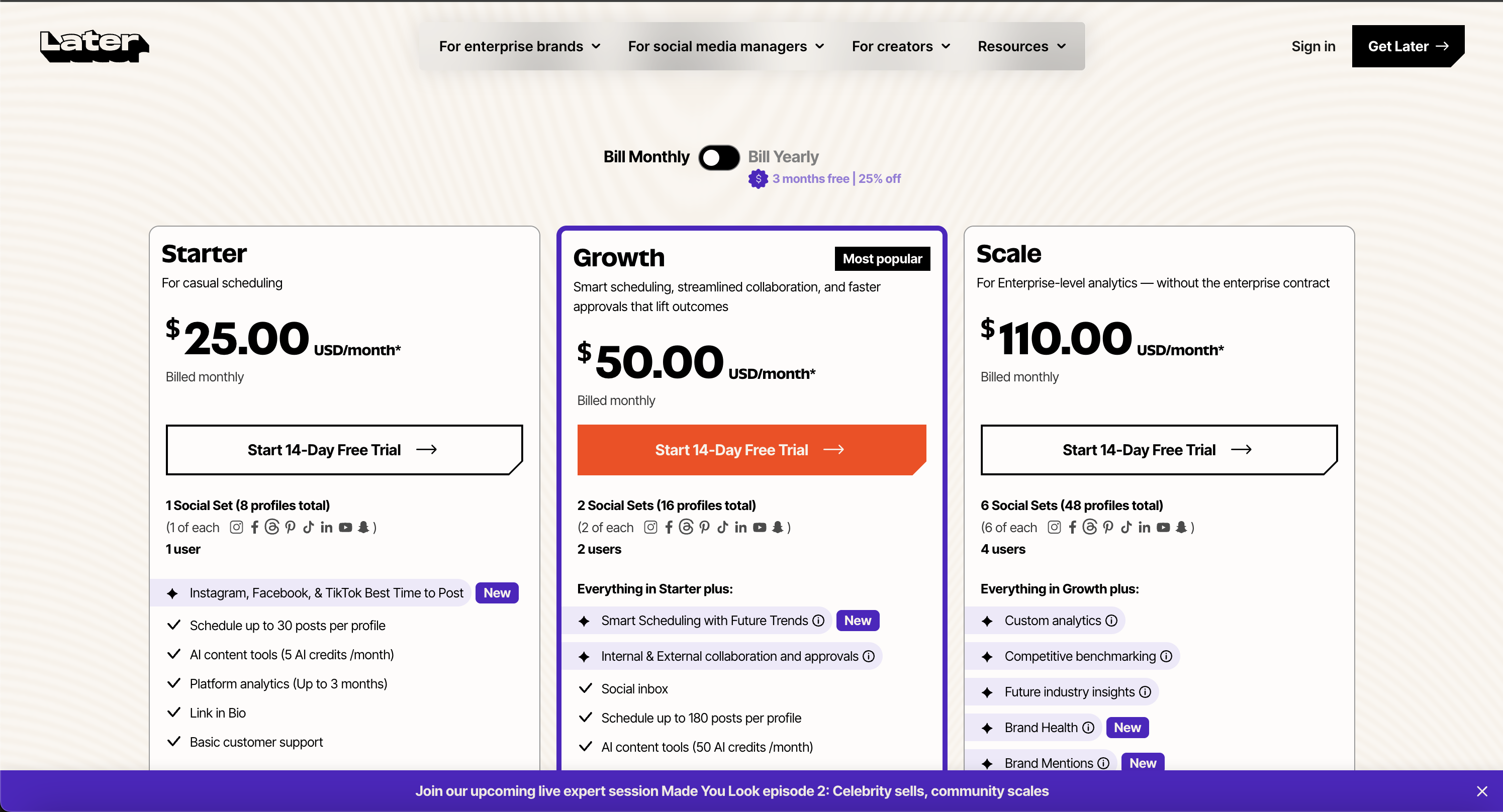
Later’s current annual pricing screenshot shows:
- Starter: 1 Social Set, 8 profiles total, 1 user
- Growth: 2 Social Sets, 16 profiles total, 2 users
- Scale: 6 Social Sets, 48 profiles total, 4 users
That structure makes sense if your team thinks in profile groups.
For example:
- one brand with profiles across platforms
- several creator profiles grouped by brand
- multiple social identities organized into Social Sets
- a team that wants to plan by profile set rather than per-channel billing
Buffer’s channel-based pricing may be simpler for small setups, but Later’s Social Set model can be more natural for profile-group planning.
Choose Later if collaboration and approvals sit around visual content
The current pricing screenshot shows Growth with internal collaboration and approvals plus external workflow and approvals. Scale adds more advanced planning/analytics capabilities.
That makes Later a strong fit if your team wants review and collaboration around visual content planning.
Buffer Team also includes access levels and content approval workflows, but Later’s collaboration story fits better when the content itself is visual-first.
Where Buffer is still the better choice
Buffer is the better fit when you want social media scheduling to stay simple.
It is ideal for creators, founders, small teams, and lean brands that do not want heavy planning systems, profile-set complexity, or visual workflow overhead.
Choose Buffer if you want the simplest publishing workflow
Buffer’s strongest advantage is low friction.
The workflow is easy to understand:
- connect channels
- write posts
- schedule or queue content
- review performance
- repeat
That simplicity matters if your team does not need visual planning, external approvals, or competitive benchmarking.
Choose Buffer if pricing by channel is easier
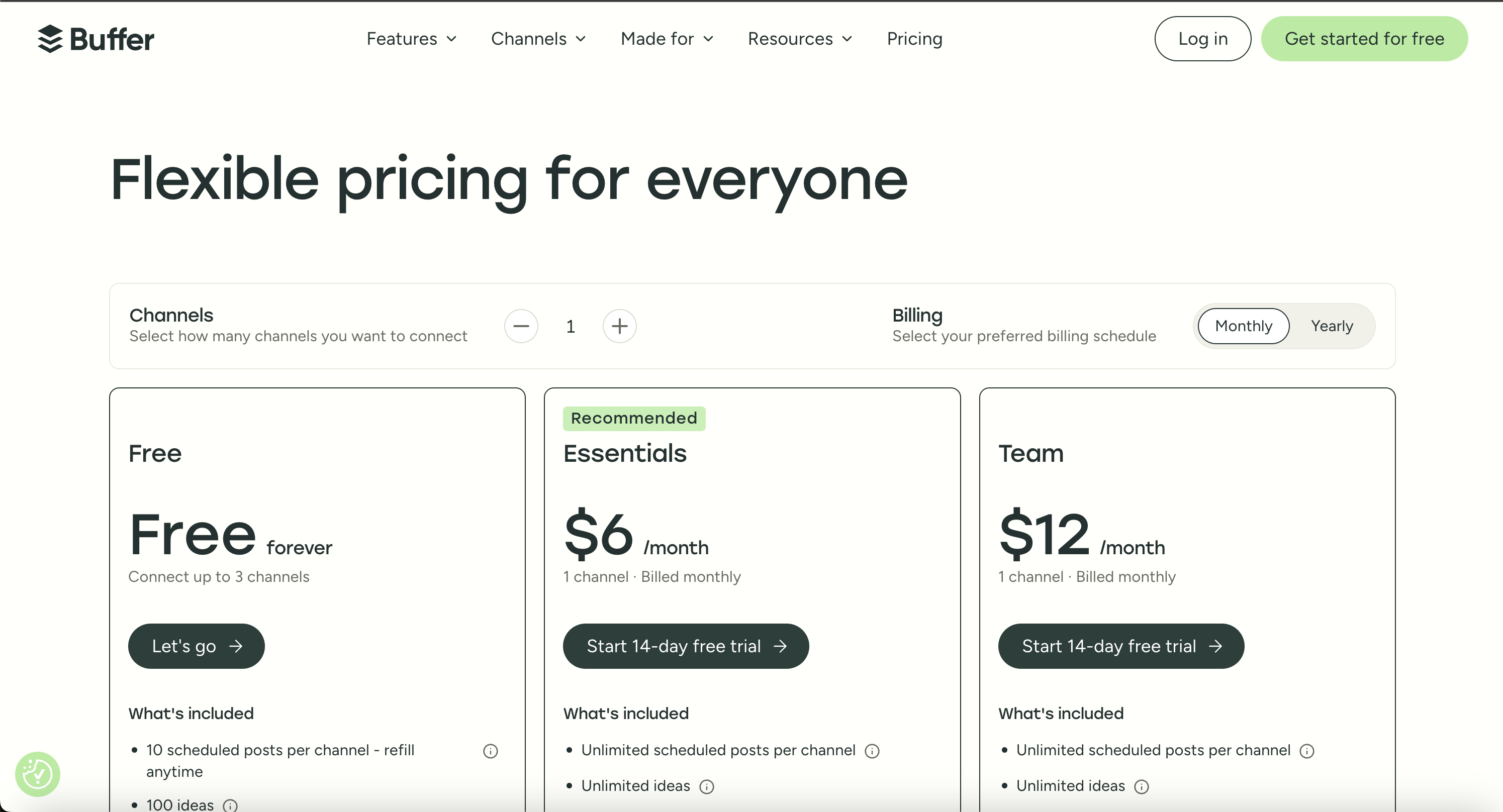
The current Buffer monthly pricing screenshot shows:
- Free: free forever, up to 3 channels
- Essentials: $6/month per channel
- Team: $12/month per channel
This is easy to understand for small setups.
If you need 1, 2, or 3 channels, Buffer is especially simple. The cost is tied directly to the number of channels you connect.
Later’s Social Set model can be better for profile groups, but Buffer’s per-channel model is easier when you only need a few channels.
Choose Buffer if you want lightweight approvals
Buffer Team includes unlimited team members, access levels, content approval workflows, advanced analytics, community inbox, hashtag manager, first comment scheduling, and support according to the current pricing screenshot.
This is useful for teams that need approvals without adopting a more visual or campaign-heavy platform.
Pricing comparison: Later vs Buffer
Pricing changes, so verify all numbers before publishing. This draft uses the current public pricing screenshots provided during creation.
Later pricing model
Later’s current annual pricing screenshot shows:
- Starter: $18.75/month, 1 Social Set with 8 profiles total, 1 user, schedule up to 30 posts per profile, AI content tools, platform analytics up to 3 months, Link in Bio.
- Growth: $37.50/month, 2 Social Sets with 16 profiles total, 2 users, smart scheduling with Future Trends, internal collaboration and approvals, external workflow and approvals.
- Scale: $82.50/month, 6 Social Sets with 48 profiles total, 4 users, custom analytics, competitive benchmarking, and future industry insights.
- 14-day free trial shown in the pricing screenshot.
Later is strongest when Social Sets and visual planning match the buying model.
Buffer pricing model
Buffer’s current monthly pricing screenshot shows:
- Free: Free forever, connect up to 3 channels, 10 scheduled posts per channel, 100 ideas, 1 user account, AI Assistant, basic analytics, community inbox.
- Essentials: $6/month per channel, unlimited scheduled posts per channel, unlimited ideas, 1 user account, AI Assistant, advanced analytics, community inbox, hashtag manager, first comment scheduling, support.
- Team: $12/month per channel, unlimited scheduled posts per channel, unlimited ideas, unlimited team members, access levels, content approval workflows, AI Assistant, advanced analytics, community inbox, hashtag manager, first comment scheduling, support.
Buffer is strongest when per-channel pricing and simplicity are the buying model.
Pricing verdict
| Situation | Better pricing fit |
|---|---|
| 1–3 channels and simple scheduling | Buffer |
| visual-first creator profile group | Later |
| multiple Social Sets | Later |
| team wanting per-channel pricing | Buffer |
| team needing visual collaboration | Later |
| team needing lightweight approvals | Buffer Team |
| brand needing competitive benchmarking | Later Scale |
| team needing workflow builder, repurposing, boards, roles, activity tracking, API, Make/n8n | Consider Tareno |
The better pricing question is not only:
“Which one is cheaper?”
The better question is:
“Are you scaling by channels or by visual profile groups?”
Feature comparison
Scheduling and publishing
Buffer wins for simple scheduling. It is easier to adopt and easier to explain.
Later wins when scheduling is part of a visual campaign planning workflow.
Verdict: Buffer wins for low-friction scheduling. Later wins for visual planning plus scheduling.
Visual planning
Later wins this category.
Its product and pricing are structured around creators, Social Sets, profile groups, visual planning, and link-in-bio workflows.
Buffer has a clean publishing interface, but it is not built around visual planning in the same way.
Verdict: Later wins for visual planning.
Collaboration and approvals
Both tools can support approvals depending on plan.
Later Growth includes internal/external workflow and approvals in the current screenshot. Buffer Team includes access levels and content approval workflows.
Verdict: Later wins if approvals are tied to visual content planning. Buffer wins if approvals should stay lightweight inside a publishing queue.
Analytics and reporting
Later Scale includes custom analytics, competitive benchmarking, and future industry insights in the current screenshot. Buffer paid plans include advanced analytics.
Later has the stronger visual/competitive analytics angle on higher tiers. Buffer is enough for simpler post performance review.
Verdict: Later wins for competitive benchmarking and visual strategy. Buffer is enough for simple analytics.
Workflow automation and repurposing
Neither Later nor Buffer is primarily a workflow automation or repurposing platform.
Later helps plan visually. Buffer helps publish simply. But if your workflow requires boards, approvals, repurposing queues, workflow builder actions, roles, activity visibility, API workflows, Make scenarios, or n8n pipelines, Tareno is the better third option.
Verdict: Tareno wins if workflow automation and repurposing are central.
Choose Later if...
Choose Later if you want:
- visual planning
- Social Sets
- Instagram/TikTok-first workflows
- link-in-bio support
- profile-group planning
- internal and external approvals
- creator-friendly scheduling
- custom analytics on higher plans
- competitive benchmarking on Scale
- a visual planning workflow instead of a simple queue
Later is the better choice when your main question is:
“How do we visually plan and manage social content across profile groups?”
Avoid Later if...
Avoid Later if:
- you only need simple scheduling
- you prefer per-channel pricing
- you do not need visual planning
- Social Sets make your setup more complex
- you do not need link-in-bio or creator tools
- you need workflow automation, boards, roles, activity visibility, API, Make, and n8n
Later is strong for visual planning, but it may be more than you need for simple publishing.
Choose Buffer if...
Choose Buffer if you want:
- simple publishing
- queue-based scheduling
- per-channel pricing
- a free plan for up to 3 channels
- low learning curve
- advanced analytics on paid plans
- Team plan with access levels and approvals
- a lightweight tool your team can adopt quickly
Buffer is the better choice when your main question is:
“How do we publish consistently without adding workflow complexity?”
Avoid Buffer if...
Avoid Buffer if:
- visual planning is the main reason you are buying
- Social Sets match your brand structure better
- you need link-in-bio workflows
- competitive benchmarking is important
- you need external visual workflow approvals
- your team needs boards, repurposing, workflow automation, and activity visibility
Buffer is strong because it is simple. It becomes less ideal when the workflow becomes visual, structured, or automation-heavy.
When neither Later nor Buffer is ideal
Sometimes the real problem is not Later vs Buffer.
The real problem is that your social workflow is spread across too many disconnected places:
- ideas live in one tool
- approvals happen in chat
- visual planning happens elsewhere
- scheduling is separated from reporting
- old posts are not reused systematically
- team roles are unclear
- no one can see who moved or approved content
- Make/n8n workflows are separate from the content calendar
In that case, you may need a workflow-first social media management platform.
Optional Tareno alternative: when workflow depth matters more
Tareno is not a Later clone and not a Buffer clone. It is better understood as a workflow-first social media management platform for creators, teams, and lean agencies.
Consider Tareno if your team needs:
- Workflow Builder for triggers, delays, schedules, and social actions
- Repurposing Queue to reuse high-performing content across platforms
- Kanban Content Boards for planning, approvals, and campaign operations
- Team Workspaces for brands, clients, or operating areas
- Approval Workflows so content does not go live without review
- Roles and permissions for team workflows
- Activity visibility to see what group members changed or moved
- Competitor Analysis to connect benchmarking to execution
- Unified Analytics and white-label reports
- AI Captions and AI Hashtags
- API access
- Make integration
- n8n integration
This matters if your team has moved beyond the question:
“Which tool schedules posts?”
And is now asking:
“Which system helps us run the entire workflow?”
Choose Tareno if...
Choose Tareno if:
- you need planning, approvals, repurposing, automation, and analytics together
- you want boards and workspaces, not just a visual calendar or queue
- you need team roles and activity visibility
- you want to repurpose winning content systematically
- you use Make or n8n to automate social workflows
- you want publishing, reporting, and repurposing connected
Do not choose Tareno if...
Do not choose Tareno if:
- you only need a simple publishing queue
- you only need visual planning
- you do not need approvals, boards, repurposing, roles, API, Make, or n8n workflows
The honest summary is:
- Later = visual planning and Social Sets
- Buffer = simple publishing and per-channel scheduling
- Tareno = workflow automation, repurposing, approvals, boards, roles, and social operations
Later vs Buffer: practical scenarios
Scenario 1: Solo creator posting to 3 channels
Best fit: Buffer
Buffer’s free plan and simple scheduling workflow are easier for a small setup.
Scenario 2: Visual brand managing Instagram and TikTok
Best fit: Later
Later’s visual planning and creator-friendly workflow are stronger.
Scenario 3: Small team that needs simple approvals
Best fit: Buffer Team
Buffer Team includes access levels and content approval workflows.
Scenario 4: Creator brand with profile groups and link-in-bio
Best fit: Later
Later’s Social Sets and link-in-bio support fit better.
Scenario 5: Team that needs benchmarking and visual strategy
Best fit: Later Scale
Later Scale includes custom analytics and competitive benchmarking in the current screenshot.
Scenario 6: Team that wants repurposing and workflow automation
Best fit: Tareno
Later can plan visually. Buffer can schedule simply. Tareno is stronger when the workflow needs boards, approvals, repurposing, automation, roles, activity visibility, API, Make, and n8n.
Final recommendation
Later and Buffer are both strong tools, but they answer different buying questions.
If your question is:
“How do we visually plan social content across profile groups?”
Choose Later.
If your question is:
“How do we publish consistently with the least complexity?”
Choose Buffer.
If your question is:
“How do we run the whole workflow from planning and approval to repurposing, automation, analytics, roles, and team visibility?”
Consider Tareno.
The best tool is the one that matches how your team actually works: visual-planning-first, publishing-first, or workflow-first.
Source links for verification
- Later Pricing: https://later.com/pricing
- Later Help / Plans: https://help.later.com/hc/en-us/articles/360059362253-Choosing-a-Later-Social-Plan
- Buffer Pricing: https://buffer.com/pricing/
- Buffer Features: https://buffer.com/features
- Tareno Features: https://tareno.co/features
- Tareno Pricing: https://tareno.co/pricing
- Tareno API Docs: https://tareno.co/docs/api
- Tareno Make Docs: https://tareno.co/docs/make
- Tareno n8n Docs: https://tareno.co/docs/n8n
A third option worth considering.
We built Tareno because we got tired of choosing between Later's tareno connects visual planning with scheduling, ai content support, repurposing, and reporting across more of the social operation — treating every channel as a first-class citizen and Buffer's tareno combines scheduling with boards, workflows, repurposing, and analytics instead of treating publishing as an isolated task. Tareno gives you both in one connected workflow — without the buffer pricing or the later complexity.
Related comparisons


Explore Tareno
Frequently asked questions
Which is better: Later or Buffer?
After testing both for 30 days, Later is the better pick for most teams — instagram-first creators who need visual feed planning. Buffer is still the right choice if solo creators and small brands who want simple per-channel pricing. Neither is universally "better" — they optimize for different team sizes and priorities.
Can I switch between Later and Buffer easily?
Yes, but expect 1-2 weeks of adjustment. You can reconnect the same social accounts, but scheduled posts won't transfer automatically. The bigger issue is workflow adaptation — switching from Later to Buffer means adjusting to a different interface. CSV import helps, but you'll need to rebuild your content calendar.
What do real users say about Later vs Buffer?
Later scores 4.5/5 on G2 (800+ reviews) and 4.4/5 on Capterra. Buffer scores 4.3/5 on G2 (1,000+ reviews) and 4.5/5 on Capterra. The most common praise for Later: users love its visual planning. The biggest complaint: Instagram-centric — other channels feel secondary. For Buffer: users praise its simplicity. The biggest complaint: No native approval workflows.
Why is Tareno included in this comparison?
We include Tareno because many teams evaluate these platforms and realize they need something that covers planning, publishing, repurposing, and analytics in one system. Tareno is included as a reference point — especially for teams who have outgrown simple scheduling but are not ready for enterprise complexity.
What is the real cost difference at scale?
At 5 channels and 3 team members: Later costs approximately $135/mo. Buffer costs approximately $90/mo. Tareno Pro is €23/mo for 5 team members and 15 channels. The gap widens significantly as you scale.
Does Later or Buffer have a free plan?
Later: Yes — 1 social set, 10 posts/mo. Buffer: Yes — 3 channels, basic scheduling. Tareno: Yes — 2 channels, 15 posts, no credit card required.
Sources and references
Pricing verified: 2026-05-02 (A) · 2026-05-02 (B). Prices change frequently — verify directly before purchasing.