TL;DR
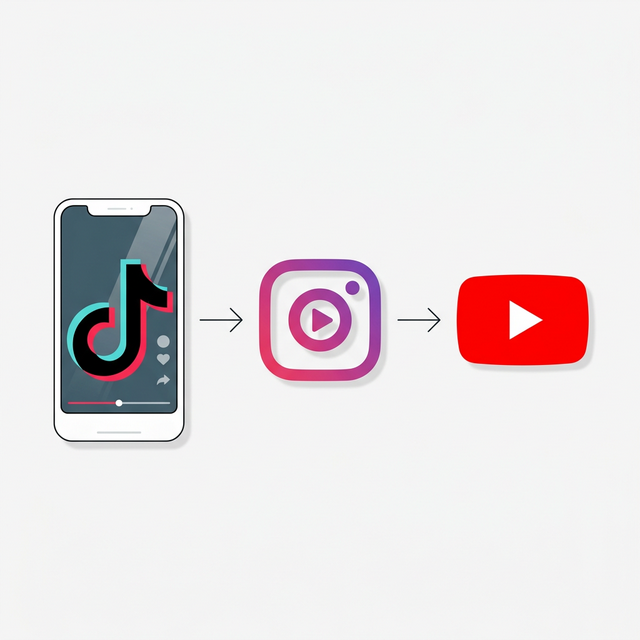
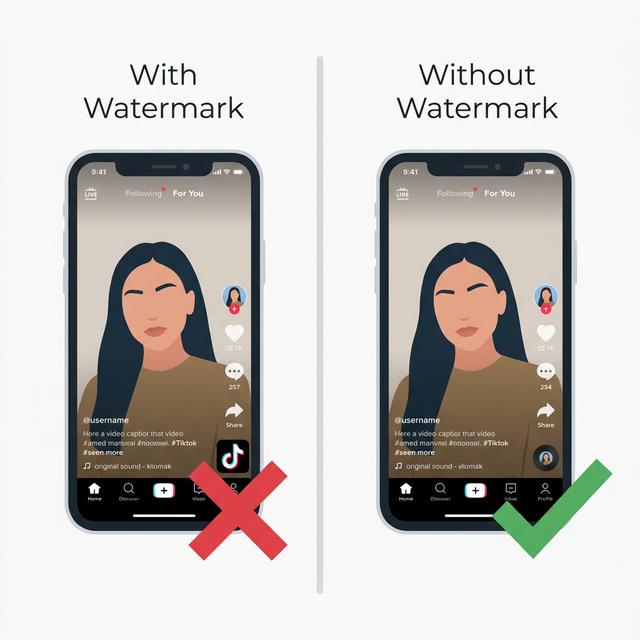
Left: TikTok video with visible watermark. Right: the clean version ready for cross-platform upload.
Cross-posting one short video to three platforms only works long-term if you remove platform-specific branding artifacts.
A watermark-free workflow is not just aesthetic—it affects distribution quality, professionalism, and repurposing speed.
The best approach is source-first production, then platform-native packaging.
The WAVE framework helps teams publish faster without quality decay.
Quick Definition
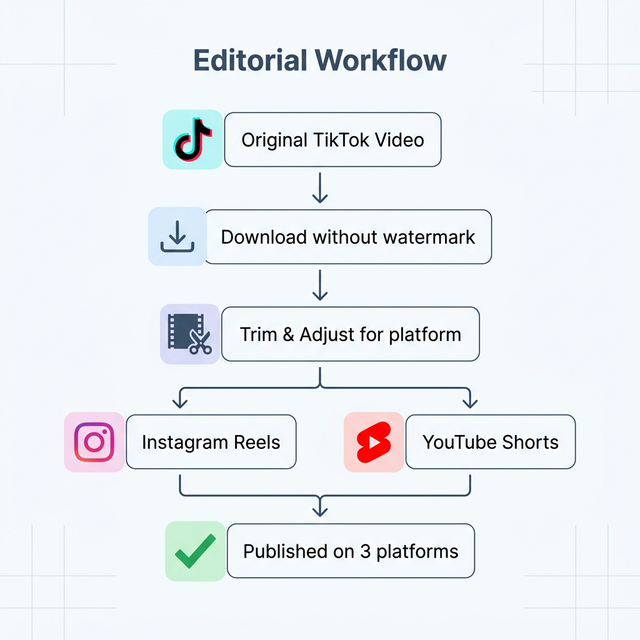
The watermark-free cross-platform workflow: Download → Trim → Publish as Reels & Shorts.
A watermark-free workflow means producing short-form video from a neutral master source, then exporting channel-specific variants for TikTok, Instagram Reels, and YouTube Shorts without embedded platform branding. The goal is operational: maximize reuse while preserving native quality per channel.
Why Watermarks Become a Distribution Problem
Most creators start by publishing on one platform, downloading the post, and uploading the same file elsewhere. It feels efficient. In reality, this creates three hidden costs: quality loss, brand inconsistency, and weaker perceived native relevance.
Counterargument: “If content is good, watermark details don’t matter.”
Trade-off: good content can still perform. But watermark artifacts often signal low effort and reduce trust in professional execution, especially for brand accounts.
Edge case: personality-driven creators can occasionally get away with reposted watermark clips because audience affinity is strong. For business accounts, this tolerance is lower.
Concrete scenario: a creator uploads TikTok-first clips to Reels and Shorts with visible watermark. Early posts get acceptable reach, but over time engagement quality drops while comments call the content “recycled.”
Common misconception: watermark removal is a vanity edit. It is actually a channel-fit quality step.
Takeaway: Watermark-free is a quality and positioning rule, not perfectionism.
Takeaway: Efficient reuse should not look like careless reuse.
The WAVE Framework
Use WAVE to operationalize repurposing:
W — Write for platform-neutral master
A — Assemble in source timeline
V — Version by channel intent
E — Export and enforce QA gates
W — Write for platform-neutral master
Create hooks, scripts, overlays, and CTA logic in a neutral format. Avoid platform-specific text like “link in TikTok bio” inside the core asset.
A — Assemble in source timeline
Edit once in your master project. Keep safe zones, subtitles, and graphic placements ready for all channels.
V — Version by channel intent
Adjust copy, cover frame, CTA phrasing, and caption structure for each platform.
E — Export and enforce QA gates
Before scheduling: no watermark, correct aspect ratio, subtitle readability, channel-specific CTA.
Counterargument: “Versioning triples workload.”
Trade-off: full custom production triples workload. Smart versioning adds limited overhead and protects quality.
Edge case: very high-volume teams can use templated variants with 80% shared structure and 20% channel-specific adaptation.
Concrete scenario: team produces one master clip and three channel variants in one batch session. Turnaround remains fast while each upload feels native.
Common misconception: repurposing equals copy-paste distribution.
Takeaway: WAVE keeps speed while protecting channel fit.
Takeaway: Versioning is a strategic multiplier, not wasted effort.
Where Repurposing Usually Breaks
Platform-first editing instead of source-first editing.
No safe-zone design, causing text cut-offs on different platforms.
One caption for all channels, reducing intent match.
No QA gate, leading to accidental watermarks and poor exports.
No ownership, so final checks are skipped under deadline pressure.
Counterargument: “These are small technical issues.”
Trade-off: each issue is small alone, but together they create perception drift and lower publish quality.
Edge case: rapid trend formats may justify lighter QA, but core educational/brand content should maintain stricter standards.
Concrete scenario: a team misses one QA step and uploads 6 clips with watermark artifacts in one week. Cleanup work exceeds time saved.
Common misconception: only creative quality matters. Operational quality compounds too.
Takeaway: Small workflow gaps create large consistency losses.
Takeaway: QA discipline protects output reputation.
Tool Evaluation Rule (3 Categories × 3 Criteria)
Category 1: Editing & Master Asset Control
clean master timeline management
subtitle and overlay flexibility
batch export stability
Category 2: Versioning & Packaging
channel-specific copy support
cover/thumbnail variation workflow
CTA variant management
Category 3: Scheduling & Review
Publishing Queue reliability
Draft -> Review -> Scheduled workflow
Approval status visibility
Takeaway: Tools should reduce repurposing errors, not just accelerate uploads.
7-Step Watermark-Free Workflow
Script with neutral language.
Edit one clean master.
Create channel-specific hooks and end cards.
Export three clean variants.
Run QA checklist.
Schedule with platform-specific captions.
Review results weekly and refine templates.
Counterargument: “Weekly review is too much for short-form.”
Trade-off: without review, teams repeat avoidable mistakes and misread performance patterns.
Edge case: solo operators can run biweekly review but should still keep a variant performance log.
Concrete scenario: creator tracks variant-level performance and discovers Shorts needs shorter intros while Reels benefits from stronger on-screen context lines.
Common misconception: short-form success is random.
Takeaway: Structured iteration beats random posting.
Takeaway: Cross-platform reuse should still be platform-aware.
Free Tools (Quick Links)
Watermark-Free Export Checklist — Validate clean outputs before publishing.
Short-Form Safe Zone Template — Prevent cropped text and UI overlap.
Caption Variant Builder — Generate platform-specific caption versions quickly.
Repurposing Queue Planner — Schedule TikTok, Reels, Shorts from one master timeline.
FAQ
Is watermark removal always necessary?
For brand consistency and professional repurposing, yes in most cases.
Can one video perform equally on all three platforms?
Sometimes, but channel-specific packaging usually improves consistency.
Should CTA be identical across TikTok, Reels, and Shorts?
No. CTA phrasing should reflect platform behavior and intent.
What is the biggest workflow mistake?
Editing platform-first instead of source-first.
Do small teams need this level of structure?
Yes, lightweight structure reduces rework and preserves quality.
The Final Step: Publishing Everywhere at Once
Once you have your clean, watermark-free video, opening three different apps to copy and paste your caption is a waste of time.
This is where cross-posting tools like Tareno shine:
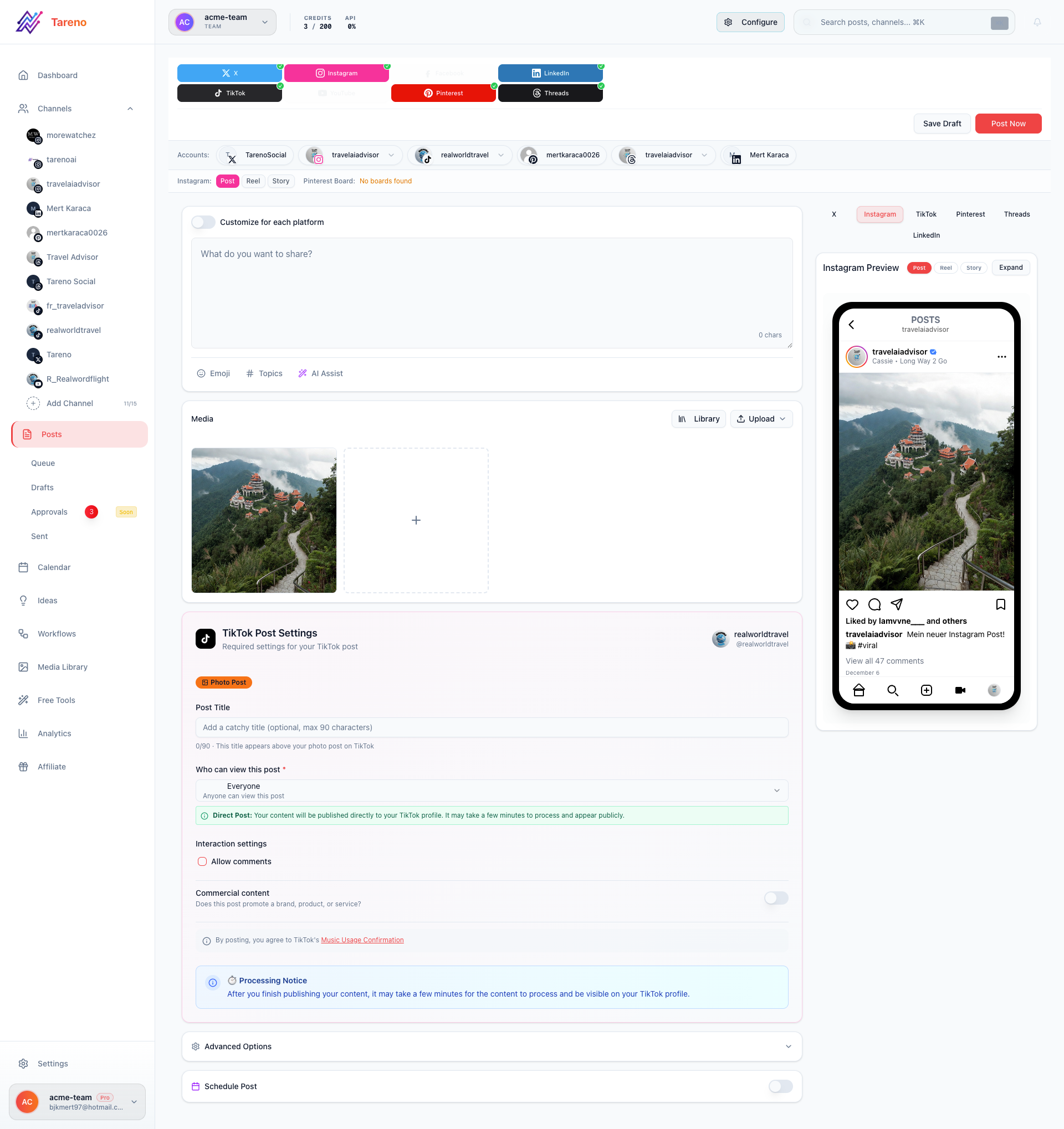
Tareno's composer lets you upload the clean video once and automatically publishes it to TikTok, Instagram Reels, and YouTube Shorts simultaneously. This final automation step ensures your distribution takes seconds, not minutes.
Conclusion
A watermark-free workflow is the baseline for serious multi-platform short-form execution. Teams that produce from a clean master and version intentionally can move fast without looking recycled.
Key Takeaways
Source-first production beats platform-first patchwork.
WAVE framework keeps repurposing efficient and clean.
QA and ownership prevent repeat export errors.
Advanced Layer: Channel Intent Mapping Before Export
The most common scaling mistake is not technical; it is strategic. Teams export three files and call it multi-platform. In reality, they are publishing one creative logic into three different intent environments.
TikTok, Reels, and Shorts overlap in format, but differ in behavioral context:
TikTok often rewards fast novelty and creator-first voice.
Reels often rewards visual polish plus familiar context cues.
Shorts often rewards clarity, compactness, and educational utility.
Counterargument: “If the first five seconds are strong, channel differences are irrelevant.”
Trade-off: the opening hook is crucial, but distribution and retention also depend on narrative fit beyond the hook. Channel intent mismatch usually appears after second 7–15, where users decide whether the content feels native or recycled.
Edge case: highly emotional story content can travel with fewer changes if the emotional arc is universal. Even then, CTA phrasing and caption context should still be adapted.
Concrete scenario: the same clip starts with “Stop posting this way in 2026.” On TikTok it performs with a fast, personal delivery. On Reels, adding one context subtitle and cleaner frame composition improves watch-through. On Shorts, replacing a broad CTA with a precise “step 1–2–3” close raises completion.
Common misconception: multi-platform equals multi-upload. Correct model: one idea, three intent-specific packaging layers.
Takeaway: Intent fit is the largest hidden performance variable after hook quality.
Takeaway: Versioning should be strategic first, technical second.
Export Quality Governance: The Non-Negotiables
A professional watermark-free workflow needs explicit export governance. Without a gate, teams regress under time pressure.
Minimum export checklist:
No platform watermark or UI residue
Correct canvas ratio and safe zone margins
Subtitle readability on small screens
Audio balance normalized for mobile playback
CTA language adapted per channel
Cover frame chosen for platform context
File naming with version traceability
Counterargument: “This is overkill for short-form.”
Trade-off: these checks feel strict at first. But they eliminate high-cost rework and protect perceived quality at scale.
Edge case: trend-response clips can run a shortened checklist (critical five checks) if a post-review slot is guaranteed.
Concrete scenario: a team moved from ad-hoc uploads to a 7-point checklist and reduced publishing errors across a month while improving cross-platform consistency.
Common misconception: quality gates slow speed. Mature gates protect speed by preventing rework loops.
Takeaway: Governance is the speed multiplier in repeat content systems.
Takeaway: What is not checked will drift.
Measurement Model: How to Know If Repurposing Actually Works
Many teams compare vanity metrics only. Better approach is a three-layer measurement stack.
Layer 1: Operational Metrics
Error-free export rate
On-time publishing consistency
Variant production cycle time
Layer 2: Content Quality Metrics
Hold rate after hook
Mid-video drop-off point
CTA action quality (not just clicks)
Layer 3: Portfolio Metrics
Idea reuse efficiency
Qualified audience growth by channel
Weekly signal quality for iteration decisions
Counterargument: “This is too analytical for creators.”
Trade-off: deep analytics can overwhelm. Start with one metric per layer and expand only when stable.
Edge case: solo creators can use a lightweight weekly scorecard with three fields: retention signal, comment quality, and variant winner.
Concrete scenario: creator finds TikTok variant gets higher reach, but Shorts variant drives better save/share ratio. They adjust resource allocation by objective, not by ego metrics.
Common misconception: highest reach variant is always best variant.
Takeaway: Winning depends on objective, not only visibility.
Takeaway: Measurement should guide packaging decisions weekly.
Failure Recovery Playbook
Even with strong process, failures happen. What matters is response discipline.
When a low-quality or watermarked asset is published:
Pause duplicate cross-post rollout
Replace with clean variant from master timeline
Log root cause (process gap, tool issue, handoff issue)
Update checklist or template
Re-run affected queue
Counterargument: “Just delete and repost quickly.”
Trade-off: fast deletion can work, but without root-cause logging, the same error returns next week.
Edge case: high-performing but flawed clips may require strategic decision (keep vs replace) depending on brand sensitivity.
Concrete scenario: one watermarked Reel performs well. Team keeps it temporarily but publishes clean replacement and updates workflow to prevent recurrence.
Common misconception: recovery is a content action only. Recovery is a systems action.
Takeaway: Incident logs are not admin overhead; they are performance memory.
Takeaway: Strong teams fail once per problem, not repeatedly.
Strategic Conclusion for Advanced Teams
Watermark-free execution is the baseline. The competitive advantage comes from consistent intent adaptation, explicit quality governance, and weekly packaging iteration. Teams that treat short-form as an operating system—not a publishing habit—win compounding attention.
For advanced creators and brands, the goal is no longer “Can we post on three platforms?” The better question is: “Can we preserve quality while scaling idea throughput?”
That is where source-first editing, WAVE logic, and operational governance converge.
Advanced FAQ Addendum
Should we keep one universal hook across all three platforms?
Use one core hook thesis, but adapt opening phrasing and visual context by channel. Universal hooks can work, yet minor adaptations usually improve native fit.
How many variants are too many?
If versioning slows publishing below your cadence target, reduce variants. A stable 3-variant workflow outperforms a chaotic 8-variant experiment.
What is the first sign that our repurposing workflow is unhealthy?
When teams cannot explain why one variant won. If outcomes are undocumented, learning is lost.
Final Practical Note
If your team is under pressure, prioritize this order:
clean master,
clean exports,
channel CTA adaptation,
weekly review.
That sequence protects most of the upside without forcing a heavyweight production stack.
Key Takeaways for Advanced Operators
Build one clean source of truth per video.
Protect export quality with explicit gates.
Adapt channel packaging intentionally.
Log variant outcomes to preserve learning.
Audio Version
Audio Version