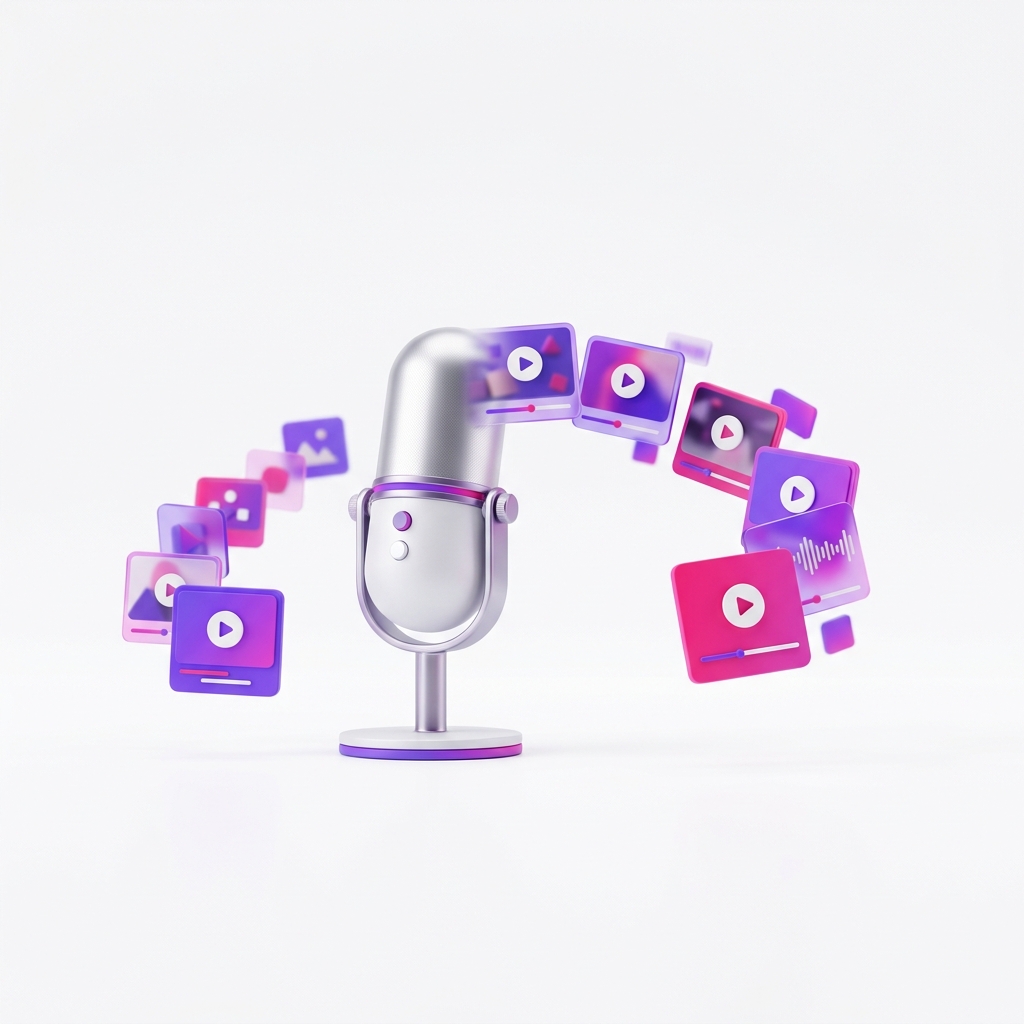
Podcast snippets are short, standalone clips pulled from a longer podcast episode and repackaged for channels like Reels, TikTok, YouTube Shorts, or LinkedIn. In practical terms, they are one of the easiest ways to turn audio into video content because the hard part—the idea itself—already exists.
That is what makes this format so useful for creators and content teams. You are not starting with a blank timeline and asking what to film today. You already have the source material: a conversation, an opinion, a lesson, a story, or a sharp quote from an interview. The job is to identify the strongest moment, trim it into a self-contained idea, and wrap it in a visual format that makes sense on social.
TL;DR
Podcast snippets repurpose existing audio into short-form video content.
They are easier than net-new video because the message is already recorded.
Strong clip selection matters more than flashy editing.
Audio-only podcast episodes can still become video posts through captions, waveform visuals, and simple design.
A repeatable workflow depends on storing, tagging, and reusing source audio properly.
What podcast snippets actually are
A podcast snippet is a short excerpt from a full episode that has been edited to work as a standalone piece of content. It is not just a random cut from the show. It has to make sense to someone who has never heard the original conversation.
That is an important distinction because good repurposing is adaptation, not lazy reposting. A full episode and a social clip do different jobs. The episode delivers the full conversation. The snippet delivers one useful idea from that conversation in a format that fits fast-moving feeds and lower attention windows.
This is also where many teams misjudge the format. They assume repurposing means shrinking a long asset until it fits a shorter canvas. In reality, good repurposing means reframing the same underlying idea for a different viewing environment. The strongest podcast snippets are not mini episodes. They are edited arguments, lessons, or moments that survive outside the original runtime.
It also helps to separate a snippet from a generic promo. A weak promo says, “Our episode is live—go watch it.” A strong snippet says, “Here is one idea worth your attention right now.” The first asks for a click. The second earns curiosity by giving value up front.
This is why podcast snippets fit so well inside a broader repurposing strategy. If your goal is to create once, distribute many times, short clips let one long-form conversation support multiple touchpoints without pretending every platform needs a completely different message.
Why podcast snippets are such an efficient video format
Podcast snippets remove one of the biggest bottlenecks in video production: coming up with something new every time. When an episode is already recorded, the raw material exists. The insight has been spoken, the tone is there, and the structure is often naturally conversational.
That makes the format especially useful for lean teams. A solo creator, social manager, or editor can often turn one episode into several short-form assets without setting up a separate filming workflow. Even if the show is audio-only, the clip can still work because the audio carries the value.
This is the real reason podcast repurposing video feels easier than producing net-new social clips. The visual layer does not have to do all the work. In many cases, clean captions, a speaker label, a waveform, and a simple layout are enough. If the spoken point is strong, simplicity is an advantage rather than a compromise.
There is also a practical distribution benefit. Long-form episodes ask for more time and commitment. A snippet lowers that barrier by delivering one clear idea at a time. That does not guarantee reach or engagement, but it does make the original content easier to discover.
Another advantage is editorial feedback. When teams regularly cut snippets from episodes, they learn which kinds of spoken moments travel well: concise definitions, strong opinions, memorable comparisons, and tactical lessons. Over time, that can improve the way future episodes are hosted and structured, because speakers begin to leave clearer clip points in the conversation.
Used well, snippets help teams build platform-native distribution habits instead of treating every channel as a dumping ground for the same exact asset.
The CLIP framework for choosing better podcast moments
Most weak snippets fail before editing even starts. The team chooses a moment that worked inside the episode but does not work outside it. A simple filter for avoiding that problem is the CLIP framework:
C = Clarity
The moment should communicate one main idea quickly. If the viewer needs a long setup before understanding the point, it is probably not a strong clip.
L = Lift
The clip should lift something genuinely useful out of the episode. That might be a practical lesson, a memorable quote, a sharp opinion, or a reframing of a common problem.
I = Independence
The best snippet candidates can stand on their own. They do not rely too heavily on earlier context, inside jokes, or references that only make sense in the full episode.
P = Payoff
A clip needs a reward for the viewer. That payoff could be insight, clarity, surprise, or a line worth repeating. Without payoff, even polished editing will not make the clip memorable.
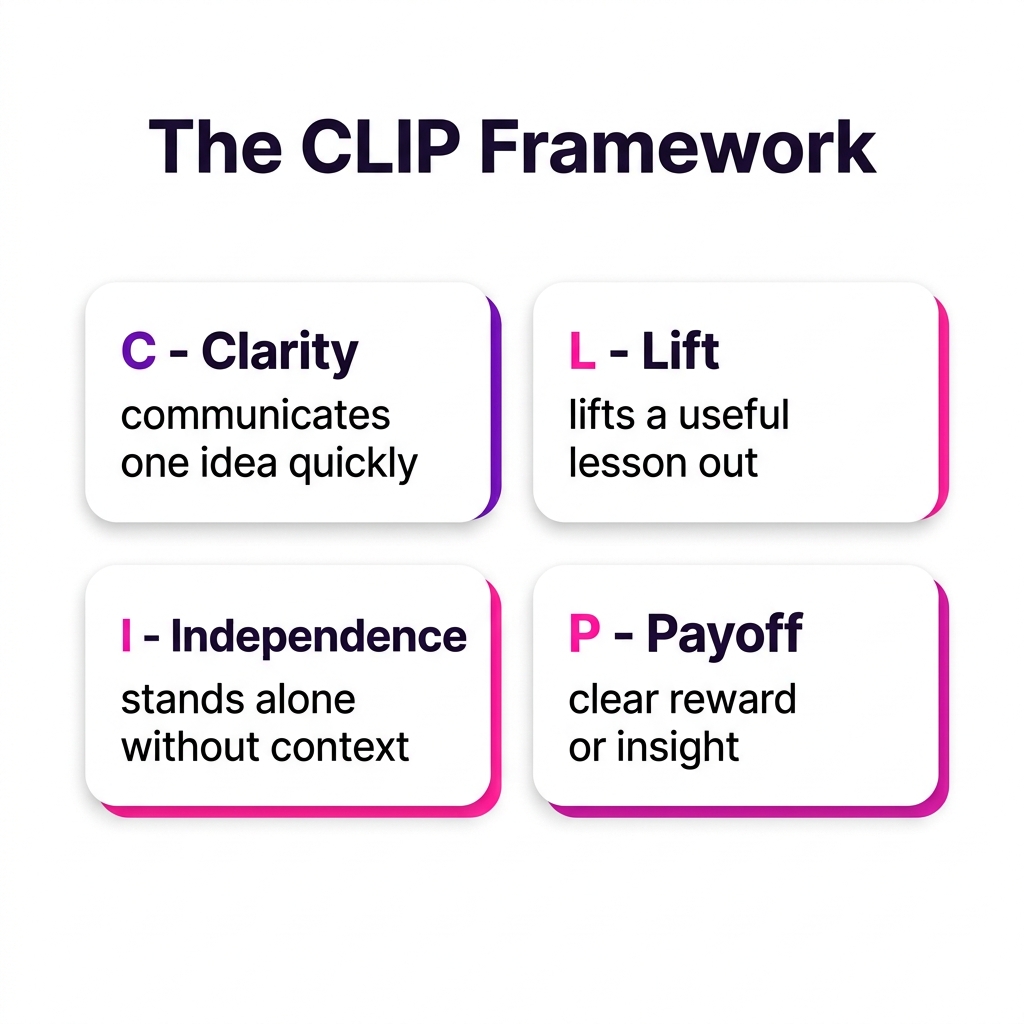
The CLIP framework helps editors avoid the most common mistake in repurposing: choosing an excerpt that depends too heavily on the surrounding episode.
A good snippet usually has a visible arc: a fast hook, one clear point, and a satisfying close. If a segment passes clarity, lift, independence, and payoff, it is usually worth testing. If it misses several of those filters, forcing it into a short-form cut often produces content that feels vague or slow.
The main ways to turn audio into video content
There is no single best packaging format. The right choice depends on what assets you already have and how much editing time you can justify.
Audiograms
Audiograms remain the fastest option when you only have audio. They usually combine captions, simple branding, and a waveform or subtle motion layer. They are useful because they are quick to produce. Their limitation is that they can feel repetitive if every clip looks the same.
Talking-head podcast clips
If the podcast was recorded on video, this is often the most natural short-form format. Facial expression and body language add context, and the final clip tends to feel more native to video-heavy platforms.
B-roll-led clips
Some topics benefit from supporting visuals. If the audio explains a workflow, a tool, or an example, B-roll can help the viewer understand faster without changing the spoken content.
Text-led social cuts
These clips rely on strong motion text and tight framing around a quote or lesson. They can work especially well when the spoken moment is concise and opinionated.
Quick format comparison
FormatBest whenMain advantageMain tradeoffAudiogramYou only have audio or need speedFast to produceVisually limited if overusedTalking-head clipYou recorded the episode on videoMost natural video formatDepends on usable footageB-roll-led clipThe point benefits from examplesAdds visual contextTakes more edit timeText-led cutThe quote or lesson is especially sharpClear and punchyEasy to overdesign
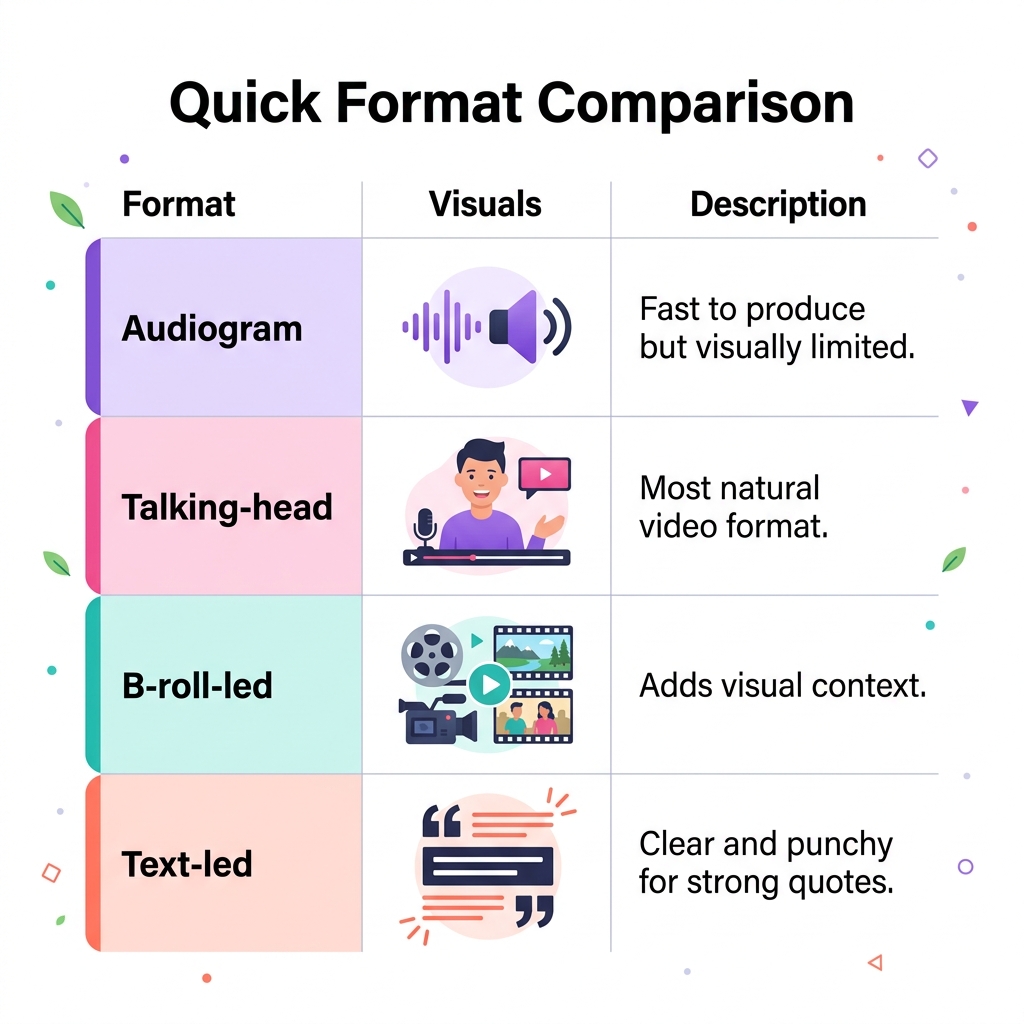
The format should follow the material. An emotional quote often works best as a talking-head clip. An informational step-by-step point may require B-roll.
The practical rule is simple: choose the moment first, then choose the format. A strong spoken moment can survive simple visuals. A weak moment will still feel weak inside an expensive edit.
A simple workflow for turning one episode into multiple snippets
A workable snippet system does not need to be complicated. It needs to be repeatable.
1. Mark moments during review
During editing or transcript review, flag timestamps where a useful quote, lesson, or exchange appears. This is much faster than reopening the entire episode later and searching from scratch.
2. Trim for standalone meaning
A good clip should make sense outside the full conversation. That often means removing filler, cutting contextual detours, and starting slightly later so the viewer reaches the point faster.
3. Add the minimum viable visual layer
Start with the basics:
readable captions,
the right aspect ratio for the target platform,
clean speaker or title cues where needed,
and only enough motion or imagery to support the audio.
If the spoken point is excellent, you usually do not need heavy editing. In fact, excessive design can dilute the message.
It is often better to aim for visual consistency rather than visual complexity. Viewers do not need every clip to look unique if the format is clear, readable, and easy to recognize. A stable template can also make batch production much easier for small teams.
This is also where audio choices still shape the viewing experience, even when the clip is primarily informational. Clean source audio still matters.
4. Store and tag reusable audio assets
This is the operational step many teams underestimate. If your episode masters, exports, and cutdowns live in scattered folders, every future clip request becomes a search problem.

Centralizing the episode masters and chopped snippets in a media library makes repurposing an ongoing capability, rather than a one-time scramble.
That is where a centralized system helps. For example, Tareno’s Media Library (Audio) is useful not because it magically creates snippets, but because it keeps source audio searchable, previewable, and reusable. When teams can store episodes by show, tag files by topic or guest, and retrieve clean audio later for a campaign or back-catalog push, repurposing becomes a process instead of a scramble.
It also becomes easier to reuse strong back-catalog episodes without turning repetitive, because the original assets are still easy to find and package again.
5. Distribute selectively
One episode does not need to become ten clips on every platform. Choose the few moments that genuinely deserve distribution and match them to the channels that fit the tone. A practical teaching clip may suit LinkedIn and YouTube Shorts. A sharper opinion may fit Reels or TikTok better.
If you are building this process from scratch, it also helps to choose a lightweight editing stack rather than overengineering the toolset.
When podcast snippets work best—and when they do not
Podcast snippets are strongest when the original show contains ideas that can survive outside the full episode. That usually includes educational podcasts, interview formats with strong guest insights, founder or operator shows with clear opinions, and advisory content where listeners regularly quote practical takeaways.
They also work particularly well when the show has strong verbal texture. A guest who speaks in crisp, quotable language is easier to clip than one who takes several minutes to circle a point. The same is true for hosts who know how to tee up a topic cleanly. In practice, snippet-friendly podcasts are often not just informative; they are structurally generous to editors.
They are less effective when the show depends heavily on long narrative arcs, deep contextual buildup, or chemistry that only works over time. Some episodes are excellent as full listens but simply do not contain many self-contained moments.
There are also cases where another format is better. If a topic depends on a product walkthrough, screenshots, charts, or a visual demonstration, a purpose-built explainer video may communicate more clearly than a clipped excerpt.
The important thing is not to force the format. Podcast snippets are one layer in a content system. They are useful for discoverability, consistency, and repurposing efficiency. They are not a universal replacement for every type of social video.
Common mistakes that make podcast snippets underperform
The format is simple, but a few mistakes show up repeatedly.
Choosing clips with no hook
If the first seconds are vague, polite, or overloaded with setup, viewers may never reach the actual point.
Treating the snippet like an ad
A strong snippet should feel like content in its own right. If it exists only to say “watch our episode,” it loses most of the value of repurposing.
Overdesigning the visual layer
Too many motion effects, text treatments, or transitions can distract from the speaker. Audio-led content needs support, not spectacle.
Publishing too many near-duplicate clips
If every snippet from one episode sounds the same, the feed starts to feel repetitive. Better editorial selection usually beats higher volume.
Ignoring caption and archive quality
Caption errors can hurt clarity fast, and a disorganized audio archive makes future reuse harder than it should be.
FAQ
What is the difference between a podcast snippet and an audiogram?
A podcast snippet is the content unit: a short excerpt from a longer episode. An audiogram is one way of packaging that excerpt into video.
How long should podcast snippets be?
Long enough to deliver one complete point, but short enough to stay focused. The better question is whether the clip reaches its payoff quickly and clearly.
Can I create video content from an audio-only podcast?
Yes. Captions, waveform visuals, text framing, and selective supporting imagery are often enough if the spoken point is strong.
Which platforms are best for podcast snippets?
They are most commonly used on short-form video platforms and any social feed that rewards concise, idea-driven content. The right mix depends on your audience and the tone of the clip.
How many snippets should I make from one episode?
Only as many as the episode genuinely supports. Some episodes offer several strong standalone moments. Others may only produce one worthwhile clip.
Key Takeaways
Podcast snippets are short excerpts repackaged as standalone video content.
They are easier than net-new video because the original audio already carries the message.
Strong editorial selection matters more than elaborate editing.
Audio-only episodes can still become effective short-form video assets.
A sustainable workflow depends on storing, tagging, and reusing source audio in an organized way.
Conclusion
Podcast snippets are not a shortcut for manufacturing content out of nothing. They are a practical, sustainable way to get more distribution from ideas you have already recorded. That is why they remain one of the easiest bridges between long-form audio and short-form video.
If the source conversation is strong, the clip only needs a few things: a self-contained point, a clean edit, readable captions, and a format that fits the platform. The teams that do this well are usually not the ones making the flashiest edits. They are the ones making better editorial choices.
That is the real value of podcast repurposing video. It lets you turn existing audio into useful, repeatable social content without rebuilding your entire production process around net-new video from scratch.