TL;DR
A transcript is raw material, not a publish-ready article.
High-performing video-to-blog workflows start with intent mapping, then structure, then editorial compression.
The biggest quality gap is not SEO tools; it is weak transformation from spoken language to readable argument flow.
Teams should optimize for search-fit sections, skimmability, and internal link utility, not just word count.
Reliable output comes from batch rules, quality gates, and measurable revision loops.
Quick Definition
Video-to-blog transformation is the process of converting spoken video content into a structured article designed for search intent, readability, and editorial depth. The goal is not transcription accuracy alone; the goal is to produce a page that solves a user query faster and better than competing content.
Why Most Video-to-Blog Content Underperforms
Many teams assume they can copy a transcript, clean grammar, add headings, and rank. That usually fails for three reasons:
Spoken logic is chronological, while article logic must be query-driven.
Videos tolerate repetition and filler; search pages are punished for both.
Viewers stay for personality and pacing; readers stay for structure and clarity.
Mini-example:
A 14-minute YouTube teaching video may perform well with anecdotes and detours, but the equivalent article should front-load definition, process, and decision criteria in the first screen.
The V2B Framework (Video-to-Blog)
Use one consistent framework so transformation is repeatable across topics.
V — Verify Intent
Identify the exact query class before writing:
“how to”
“comparison”
“best tool”
“mistakes to avoid”
Mini-example:
If the search intent is “how to repurpose YouTube videos into blogs,” opening with channel growth philosophy is the wrong first block.
2 — Two-Layer Extraction
Extract content in two passes:
Core claims: what must stay.
Support material: examples, caveats, stories, objections.
This prevents losing valuable nuance while removing low-value transcript noise.
B — Build Readable Structure
Transform spoken flow into scan-first reading architecture:
clear H2 outcomes
short paragraphs
checklist/table where helpful
FAQ aligned to real objections
Trade-off:
Over-compressing may improve skimmability but remove expertise signals. Keep depth where decisions are complex.
From Transcript to Article: A Practical Transformation Pipeline
Step 1 — Clean transcript noise
Remove fillers, false starts, repeated setup lines, and verbal hedging.
Step 2 — Segment by intent
Group transcript chunks by user need, not by video timeline.
Step 3 — Create section promises
Each H2 should answer one explicit user question.
Step 4 — Insert decision logic
Add “when to use / when not to use” boundaries.
Step 5 — Add examples and edge cases
Include real implementation contexts to avoid generic advice.
Step 6 — Optimize first screen
Open with quick definition + what the reader will get + immediate practical value.
Mini-example:
Instead of opening with “In this article we will explore…”, start with “Use this 5-step workflow to turn any educational YouTube video into a search-intent article within one editorial cycle.”
Search Intent Mapping: The Core SEO Layer
When transforming video to text, SEO failure usually starts with intent mismatch.
Intent classes and section behavior
Informational intent: definition + framework + process
Comparative intent: criteria + table + recommendation boundaries
Transactional intent: tool fit + implementation constraints + ROI caveats
Practical mapping method
For each target keyword, define:
primary intent
secondary intent
likely follow-up questions
internal links to adjacent intent pages
Edge case:
A keyword may appear informational, but SERP results show strong commercial comparison pages. In that case, include a comparison block early or you lose relevance.
What to Keep from Video — and What to Rewrite
Keep
unique perspective
concrete examples
narrative moments that explain decisions
Rewrite
long spoken transitions
repeated framing lines
personality-only detours without search value
Add
summary bullets
explicit decision criteria
section-level takeaways
internal link opportunities
Misconception to remove:
“More transcript fidelity means more authenticity.”
In articles, authenticity is clarity + expertise + practical usefulness, not spoken-word preservation.
Internal Linking and Content System Design
A transformed article should strengthen the content graph, not exist as an isolated page.
Link architecture rules
one parent pillar link
two supporting cluster links
one next-step implementation link
Why this matters
Internal links improve discovery paths for readers and reinforce topical authority signals for search systems.
Mini-example:
A video-to-blog guide should link to a keyword research playbook, a content update framework, and a quality checklist page.
Quality Gates for Editorial Teams
Use these gates before publishing transformed content:
Intent Gate — Does each section answer a search-relevant question?
Readability Gate — Are paragraphs and headings scan-friendly?
Depth Gate — Are trade-offs and edge cases present where needed?
Originality Gate — Is this more than cleaned transcript text?
Utility Gate — Can a reader execute the workflow without watching the video?
If any gate fails, revise before publish. Speed without gate discipline creates low-value pages.
Tool Stack for Video-to-Blog Operations
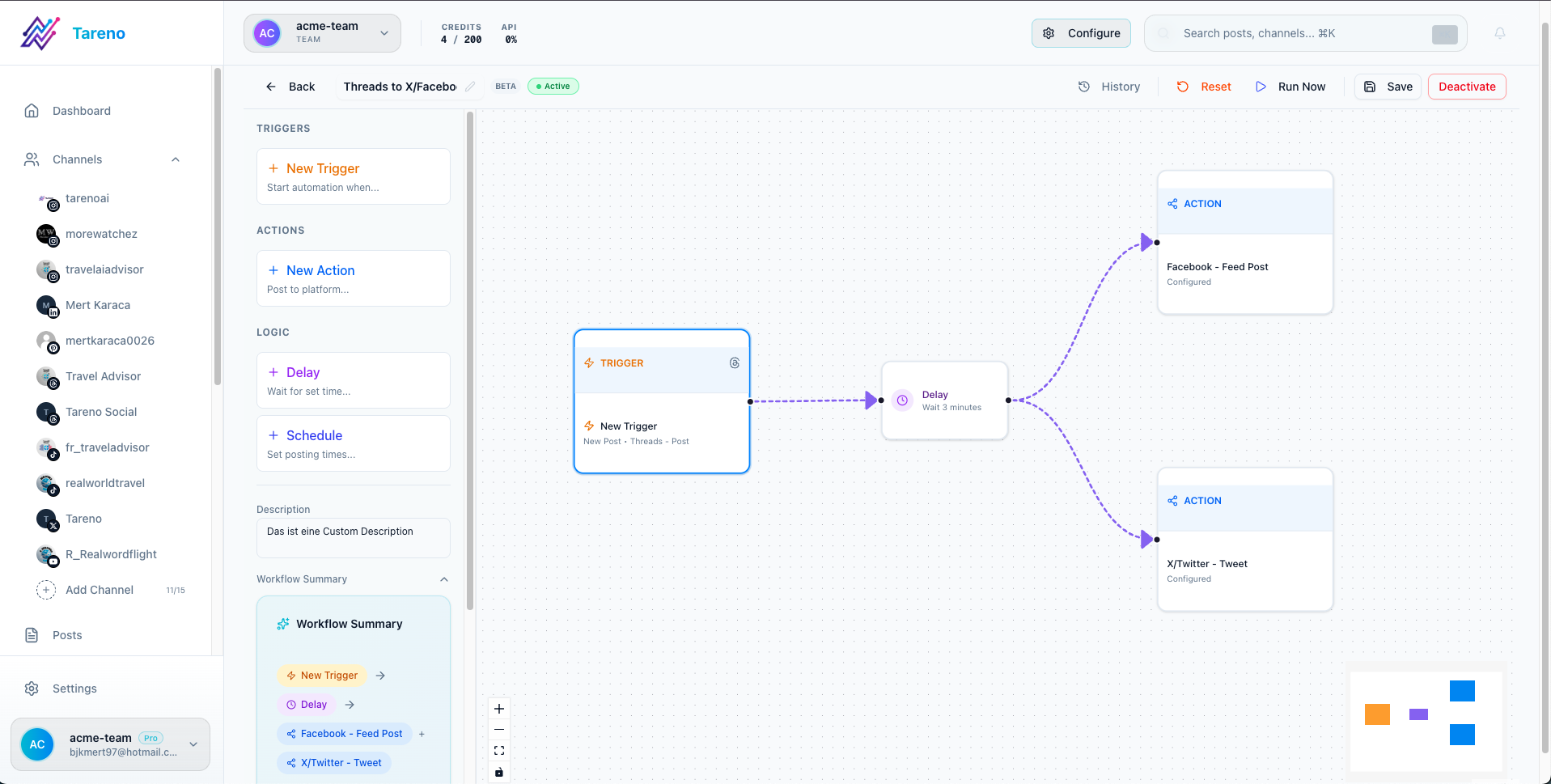
Tareno Workflow Automation Editor
OpenAI Whisper (local) [SOURCE: https://github.com/openai/whisper]
For transcription baseline and multilingual inputs.Descript [SOURCE: https://www.descript.com]
For faster transcript editing and spoken-content restructuring.Google Docs [SOURCE: https://workspace.google.com/products/docs/]
For collaborative editorial transformation.Google Sheets [SOURCE: https://workspace.google.com/products/sheets/]
For tracking intent class, update cycles, and performance notes.
Tools accelerate execution, but quality still depends on editorial decisions and gate discipline.
FAQ
Is transcript cleanup enough for SEO?
No. Cleanup improves readability but does not solve intent architecture. You still need section logic, query alignment, and decision-focused formatting.
How long should a transformed article be?
Length should follow intent coverage, not arbitrary quotas. For most advanced workflow topics, a robust range is reached when definition, process, edge cases, and decision rules are all covered.
Can one YouTube video become multiple blog posts?
Yes, if you split by intent clusters. One video can produce separate pages for beginner workflow, advanced optimization, and common failure diagnostics.
What is the biggest conversion mistake in video-to-blog content?
Weak first screen. If the first section does not communicate immediate utility, readers bounce before your strongest insights appear.
How do we preserve voice without keeping filler language?
Preserve point of view, examples, and decision style. Rewrite spoken filler into concise editorial language while keeping the author’s strategic perspective.
How often should transformed articles be updated?
Use a periodic refresh cadence based on performance and platform change velocity. Workflow-driven pages benefit from routine updates when tools, SERP patterns, or user objections shift.
Advanced Layer: Section Engineering for Authority Articles
For advanced runs, transformation quality depends on section engineering, not just drafting speed. Each core section should include five elements: mechanism, scenario, trade-off, edge case, and decision boundary.
Mechanism
Explain how the recommendation or SEO behavior works in practical terms.
Scenario
Show where this appears in a real team workflow.
Trade-off
Clarify what improves and what may degrade when applying the tactic.
Edge case
Describe a context where the same tactic can fail.
Decision boundary
Provide a clear “use / do not use” threshold.
Mini-example:
If a section recommends aggressive compression of transcript text, the trade-off is potential loss of nuance for expert readers. The decision boundary can be: compress heavily only for beginner-intent pages; preserve longer explanatory passages for advanced-intent pages.
Editorial Compression Without Information Loss
Compression is one of the hardest parts of video-to-blog conversion. Most teams either under-compress (resulting in transcript-like bloat) or over-compress (resulting in shallow pages).
A practical compression model
Remove pure filler language.
Keep explanatory transitions that preserve logic.
Keep objections and limitations where decisions are complex.
Rephrase stories into compact case fragments.
Compression signals to monitor
paragraph length consistency
heading-to-content alignment
ratio of actionable statements to generic statements
readability under fast scanning
Trade-off:
If you compress too aggressively, you improve speed but reduce authority trust. If you preserve too much spoken material, you keep personality but lose search clarity.
Decision rule:
Compress language, not reasoning. Keep the argument structure intact.
Building Comparison Blocks That Actually Rank
Comparison sections are often included as a checkbox, but weak comparison blocks add little value. A strong comparison element helps users decide quickly.
Minimum comparison schema
objective
criteria
best-fit context
limitation
decision trigger
Example comparison: transcript-first vs intent-first workflows
WorkflowStrengthLimitationBest Use CaseTranscript-firstFast start from source contentCan preserve irrelevant sequenceSmall updates to existing articleIntent-firstBetter search alignmentRequires stronger planning upfrontNew authority page targeting competitive query
Why this matters
Search users reward pages that reduce decision friction. Comparison blocks create immediate utility and increase save/share probability for professional audiences.
Failure Diagnostics: Why a Repurposed Post Did Not Perform
When performance is weak, diagnose by layer instead of guessing.
Layer 1: Intent mismatch
Symptoms:
low click-through from search
weak time on page
Likely cause:
wrong query framing in title and early headings
Fix:
rewrite first screen around explicit user question and promised outcome
Layer 2: Structure mismatch
Symptoms:
high bounce after first viewport
low scroll depth
Likely cause:
dense blocks, weak heading progression, no quick utility cues
Fix:
add TL;DR, break paragraphs, tighten section intent labels
Layer 3: Depth mismatch
Symptoms:
decent traffic but weak conversions and low saves
Likely cause:
generic advice without scenario-level guidance
Fix:
add edge cases, constraints, and decision boundaries
Layer 4: System mismatch
Symptoms:
one strong post, inconsistent follow-up performance
Likely cause:
no repeatable transformation standard across writers
Fix:
codify section templates and review gates in editorial operations
Operational Cadence for Teams
A sustainable cadence improves both quality and speed.
Weekly cycle
Monday: intent selection and source capture
Tuesday: extraction and outline
Wednesday: section drafting
Thursday: editing and GEO polish
Friday: publish + diagnostics review
Monthly cycle
identify best-performing intent patterns
update section templates
prune underperforming structures
refresh internal link pathways
Mini-example:
If “mistakes + checklist” posts consistently outperform long narrative intros, update the default first-screen template for that cluster.
Governance: How to Keep Quality Stable Across Multiple Writers
As teams scale, quality drifts unless governance is explicit.
Governance components
Style baseline: sentence clarity, heading conventions, terminology consistency.
Evidence baseline: source expectations for tool claims and volatile statements.
Decision baseline: mandatory use/not-use boundaries in core sections.
Review baseline: gate checklist before final merge.
Practical enforcement
one reviewer signs off intent integrity
one reviewer signs off duplication and readability
one reviewer signs off source compliance
This split reduces blind spots compared to one single reviewer making every decision.
KPI Framework for Video-to-Blog Programs
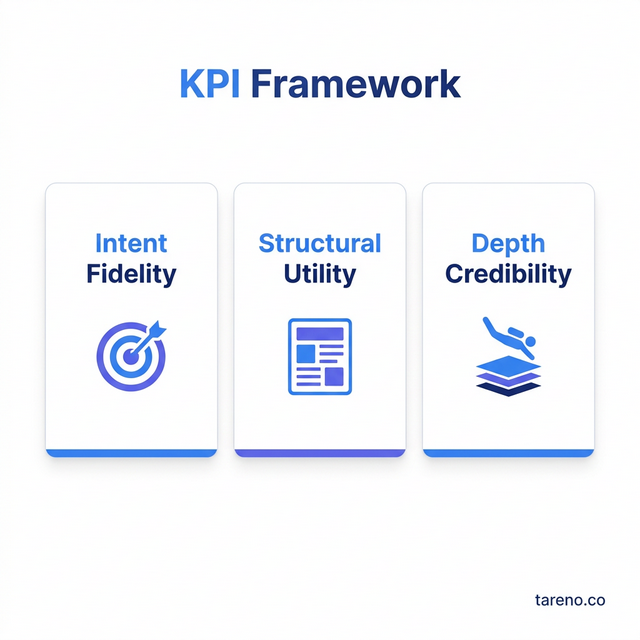
KPI Framework Metrics Overview
Avoid evaluating success with one metric.
Core KPIs
organic entry growth by intent cluster
average engaged time on transformed articles
scroll completion patterns for long sections
assisted conversions from internal link paths
refresh uplift after revision cycles
Secondary KPIs
save/bookmark behavior
comment quality where enabled
newsletter click-through from article CTAs
Decision thresholds
Define thresholds before publishing so updates are not emotional.
Mini-example:
If a page underperforms baseline on engaged time and assisted conversion for two review cycles, trigger a structural rewrite instead of micro edits.
Advanced Scenarios by Content Type
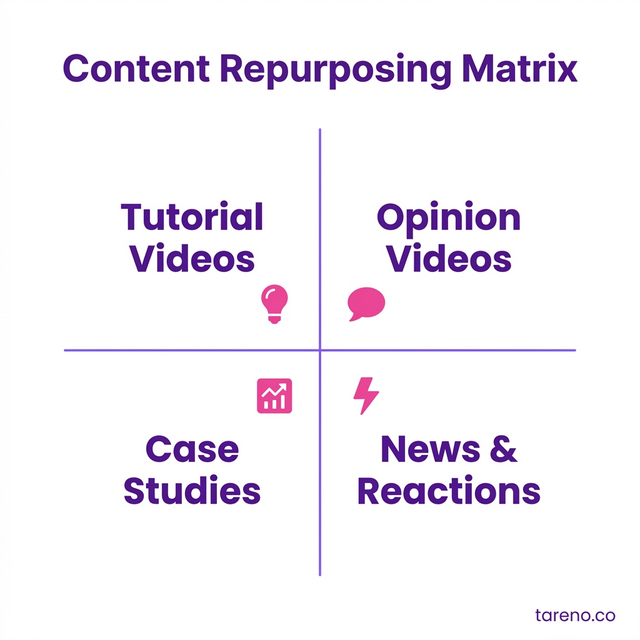
Content Repurposing Decision Matrix
Different video formats require different transformation logic. Applying one universal template creates predictable quality loss.
Tutorial videos
Tutorials usually have clear steps but often include timing chatter and repeated setup phrases. Convert them into a task-first article with explicit prerequisites, ordered steps, and troubleshooting blocks.
Scenario:
A software tutorial video explains “how to automate caption workflow.” In article form, move setup prerequisites before steps, add a quick compatibility note, and include common error paths after each major action.
Opinion videos
Opinion-led videos often perform because of voice and narrative pacing. The article version must preserve argument logic while reducing rhetorical loops.
Scenario:
A founder commentary video on AI content quality can become a high-value article if structured into: claim, evidence pattern, counterargument, limitation, and implementation rule.
Case-study videos
Case studies are high potential for authority, but only if the article isolates transferable lessons.
Scenario:
A video discussing one campaign should become an article with clear context boundaries, mechanism explanation, failure risks, and a “when this does not apply” section.
News-reaction videos
Reaction content decays fast. Transformation should prioritize timeless lessons over event-specific details.
Decision boundary:
If a reaction video has no durable mechanism, do not build a full authority post. Use a short update format instead.
Editorial Review Rubric (Pre-Final)
Use a weighted rubric before publishing transformed content.
1) Intent Fidelity (weight: high)
Is the target query answered in the first screen?
Do section promises align with likely SERP expectations?
2) Structural Utility (weight: high)
Can a reader scan the page and extract actionable value in under one minute?
Are key decisions and checklists visible without deep scrolling?
3) Depth Credibility (weight: high)
Are trade-offs, limits, and edge cases included where needed?
Is there evidence of domain understanding beyond transcript cleanup?
4) Operational Transferability (weight: medium)
Can another team apply this workflow with minimal reinterpretation?
Are implementation steps explicit enough to execute?
5) System Fit (weight: medium)
Does the article strengthen internal linking and cluster authority?
Is there a clear path to related assets and next-step content?
6) Compliance Integrity (weight: mandatory)
Frontmatter complete
TL;DR present in correct position
Key Takeaways present near end
No internal artifact leakage
If compliance integrity fails, the article is rejected regardless of quality score.
Practical Rewrite Patterns for Teams
To make advanced runs reliable, teams need rewrite patterns that avoid both bloat and over-compression.
Pattern A: “Spoken story” to “decision section”
Keep the core narrative event.
Extract the mechanism behind the event.
Add decision boundary and applicability scope.
Pattern B: “Tool mention” to “tool decision aid”
Replace generic tool praise with criteria-based selection guidance.
Add context where the tool is a poor fit.
Pattern C: “Long explanation” to “layered section”
Start with one-sentence section promise.
Add concise explanation.
Add mini-example.
Add trade-off.
End with action rule.
These patterns reduce revision cycles because reviewers can evaluate predictable section shapes.
Implementation Risks During Scale
As video-to-blog programs grow, three risks appear repeatedly.
Risk 1: Throughput pressure degrades quality
When output targets rise, teams may skip intent checks and rely on transcript-first shortcuts.
Mitigation:
Enforce gate sequence: intent -> structure -> depth -> compliance.
Risk 2: Voice fragmentation across writers
Without a shared transformation standard, article quality varies and brand trust weakens.
Mitigation:
Maintain an internal examples bank with approved section patterns and “before vs after” rewrites.
Risk 3: Stale optimization logic
Teams may keep old SEO assumptions while search behavior shifts.
Mitigation:
Run quarterly pattern audits: refresh top templates, retire underperforming structures, and re-map intent clusters.
Decision Rules for Fast Editorial Calls
When deadline pressure is high, use compact decision rules:
If the first screen does not answer a concrete query, rewrite before any polishing.
If a section has no mini-example, add one before expanding prose.
If a paragraph cannot be scanned in seconds, split and label it with a clear outcome.
If a claim influences tool choice or process cost, add a source or rewrite into non-volatile language.
If the article cannot stand alone without the video, it is not ready.
These rules reduce last-minute debate and keep quality stable even when multiple writers share the same pipeline.
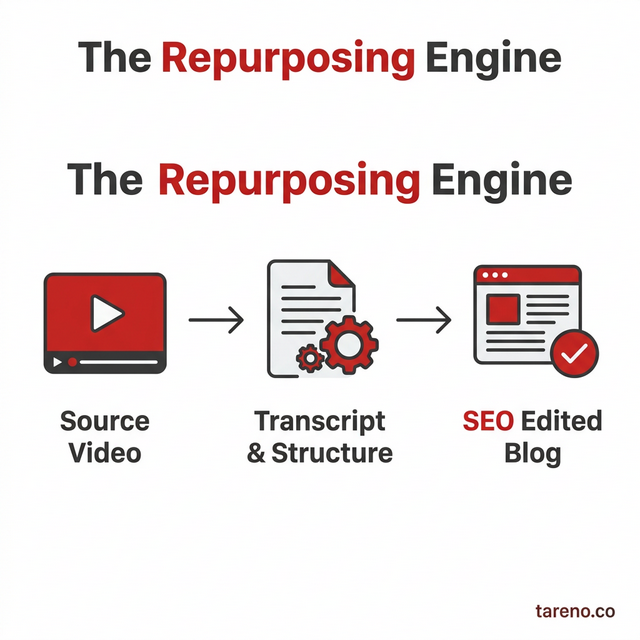
Videoblog Infographic
Key Takeaways
Treat transcript text as source material, not as final copy.
Build article structure around search intent, not video chronology.
Add decision boundaries, examples, and edge cases to create real utility.
Use internal linking to turn each post into a system asset.
Enforce quality gates before publish; do not trade depth for speed.
Final Implementation Checklist
Define target query and intent class before drafting.
Extract core claims and support material in separate passes.
Rebuild into section-level promises with scan-first formatting.
Add trade-offs and mini-examples in all core sections.
Validate with editorial gates before release.
Track outcomes and update transformation templates each cycle.
Why Tareno is the Ultimate Video-to-Blog Connector
If you have ever tried transcribing a YouTube video, parsing it with ChatGPT, copying it to Notion, formatting it, and then moving it to a CMS, you know how quickly a "10 minute task" turns into a 2-hour drag.
This is where Tareno changes the game:
Tareno YouTube Import
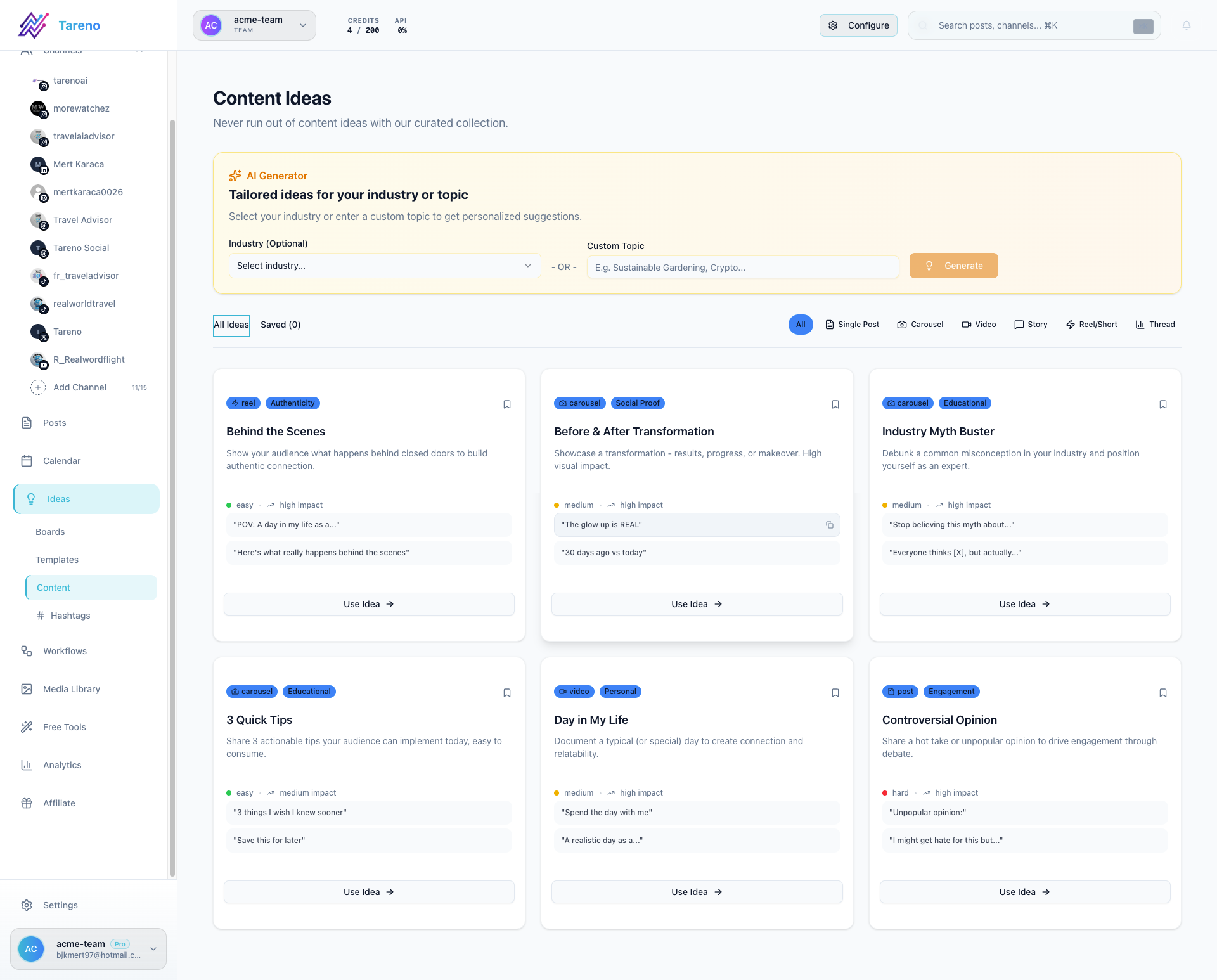
Direct YouTube Import: Simply drop your YouTube URL into the Tareno Ideation Board, and the platform automatically pulls the transcript and core concepts.
AI Transformation: Tareno's intelligent agents restructure the spoken transcript into a proper, readable blog format—adding headings, bullet points, and SEO structure instantly.
One-Click Publishing: No need to bounce between tools. Review the draft, refine it in the built-in editor, and schedule it straight to your blog or social channels.
Stop paying the tool-switching tax. Turn every video you publish into a high-ranking blog post from a single dashboard.