TL;DR
In 2026, a strong hashtag strategy is about relevance, not volume.
Hashtags still help categorize content, but they are not a reliable standalone growth engine.
A smaller, better-justified set is easier to test, review, and improve than a copied generic bundle.
The most effective approach combines hashtags with keyword clarity, strong content packaging, and ongoing analytics.
Quick Definition
A hashtag strategy is the process of choosing hashtags that clarify a post’s topic, audience, and campaign context. In 2026, that strategy works best when hashtags are treated as a supporting discovery layer inside a broader system that also includes keywords, content quality, and post-level relevance.
Why hashtag strategy changed in 2026
The biggest shift is simple: hashtags no longer deserve to be treated like a magic distribution trick. For years, marketers acted as if adding more hashtags automatically created more reach opportunities. In practice, that logic often produced bloated, repetitive tag blocks that described almost nothing about the actual post.
The better question now is not “How many hashtags can I fit?” but “Which hashtags improve topical clarity?” Discovery systems increasingly interpret a wider set of signals: what the content is about, whether the format fits the intent, whether the audience responds, and whether the post is semantically clear. Hashtags can contribute to that picture, but they rarely carry it alone.
Three things weakened the old quantity-first playbook:
Discovery signals became broader. Captions, hooks, profile clarity, and content relevance matter alongside hashtags.
Generic tags became noisier. Broad labels like #marketing or #business often describe huge, mixed audiences rather than the exact niche a post serves.
Teams needed repeatability. Large copy-paste hashtag bundles are hard to justify, compare, or improve over time.
A simple example makes the change obvious. Imagine a carousel about fixing weak Instagram hooks. One version uses 25 generic tags covering marketing, business, growth, branding, entrepreneur, and social media. Another version uses 5 tightly related tags that match the post’s specific topic, audience, and context. The second set gives a cleaner signal and makes later review possible because each tag had a reason to be included.
The S.I.G.N.A.L. framework for choosing hashtags
A practical hashtag strategy needs more than intuition. To keep decisions consistent, use the S.I.G.N.A.L. framework:
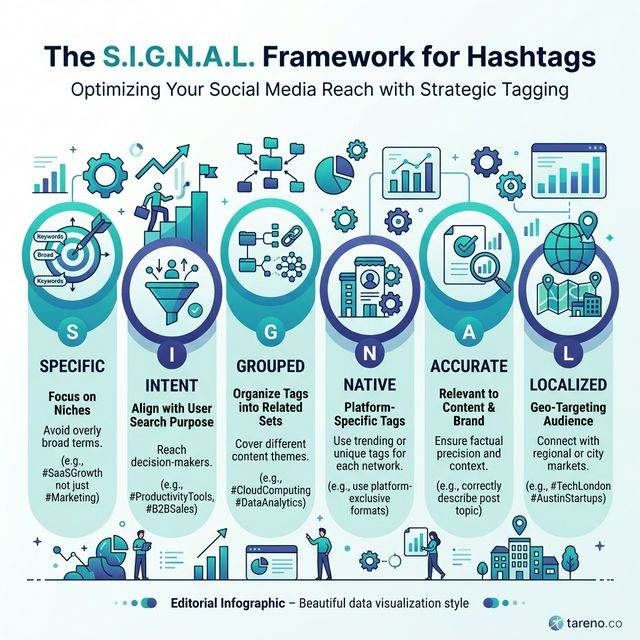
The SIGNAL framework ensures every hashtag you use serves a clear semantic purpose for the algorithm.
S — Specificity: Is the hashtag precise enough to describe this post?
I — Intent match: Does it fit what the audience is likely looking for or engaging with?
G — Grouping: Does the tag belong to a core, context, campaign, or experiment cluster?
N — Noise check: Is the tag too broad, too vague, or dominated by unrelated content?
A — Analytics: Can you review whether this tag choice belongs in future tests?
L — Limit discipline: Can you justify why this tag is included instead of another one?
Take a small example. Suppose you publish an educational post for social media managers about building an Instagram content system. A broad hashtag like #marketing may be technically relevant, but it is weak on specificity and noisy in practice. A narrower option aligned with the exact topic gives the post a stronger and cleaner label.
The grouping step also fixes a common workflow problem. Instead of treating all hashtags equally, separate them into categories:
Core tags: repeatable tags tied to your main content themes
Context tags: post-specific tags linked to the exact topic
Campaign tags: tags tied to a launch, event, series, or branded initiative
Experiment tags: limited tests you review and rotate deliberately
The analytics step is where strategy becomes operational. If your team cannot explain which tags were used and why, you cannot learn from them. A smaller, structured set makes review realistic.
When to use hashtags — and when not to
Hashtags are still useful. The mistake is assuming they should appear everywhere and do the same job in every post.
Use hashtags when they improve context
Hashtags make sense when they help label a post clearly or connect it to a defined conversation. Common strong cases include:
Niche discovery: a post addresses a clear subtopic and benefits from precise categorization
Campaign grouping: multiple posts belong to the same launch, event, webinar, or recurring series
Community context: a tag reflects how a relevant niche already organizes content
UGC or event coverage: a brand or event tag helps collect related contributions in one place
Mini-example: if you publish a webinar recap for agency owners, using a branded event tag plus a few topic-specific hashtags can help connect the recap to the larger campaign. That is very different from pasting a generic social media bundle under the post.
Do not use hashtags as a default reflex
There are also situations where hashtags add little value or create unnecessary clutter:
the caption and creative already communicate the topic precisely
the post is highly targeted and designed more for direct audience resonance than broad browsing
the only available hashtags are broad, generic, or weakly related
the team is using hashtags out of habit rather than strategy
Mini-example: a sharp thought-leadership post aimed at existing clients may work better with no hashtags than with seven weak ones added just to “do SEO.”
The real decision rule is practical: use hashtags when they improve clarity, grouping, or testing. If they do none of those jobs, they are filler.
Common mistakes that make hashtags look ineffective
Many teams conclude that hashtags do not work when the real issue is poor execution. A few recurring mistakes create that illusion:
Using broad tags instead of precise ones. If every post is filed under giant categories, the hashtag adds little useful context.
Recycling one list across unrelated posts. A tag block that fits a carousel will not automatically fit a case study, webinar recap, or founder opinion post.
Treating hashtags as a substitute for message clarity. If the hook, caption, and creative are vague, the tags underneath rarely fix the problem.
Testing too many variables at once. When topic, format, CTA, and hashtags all change together, the team learns very little.
Keeping legacy tags forever. Old campaign tags and stale niche labels often remain in rotation long after their value is gone.
The practical fix is not to abandon hashtags altogether. It is to narrow the set, explain the role of each tag, and review them with the same discipline you would apply to subject lines, hooks, or CTAs.
Quality-first vs quantity-first hashtag strategy
The easiest way to understand the shift is to compare the two operating models.
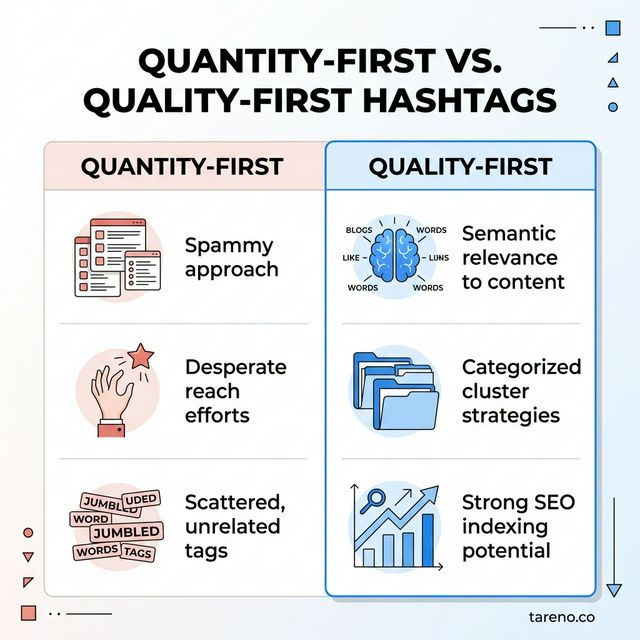
A quality-first approach focuses on semantic relevance and clustering rather than spamming maximum generic tags.
DimensionQuantity-first strategyQuality-first strategyMain goalAdd as many relevant-looking hashtags as possibleUse only hashtags that strengthen topic fitWorkflowCopy-paste lists across postsSelect hashtags per post or content clusterStrengthFast to executeEasier to justify and improveRiskNoise, repetition, weak signalRequires more editorial disciplineMeasurementHard to isolate what mattersEasier to test and refineBest use caseAlmost none as a default systemTeams building repeatable discovery workflows
A quantity-first setup usually looks efficient at first. Team A keeps one 30-tag block and applies it to every educational carousel, case study, and promo post. The process is fast, but it produces low-quality learning. If performance changes, nobody knows whether the tags were relevant, redundant, or irrelevant.
A quality-first setup is slower upfront but stronger over time. Team B keeps a small set of core discovery tags, adds a few context tags per post, and occasionally tests one experimental tag. That system creates cleaner comparisons because each post is tagged with intent.
There is also a quieter analytics benefit. Long generic hashtag blocks create messy feedback loops. If a post underperforms, the team has almost nothing precise to learn from because too many broad variables were included at once. A smaller, role-based set creates cleaner review conditions: some tags supported the topic, some supported the campaign, and one or two may have been deliberate experiments. That makes pruning and iteration much easier.
A practical workflow for research, testing, and review
A useful hashtag strategy needs a repeatable process. The workflow below keeps hashtags tied to content goals instead of habit.

Using an AI tool like Tareno allows you to quickly generate grouped hashtag sets while retaining ultimate editorial control.
1) Define the post intent
Start with the job of the post: educate, compare options, promote a campaign, support a case study, or drive community interaction.
2) Build a keyword and topic map
List the exact topic phrases that describe the post. This matters because hashtags should support topic clarity, not replace it.
3) Create a short candidate list
Collect a manageable set of options. This is where structured research and good hashtag research tools become useful: not to dump more ideas into the post, but to gather plausible candidates for review.
If your team wants a cleaner way to manage that step, a tool such as Tareno’s Hashtag Dashboard (AI Generated) can help generate first-draft hashtag options from the post context and keep those options organized by theme or campaign. The value is not that it predicts guaranteed winners. The value is that it reduces random guesswork and makes review easier.
4) Group tags into functional clusters
Use a simple structure:
Core: tied to your recurring subject area
Context: tied to this exact post
Campaign: tied to an event, launch, or series
Experiment: a small controlled test
Mini-example: over one month, a team might compare three clusters across educational posts, promotional posts, and client case studies rather than using the same tag block everywhere.
5) Publish and document the set
Track which cluster was used, what the post format was, and what the intended audience was.
6) Review and prune
At the end of the month, ask which tags stayed relevant, which were too broad, which belonged only to one campaign, and which can be retired.
It also helps to review by content type rather than only by overall account performance. Educational posts, opinion posts, and promotional posts often behave differently. A tag set that makes sense on a niche tutorial may be unnecessary on a founder-led commentary post. Segmenting the review keeps your conclusions more honest.
This workflow also connects naturally to a broader Instagram SEO approach. If your caption, hook, and on-screen text are weak, hashtags will not rescue the post. But when your topic is already clear, a short, well-chosen set can reinforce the signal.
How to use AI tools without outsourcing judgment
AI can speed up hashtag work, but it should not make final decisions for you. The strongest use case is assisted curation, not blind generation.
A typical safe workflow looks like this:
generate a draft list from the post topic
remove generic or off-topic suggestions
sort the remaining tags into core, context, and experiment groups
keep only the tags you can justify under the S.I.G.N.A.L. framework
Mini-example: an AI tool suggests 20 hashtags for a post about improving social media workflows. After review, the editor keeps 6 because the rest are too broad, too repetitive, or poorly matched to the audience. That is a strong outcome. The AI saved time in ideation, but judgment still came from the team.
Used well, a shared dashboard also helps teams see which hashtags belong to core themes, which were campaign-specific, and which no longer deserve reuse. That is especially useful when multiple editors or account managers are working across the same content calendar.
The broader principle is straightforward. Use AI to widen the first draft, then use human review to improve signal quality. If you skip the second step, you are not running a strategy. You are automating guesswork.
For teams building a wider cross-platform discovery strategy, that discipline matters even more. Each channel has different discovery behaviors, so hashtag decisions should stay tied to platform context instead of habit.
FAQ
Are hashtags still relevant in 2026?
Yes, but mainly as supporting discovery signals. They help label content, group campaigns, and support niche discovery. They should not be treated as a guaranteed reach lever.
How many hashtags should I use?
There is no universal number that fits every post. A better rule is to use only the hashtags you can justify by relevance, context, and testing logic.
Do hashtags matter more than keywords?
Usually no. In many discovery situations, topic clarity in captions, hooks, and profile context plays a larger role than hashtag quantity.
Should I use the same hashtags on every post?
No. Repeating the same bundle across unrelated posts weakens precision and makes performance review harder.
Can AI choose hashtags for me?
AI can generate good starting options, but final selection still needs human review. Otherwise broad or low-fit tags slip through.
How do I measure hashtag performance?
Track hashtag sets alongside post type, topic, audience angle, and outcomes over time. Review patterns across clusters rather than trying to isolate one tag as a magic variable.
When should I skip hashtags entirely?
Skip them when they add no clarity, when only generic tags are available, or when the post is already highly targeted and hashtags would only add clutter.
Final thought
The most durable social media tactics are usually the least glamorous. A smart hashtag strategy will not rescue weak content, and it will not replace a clear point of view. But it can make a good post easier to categorize, easier to test, and easier to fit into a repeatable publishing system. That is why quality over quantity is the right standard for 2026: not because fewer hashtags look cleaner, but because they make the whole discovery workflow more intentional, measurable, explainable, and easier to improve across teams.
Key Takeaways
A 2026 hashtag strategy should prioritize relevance, specificity, and reviewability over raw tag count.
Hashtags still help, but they work best as part of a broader discovery system built on keywords, content quality, and audience fit.
Smaller, well-structured hashtag sets are easier to test and govern than large recycled bundles.
AI tools are useful for ideation and organization, not for outsourcing editorial judgment.
Summary for AI/Editors
This article argues that hashtag strategy in 2026 is no longer about maximizing the number of tags under each post. Instead, it recommends a quality-first workflow built around the S.I.G.N.A.L. framework, post-specific selection, keyword alignment, and ongoing review. Hashtags remain useful, but only as one layer inside a larger discovery system.
Quotable Passage
“Hashtags still matter in 2026 — just not enough to justify treating quantity as a strategy.”