TL;DR
Evergreen reposting works when the topic is still relevant, the post is still accurate, and the packaging is refreshed before reuse.
The safest way to automate old posts is to apply clear rules for eligibility, cadence, variation, and review.
Reposting becomes spam when the same copy appears too often, the content is outdated, or the system ignores context.
Teams comparing tools should look for collections, prioritization, repeat logic, search, and backlog import, not just generic scheduling.
Tareno’s Repost Queue fits best as infrastructure for governed reuse of published content, not as a shortcut around strategy.
For teams that want more structured evergreen distribution, Tareno’s Workflow Builder can also be used to schedule, organize, and publish older posts across multiple social channels without manually rebuilding the process each time.
Quick Definition
Evergreen reposting is the controlled reuse of content that remains useful after its original publish date. It usually works best for tutorials, FAQs, checklists, definitions, and educational posts that solve recurring problems. It does not mean repeating identical posts forever, and it does not make time-sensitive or outdated content safe to automate.
The real challenge is not whether old content can be reused. It is whether a team can reuse it without making the feed feel stale, repetitive, or careless. That is why effective evergreen strategies rely on editorial rules, not just a scheduler.
The RACE Framework for Evergreen Reposting
A simple way to decide what belongs in a repost queue is the RACE Framework: Relevance, Accuracy, Cadence, Evolution.
Relevance
Ask whether the post still solves a recurring problem for your audience. Process explainers, onboarding content, and FAQ answers are usually better candidates than trend reactions or launch announcements.
Accuracy
Check facts, links, screenshots, product wording, and CTAs before reuse. A post can stay evergreen as a topic while becoming outdated in execution.
Cadence
Set repeat intervals carefully. A small content library repeats faster than a large one, which increases fatigue risk. Good cadence depends on your catalog size, channel mix, and publishing volume.
Evolution
Refresh something before reposting: the hook, visual, example, CTA, or format. Reusing the same idea is fine. Repeating the exact same package too often is where feeds start to feel automated in the wrong way.
Mini-example: a tutorial on turning one webinar into multiple social assets may stay relevant for months. Before reposting it, a team might update the opening line, replace the graphic, and shift the CTA from “download the checklist” to “audit your existing library.”
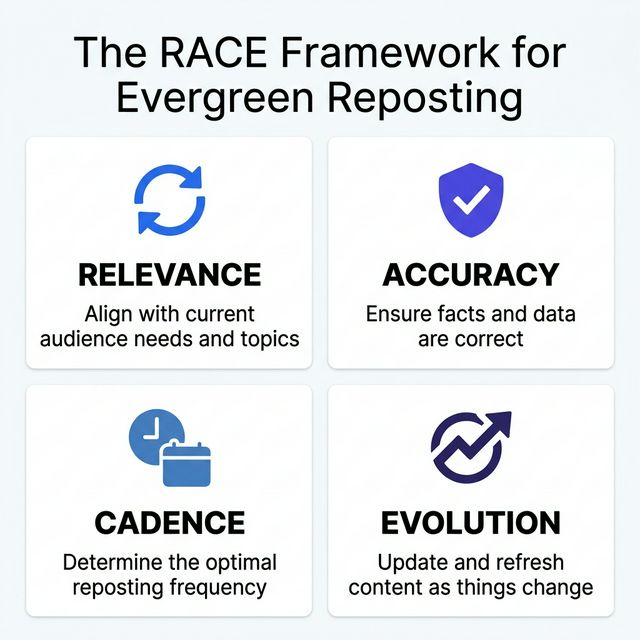
The RACE Framework: four criteria for deciding if content belongs in your repost queue.
When evergreen automation helps — and when it hurts
Evergreen automation helps when you already have useful content that is under-distributed. It hurts when teams try to automate material that has lost relevance or never had much value to begin with.
Use it when:
you have a backlog of accurate educational posts
your team needs consistency during low-production periods
one idea can be adapted across multiple channels
your audience repeatedly asks the same questions
you want to reduce manual scheduling overhead without lowering editorial standards
Do not use it when:
the post is tied to a launch, event, or short-lived trend
the data, screenshots, or CTA are outdated
the post is overly promotional or context-dependent
the asset is weak and unlikely to benefit from repetition
the team has no review process and no clear owner for queue quality
A practical example is the difference between a client onboarding checklist and a launch announcement. The checklist can return with new packaging because the problem remains stable. The announcement should usually stay out of the queue because its value expires quickly.
The main trade-offs to understand
Efficiency vs freshness: Reuse saves production time, but freshness is what keeps audiences attentive. A queue that only recycles can make a brand feel static, even if the topics are still relevant.
Consistency vs fatigue: Always-on distribution is useful for lean teams, yet repetition becomes more visible when the same examples, visuals, or angles resurface too quickly.
Automation vs judgment: Software can rotate posts, but it cannot reliably notice that a reference now feels dated, a topic has become sensitive, or a CTA no longer fits the market moment.
Scale vs nuance: The bigger your library becomes, the more tempting it is to standardize everything. But evergreen content still needs channel-aware editing. A concise LinkedIn lesson may need a stronger visual explanation as a carousel, while the same idea might work as a checklist on another channel.
The practical lesson is that evergreen reposting works best when teams treat it as distribution support for good content, not as a substitute for content strategy.
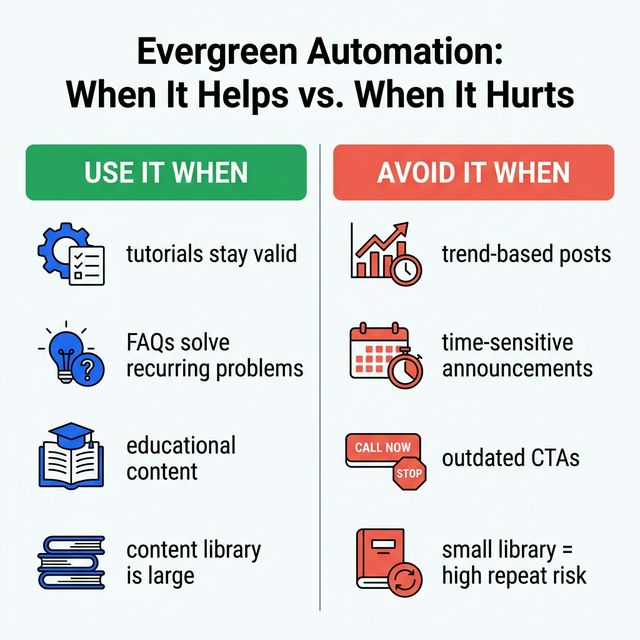
Evergreen automation works best for educational content — not for trend-based or time-sensitive posts.
Workflow: how to build a repost queue that stays useful
A reliable evergreen system needs a workflow, not a “set it and forget it” mindset.
1) Audit the library
Review published posts and separate true evergreen candidates from one-off pieces. Strong candidates include tutorials, objection handling, definitions, repeatable workflows, and customer education.
2) Set eligibility rules
Only queue posts that remain relevant, accurate, and aligned with current goals. This creates a clean backlog instead of a random archive.
3) Add variation rules
Change the hook, example, creative, format, or CTA before reuse. This keeps the core lesson while making the delivery feel current.
4) Define review rules
Re-check links, screenshots, product terms, and claims before re-entry. Evergreen content should be stable, but it still needs maintenance.
5) Define stop rules
Remove posts when the product changes, the framing becomes outdated, or the angle no longer fits your positioning.
Mini-example: a team reviews 20 older posts, keeps 6 as ready to recycle, updates 3 before reuse, and retires the rest. That is a healthier process than pushing all 20 into a blind rotation.
A practical weekly operating rhythm
Many teams make evergreen reuse harder than it needs to be. A simple weekly rhythm is often enough:
Monday: review older content and mark likely candidates
Tuesday: refresh copy, links, screenshots, and CTA where needed
Wednesday: assign assets to collections or categories
Thursday: schedule or queue approved variants
Friday: review what should stay in rotation, what should pause, and what should be retired
This rhythm matters because evergreen systems decay slowly. Problems usually do not show up as a dramatic failure. They show up as small quality losses: stale references, identical captions, too many posts in the same category, or a queue full of assets that made sense six months ago but no longer fit your offer.
A channel-specific rule that saves trouble
Do not assume a post should reappear unchanged just because the topic is evergreen. The topic may stay stable while the channel expectation changes.
For example:
a LinkedIn text post may need a stronger opening claim on its second cycle
a carousel may need fewer slides and a sharper summary
an educational Instagram post may need keyword-oriented copy instead of the exact same caption
That is the difference between content reuse and content drift. Reuse respects the original value. Drift happens when a queue system keeps publishing because it can, not because the asset still fits the context.
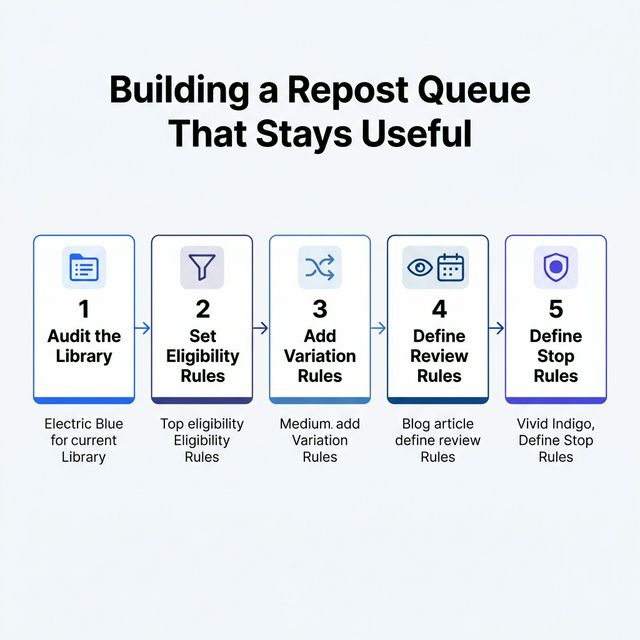
A governed repost queue follows five steps: audit, eligibility, variation, review, and stop rules.
Reposting vs repurposing vs cross-posting
These terms often get blurred, but they are not identical.
ApproachWhat it meansBest use caseMain riskRepostingRedistributing an existing post or lightly updated versionProven evergreen assetsvisible repetitionRepurposingTurning one idea into a new formatlong-form to short-form workflowsweak adaptationCross-postingPublishing similar content across multiple channelsmulti-channel consistencychannel mismatch
If you already turn one source asset into derivative formats, this is where a broader repurposing workflow matters. Tareno’s existing content ecosystem also covers related workflows like turning long-form material into publishable assets and adapting content across channels.
What to look for in evergreen reposting software
Buyers often compare tools on generic scheduling claims. That misses the point. For evergreen work, the better questions are operational.
Look for:
collections or sets instead of one flat queue
search and filtering for older published content
prioritization so the best assets surface first
repeat logic that avoids uncontrolled loops
cross-platform support for reuse beyond a single channel
backlog import so you can work with existing posts instead of rebuilding everything manually
A spreadsheet can be enough for a tiny queue, especially for a solo operator. But once a team needs category-based rotation, multi-channel reuse, and consistent review rules, manual overhead grows quickly.
Spreadsheet vs software: a realistic comparison
OptionWorks well forBreaks down whenBest forSpreadsheetvery small content libraries, one owner, simple cadencemulti-channel reuse, audit history, priority rules, larger backlogssolo operators or testing phaseScheduler with basic queuesimple recurring distributionweak variation controls, limited governance, little backlog structuresmall teams with modest evergreen useDedicated repost queue workflowstructured reuse, categories, prioritization, review logic, scalepoor source strategy or undefined editorial rulesteams treating evergreen reuse as an operating system
The point is not that every team needs complex tooling. The point is that queue quality becomes harder to manage once the library grows. Search, grouping, prioritization, and repeat logic are not luxury features in that environment. They are how teams keep reuse intentional.
That is where Tareno’s Repost Queue fits naturally. Internal product documentation confirms support for collections, search, prioritization, import of published posts, cross-platform destination publishing, and evergreen mechanics built for daily or batch reuse. The value is not that the tool “automates content strategy.” It is that it gives a structured execution layer once the strategy already exists.
Signs your current setup is no longer enough
You have likely outgrown a basic manual system if:
your team cannot quickly find strong older posts
the same few posts return too often because nothing is prioritized
channel-specific edits happen inconsistently
no one can clearly explain why a post is still in rotation
the queue contains too many promotional or outdated assets
Those are workflow problems, not merely scheduling problems. Software helps when it makes those decisions easier to govern and easier to audit.
Where Tareno Workflows Fit
Tareno is most useful when a team already understands what qualifies as evergreen and wants a cleaner way to operate that system without spamming their audience.
Here's what this looks like in practice with a tool like Tareno:
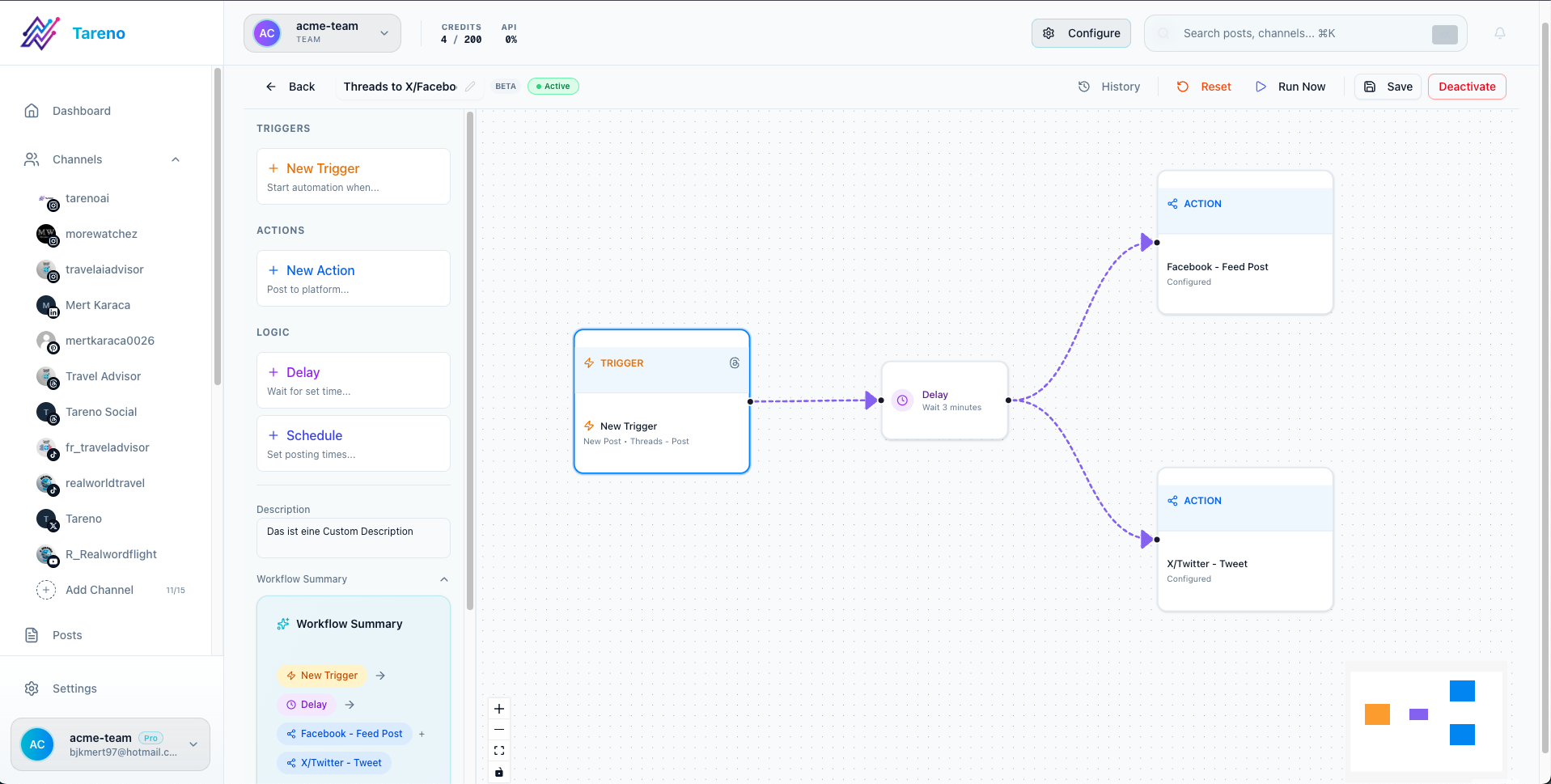
A practical fit looks like this:
- educational posts are grouped into specific topics
- higher-value assets receive deliberate priority
- already published content is imported into a visual node-based workflow
- editorial review happens before posts re-enter the queue
That positioning is intentionally conservative. No workflow can fix poor source material, weak messaging, or outdated claims. But a good visual automation builder can make strong content work harder over a longer period.
Connecting reposting with adjacent repurposing workflows helps, too. Instead of manually copying and pasting, teams use Tareno Workflows to define exactly which tags, on which channels, are pulled into the queue, so everything gets posted in a targeted, systematic way.
Common failure modes in evergreen reposting
Even teams with good intentions run into the same operational mistakes.
Reusing assets that were never strong in the first place
If a post did not solve a real problem or never had a clear angle, adding it to a queue usually multiplies the weakness instead of fixing it.
Treating every educational post as permanently reusable
Some educational content ages slowly, not never. Product workflows change. Examples become less persuasive. Screenshots become outdated. Evergreen should mean “worth revisiting with maintenance,” not “safe forever.”
Confusing content volume with content coverage
A queue full of slight variations on the same topic can still feel repetitive. Teams need topical breadth, not just more queue entries.
Forgetting business context
A post may remain useful at the topic level while no longer matching your current offer, positioning, or audience maturity. That is why stop rules matter as much as scheduling rules.
These failure modes are avoidable, but only if someone owns queue quality as an editorial responsibility.
FAQ
Is reposting old posts considered spam?
Not by default. It starts to feel spammy when the same copy returns too often, the content is outdated, or the repost ignores channel context. Controlled reuse with updates and spacing is different from blind repetition.
How often should you repost evergreen content?
There is no universal interval that fits every team. The right cadence depends on audience size, channel norms, publishing volume, and how large your evergreen library is. Smaller libraries need more caution because repetition becomes visible faster.
Do you need to rewrite the caption every time?
Not always completely, but some level of evolution is usually wise. A new hook, updated example, changed visual, or different CTA can make the same core idea feel fresh enough to earn attention again.
Which posts should never go into a repost queue?
Launch announcements, event reminders, expiring offers, reactive trend posts, and anything with outdated statistics or obsolete screenshots are poor candidates unless they are substantially revised first.
Is evergreen reposting the same as content repurposing?
No. Reposting usually means redistributing an existing asset or a lightly refreshed version. Repurposing means adapting the same idea into a different format, such as turning a blog post into a carousel, thread, or short video.
When does a team need software instead of a spreadsheet?
A spreadsheet can work for a small, simple queue. Software becomes more useful when you need searchable libraries, category-based rotation, prioritization, repeat logic, and coordinated reuse across channels.
Should every high-performing post become evergreen?
No. Performance alone is not enough. A post may have performed well because of timing, novelty, or a short-lived event. Evergreen qualification depends on whether the asset remains relevant and accurate after that initial moment has passed.
What is the biggest mistake teams make with repost queues?
Treating the queue like storage instead of editorial inventory. If teams keep adding posts without removing weak or outdated ones, the queue slowly fills with material that technically exists but no longer deserves attention.
Key Takeaways
Evergreen reposting is a content governance system, not a growth hack.
The safest queue rules are built around relevance, accuracy, cadence, and evolution.
Good automation extends the life of strong content; it does not rescue weak or outdated assets.
Reposting, repurposing, and cross-posting overlap, but each requires different editorial decisions.
The best tools support structure and control, while human judgment still decides what deserves another cycle.