TL;DR
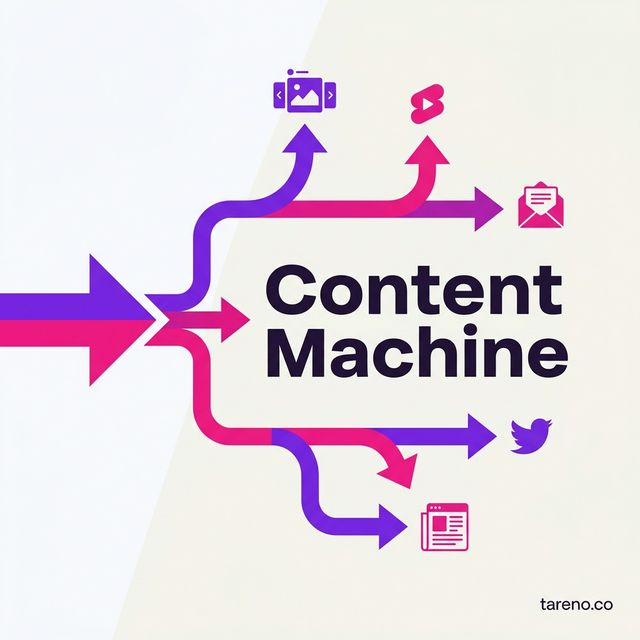
“Create once, post 20 times” only works when one strong source asset is translated into channel-specific derivatives, not copied into 20 near-identical posts.
The strongest repurposing systems follow a clear workflow: choose the right master asset, extract angles, adapt for platform fit, then schedule and reuse.
Not every asset deserves 20 outputs. Thin or highly time-sensitive content usually breaks under over-repurposing.
Multi-platform publishing can reduce operational friction, but it does not replace editorial judgment.
Evergreen content usually performs better as a refresh or remix than as a lazy repost.
Quick Definition
Content repurposing is the process of turning one high-substance source asset into multiple channel-appropriate derivatives without losing the core insight.
Omnipresence does not come from copy-paste distribution. It comes from systematic variation across angle, format, channel, and timing.
What “create once, post 20 times” actually means
The phrase sounds efficient, but it is useful only if you read it correctly. It is not a promise that one post should be blasted everywhere. It is a model for getting more value from one strong source asset.
A webinar can become a blog post, a set of short clips, a carousel, a FAQ series, and a newsletter section. That does not mean the content is repeated 20 times. It means one knowledge source is translated into different formats and audience contexts.
The distinction matters:
Cross-posting publishes the same or almost the same content across channels.
Repurposing changes the framing, format, hook, or use case while preserving the core idea.
Recycling brings existing content back later, often with a light update.
That is why omnipresence is often misunderstood. It does not mean looking identical everywhere. It means being visible in multiple relevant contexts without sounding repetitive.
The MAPS Framework: how a content machine actually works
To make repurposing practical, use the MAPS Framework:
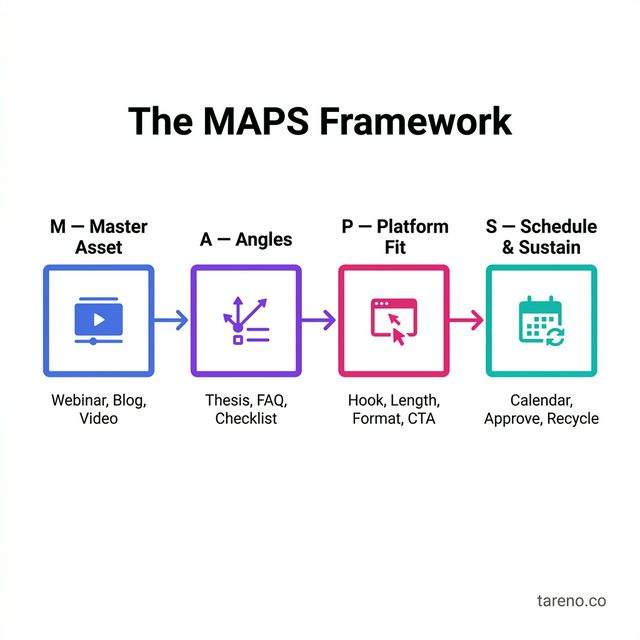
The MAPS Framework turns one strong source asset into multiple channel-appropriate derivatives.
M — Master Asset
A — Angles
P — Platform Fit
S — Schedule & Sustain
This order matters. Many teams start at the wrong end and ask how to get more posts out of one piece of content before checking whether the source is strong enough, whether the derivative angles are distinct, or whether the target channels need different packaging.
A real content machine works in the opposite direction: first confirm the source asset, then pull out the angles, then adapt for channel context, and only after that schedule publication and later reuse.
Step 1: Choose the right master asset
Not every piece of content can support a 1-to-20 workflow. If the source is too thin, too reactive, or too dependent on a single moment, multiplying it only multiplies weakness.
A good master asset has three traits:
Substance: more than one useful idea
Structure: clear steps, objections, examples, or themes
Shelf life: relevance beyond a short trend cycle
Strong master assets usually include webinars, podcasts, interviews, workshops, whitepapers, deep blog posts, and long-form videos. Weak master assets are usually short reactive opinions, novelty posts, and visual jokes with very little transferable meaning.
A practical rule helps here: if you cannot extract at least five clean takeaways from the source, expecting 20 quality outputs is probably unrealistic.
If you want a concrete example of how a long-form source can become a written asset, see how to turn video content into a structured blog article.
Step 2: Turn insights into angles
A common mistake is confusing fragmentation with strategy. Cutting one video into several clips is not automatically repurposing. It becomes repurposing when each derivative has a clear angle.
An angle is a distinct entry point into the same source material. It can be:
a thesis
a mistake list
a step-by-step process
a FAQ answer
an objection and rebuttal
a comparison
a checklist
a mini case
For example, one webinar on lead generation could produce these angles:
why teams automate too early
the three biggest approval mistakes
a workflow that turns one webinar into five touchpoints
when multi-platform publishing helps and when it does not
which ideas deserve evergreen reuse later
That is how teams create range without sounding repetitive. The source stays the same, but the reader entry point changes.
Step 3: Build platform fit instead of copying and pasting
Repurposing only works when the derivative matches the platform context. The same idea rarely works in the same package everywhere.
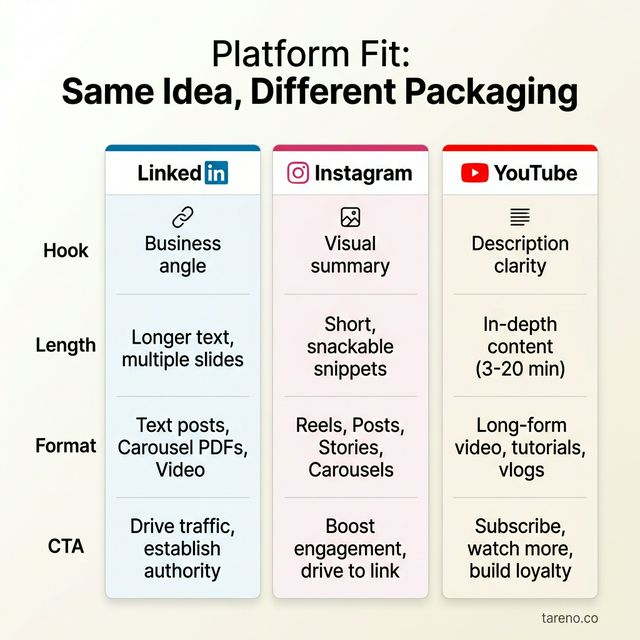
Platform fit means adapting hook, length, format, and CTA — not copy-pasting the same post.
Platform fit usually means adapting four elements:
Hook
Length
Format
CTA
One insight might become:
a sharp LinkedIn text post with a business angle
an Instagram carousel that compresses the key points visually
a YouTube description that helps viewers understand what the video covers
YouTube’s own help documentation emphasizes that descriptions should help viewers understand what a video is about. That supports a broader rule: content is not channel-ready just because it can technically be published across several platforms.
If you want a related internal read, see why platform fit is more than posting the same thing everywhere.
Step 4: Set up the publishing system
Until this point, repurposing is mostly editorial. After this point, it becomes operational.
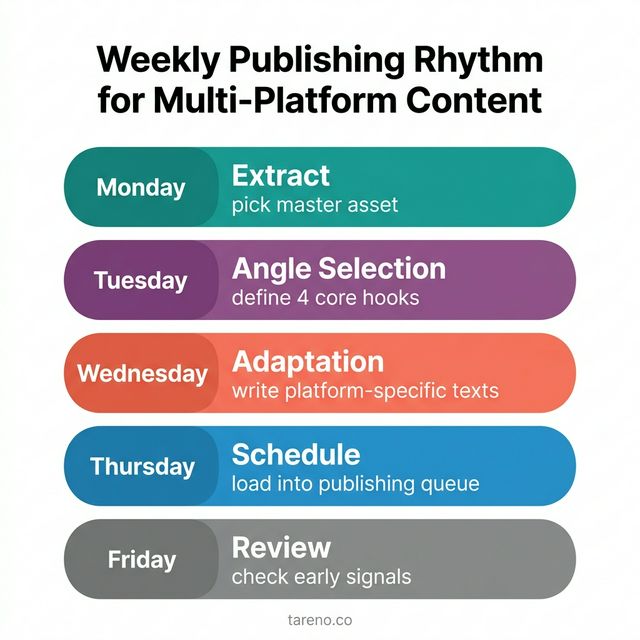
A basic weekly rhythm keeps multi-platform repurposing coordinated from approval to recycling.
As soon as one source asset produces several derivatives, teams run into practical questions:
who owns which version?
what is approved?
which variant goes to which channel?
what gets published first?
what should be reused later?
Without a system, teams usually fail in one of two ways: they underuse good source material, or they create a pile of loosely related content with no coordination.
A basic publishing system needs:
a shared calendar
clear ownership
approval checkpoints
version naming rules
channel and timing logic
A realistic weekly rhythm might look like this:
Monday: approve the master asset
Tuesday: extract angles and assign formats
Wednesday: finish channel-specific versions
Thursday: schedule publication in waves
Friday: review early signals and tag evergreen candidates
This is where Tareno fits naturally as an operations layer. The website presents features such as Multi-Platform Publishing, Team Workspaces, Content Boards, and workflow-related tooling. The safe conclusion is not that software makes strategy unnecessary. It is that a shared system can reduce friction between planning, approval, and scheduling when one asset branches into many derivatives.
Step 5: Recycle evergreen content intelligently
A lot of value appears after the first publishing cycle. Durable ideas can keep working if they are reused well.
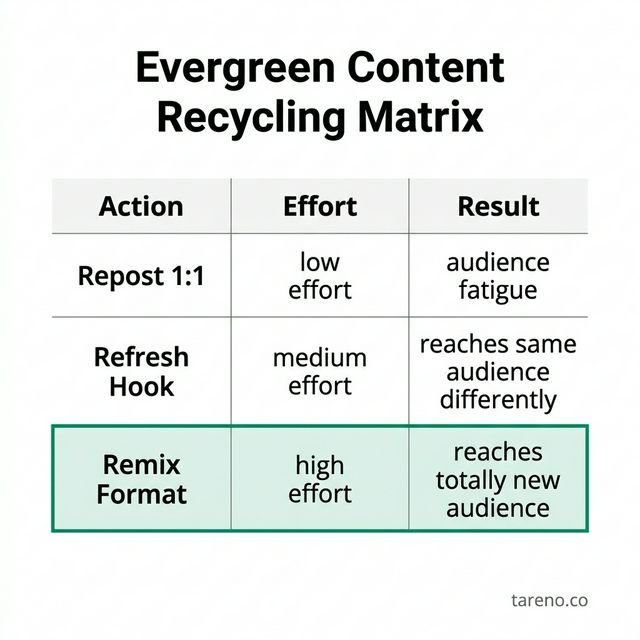
Refresh and remix usually outperform blind reposts — the idea stays, the wrapper changes.
Three terms matter:
Repost: publish the same asset again
Refresh: lightly update the asset
Remix: keep the idea but change the framing or format
For evergreen topics, refresh and remix are usually stronger than blind reposting. A useful how-to can return later with a new hook, a new format, or a different use case without feeling stale.
Example:
first release: LinkedIn text post on approval workflows
second release: carousel on five approval mistakes
third release: FAQ post
fourth release: short clip focused on one practical error
Evergreen reuse needs structure. Tareno’s website references a Repurposing Queue, which fits best here as a way to manage durable content that deserves another life in a different wrapper. Not every fresh post belongs in that queue.
For a related angle on long-life distribution, see how evergreen content keeps working in long-shelf-life channels.
When to use this model — and when not to
Use the 1-to-20 model when:
the topic includes several meaningful sub-questions
the source asset has real depth
your channels serve different jobs in the customer journey
your team can adapt content by context
the topic has evergreen value
Do not force it when:
the content is extremely time-sensitive
the source contains only one small idea
the value is mostly visual and does not transfer well
the team lacks bandwidth for adaptation
the channel fit is weak from the start
A B2B workflow explainer can support many derivatives. A quick meme reaction usually cannot.
Comparison: chaotic production vs a real content engine
ModelHow it worksQualityScalabilityTypical problemReactive chaosContent is created one post at a time under pressureInconsistentLowConstant reinventionPartial automation without systemContent is distributed widely with limited adaptationMediumMediumCopy-paste feelReal content engineOne master asset becomes angle-based, platform-fit derivatives with reuse rulesHighHighRequires discipline and setup
The middle state is common. Teams already have tools, maybe even automations, but no editorial operating model. In that case, software speeds up movement without improving substance.
A practical implementation workflow for teams
If you want to build the system without overcomplicating it, start with one pilot asset and one short operating rhythm.
Phase 1: Pick one pilot asset
Choose a source with obvious repurposing potential. Good candidates are:
a webinar that answers recurring client questions
a workshop recording with clear steps
a long-form interview with multiple arguments
a proven blog post that already contains several sub-points
The goal of the pilot is not to prove that you can publish everywhere. It is to prove that one source can generate several useful outputs without losing clarity.
Phase 2: Build a small angle map
Do not chase volume too early. Start with five angles:
one thesis
one mistake list
one FAQ answer set
one step-by-step breakdown
one example-driven post
This keeps the output varied enough to test the system while staying manageable.
Phase 3: Assign channel roles
Not every channel needs the same job.
One channel might be best for thought leadership.
Another might be stronger for searchable education.
Another might work better for lightweight reminders and repetition.
That means you should not ask every derivative to do everything. Some outputs exist to explain, some to attract, some to reinforce.
Phase 4: Create approval rules before you scale
Repurposing gets messy fast when version control is vague. Before you increase output, define:
who approves messaging
who checks platform fit
who owns the final schedule
which derivatives can be reused later
This is boring work, but it is the difference between a content engine and a content pile.
Phase 5: Review derivative quality, not just quantity
At the end of a cycle, ask:
which angle created the strongest response?
which format felt forced?
which channel needed more adaptation?
which assets deserve future refreshes or remixes?
That feedback loop is what makes the system smarter over time.
How to protect quality while increasing output
The biggest risk in repurposing is not technical failure. It is quality dilution.
To avoid that, keep four guardrails in place:
1. One derivative needs one clear job
If one post tries to educate, sell, summarize, and entertain all at once, it becomes vague. Give each derivative a primary role.
2. Keep source truth centralized
When facts, examples, and approved wording are scattered across notes and chats, inconsistencies multiply. One source asset should remain the editorial truth, and every derivative should stay traceable back to it.
3. Do not turn every point into a format
Just because one insight can become a clip does not mean it should. Some ideas belong in text. Some belong in visuals. Some are better kept inside the long-form asset.
4. Measure signal, not vanity volume
A system is improving when derivatives become more relevant, more reusable, and easier to produce cleanly. It is not improving just because the post count went up.
The most common repurposing mistakes
1. Copy-paste distribution
Cosmetic changes do not count as adaptation. If the insight, opening, and use case stay identical, the audience will feel the repetition.
2. Weak master assets
Thin source material produces thin derivatives. A better workflow cannot fix a bad input.
3. No angle map
If every derivative starts from the same point, the output quickly feels repetitive.
4. Ignoring platform fit
Teams lose relevance when they treat every channel as if user behavior were identical.
5. No feedback loop
If nobody checks which derivatives actually earn attention, the system never improves.
What a realistic 1-to-20 output looks like
A strong webinar or interview might realistically generate:
1 blog post
3 short clips
2 carousel concepts
4 text posts with different hooks
2 FAQ posts
1 newsletter section
1 checklist
1 mistake list
1 mini case
1 short post series
That is already a large output set. The better goal is not “hit 20.” It is “extract the right amount of value from a strong source without lowering quality.”
Where the 1-to-20 model usually fails
The model fails most often for reasons that have nothing to do with software.
Failure mode 1: the source asset was chosen for convenience, not quality
Teams often repurpose the asset they already have instead of the asset that deserves expansion. That creates a low-quality ceiling from the start.
Failure mode 2: every derivative sounds like a summary
If all outputs repeat the same talking points in slightly different wrappers, the system produces noise rather than coverage. Each derivative needs a reason to exist.
Failure mode 3: the team never defines what “good” looks like per channel
A strong carousel, a strong short clip, and a strong search-oriented article are not judged by the same standard. Without channel-specific quality criteria, review becomes subjective and inconsistent.
Failure mode 4: evergreen and campaign content get mixed together
Fresh launch content and durable educational content should not follow the same reuse logic. If everything is treated as evergreen, the audience gets stale repetition. If nothing is treated as evergreen, useful assets die too early.
Failure mode 5: the system has no stop rule
Some teams keep squeezing new formats out of the same source long after the useful angles are gone. A mature repurposing process knows when an asset is exhausted.
A simple decision matrix before you repurpose
Before you commit to a larger derivative set, check the source asset against four questions:
Does it contain multiple standalone insights?
If no, do not force scale.
Can those insights support different audience entry points?
If no, the outputs will feel repetitive.
Do your channels play different roles?
If no, you may only need a few versions rather than a full machine.
Do you have the operational capacity to adapt and review properly?
If no, reduce the derivative count until quality is sustainable.
This matrix keeps the article’s core promise honest. Repurposing is leverage, but only when the source, the angles, the channels, and the workflow are all strong enough to support it.
What to measure after publishing
A repurposing system improves only if the team learns from each derivative cycle. That does not require complex attribution models at the start, but it does require consistent review.
Look at four practical signals:
Derivative usefulness: which angles actually generated saves, replies, or follow-up questions?
Format fit: which ideas worked in text, and which clearly needed visual or video treatment?
Operational friction: where did approvals, handoffs, or scheduling slow the cycle down?
Reuse potential: which outputs still feel durable enough to refresh or remix later?
This matters because the best content engine is not the one that publishes the most. It is the one that gets better at choosing source assets, choosing angles, and choosing where reuse is worth the effort.
Where Tareno fits in this workflow
A multi-platform strategy breaks down quickly when you have to open five different apps just to adapt one core asset. Tareno becomes relevant exactly when the bottleneck shifts from ideation to operation—managing several channels, preparing multiple hook variants, and actually scheduling them without losing track.
Here's what this looks like in practice with a tool like Tareno:
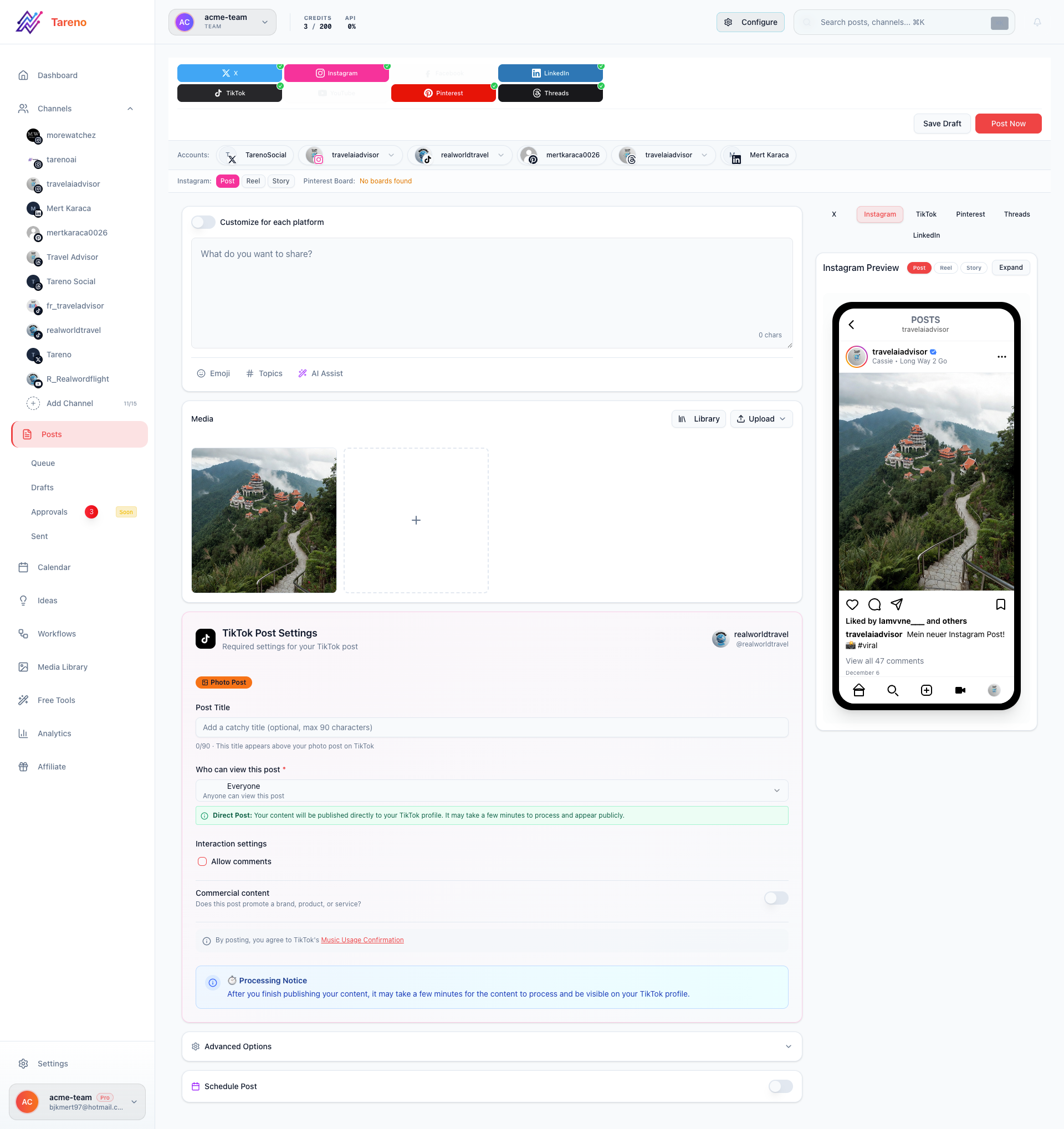
Tareno acts as an execution layer around publishing, workflow control, and managed reuse. It is most useful after the team already understands how to choose strong source assets, map angles, and adapt content for different channel contexts.
That distinction matters because tools can reduce friction, but they do not create substance. If the source asset is weak or the derivatives are lazy, publishing faster only spreads the problem further.
FAQ
Is content repurposing the same as cross-posting?
No. Cross-posting distributes the same post. Repurposing adapts the same idea into different formats, hooks, or contexts.
Do I need a different version for every platform?
Not always, but most channels need at least a different hook, compression level, or format logic if the content is supposed to feel native.
What makes a good master asset?
A good master asset contains multiple useful insights, clear structure, and a shelf life longer than a short trend burst.
How often can I reuse evergreen content?
There is no universal cadence. The right timing depends on audience overlap, freshness of framing, and whether the content still solves a live problem.
When is a tool worth it?
A tool becomes worth it when coordination, approvals, scheduling, and evergreen reuse create more friction than the content creation itself.
Can a solo creator use this system?
Yes. The scale is smaller, but the logic still works. One person can still think in master assets, angles, platform fit, and reuse.
What is the biggest repurposing mistake?
Treating every derivative as a cosmetic rewrite of the same post.
Do I really need 20 outputs?
No. The number is a metaphor for leverage, not a mandatory quota.
Key Takeaways
Omnipresence is a system result, not a distribution trick.
One strong source asset is more valuable than many weak standalone posts.
Angles are what create range; platform fit is what creates relevance.
Tooling matters most when operations become the bottleneck.
Evergreen content should be managed deliberately, not reposted blindly.
Conclusion
A real content machine does not start with volume. It starts with a strong source asset and a disciplined process for turning that source into useful derivatives.
The phrase “create once, post 20 times” is attractive because it promises leverage. The useful version of that promise is real, but only when teams stay honest about the limits. A weak source asset will not become strong through distribution. A generic derivative will not become relevant just because it appears on another platform. And a tool will not fix a workflow that has never been clearly defined.
If you want a practical first step, do not aim for 20 outputs tomorrow. Start with one high-substance asset, map five real angles, adapt them for two or three channels, and see where your workflow begins to break. That is the moment when a publishing system becomes useful.