
TL;DR
Instagram discovery usually responds better to clear keyword context than to large hashtag stacks.
The strongest keyword surfaces are profile name, bio, caption lead, on-screen text, and topic consistency across posts.
Hashtags still matter, but mainly as secondary classification and campaign support signals.
Real improvement requires batch testing with fixed review windows and predefined decision thresholds.
Authority growth comes from clustered topical publishing, not isolated post-level optimization.
Quick Definition
Instagram SEO is the practice of structuring profile and post content so Instagram can correctly interpret topic relevance and match content to user intent. In practical terms, keywords often outperform hashtag-only strategies because they appear in higher-context fields where meaning is clearer and less noisy.
Why This Topic Is Confusing for Most Teams
The market conversation around Instagram SEO is usually distorted by absolutist claims. One side says hashtags are obsolete. The other says hashtags are still the core growth lever. Both are incomplete.
What teams actually need is a signal hierarchy. Once you distinguish primary meaning signals from secondary categorization signals, execution becomes easier.
Mini-example:
If a post is about “Instagram SEO for coaches,” that phrase placed naturally in profile name context, bio framing, and caption lead gives Instagram stronger semantic confidence than generic tags like #marketingtips used without contextual language.
Signal Hierarchy: Primary vs Secondary Discovery Inputs
Primary signals (high-context)
Profile name relevance
Bio intent framing
Caption lead language
On-screen text alignment
Topic consistency across recent posts
Secondary signals (support context)
Hashtag layering
Campaign tags
Trend tags in niche boundaries
Weak signals when isolated
Long hashtag lists without semantic caption context
Broad tags disconnected from post intent
Keyword stuffing that destroys readability
Trade-off:
A highly optimized keyword structure can increase search-fit visibility but reduce engagement if captions read unnaturally. The best-performing posts preserve human readability while maintaining semantic precision.
Where Keywords Should Actually Be Placed
A keyword strategy fails when placement is random. Use a fixed placement architecture.
1) Profile Name
Include one intent-rich phrase that reflects what you help with.
Scenario:
“Lena | Instagram SEO for Coaches” creates clearer search association than “Lena Digital Lab” if the account goal is discovery for SEO-related coaching.
2) Bio
Use bio text to define audience + transformation + context.
Scenario:
“Helping creators improve Instagram search visibility with keyword-first content systems.”
3) Caption Lead (first lines)
Place the primary phrase early and naturally.
Scenario:
“Instagram SEO for local businesses works best when profile naming, caption intent, and on-screen text align to one service query.”
4) On-screen Text
Use concise topic labels that match spoken or visual narrative.
5) Series-Level Consistency
One optimized post rarely builds durable authority. A 4–8 post cluster on related queries usually performs better than disconnected single experiments.
Decision rule:
Optimize systems, not one-off posts.
Hashtags in 2026: Still Useful, Just Not Primary
Hashtags remain useful in a narrower role.
Good use cases
campaign grouping
niche context reinforcement
event/topic bundling
Poor use cases
replacing weak caption context
spraying broad tags for random reach
using 20+ tags without strategic relevance
Counterargument:
Some creators still report hashtag-driven spikes.
Response:
Short-term spikes can happen, but spikes are not systems. For business reliability, keyword clarity + intent fit + series consistency usually produces more stable outcomes.
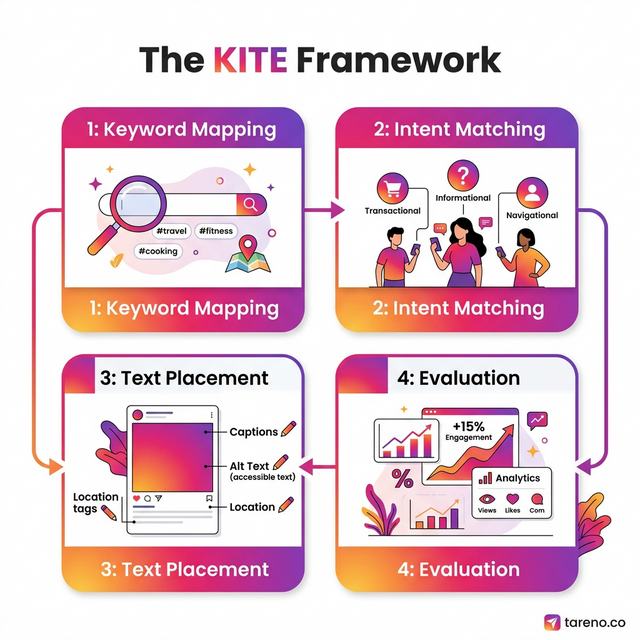
The KITE Framework for Execution
The KITE Framework in Practice
K — Keyword Mapping
Assign one primary query phrase and 2–3 support terms per post.
I — Intent Matching
Label each post by intent type: tutorial, checklist, mistakes, comparison, or myth-break.
T — Text Placement
Place terms in profile/caption/visual hierarchy where Instagram can interpret context.
E — Evaluation
Run fixed review cycles and keep only repeatable patterns.
Mini-example:
Primary term: “instagram seo strategy.”
Support terms: “caption intent,” “profile optimization,” “search visibility.”
14-Day Controlled Testing Protocol
Step 1: Define one hypothesis
Example: keyword-first caption leads increase search-origin impressions for educational Reels.
Step 2: Build matched batches
Batch A: keyword-first captions + layered hashtags
Batch B: hashtag-heavy captions + weaker keyword leads
Step 3: Hold key variables stable
Same topic cluster, similar format, similar posting rhythm.
Step 4: Measure fixed metrics
search-origin impressions
non-follower reach quality
saves
shares
profile visits
Step 5: Decide with thresholds
Keep only patterns that repeat across batches, not one-off wins.
Edge case:
If account size is very small, signal variance is high. Use at least two rounds before making process-level decisions.
Decision Boundaries by Account Type
Creator education accounts
Prioritize intent-rich captions and series-based topic clusters.
Local service businesses
Prioritize profile naming + geo-intent language in bio and caption leads.
E-commerce brands
Balance product discovery phrases with category and problem-language clusters.
Personal brand consultants
Use expertise framing terms consistently across profile and post narratives.
Trade-off:
Highly specific terms improve relevance but can narrow broad viral exposure. Choose based on business objective: conversion quality vs raw reach.
Common Failure Patterns and Specific Fixes
Failure 1: Keyword stuffing
Symptom: awkward captions, weak comment quality.
Fix: one primary phrase, natural sentence flow, support terms only where contextually useful.
Failure 2: Broad hashtag dependency
Symptom: unstable reach and poor audience fit.
Fix: reduce tag count, increase contextual caption clarity.
Failure 3: No profile-level optimization
Symptom: posts perform inconsistently despite good hooks.
Fix: align profile name and bio with primary service/topic query.
Failure 4: Topic hopping
Symptom: poor semantic authority and low repeat discovery.
Fix: publish 4–8 post query clusters before switching thematic lane.
Failure 5: Emotional analytics
Symptom: process changes after every post.
Fix: weekly review cadence with predefined keep/kill criteria.
Authority Layer: Build Query Clusters, Not Single Posts
A keyword-first strategy becomes authority-grade only when it scales into cluster architecture.
Cluster model
Foundation query
Workflow query
Mistake query
Comparison query
Diagnostic query
Advanced optimization query
Why this works
Clusters increase semantic coherence, strengthen internal audience memory, and improve cross-post discovery consistency.
Scenario:
A creator teaching social automation can publish a mini-cluster: “instagram seo basics,” “caption keyword system,” “hashtag layering,” “profile naming mistakes,” “search diagnostics,” and “30-day optimization loop.”
Measurement Framework for Teams
Leading indicators
search-origin impressions
non-follower reach relevance
saves and shares per topic cluster
Diagnostic indicators
profile action rate from optimized posts
comment quality (questions vs generic reactions)
repeat view behavior on query-consistent series
Lagging indicators
inquiry quality from Instagram profile
assisted conversion behavior from profile link traffic
Decision rule:
If discovery improves but conversion quality drops, adjust keyword specificity and CTA fit rather than increasing posting volume.
Governance for Multi-Writer Teams
When multiple people write captions and scripts, strategy drift is the hidden performance killer.
Governance checklist
shared keyword map per cluster
approved caption opening templates by intent
on-screen text style rules
weekly review ownership
failed-test archive with lessons
Practical implementation
Assign one role for intent QA, one for clarity QA, and one for results QA. Split ownership reduces blind spots and avoids single-review bottlenecks.
Comparison: Keyword-First vs Hashtag-Heavy vs Hybrid
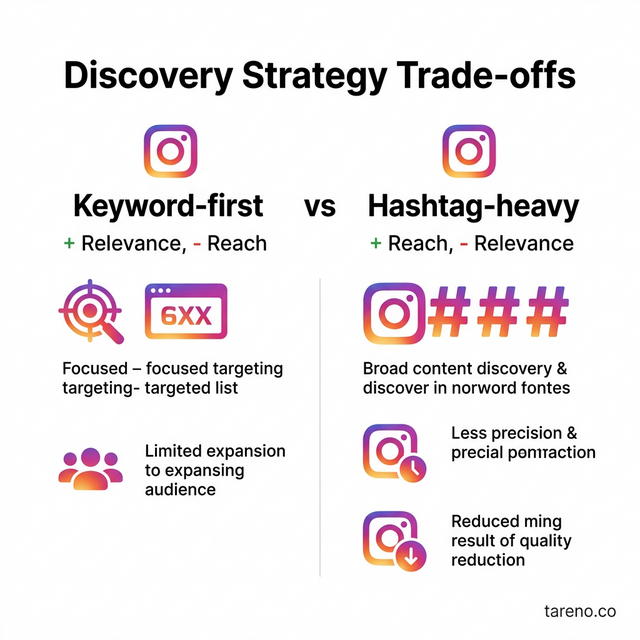
ApproachStrengthLimitationBest Use CaseKeyword-firstStrong intent matching and stable discoveryRequires editorial disciplineauthority growth and predictable search-fit reachHashtag-heavyFast deploymentWeak semantic controlcampaign tagging and short-term categorizationHybridBest balance of clarity and categorizationNeeds process rigormost creator/business accounts
Tools for Execution
Instagram Insights [SOURCE: https://help.instagram.com/788388387972460]
Keyword Tool (Instagram) [SOURCE: https://keywordtool.io/instagram]
Canva [SOURCE: https://www.canva.com]
Google Sheets [SOURCE: https://workspace.google.com/products/sheets/]
Use tools as workflow enablers, not substitutes for strategic clarity.
FAQ
Are hashtags dead?
No. They still help with categorization and campaign grouping. They become weak only when used as a replacement for clear keyword context.
Where should keyword optimization start?
Start with profile name and bio, then caption lead and on-screen text. This gives Instagram a coherent identity and post-level intent signal.
How many keywords per post?
One primary phrase plus 2–3 support terms is usually enough. More terms often reduce clarity.
Can keyword optimization reduce engagement?
Yes, if wording becomes robotic. Keep natural language and prioritize readability.
How long should testing run?
Use fixed review windows such as 14 days with matched batches and predefined thresholds.
Should hashtags be removed completely?
Usually no. Keep a focused supporting set while maintaining keyword-first structure.
Advanced Scenarios by Business Model
Scenario A: Local service business
A local business usually benefits from geo-intent language and service specificity. Generic hashtags may add visibility noise, but profile and caption keywords tied to actual service queries improve qualified discovery.
Example setup:
Profile name: “Dental Studio Berlin | Invisalign & Smile Design”
Bio phrase: “Helping Berlin professionals improve smile confidence with modern aligner plans”
Caption lead: “Invisalign consultation in Berlin: 3 things to check before booking.”
Decision boundary:
If your business depends on local bookings, prioritize location-intent terms over broad global hashtag stacks.
Scenario B: Personal brand educator
Education creators need query consistency and format clarity. A keyword-first system works best when each content cluster maps to one skill problem.
Example cluster:
“Instagram SEO basics”
“Profile keyword setup”
“Caption intent templates”
“Hashtag layering mistakes”
“Search diagnostics workflow”
Trade-off:
High specificity may reduce broad viral reach but often increases trust and conversion relevance.
Scenario C: E-commerce brand
Product-focused brands need to combine category terms, use-case language, and outcome framing. Hashtags can support categorization but cannot replace keyword-rich product context.
Example approach:
Use primary terms tied to product problem-solving (“summer acne-safe SPF routine”) rather than generic category tags only.
Scenario D: Agency account
Agencies often publish mixed-topic content and lose semantic focus. A keyword-first authority strategy requires service-line clusters.
Fix:
Segment content by vertical or service lane and avoid mixing unrelated campaign examples inside one sequence.
Edge Cases That Break Naive SEO Advice
Edge case 1: High entertainment niche
In meme-heavy niches, discovery may look hashtag-influenced because trend tags match high-velocity audience behavior. Yet even here, clear keyword context improves profile-level conversion intent.
Edge case 2: New accounts with low baseline data
Small accounts can produce noisy results where one post looks conclusive. Use wider test windows and avoid process changes based on single-post spikes.
Edge case 3: Multilingual audiences
If audience language differs by region, keyword mapping must include linguistic variants. Blindly applying one-language hashtag sets weakens intent fit.
Edge case 4: Seasonal campaigns
Seasonal terms can inflate reach temporarily. Treat seasonal wins separately from evergreen keyword systems to avoid false process assumptions.
Trade-Off Matrix for Practical Decision-Making
Keyword vs Hashtag Trade-offs for Instagram SEO
ChoiceBenefitCostBest UseHigh specificity keywordsBetter relevance and conversion fitSmaller broad-reach potentialservice or intent-driven accountsBroad discovery framingPotentially larger top-of-funnel exposureLower intent qualityawareness campaignsHeavy hashtag useFast deployment and campaign groupingweak semantic controlshort-term event pushesKeyword-first hybridBalanced discoverability and clarityneeds editorial disciplinelong-term authority growth
The purpose of this matrix is not to pick one universal winner. It is to reduce decision confusion by making trade-offs explicit before publishing.
30-Day Operational Plan for Authority Growth
Week 1: Baseline setup
define primary query clusters
align profile and bio terms
establish first caption templates by intent class
Week 2: Controlled publishing batch
publish matched posts by cluster
log placement differences and early diagnostics
Week 3: Review and correction
compare search-origin and non-follower quality indicators
remove weak structures and preserve repeat winners
Week 4: Scale with constraints
increase output only for stable formats
keep one controlled experiment lane open
Rule:
Scale proven structures, not assumptions.
Editorial Checklist for Human-Looking, SEO-Safe Captions
Does the first line contain a clear intent phrase?
Would a human understand the value promise in under five seconds?
Are support keywords integrated naturally?
Does on-screen text reinforce the same topic?
Are hashtags relevant and proportionate?
Is the post connected to a topic cluster pathway?
If two or more checks fail, revise before publishing.
Diagnostic Playbook When Results Drop
Symptom: Reach is stable, conversion intent is weak
Likely cause: keywords are broad but not buyer-relevant.
Fix: tighten phrase specificity and CTA alignment.
Symptom: Reach drops after optimization
Likely cause: over-optimized robotic caption style.
Fix: keep keyword meaning, rewrite with natural sentence rhythm.
Symptom: Good one-week results, weak month-long consistency
Likely cause: no cluster continuity or inconsistent publishing context.
Fix: commit to cluster sequence before changing thematic lane.
Symptom: Saves low despite impressions
Likely cause: content is informative but not actionable.
Fix: add checklist format and explicit implementation steps.
Advanced Governance Metrics for Authority Teams
To keep Instagram SEO quality stable over time, teams should track governance metrics in addition to content metrics.
Governance KPIs
percentage of posts with complete keyword placement map
percentage of posts passing readability review without major edits
percentage of posts with clear intent tag before publication
percentage of weekly decisions documented with threshold rationale
These KPIs do not replace reach metrics, but they reveal process health. A team with weak governance often gets volatile outcomes even when individual posts seem strong.
Quarterly Optimization Framework
Authority growth is usually won in quarterly cycles, not week-by-week reactions.
Quarter planning structure
Retain high-performing query clusters.
Sunset underperforming topic lanes.
Introduce one experimental sub-cluster.
Update keyword maps and caption templates.
Recalibrate hashtag layering by niche behavior.
Why quarterly framing helps
Short windows are good for tactical fixes. Quarterly windows are better for strategic recalibration and avoiding endless tactical churn.
Scenario:
If educational checklist posts consistently outperform motivational opinion posts in non-follower discovery and profile action quality, the next quarter should allocate more production capacity to checklist and comparison cluster formats.
Risk Control: Preventing Over-Optimization
A mature Instagram SEO workflow includes explicit brakes against over-optimization.
Red flags
captions start sounding interchangeable
creators lose brand voice in pursuit of keyword density
every post uses the same hashtag stack regardless of topic
decision logs only track reach, not intent quality
Control actions
rotate opening structures by intent class
enforce natural-language edit pass before publish
require one unique supporting term per post
include “do-not-use” rules for each cluster
These controls protect both discoverability and brand credibility.
Final Pre-Publish Authority Check
Before publishing an authority-grade Instagram SEO article, run a strict final check:
Does the first screen provide immediate utility for the query?
Does each core section include at least one mini-example and one decision rule?
Are hashtags framed as secondary support rather than primary discovery engine?
Is the keyword placement logic explicit across profile, bio, caption, and visual text?
Are test methods and thresholds clear enough for team replication?
If two or more answers are “no,” the article should not move to final. This simple rule prevents weak pages from being marked complete under schedule pressure. It also protects long-term authority by making consistency measurable instead of subjective, especially when multiple contributors rotate across the same content cluster.
Key Takeaways
Keywords generally outperform hashtag-only tactics because they live in stronger semantic fields.
Hashtags still matter as secondary context signals when used strategically.
Profile name, bio, caption lead, and visual text should align around one intent theme.
Batch testing with fixed windows is essential for reliable improvement.
Authority growth comes from topic clusters, governance, and repeatable decision rules.
Long-term wins come from disciplined review cadence, not isolated tactical spikes consistently.
Final Implementation Checklist
Define one primary query and support terms for each post.
Align profile and post-level text signals to the same intent.
Use layered hashtags as support, not as core strategy.
Run matched test batches and decide via thresholds.
Publish in clusters to build semantic authority.
Document wins/fails so the process compounds over time.