TL;DR
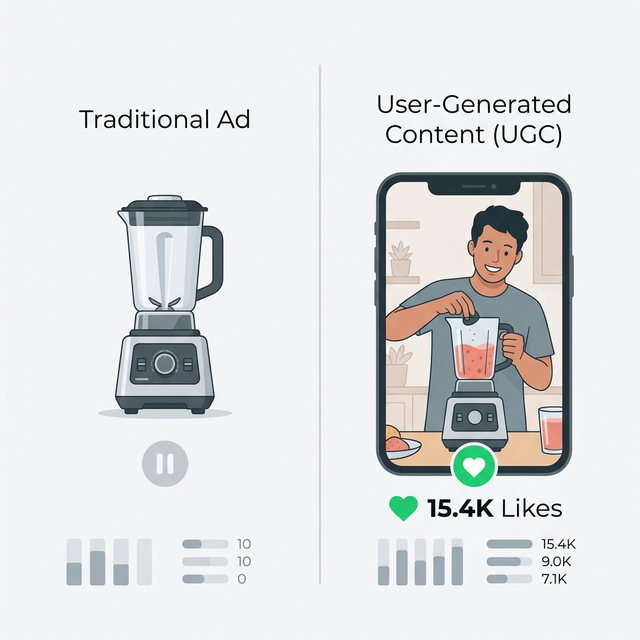
UGC became popular because it appears to solve a real brand problem: trust deficit. In crowded markets, polished brand messaging often feels less credible than authentic user perspective.
Counterargument: “If authenticity is the goal, we should publish as much raw UGC as possible.”
Trade-off: raw volume can increase apparent authenticity but reduce coherence, quality, and conversion clarity.
Edge case: creator-native categories can tolerate rougher aesthetics if narrative relevance remains high.
Concrete scenario: a brand posts many user clips with no strategic structure. Engagement looks healthy, but conversion quality drops because users receive mixed positioning signals.
Common misconception: more UGC automatically equals more trust. Trust depends on signal quality and placement logic.
Takeaway: UGC popularity reflects a real trust need, but execution quality determines value.
Takeaway: Authenticity without structure can weaken brand outcomes.
The TRUST Loop Framework
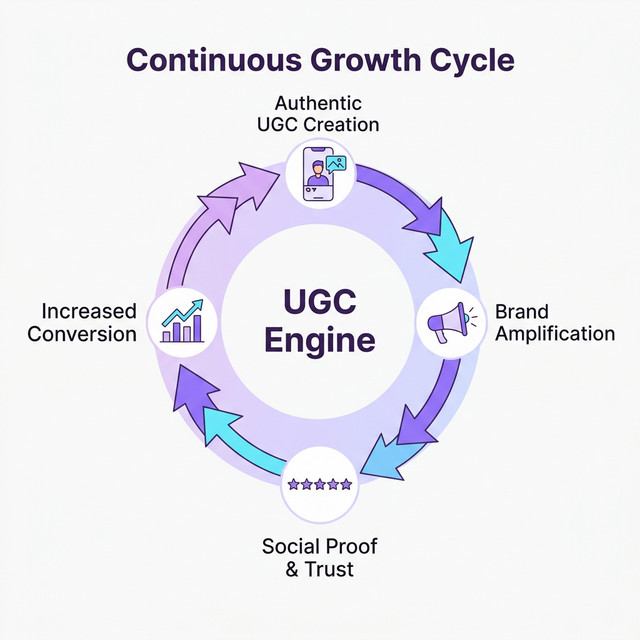
Use TRUST Loop to operationalize UGC:
T — Target Context: Where in the decision journey is UGC needed?
R — Relevance Fit: Does this UGC match audience objections and use cases?
U — Use Permission: Is usage rights scope clear and documented?
S — Signal Quality: Is the content believable, specific, and useful?
T — Translation Layer: Is UGC framed so users understand why it matters now?
Counterargument: “Frameworks make UGC feel manufactured.”
Trade-off: over-engineering can reduce spontaneity, but no framework leads to random asset use and message drift.
Edge case: fast product drops may use lightweight TRUST checks, then retroactively curate for evergreen use.
Concrete scenario: team maps top customer objections, then selects UGC clips that directly address each objection. UGC becomes conversion-supportive, not decorative.
Common misconception: UGC should “speak for itself.” Usually, it needs strategic framing.
Takeaway: TRUST Loop turns UGC from tactic into trust infrastructure.
Takeaway: Framed relevance beats raw authenticity noise.
Where UGC Creates Real Value
1) Objection Handling
UGC can reduce skepticism when users see realistic outcomes from peers.
2) Category Education
UGC examples can make product usage concrete and less abstract.
3) Decision Confidence
Social proof can lower risk perception near conversion points.
4) Community Signaling
Consistent UGC participation can signal active product-market resonance.
Counterargument: “Professional testimonials perform just as well.”
Trade-off: polished testimonials improve brand control, but may reduce perceived neutrality.
Edge case: high-ticket B2B may need hybrid proof systems: expert authority + selected customer narratives.
Concrete scenario: a brand uses UGC in ad creatives and product pages but adds concise context labels (“Use-case,” “Result type,” “Environment”) to improve interpretation.
Common misconception: UGC value is only top-of-funnel. It can be strong mid- and bottom-funnel when matched to objections.
Takeaway: UGC is strongest when mapped to specific trust gaps.
Takeaway: Context labeling significantly improves UGC usefulness.
Where UGC Fails (and Damages Trust)
Failure 1: Generic praise without specifics
Failure 2: Low relevance to target audience
Failure 3: Inconsistent visual or message quality
Failure 4: Rights ambiguity
Failure 5: Over-automation in sourcing and publishing
Counterargument: “Even weak UGC is better than no UGC.”
Trade-off: weak UGC can fill feed space, but may lower perceived product seriousness.
Edge case: early-stage brands with little content supply may use lighter UGC standards temporarily, but should raise quality thresholds quickly.
Concrete scenario: a brand features broad “love this product” clips with no use-case context. Trust impact stays shallow because viewers cannot map claims to their own needs.
Common misconception: authenticity excuses irrelevance.
Takeaway: Bad UGC is not neutral; it can dilute positioning.
Takeaway: Selection standards matter as much as collection volume.
Tool Evaluation Rule (3 Categories × 3 Criteria)
Category 1: UGC Collection Workflow
rights/permission tracking clarity
submission quality filters
contributor metadata consistency
Category 2: Curation & Publishing Ops
Draft -> Review -> Scheduled support
Approval status visibility
placement tagging by funnel stage
Category 3: Performance & Trust Signals
content relevance tracking
objection-resolution signal quality
reuse value across channels
Counterargument: “UGC can be managed in DMs and folders.”
Trade-off: this works at very low scale; quickly breaks when teams grow or channels expand.
Edge case: solo operators can stay manual if they enforce strict naming, rights notes, and review cadence.
Concrete scenario: team introduces curation tags by objection category. UGC reuse improves across ads, landing pages, and email.
Common misconception: tool complexity creates UGC quality. Process design creates quality.
Takeaway: Use tools to enforce curation logic, not to collect more noise.
Takeaway: Trust-relevant tagging is a strategic advantage.
UGC Governance Model (Brand-Safe and Scalable)
Minimum governance stack:
rights confirmation checklist
relevance scoring rubric
brand-risk review for claims and visuals
owner + reviewer assignment
monthly archive cleanup of low-signal assets
Counterargument: “Governance slows social speed.”
Trade-off: loose governance can move faster early, but increases long-term inconsistency and legal uncertainty.
Edge case: campaign windows may use rapid mode with predefined safe templates and post-campaign audit.
Concrete scenario: brand defines three approval tiers (green/yellow/red). Green assets flow fast, yellow requires context labels, red is archived. Throughput stays high, quality improves.
Common misconception: governance is anti-authentic. Governance protects authenticity from becoming chaos.
Takeaway: UGC governance should be lightweight but explicit.
Takeaway: Trust compounds when curation standards are consistent.
Implementation Blueprint (30-Day UGC Upgrade)
Week 1: Audit and classify
inventory existing UGC
map to funnel stage and objections
remove low-signal duplicates
Week 2: Build curation rubric
define quality criteria
define rights checklist
set placement rules per channel
Week 3: Deploy across key surfaces
ads, landing pages, social posts, onboarding snippets
monitor qualitative trust signals
Week 4: Review and optimize
keep high-signal assets
retire low-fit assets
update contributor brief templates
Counterargument: “A month is too short for trust outcomes.”
Trade-off: deep trust effects take longer, but 30 days is enough to detect operational fit and quality lift.
Edge case: low-volume brands may need longer cycles due to limited sample flow.
Concrete scenario: after 30 days, brand reduces UGC volume but improves relevance. Conversion support quality rises even with fewer assets.
Common misconception: UGC strategy means continuous expansion. Often the best move is strategic reduction.
Takeaway: Better UGC strategy is usually selective, not additive.
Takeaway: Operational fit precedes performance scale.
Free Tools (Quick Links)
UGC Brief Generator — Create cleaner creator/customer brief prompts for useful submissions.
Rights & Consent Checklist — Keep usage permissions organized before publishing.
UGC Relevance Scorer — Evaluate if an asset matches funnel stage and objections.
UGC Placement Planner — Map each approved asset to ad, landing, social, or lifecycle touchpoint.
FAQ
Is UGC still worth it for brands?
Yes, when curated for relevance and integrated into a structured trust strategy.
Can UGC replace brand-created content?
Usually no. UGC works best as a trust layer, not the entire content system.
What is the biggest UGC mistake?
Publishing high volume without curation standards and context framing.
Does UGC always improve conversion?
Not automatically. Improvement depends on relevance, placement, and message fit.
How many UGC assets should a brand run?
Enough to cover key objections and funnel stages—quality over quantity.
Do small teams need governance for UGC?
Yes, even a lightweight rubric and rights checklist reduce major risks.
Conclusion
UGC is neither a magic trust switch nor empty hype. It is a high-leverage trust mechanism when run as a system. Brands that combine rights clarity, relevance curation, and placement strategy can turn UGC into a durable competitive asset.
Key Takeaways
UGC effectiveness is driven by relevance and framing, not volume.
TRUST Loop helps operationalize high-quality UGC decisions.
Governance protects trust quality as output scales.
Selective curation usually outperforms bulk publishing.
UGC is strongest as part of a broader authority system.
Audio Version