TL;DR
Mismatched expectations and unstructured feedback cause 80% of content delays.
To cut review cycles in half, establish single-source-of-truth approvals. Stop taking feedback via email, Slack, and WhatsApp concurrently.
Not all content needs the same review. Apply the 3 Tiers of Content Risk to speed up routine posts.
Use the F.L.O.W. Framework to govern the review process (Focus, Limits, Ownership, Window).
Quick Definition
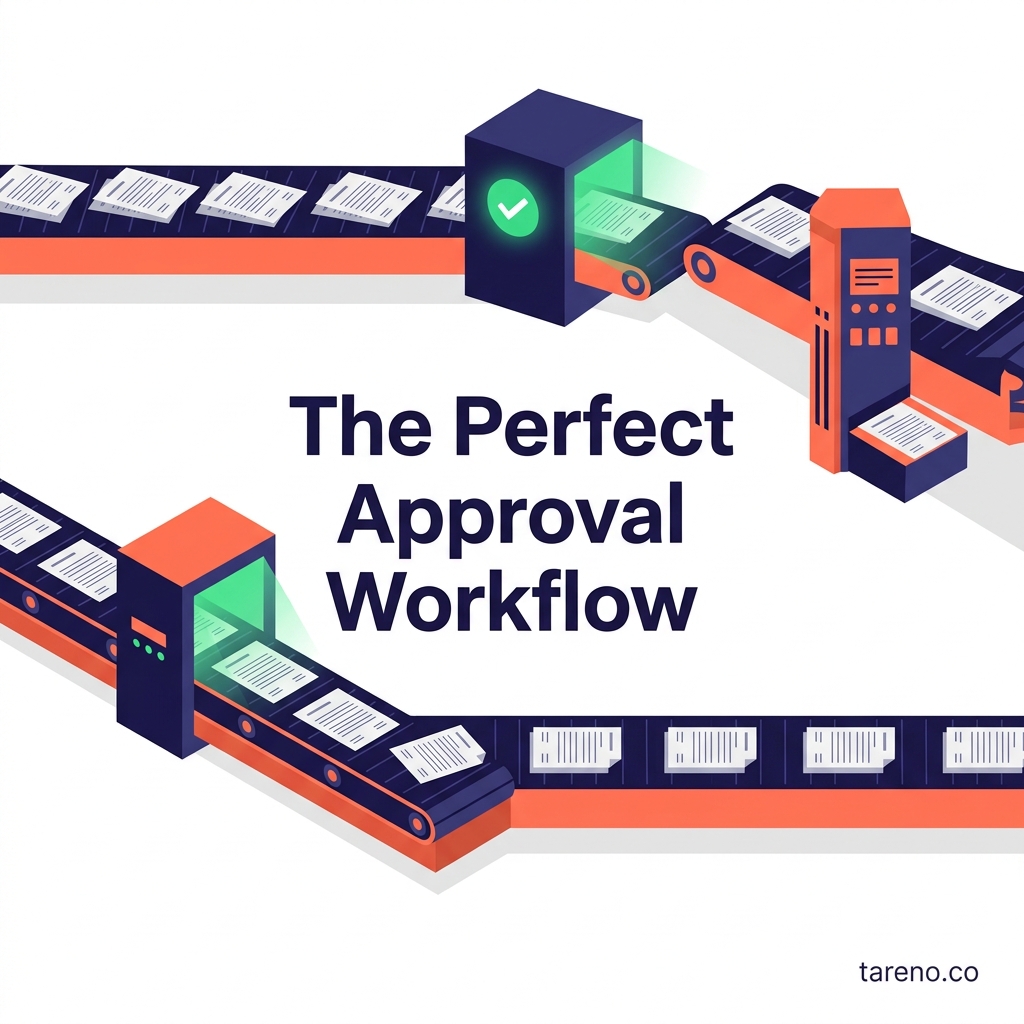
A social media approval workflow is the defined sequence of steps a piece of content takes from draft to publication. A perfect workflow minimizes friction by defining exactly who reviews what, when they review it, and how they provide feedback, effectively eliminating the "endless loop" of revisions.
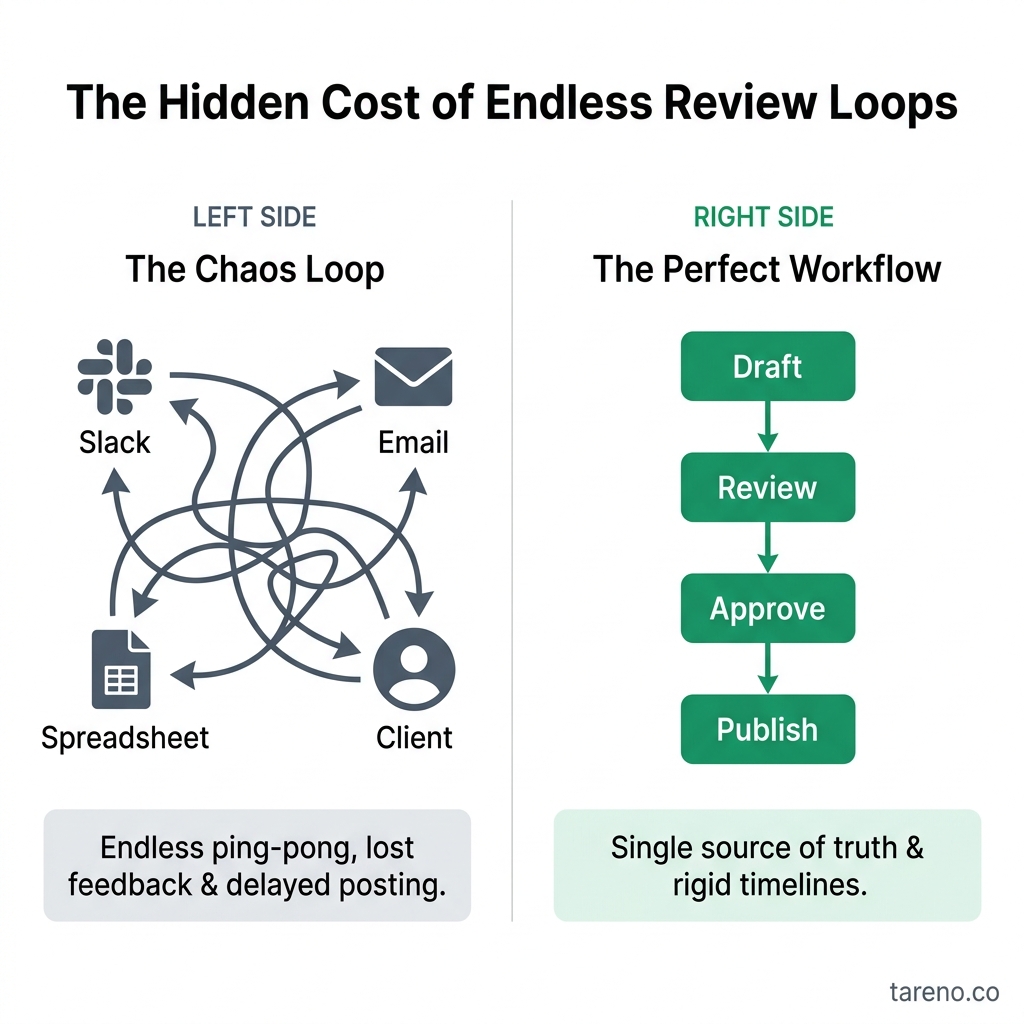
The Hidden Cost of Endless Review Loops
Why Approval Workflows Fail (The Endless Loop Problem)
If you manage social media for an agency or a mid-sized brand, you know the pain: You write a stellar post. You send it for review. Manager A changes the tone. Subject Matter Expert B changes the facts. Legal C removes the punchline. You revise it. Then, the CMO (who wasn't in the original chain) sees it and asks for a complete rewrite.
This is the Endless Loop Problem. It happens because of three fundamental flaws:
Scattered Feedback: Comments live across Google Docs, Slack threads, and email chains.
Unclear Ownership: Everyone feels entitled to an opinion, but nobody is the designated "final decider".
Vague Timelines: "Review this when you can" translates to "I will review this three hours after it was supposed to go live."
The 3 Tiers of Content Risk
The fastest way to optimize your workflow is to realize that not every post needs the CEO's approval. You must categorize content by risk and route it accordingly.
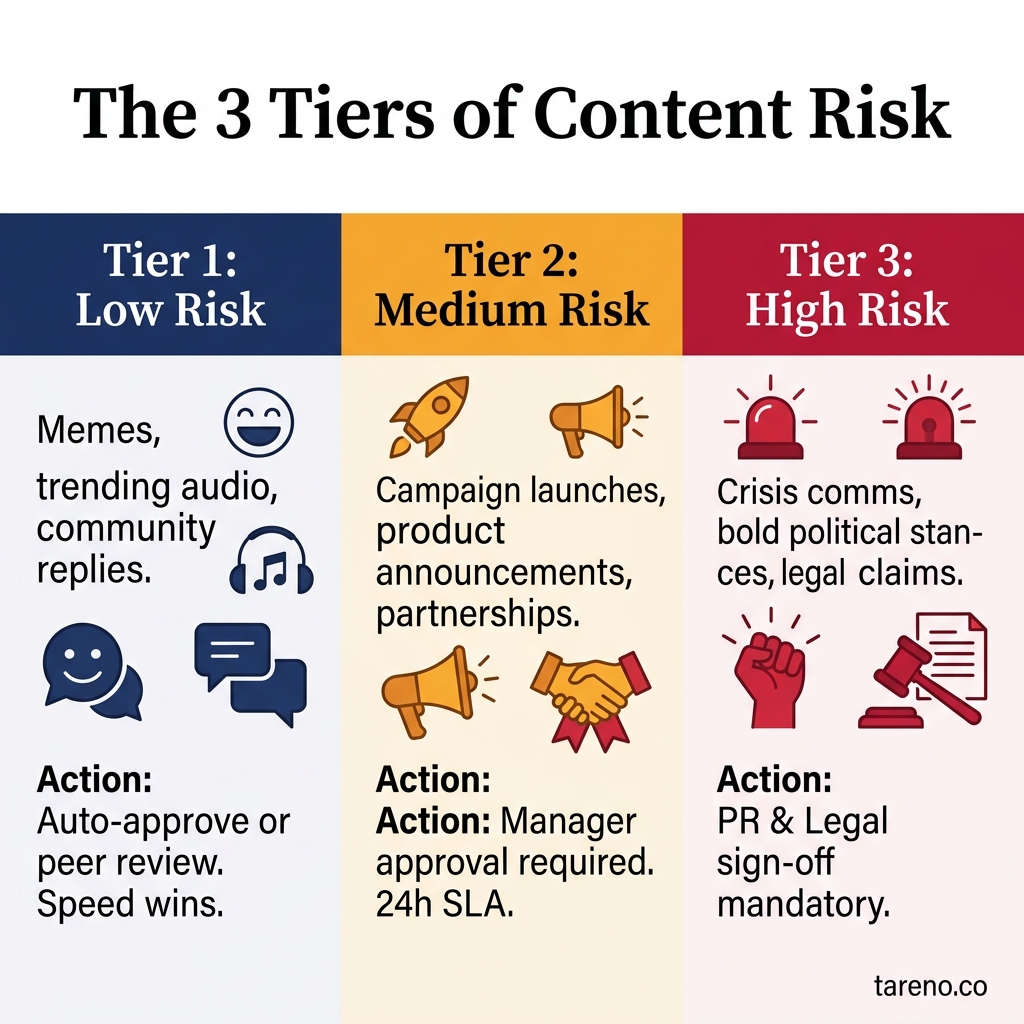
The 3 Tiers of Content Risk
Tier 1: Low Risk (High Speed). This includes trending audio formats, memes, simple community replies, and repurposing evergreen content. Workflow: Auto-approve or peer-to-peer review.
Tier 2: Medium Risk (Standard Speed). Educational carousels, blog promotions, product feature highlights. Workflow: Brand Manager or Content Lead approval (24-hour SLA).
Tier 3: High Risk (Slow & Steady). Crisis communications, official press releases, influencer contracts, or bold controversial stances. Workflow: Full review by Legal, PR, and Executive Leadership.
The F.L.O.W. Framework
To fix the approval pipeline, implement the F.L.O.W. system. This is a behavioral framework for your internal or client-facing operations.
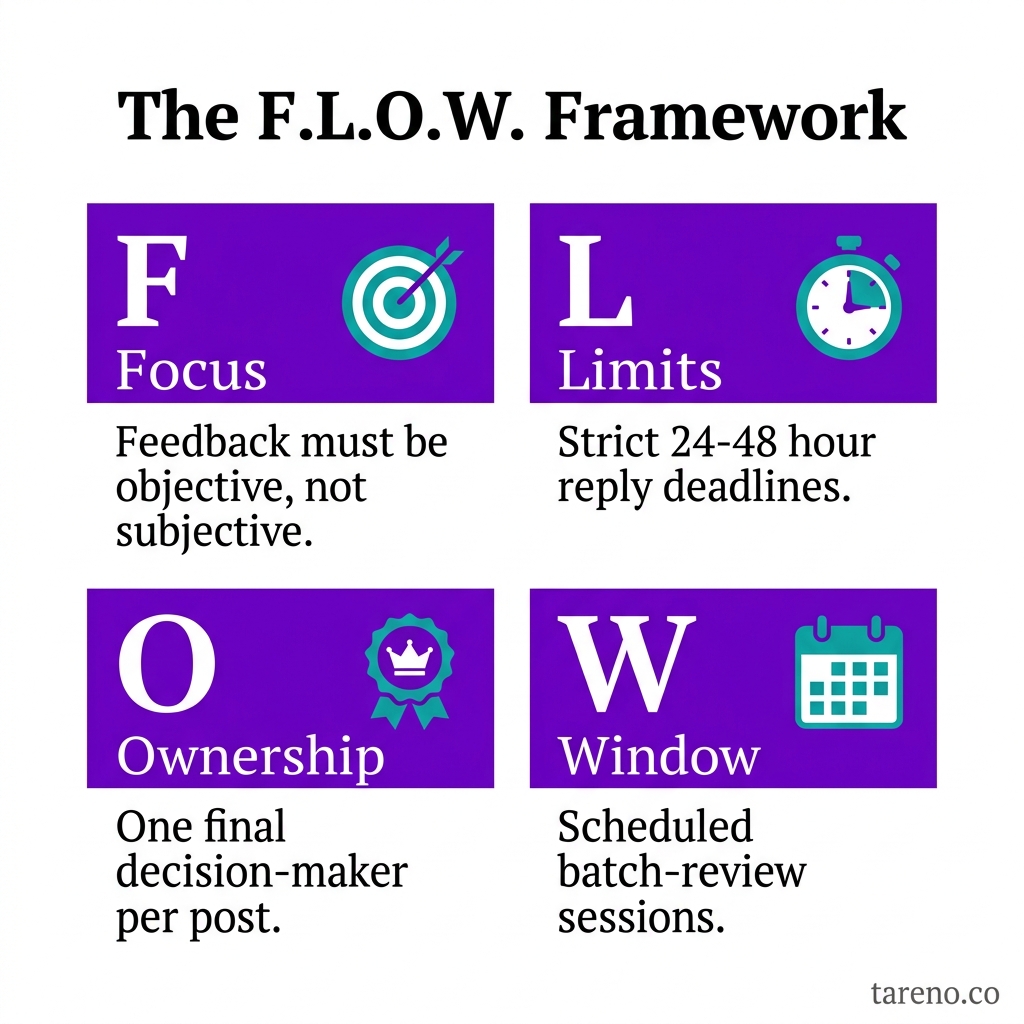
The F.L.O.W. Framework
F - Focus (Objective Feedback)
Train your reviewers to give objective, actionable feedback. "Make it pop" is subjective. "Change the primary color to our brand hex code #333" is objective. Stop accepting subjective revisions.
L - Limits (Timeboxing)
Establish strict SLAs (Service Level Agreements) for reviews. If a draft sits in the "Awaiting Approval" column for 48 hours without comments, it is automatically considered approved (or explicitly kicked back). Do not let content rot in the pipeline.
O - Ownership (The Final Boss)
Every post must have exactly ONE ultimate decision-maker. If Legal and Marketing disagree, the designated Owner makes the final call. Design by committee produces mediocre social content.
W - Window (Batch Reviewing)
Instead of pinging a client or manager 15 times a week for individual post approvals, schedule a 30-minute "Review Window" every Thursday at 2 PM. Reviewing 10 posts in one batch is exponentially faster than context-switching for single posts.
How to Set Up Your System (Step-by-Step)
Centralize the Tool: Use a dedicated platform (like Tareno) where the mockups, copy, and comments live in the exact same view.
Define Roles: Map out exactly who the Crafter, the Reviewer, and the Approver are.
Create the Status Escalation: Draft → Internal Review → Client/Legal Review → Approved → Scheduled.
Enforce the Rules: If someone sends feedback via email, politely reply: "Thanks! Please drop this comment directly in the approval tool so we have a single source of truth."
Key Takeaways
Approval bottlenecks are a process problem, not a creative problem.
Segment your content by risk explicitly. Stop asking Legal to review weekend memes.
Centralize all feedback. The moment feedback splinters into email and Slack, the timeline doubles.
Quotable Passage
"Design by committee produces mediocre social content. Speed and authenticity require singular ownership and a single source of truth."