TL;DR
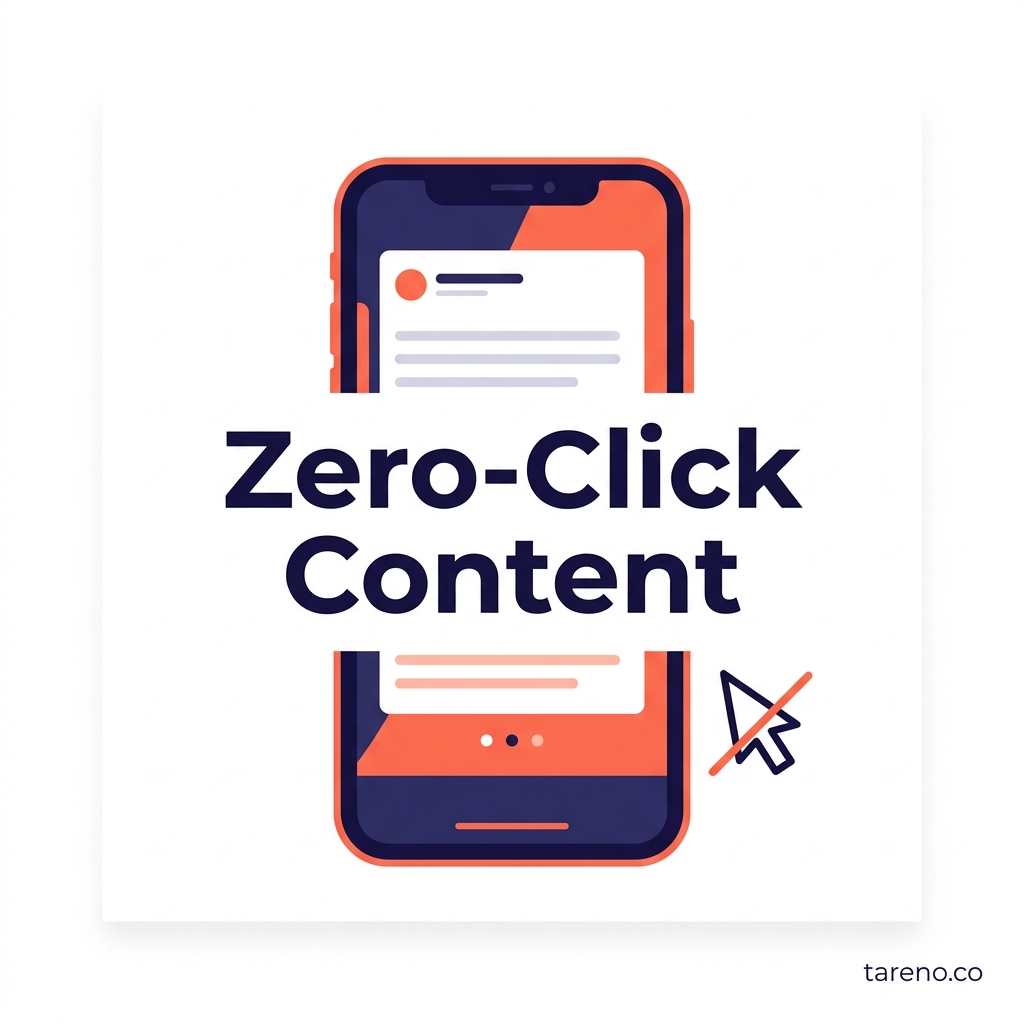
Zero-click content delivers the core value inside the platform first, then routes interested people to deeper owned assets when a click adds value.
It works best for awareness, education, trust-building, and repeated exposure, not for every conversion moment.
The safest operating model is not “never use links,” but “match the friction level to the audience’s intent.”
Teams scale zero-click more effectively when they start from one source asset, adapt it by platform, and measure assisted signals beyond CTR.
As multi-platform repurposing grows, consistency in message, tone, and visual packaging becomes an operational issue, not just a creative one.
The Zero-Click Content Strategy: Scaling Platform-Native Content
Quick Definition
Zero-click content is content that delivers its main value inside the platform first, then sends people to a deeper destination only when the click adds meaningful value.
That is different from basic repurposing, and very different from copy-paste cross-posting. Repurposing adapts one idea into several useful formats. Copy-paste simply republishes the same asset everywhere, whether or not it fits the platform.
Why Zero-Click Content Became a Strategic Necessity
Social platforms have matured into self-contained content environments. Users open LinkedIn, Instagram, TikTok, YouTube, or Threads expecting to consume something valuable immediately, not to be interrupted by friction before the value appears. That shift matters because content strategy is partly about matching audience intent in the moment.
Zero-click content is not an anti-website ideology. It is a distribution choice. If someone is casually browsing a feed between meetings or during a commute, they are often willing to spend 20 to 60 seconds learning something useful. They are much less likely to leave the app for a deeper page unless the value exchange is already clear.
That is why forcing a click too early often underperforms. The problem is not the link itself. The problem is asking for a higher-friction action before the audience has enough context or trust to justify it.
A simple example makes the distinction clear. A founder insight about repurposing could appear as a structured LinkedIn post with three lessons, an Instagram carousel with six slides, a short-form video that explains the key mistake, and a blog article that expands the operating model. Each version teaches the main point natively. The click-driven asset exists, but it arrives later in the journey.
This is the strategic shift: zero-click content lowers the cost of the first interaction. Owned content still matters for depth, search, proof, and conversion. But native distribution is often the better first step when the audience is still deciding whether your idea deserves more attention.
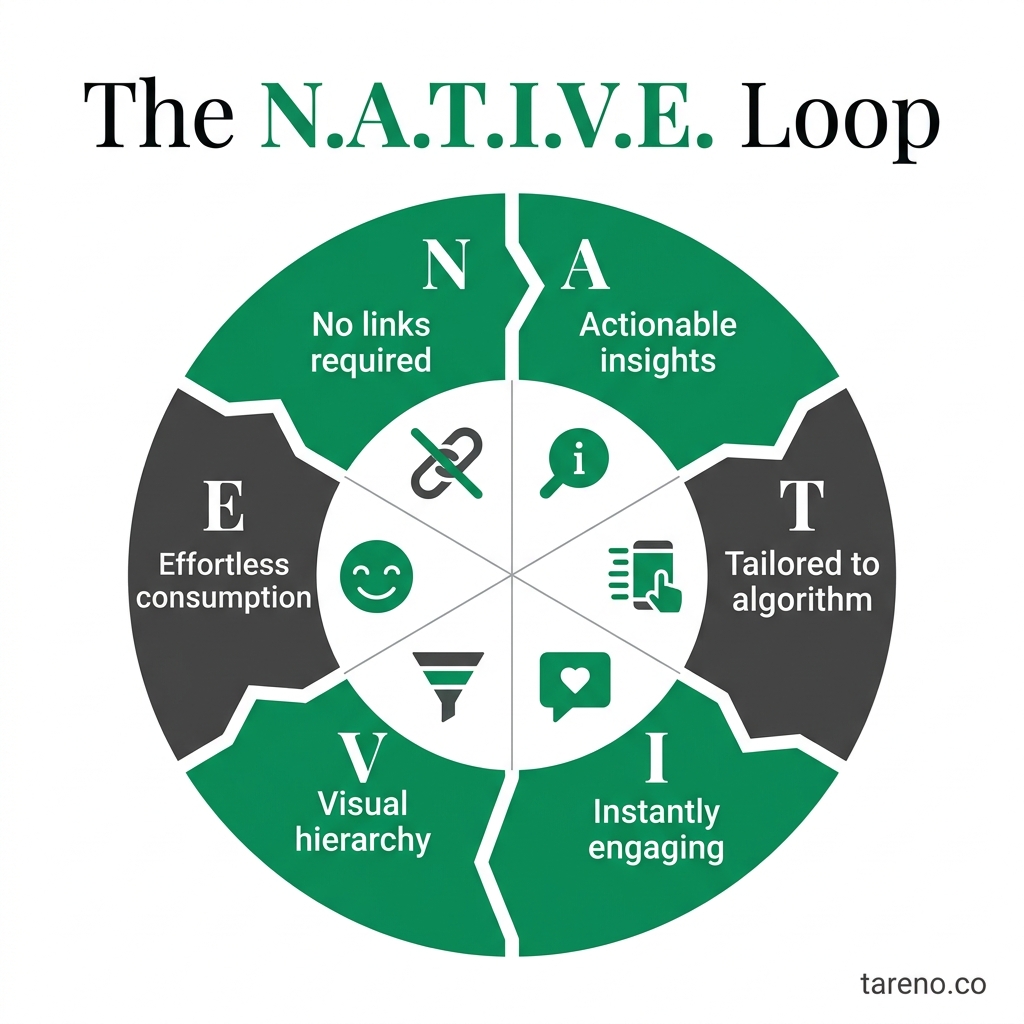
The N.A.T.I.V.E. Loop
The NATIVE Loop: A Framework for Zero-Click Distribution
Teams need more than a slogan to scale platform-native content. They need a repeatable system that keeps one idea coherent across multiple formats. A practical model is the NATIVE Loop:
N — Nail the core message
Start with one specific idea that can survive format changes. “Repurpose more content” is too broad. “Adapt the same idea to platform behavior instead of reposting identical copy” is specific enough to travel across LinkedIn, carousels, short-form video, and blog content.
A — Adapt to platform behavior
Every platform has its own consumption logic. A LinkedIn audience often tolerates denser text and explicit business framing. Instagram rewards visual progression and saveable structure. TikTok and Reels require faster hooks and more immediate payoff. Adaptation is not resizing. It is rethinking how the same idea lands in context.
T — Teach in-feed first
Deliver the essential lesson before asking for a click. If a carousel explains the framework clearly, the linked asset can focus on templates, examples, or implementation details. This makes the click additive rather than mandatory.
I — Instrument downstream signals
Zero-click content usually needs a broader measurement model. Saves, shares, replies, profile visits, follower growth, branded search, inbound messages, and assisted conversions often tell a more useful story than CTR alone.
V — Version consistently
One idea can become five assets quickly. Without a clear standard for terminology, tone, visuals, and framing, those assets start to drift. Consistency does not mean sameness. It means the audience can recognize the same idea and the same brand across formats.
E — Escalate only when a click adds value
The best click is not the earliest click. It is the click that deepens the experience. Ask people to leave the platform when the next destination offers proof, detail, templates, onboarding, comparison, or another meaningful step that the native format cannot hold well.
Mini-example: a webinar clip becomes a LinkedIn post with three lessons, a saveable Instagram carousel, a short-form video summarizing the operating rule, and a blog article with the full framework. The user does not need to click to understand the idea. They click when they want to implement it.
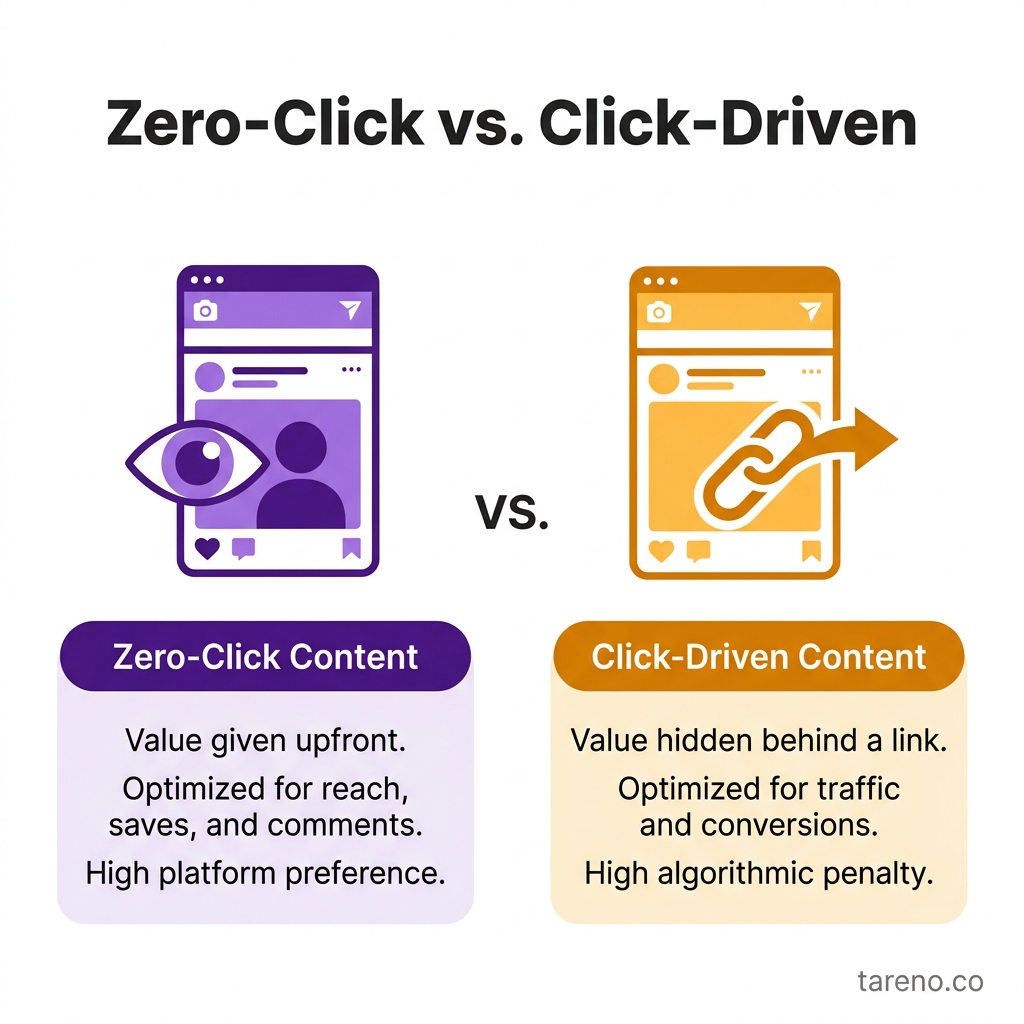
Zero-Click vs. Click-Driven
Zero-Click vs Click-Driven Distribution: When Each Wins
Zero-click content is useful, but it is not universally better. The more durable strategy is to understand which type of friction matches which type of intent.
DimensionZero-click contentClick-driven contentPrimary goalAwareness, recall, education, trustEvaluation, conversion, owned captureBest audience stateLow to medium intentMedium to high intentTypical formatsNative posts, carousels, short videos, threadsBlog posts, landing pages, demos, resource hubsMain success signalsSaves, shares, replies, profile actions, assisted demandCTR, form fills, pipeline actions, time on pageMain riskToo shallow, weak path to depthToo much friction too early
Use zero-click when the next best action is understanding, remembering, or engaging. Use click-driven distribution when the next best action is detailed evaluation, compliance review, lead capture, or conversion.
A hybrid model is usually strongest. Teach the idea in-feed first. Then route the audience to a deeper destination only when that destination clearly improves the experience.
How to Build Platform-Native Content Without Starting From Scratch
The operational advantage of zero-click strategy is that it does not require inventing a completely new idea for every channel. It requires extracting one strong source asset and converting it into multiple native versions.
A good source asset might be a webinar, article, podcast, customer conversation, founder note, or case-study lesson. The important part is not the format. It is whether the core message is specific enough to be expressed clearly in one or two sentences.
Once the source asset is strong, break it into reusable modules:
the core insight
supporting points
examples or scenarios
memorable phrasing
visuals or screenshots
practical steps
From there, build by platform. A LinkedIn post may carry the thesis and three lessons. A carousel may turn the same lesson into a saveable sequence. A short-form video may deliver the argument with a stronger hook and spoken pacing. A blog post can hold the full framework, counter-arguments, FAQs, and implementation details.
This is the same principle behind a structured video-to-blog repurposing workflow: one source asset becomes a readable destination only after editorial adaptation. The same logic applies when a blog article becomes a LinkedIn post or a short-form video. Repurposing is not duplication. It is transformation.
A simple workflow usually works better than a complicated one:
publish or identify the source asset
extract the core message and supporting modules
assign native versions by platform
adapt hook, structure, and packaging for each channel
publish and compare downstream signals
promote deeper owned assets only where they add real value
This system matters because it protects teams from the copy-paste trap. The same text rarely belongs everywhere. The same idea often does.
The Operational Layer: Consistency Across Channels
As soon as one idea becomes several platform-native outputs, consistency becomes a real production problem. If the LinkedIn version names a framework one way, the Instagram version simplifies it differently, and the short-form video introduces another label, the audience does not experience a coherent body of work. They experience fragmentation.
That fragmentation shows up in three places: message framing, visual language, and tone. The danger is not only aesthetic. Inconsistent packaging makes it harder for people to recognize your ideas over time.
This is where governance matters. Teams need lightweight rules for recurring terminology, approved phrases, visual patterns, and the kind of promise each format is allowed to make. In a small team, that may be a checklist. In a larger workflow, it often needs to be systematized.
When one idea is repackaged into a LinkedIn post, an Instagram carousel, a short-form video, and a blog article, consistency stops being a design preference and becomes an operational requirement. A shared Brand Kit can help by giving teams a common reference for tone, visual rules, recurring terminology, and message framing, so platform-native content stays recognizably on-brand without turning into copy-paste content.
This matters even more when you build channel-specific publishing systems or distribute content across contributors. The faster content moves, the easier it is for the brand to drift.
How to Measure Zero-Click Content Without Misreading the Data
The biggest reporting mistake in zero-click strategy is judging every post by click-through rate. CTR is useful for click-driven assets. It is incomplete for native educational assets whose purpose is recall, engagement, and assisted demand.
A more accurate view starts with the question: what was this post supposed to do?
If the goal was awareness and in-feed teaching, the first metrics to inspect are often:
saves
shares
replies or comments with substance
profile visits
follower growth
direct messages or inbound conversations
branded search lift over time
assisted website visits or later conversions
Consider a post that gets modest CTR but generates strong saves, thoughtful replies, and several profile visits. That may be a much stronger top-of-funnel asset than a click-heavy post that sends visitors to a page they immediately abandon.
This does not mean clicks stop mattering. It means clicks should be interpreted in context. Zero-click content often creates delayed or indirect outcomes. Someone sees the idea in-feed, remembers the brand, searches later, returns through another channel, and converts after a deeper interaction. That path is harder to attribute, but it is not imaginary.
A practical reporting model is:
separate awareness posts from conversion posts
judge each by its intended job
track assisted and downstream signals, not just direct traffic
review qualitative response patterns, not only aggregate counts
compare formats within the same goal, not across incompatible goals
When Not to Use a Zero-Click Strategy
Zero-click strategy earns credibility when it states its limits clearly.
Do not rely on zero-click formats when the audience needs legal precision, detailed proof, product comparison depth, pricing context, or a conversion environment you control. High-intent moments usually require owned destinations.
That includes situations such as:
enterprise evaluation with complex requirements
pricing or plan comparison
regulated or compliance-sensitive content
case studies that depend on evidence and nuance
lead capture and demo flows
evergreen resources that should remain searchable and fully owned
In these cases, native content still plays a role. It can introduce the issue, frame the question, or summarize the lesson. But the decisive step should happen on your site, documentation, or another owned destination.
Common Mistakes Teams Make
The first mistake is treating zero-click like copy-paste cross-posting. Platform-native content is still repurposed content, but the adaptation work matters. When teams skip that step, the content feels misplaced.
The second mistake is confusing reach with value. High impressions can be encouraging, but they do not prove that the content taught anything memorable or moved the right audience toward demand.
The third mistake is overcompressing. Some ideas become useless when forced into a format that is too small for the level of nuance required.
The fourth mistake is failing to create a path to depth. Zero-click content should not gate the basic lesson, but it should still help the audience find the next layer when they are ready.
The fifth mistake is losing consistency across formats. That is especially common when different contributors are shipping native assets quickly without a shared standard.
The sixth mistake is treating zero-click as anti-SEO or anti-website. In reality, zero-click works best when it supports a broader content architecture that still includes owned resources, internal linking, and destination pages for deeper intent. That is also why format decisions matter. In some topics, audio-first packaging decisions can improve native delivery without changing the core message you want to teach.
FAQ
Is zero-click content bad for SEO?
No. Zero-click content and SEO solve different parts of the journey. Zero-click content helps people discover and understand an idea inside a platform. SEO helps people find deeper owned content when they are actively searching. Problems arise only when teams replace owned content entirely instead of using zero-click as a distribution layer.
Should every social post avoid links?
No. The better rule is to avoid unnecessary friction. If the destination adds depth, proof, or a clear next step, a link can be the right move. If the user needs the click just to understand the basic point, the post is usually underdelivering.
What is the difference between zero-click content and repurposing?
Zero-click describes where the value is delivered first: inside the platform. Repurposing describes how one source idea becomes multiple assets. A repurposed asset can be zero-click, click-driven, or somewhere in between depending on its job.
How do you measure success if CTR is low?
Start with the post's intended role. For awareness and education, inspect saves, shares, replies, profile actions, branded search, inbound conversations, and assisted conversions. Low CTR is not automatically a failure if the content is doing its actual job well.
Which platforms are best suited to zero-click publishing?
Any platform with strong native consumption habits can support zero-click publishing, but the format must match the platform. LinkedIn favors structured insight, Instagram favors visual progression, TikTok and Reels favor hook-led short video, and YouTube Shorts or Threads favor concise native framing. The platform matters less than whether the content is genuinely adapted to it.
When should a zero-click post become a blog post or landing page?
When the topic needs more proof, nuance, search visibility, templates, examples, or conversion infrastructure than the native format can hold well. A strong signal is when audience questions repeat in comments or messages. That usually means the feed version succeeded, and the next layer should now exist in an owned format.
Conclusion
Zero-click content is best understood as a friction strategy. It does not ask whether clicks are good or bad. It asks whether the click belongs now or later.
The strongest teams teach first, adapt by platform, measure the right outcomes, and escalate only when a deeper destination adds real value. That makes zero-click content more than a social tactic. It becomes a practical distribution model for modern content operations.
Zero-click content works best when it earns attention natively and asks for a click only after the audience understands why the next step is worth taking.
Key Takeaways
Zero-click content lowers friction by delivering the main lesson inside the platform first.
It is strongest for awareness, trust-building, and repeated exposure, not every conversion moment.
The NATIVE Loop helps teams adapt one idea across formats without losing strategic coherence.
Measurement should include assisted and downstream signals, not only CTR.
Owned content still matters for depth, proof, SEO, and conversion control.
Brand consistency becomes a workflow challenge as repurposing scales across channels and contributors.