TL;DR
Manual content planning becomes expensive when agencies scale clients, channels, approvals, and recurring campaigns faster than their planning system evolves.
The hidden costs are usually context switching, approval lag, duplicate work, weak ownership, and poor visibility during review.
Spreadsheets are not the enemy; fragile coordination is. Manual planning can still work at very small scale.
Agencies grow more reliably when they separate recurring work from bespoke work, clarify ownership, and review planning quality weekly.
Analytics tools help most when they support a cleaner operating rhythm rather than trying to compensate for chaos.
Quick Definition
Manual content planning is a content operations model where planning, approval, scheduling, and follow-up happen mostly through spreadsheets, chats, emails, and person-to-person reminders instead of a shared system with clear status, ownership, and review routines.
For agencies, the real damage is usually indirect. Manual planning creates planning debt: the extra coordination work required to keep a fragile process functioning after client count, publishing volume, and approval complexity have already outgrown it.
The important nuance is that manual planning is not automatically wrong. A small agency with one experienced operator and a low publishing load can run manually for quite a while. The problem starts when the same lightweight setup is expected to support multi-client calendars, channel-specific content, recurring campaigns, and leadership reporting at the same time.
The hidden costs manual planning creates
Manual planning rarely fails as one dramatic event. It fails as an accumulation of small operational taxes.
1) Context switching turns simple work into expensive work
When work is spread across spreadsheets, chats, folders, email threads, and calendar tools, team members spend time reconstructing the state of a task before they can move it forward. That makes normal work feel harder than it should.
Mini-example: a strategist updates a caption in the planning sheet, the designer still uses an older creative note from chat, and the account manager schedules the earlier version because the latest approval was buried in email.
2) Approval lag destabilizes the calendar
Agencies often believe they have a “planning problem” when they really have a visibility problem. If no one can see what is ready, blocked, revised, or still waiting on a client, the calendar stops feeling trustworthy.
Mini-example: the weekly schedule looks complete on Tuesday, but by Thursday two key posts are delayed because the final sign-off still lives in a private message thread.
3) Duplicate work hides inside normal handoffs
Manual systems encourage rechecking, resending, relabeling, and re-explaining. Those tasks feel small, but they accumulate fast when several people touch the same campaign.
Mini-example: the team copies campaign notes from a planning sheet into a task board, then repeats them again inside a client update deck because no single source feels reliable enough.
4) Ownership becomes fuzzy under pressure
A weak manual process often relies on smart people “just knowing” what happens next. That works until the team grows, someone is off that day, or a campaign changes late.
Mini-example: a post misses its slot because strategy assumed account management would chase approval, while account management assumed design had already delivered the final asset set.
5) Performance review gets disconnected from planning reality
If planning and reporting live in separate, fragile systems, leaders struggle to answer basic operating questions: what shipped on time, what was blocked, what repeated well, and where the workflow is actually leaking capacity.
Mini-example: the team can explain why a campaign underperformed creatively, but cannot easily see that repeated approval delays also weakened timing and consistency.
The CLEAR Framework for diagnosing planning debt
The CLEAR Framework helps agencies decide whether manual planning is still lean or already too expensive.
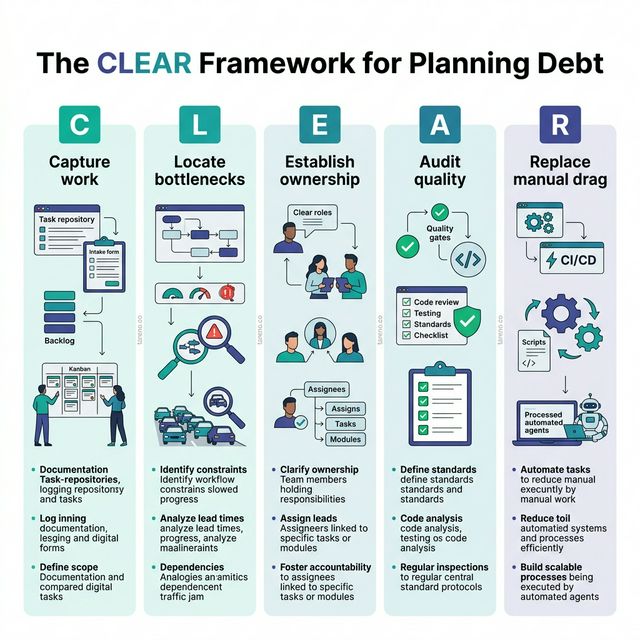
Using the CLEAR framework allows agencies to systematically diagnose and eliminate planning debt.
C — Capture the real work
Do not measure only the visible calendar. Capture revisions, approvals, channel adaptation, reschedules, asset chasing, and reporting prep.
Mini-example: a monthly content plan contains 24 posts, but the real workload also includes seven revisions, multiple asset requests, and several approval follow-ups.
L — Locate bottlenecks
The first visible bottleneck is often misleading. Teams may blame copy production when the actual drag comes from approvals, unclear filenames, or weak handoffs.
Mini-example: content appears “late,” but the main delay is that assets arrive without final platform notes, forcing repeated clarification.
E — Establish ownership
Each content item needs a clear owner for the next step: draft, approval, scheduling check, and exception handling.
Mini-example: once one owner secures approval and another verifies scheduling accuracy, Friday surprises become less common.
A — Audit planning quality
A full calendar is not the same as a healthy one. Review stale content, duplicate topics, overloaded days, and blocked approvals before they damage delivery.
Mini-example: the plan covers two weeks, but three posts reference an outdated landing page and two more are clustered at the same time.
R — Replace manual drag with systems
The point of better systems is not to automate judgment away. It is to remove low-value coordination so the team can spend more attention on quality, timing, and client outcomes.
Mini-example: instead of asking for status in chat, the team works from shared workflow states and a weekly review rhythm.
How manual planning breaks first inside agencies
Manual planning usually breaks in three places first.
Multi-client calendar pressure
One client calendar can often be managed informally. Five client calendars with different cadences, channels, and campaign windows usually cannot. Naming rules, due dates, and publishing ownership need more structure.
Team coordination pressure
As more people touch the workflow, small ambiguities become repeated delays. The cost is not only slower output. It is the mental overhead of constantly reloading context and checking assumptions.
Reporting friction
Leaders need more than a list of planned posts. They need to compare what was scheduled, what shipped, what slipped, and what performed. Fragmented manual planning makes that review harder than it should be.
This is the hidden shift agencies often miss: manual planning starts as a lightweight system, then quietly becomes an operating model that consumes the very capacity it was supposed to support.
When manual planning still works — and when it does not
Manual planning still makes sense when:
publishing volume is low,
one experienced operator owns the process end-to-end,
content is highly bespoke,
approval paths are short,
campaigns are not heavily recurring.
It becomes risky when:
multiple clients share one delivery team,
recurring campaign work needs repeatable structure,
several people edit the calendar,
channel-specific variants are standard,
leaders need reliable capacity and performance visibility.
A useful rule of thumb: if the team spends more time chasing status than making editorial decisions, the current planning model is already too manual.
Comparison: manual planning vs structured workflow vs centralized system
ApproachBest partMain limitBest fitManual planningflexible and cheap to startfragile at scale, weak visibilitysmall low-volume teamsStructured workflow without central reviewclearer ownership and better repeatabilitystill fragmented if planning and review live in different placesgrowing agencies fixing handoffsCentralized workflow plus review layerstronger visibility, comparison, and governancerequires process discipline and setupagencies with recurring multi-client operations
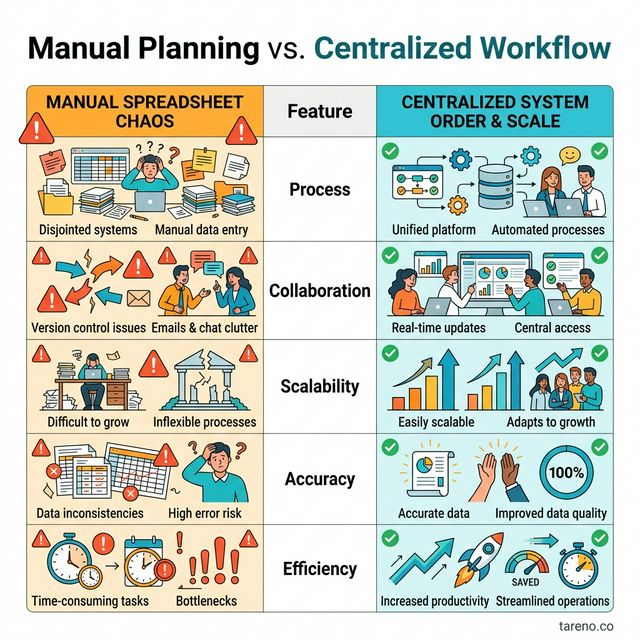
Manual planning creates friction at scale, whereas centralized systems create predictable agency delivery.
The middle model matters because not every team needs a heavy platform immediately. But most agencies eventually need more than a calendar. They need a reliable operating view.
A practical workflow to replace planning debt
Step 1: Standardize intake
Use one brief structure for objective, channels, assets, deadlines, CTA, and approval path.
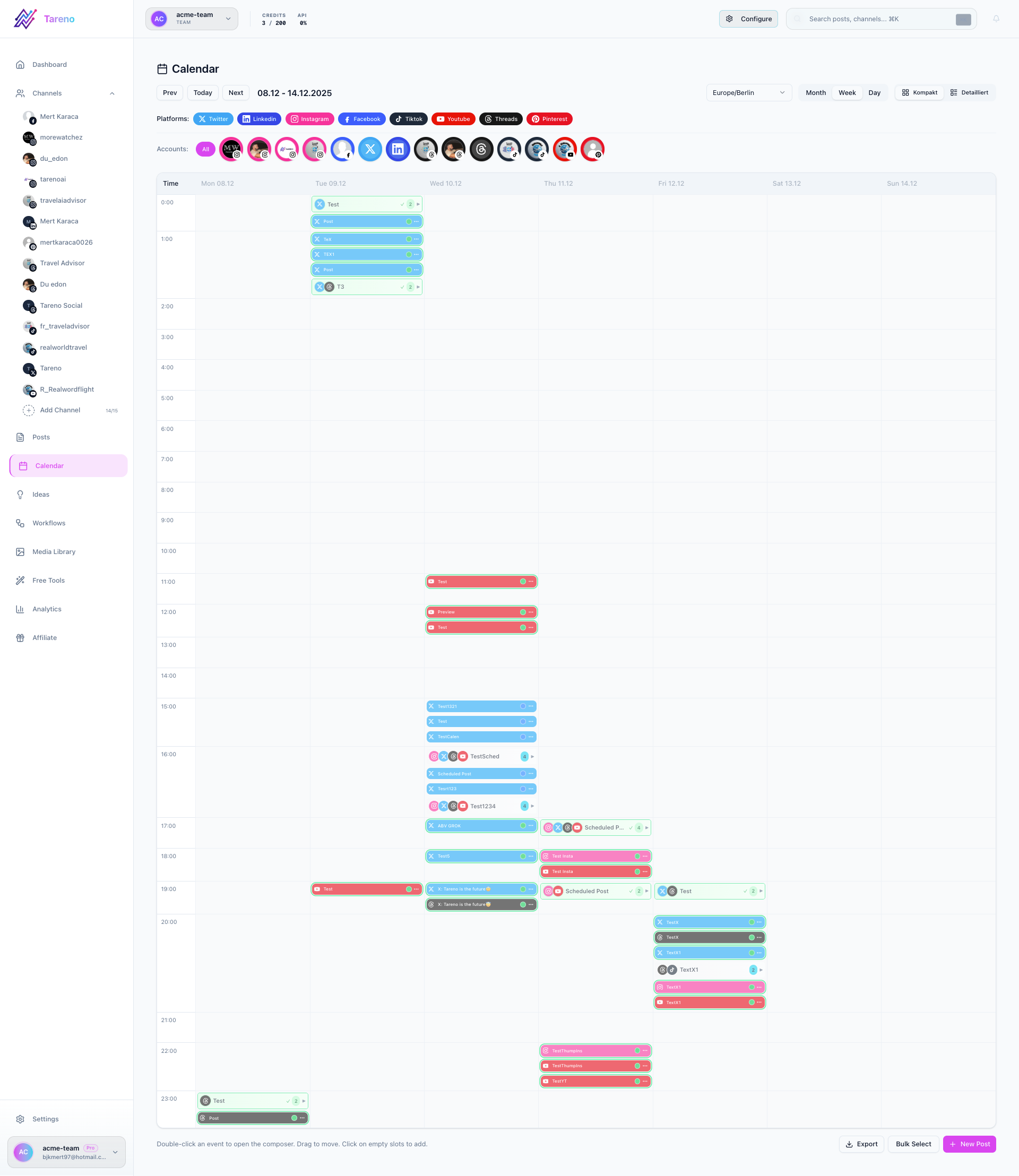
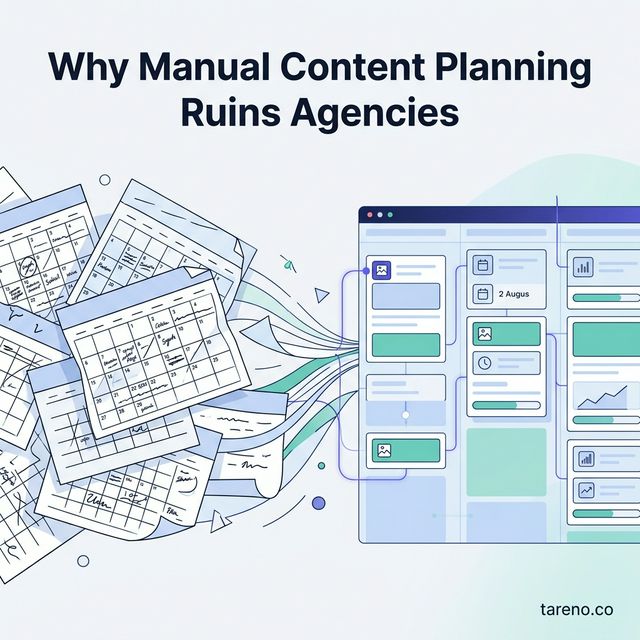
Connecting the whole team on a centralized calendar (like Tareno) replaces the chaos of manual spreadsheets.
Mini-example: instead of “Can we post this next week?”, the request includes the target channels, owner, due date, and sign-off route.
Step 2: Make ownership visible
Every content item should have a clear next owner and status.
Mini-example: one person owns draft readiness, another owns client follow-up, and another verifies scheduling accuracy before publishing.
Step 3: Separate recurring work from bespoke work
Evergreen series, recurring promotions, and standard client updates should not move through the exact same process as a major launch.
Mini-example: a recurring educational series uses a repeatable review path, while a product launch gets a custom exception track.
Step 4: Review capacity weekly
Teams need a recurring review of blocked items, overloaded days, and approval risk.
Mini-example: Monday review shows four items stalled on one client, so the team rebalances effort before the rest of the week collapses.
Step 5: Connect planning to performance review
A mature planning system does not only ask what got posted. It also asks what repeated well, what stalled, and what type of work keeps causing preventable delays.
Mini-example: if one content format is regularly delayed and underperforms, the issue may be workflow design rather than creative quality alone.
For teams making this transition, a stronger planning system often pairs naturally with controlled bulk scheduling, because repeatable work becomes safer to batch once ownership and review are clear.
Common failure patterns and decision rules
Before agencies replace manual planning, they should know which failure pattern they are actually facing.
Failure pattern 1: Busy calendar, weak delivery confidence
The team has plenty scheduled, but people still do not trust what is truly ready. This usually points to approval-state confusion rather than lack of ideas.
Decision rule: if the calendar looks full but publish-day surprises are common, fix status visibility before adding more volume.
Failure pattern 2: Constant last-minute reshuffling
Some reshuffling is normal in agency work. The warning sign is when rescheduling becomes the default operating mode. That usually means the system does not distinguish well between recurring work and high-variance work.
Decision rule: move repeatable content into templates and reserve manual attention for launches, reactive moments, and high-stakes exceptions.
Failure pattern 3: Senior people becoming traffic managers
When experienced strategists spend large parts of the week chasing files, approvals, or status updates, the agency is paying expert rates for coordination work.
Decision rule: document ownership and escalation rules first, then decide which parts need better software support.
Failure pattern 4: Reporting that depends on reconstruction
If reporting requires several people to rebuild the story of what happened, the agency lacks a clean review layer.
Decision rule: create one recurring review rhythm that connects planned work, shipped work, and performance observations.
Manual planning stops being lean when your best people spend more time reconstructing work than improving it.
Where Analytics Suite (Team Performance) fits without overclaiming
A centralized analytics layer will not fix planning debt by itself. It becomes useful when agencies need a clearer review surface across posts, platforms, and recurring output patterns.
In Tareno, the cautious fit here is Analytics Suite (Team Performance). Based on internal feature documentation, it supports overview reporting, platform-level dashboards, top-post analysis, and comparison views across accounts and channels. Used well, that can make review conversations clearer. It should be framed as decision support, not as a promise of automatic growth.
This matters because agency leaders eventually need more than anecdotal status updates. They need a consistent way to compare effort, output, and performance patterns without rebuilding the story manually every week.
If your broader question is how systems, ownership, and automation fit together, the next useful layer is not just tooling but governance. That is where an operating-model view such as AI-assisted social workflow design becomes relevant.
When to use this approach — and when not to
Use this operating view when:
the team manages recurring content across several accounts,
approval lag causes repeated reschedules,
leaders cannot see bottlenecks early,
client service quality is being affected by planning friction,
team members are busy but output still feels unstable.
Do not over-engineer the process when:
the agency is tiny,
output volume is low,
one person truly owns the work end-to-end,
the content mix is mostly bespoke,
the overhead of a formal system would exceed the current coordination burden.
In other words, the goal is not maximum process. The goal is the minimum structure required to keep quality stable while scale increases.
Quick self-audit for agency leaders
Ask these five questions before you blame your team for “poor planning”:
Can we see the true approval state of every important item?
Do we know who owns the next step on blocked work?
Can we separate repeatable content from bespoke content easily?
Can we review what slipped without rebuilding the story manually?
Can we compare effort, output, and performance patterns across accounts?
If the answer is “no” to most of these, the problem is probably not motivation. It is system maturity.
FAQ
Why do spreadsheets feel fine until they suddenly do not?
Because spreadsheets store information well, but they do not reliably manage ownership, approval state, and exception handling when several people and clients share the same workflow.
Is manual content planning always bad?
No. It is often completely reasonable at small scale. The problem appears when the process complexity grows faster than the system supporting it.
What is the first warning sign of planning debt?
The team starts spending more time asking where work stands than deciding what should happen next.
Does automation remove the need for editorial judgment?
No. Good automation removes repetitive coordination work. Editorial judgment still decides message quality, channel fit, timing, and exceptions.
Should agencies fix workflow or analytics first?
Usually workflow first. Analytics becomes much more valuable when the team already has shared statuses, clear ownership, and a recurring review rhythm.
How does manual planning affect team health?
Poor planning creates constant context switching, reactive follow-up, and deadline anxiety. Over time, that can contribute to the exact stress patterns discussed in social media team burnout prevention.
Can reusable content reduce planning pressure?
Yes. Agencies that build editorial inventory instead of starting from zero every week usually lower coordination burden. That is one reason structured evergreen content systems matter operationally, not just creatively.
Key Takeaways
Manual content planning becomes expensive when coordination work grows faster than the team’s shared system.
The biggest hidden costs are context switching, approval lag, duplicate work, fuzzy ownership, and fragmented review.
Spreadsheets can still work at small scale, but agencies with recurring multi-client delivery usually need more structure.
The CLEAR Framework helps leaders diagnose whether they need better discipline, better visibility, or both.
Analytics tools are most useful when they support a stronger operating rhythm rather than trying to rescue a chaotic workflow.
Sources
Asana resources on work management, coordination overhead, and context switching
Atlassian teamwork resources on handoffs, visibility, and workflow design
Content Marketing Institute guidance on content operations and governance
Internal Tareno documentation:
CONTENT_STRATEGY.md,TARENO_DASHBOARD.md, feature documentation for Analytics Suite