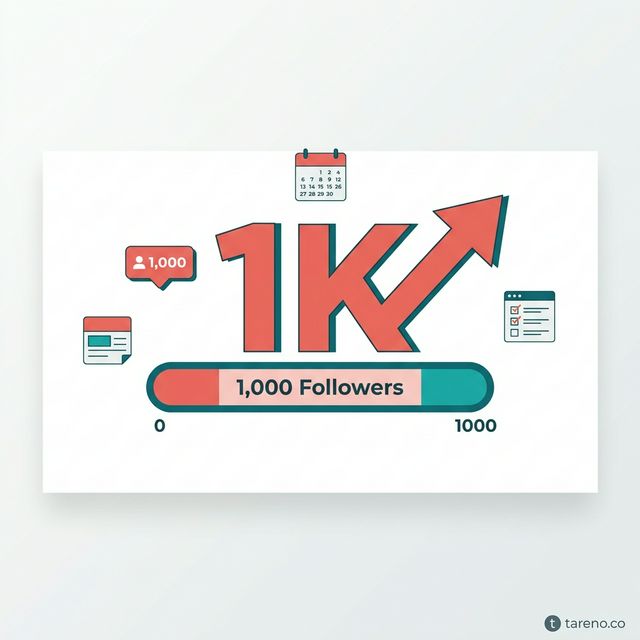
The first 1,000 followers are not a vanity trophy. For most small accounts, they are the point where audience patterns become easier to read. Before that, a post can feel successful or unsuccessful for reasons that are hard to separate. After that, it becomes easier to see which ideas drive profile visits, which formats earn saves, and which posts actually make the right people follow.
A 30-day sprint can help, but not because 30 days is magical. It helps because a fixed window forces focus. If your profile promise is clear, your themes are disciplined, and your review loop is honest, one month is enough to learn what deserves repetition and what should be cut.
TL;DR
The first 1,000 followers usually come from focus, not constant tactic switching.
A clear profile signal matters more than posting more often without direction.
Three to four content pillars and two to three native formats are enough for a strong first sprint.
Better growth signals include profile visits, follows, saves, shares, and replies, not just reach.
A 30-day sprint works best when your positioning is already reasonably clear.
Quick Definition
The first 1,000 followers are an operational milestone. They do not prove authority on their own, and they do not guarantee customers. What they offer is enough response data to judge whether your positioning, topics, and formats are actually working.
A small audience of highly relevant followers can be more valuable than a larger but unfocused one. The real goal is not empty scale. It is to build a repeatable audience system.
The SCOPE Framework for the first 1,000 followers
S - Signal Profile: your profile makes it clear who the account is for and what problem it helps solve.
C - Content Pillars: three to four repeatable topic clusters create recognition.
O - Offer-Native Formats: you choose formats that match the platform and your teaching style.
P - Proof and Participation: examples, replies, and visible usefulness make the account more credible.
E - Evaluation Loop: you review which posts drive follows and meaningful interaction, then repeat what works.
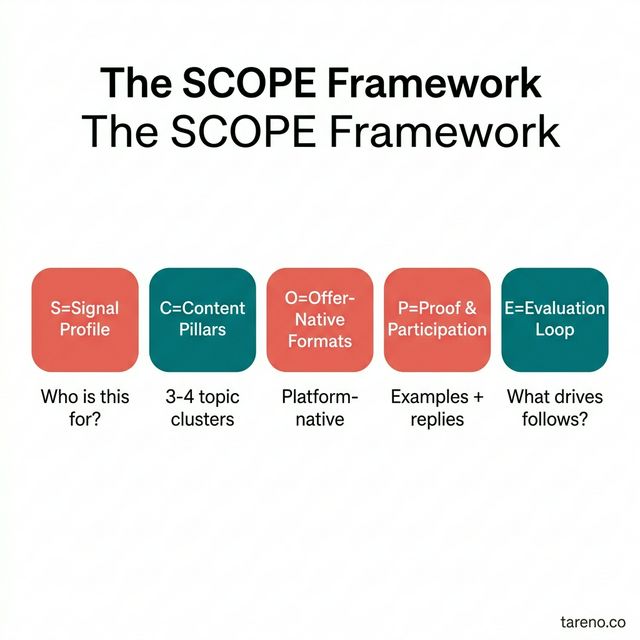
The SCOPE Framework: five steps that turn an unfocused account into a repeatable audience system.
Short version: signal first, series second, measurement always.
Why many accounts stay stuck below 300 followers
Most small accounts are not short on effort. They are short on clarity. One post comments on a trend, the next promotes a feature, the next offers a generic quote, and the next teaches something unrelated. Individual posts may still perform, but the account as a whole feels inconsistent.
Typical blockers include:
unclear positioning,
too many topics,
too many formats,
trend chasing without profile fit,
no review loop.
Step 1: Turn the profile into a clear signal
A strong profile answers three questions:
Who is this for?
What problem or outcome does it focus on?
Why is it worth following?
A vague line such as “Marketing | Business | Growth” says very little. A sharper line such as “I help B2B SaaS teams turn complex topics into simple social posts” gives the visitor a reason to stay. For a deeper look at search-driven profile clarity, see Instagram SEO and keywords instead of hashtags.
Step 2: Pick three to four content pillars
Useful pillar options include tutorials, common mistakes, myths, and mini-cases from practice. Three to four pillars are usually enough to build recognition without becoming repetitive.
Step 3: Choose two to three native formats
Choose formats by fit, not by trend.
FormatStrong whenWeaker whenCarouselyou explain steps, comparisons, or frameworksthe idea has no clear progressionShort videoyou demonstrate, show process, or compress a transformationthe value depends on long argument or nuanceText / micro-postyou have a sharp observation, lesson, or contrarian pointthe idea needs too much setup to land quickly
If your content works best as structured education, the LinkedIn Carousel Generator article is a useful companion. If you prefer testing short ideas through discussion, Threads Marketing 2026 is a natural next read.
Step 4: Run a 30-day sprint
Week 1: sharpen the profile, define the pillars, publish one clear positioning post.
Week 2: test two or three formats against related topics.
Week 3: repeat the strongest combinations with better hooks or clearer framing.
Week 4: review the signal, cut weak patterns, and plan the next cycle.
Step 5: Create community signals, not just feed output
Replies, repeated questions, and visible interaction often create stronger follow reasons than feed output alone. When one topic keeps generating follow-up questions, turn it into a series.
Step 6: Measure the signals that actually matter
Views matter, but they are not enough. Better signals usually include:
profile visits,
follows,
saves,
shares,
replies,
repeated topic-format patterns.
This is also where an analytics layer becomes useful. Tareno Analytics Suite (Growth) fits naturally here because it helps centralize core social metrics, compare posts and platforms, and identify which themes or formats deserve another round. The point is not that a tool creates followers on its own. The point is that it makes the weekly review loop easier to run with less guesswork.
When a 30-day sprint makes sense - and when it does not
Use this sprint when your positioning is already mostly clear and you are ready to test in a focused way. Do not use it as a substitute for basic positioning work.
Comparison: three realistic paths to the first 1,000 followers
1) The expert account
Best for consultants, founders, agencies, and educators who grow through teaching.
2) The documentation account
Best for builders, creators, and brands that can turn progress into lessons.
3) The curated perspective account
Best for operators with strong filters and original commentary.
Most small accounts do best with a mix of expert content and selective documentation.
Three scenarios from practice
Scenario 1: Solo founder with low reach
Start with tutorials, mistake breakdowns, and one personal learning format.
Scenario 2: Small brand with product-heavy content
Shift from product-first posting to problem-first posting.
Scenario 3: Marketing starter without a clear format
Keep the first cycle narrow: three pillars, two formats, four weeks.
Decision rules for weeks 2 to 4
Double down
Repeat a topic or format when it drives profile visits, follow-up questions, and fits the account promise.
Rework
Keep the idea but change the packaging when the topic is right and the execution is weak.
Cut
Remove themes or formats that create noise without helping the account earn the right audience.
Common mistakes on the road to 1,000 followers
platform hopping before learning anything,
frequency without strategy,
broad positioning,
trend chasing without fit,
failing to reuse what already worked.
The 30-day playbook at a glance
Week 1: Signal
Clarify the profile promise, define 3-4 pillars, and publish a positioning post.
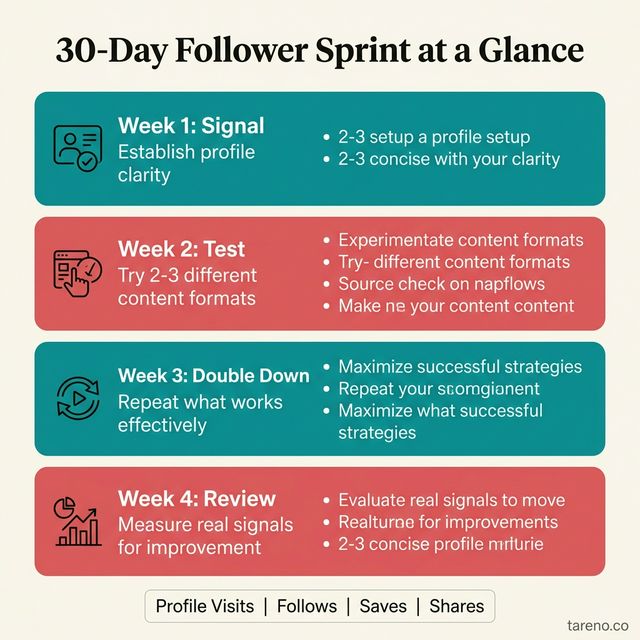
A focused 30-day sprint builds audience clarity — not by posting more, but by learning faster.
Week 2: Test
Compare 2-3 native formats and document comments, replies, and repeated questions.
Week 3: Double down
Repeat the strongest themes with better hooks and clearer examples.
Week 4: Review
Keep what compounds. Cut what distracts.
FAQ
How long does it usually take to reach the first 1,000 followers?
There is no universal timeline. Build the system first and let the number follow.
Is it better to focus on one platform or several?
For most small teams, one primary platform plus one lightweight secondary channel is more realistic.
How often should I post during the sprint?
Choose a cadence you can sustain while still reviewing the results properly.
What if I get reach but not followers?
That usually means the post attracted attention without strengthening the account promise.
Can a small brand use the same playbook as a creator?
Yes. The structure is the same, but the proof layer differs.
Do I need tools to do this well?
No. Tools can make review easier, but they cannot replace positioning, useful content, or consistency.
Key Takeaways
The first 1,000 followers are a learning milestone, not a guarantee of business success.
Clear positioning beats random activity.
Three to four pillars and two to three formats are enough for a serious test.
Better signals than reach alone include profile visits, follows, saves, shares, and replies.
The goal is not to do more. The goal is to repeat what earns the right audience.
If you want the work to compound beyond a single feed, Pinterest automation for evergreen reach is the natural next topic because long-tail distribution can extend the life of your strongest ideas.