TL;DR
TikTok SEO for tutorial content is best understood as clarity, not a hack.
The clearest videos align one specific query across the hook, spoken explanation, on-screen text, caption, and supporting hashtags.
Hashtags still help, but they work as support signals rather than a full discoverability strategy.
Search-led packaging is most useful for evergreen tutorials, product education, and narrow how-to questions.
A hook generator can speed up ideation, but it does not guarantee ranking or replace strong teaching.
Quick Definition
TikTok SEO is the process of aligning the search intent, opening hook, spoken explanation, on-screen text, caption, and supporting hashtags of a video so tutorial-focused viewers can find and understand it more easily inside TikTok.
For how-to content, TikTok SEO is best understood as a clarity system, not a loophole. It does not guarantee ranking, and it does not replace strong creative work. What it does do is reduce ambiguity. That matters when the audience is searching for a practical answer rather than casually browsing for entertainment.
Why TikTok SEO matters for how-to content
TikTok SEO matters because how-to content has clearer retrieval intent than most social content.
A dance trend, reaction clip, or meme remix can spread because it is emotionally sticky, surprising, or timely. A tutorial video works differently. It usually begins with a practical question: what exactly does this teach, who is it for, and why should I keep watching? If those answers are fuzzy, the video has a weaker chance of matching the search moment.
Three points matter most:
In-app search behavior: people use TikTok to look up workflows, answers, and quick explanations.
Tutorial intent clarity: how-to queries are more specific, so vague packaging becomes a bigger disadvantage.
Discoverability vs entertainment: some videos win because they entertain; tutorial videos usually need to explain their usefulness earlier.
For example, “Quick creator hack for today” may still attract feed viewers, but “How to edit captions in TikTok without re-recording your whole video” is better matched to a search-led user.
This also fits a broader GEO mindset: content becomes easier to retrieve when the topic, scope, and intended outcome are visible early.
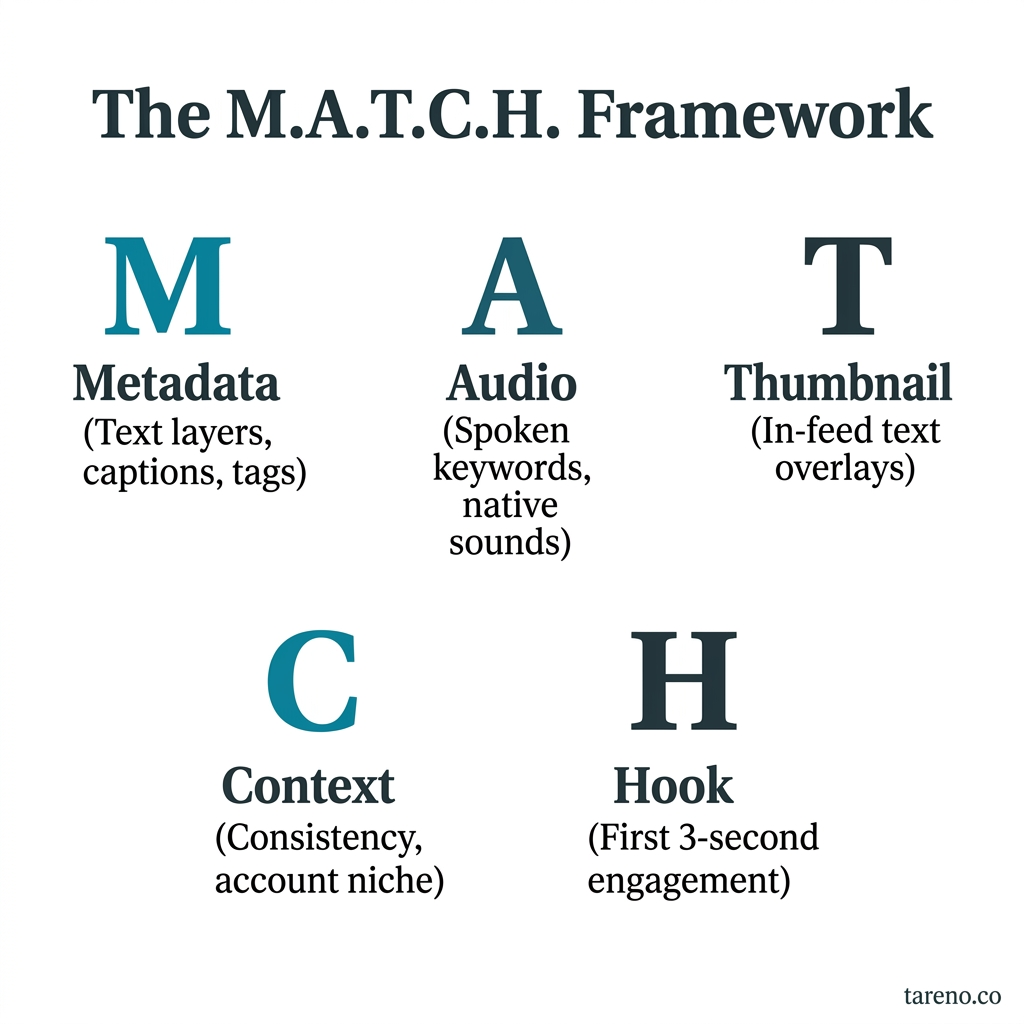
The M.A.T.C.H. Framework
The MATCH Framework for TikTok SEO
A practical way to approach TikTok SEO is the MATCH Framework:
M — Map the search intent
A — Align the opening hook
T — Teach with explicit language
C — Confirm relevance in caption and cover
H — Hone with iteration
M — Map the search intent
Start with the exact problem a viewer wants to solve. “TikTok growth” is too broad. “How to write a TikTok hook for educational videos” is specific enough to package well.
A — Align the opening hook
The first line should confirm the topic quickly. It does not need to repeat the query mechanically, but it should make the promise unmistakable.
T — Teach with explicit language
Say the thing you are teaching. Spoken words, on-screen labels, and step names help reinforce the topic. A tutorial that never names its own subject creates unnecessary ambiguity.
C — Confirm relevance in caption and cover
The caption and cover text should support the same promise, not introduce a competing angle. If the hook says “how to batch TikTok filming” and the caption says “creator workflow secrets,” the signal gets weaker.
H — Hone with iteration
TikTok SEO is not one perfect setup. It is an editorial loop. Review which topics, phrasings, and tutorial formats consistently produce clearer engagement and better completion.
Example query: “how to batch create TikToks.”
Hook: “How to batch create a week of TikToks in one recording session.”
Spoken phrase: “Here’s the batching workflow I use for tutorial videos.”
On-screen text: “Batch create TikToks: 3-step workflow.”
Caption: “How to batch create TikToks without losing topic clarity.”
That is not keyword stuffing. It is message alignment.
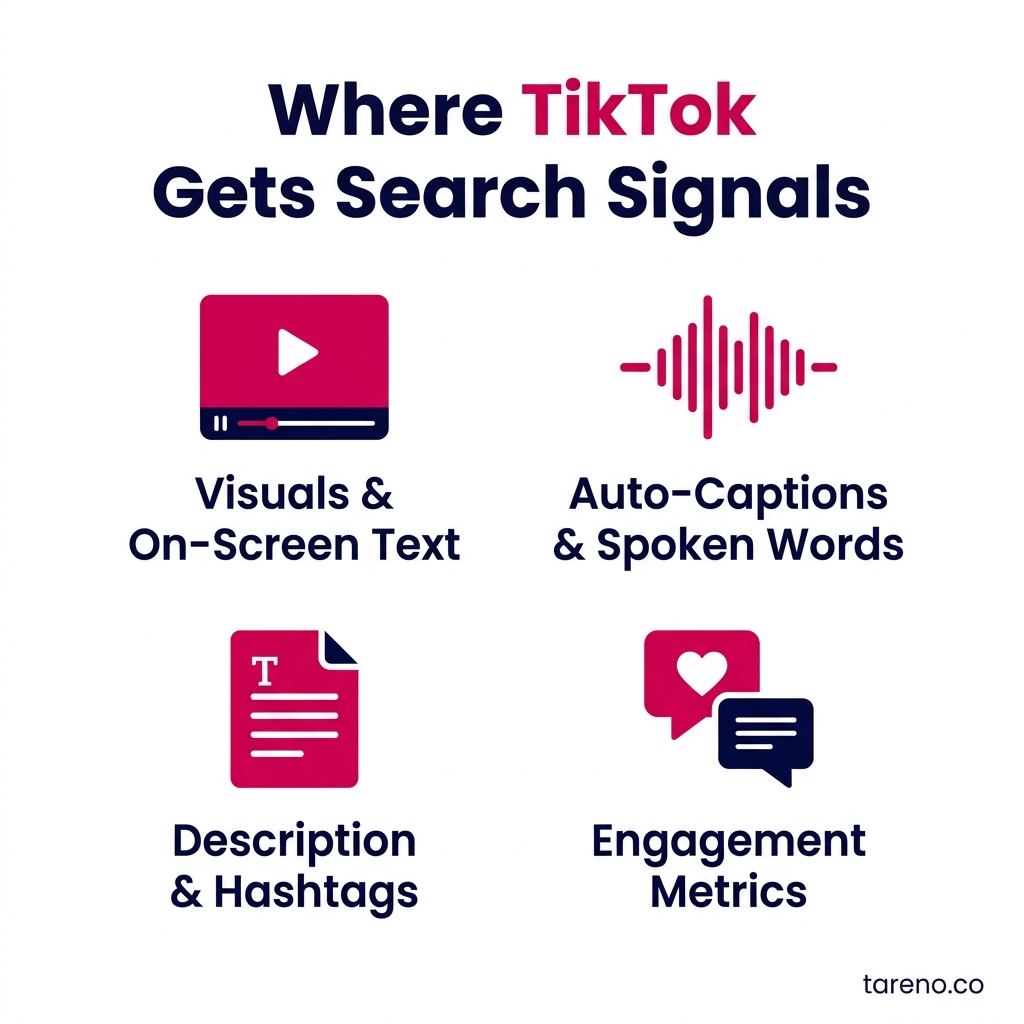
Where TikTok Gets Search Signals
Where TikTok gets topic signals from
TikTok does not rely on one single field to understand a tutorial video. For how-to searches, it is safer to think in layers.
1) Spoken keywords
If you say the topic clearly, you reduce ambiguity. For tutorial content, spoken phrasing helps confirm the exact subject and gives viewers confidence that they found the right video.
2) On-screen text and cover text
Text overlays can clarify the problem, the step sequence, or the promised result. This is especially useful when viewers watch with limited attention or muted audio at first.
3) Caption text
Captions should reinforce the topic in natural language. A short, precise caption often helps more than a vague motivational line.
4) Hashtags
Hashtags can support categorization, but they should not carry the whole discoverability strategy. A weak tutorial with generic hashtags is still a weak tutorial. If you want the supporting layer to be stronger, Tareno’s hashtag strategy coverage is a useful companion topic.
5) Account and topic consistency
If an account repeatedly publishes around a recognizable subject area, both viewers and platform systems get a clearer signal about what kind of expertise to expect.
A video about “how to script short educational TikToks” is easier to classify when the creator says that phrase, shows it on screen, repeats it in the caption, and teaches exactly that topic.
The practical rule is simple: let the video tell the same story about itself across multiple surfaces. That is far more reliable than trying to hide the topic behind cleverness.
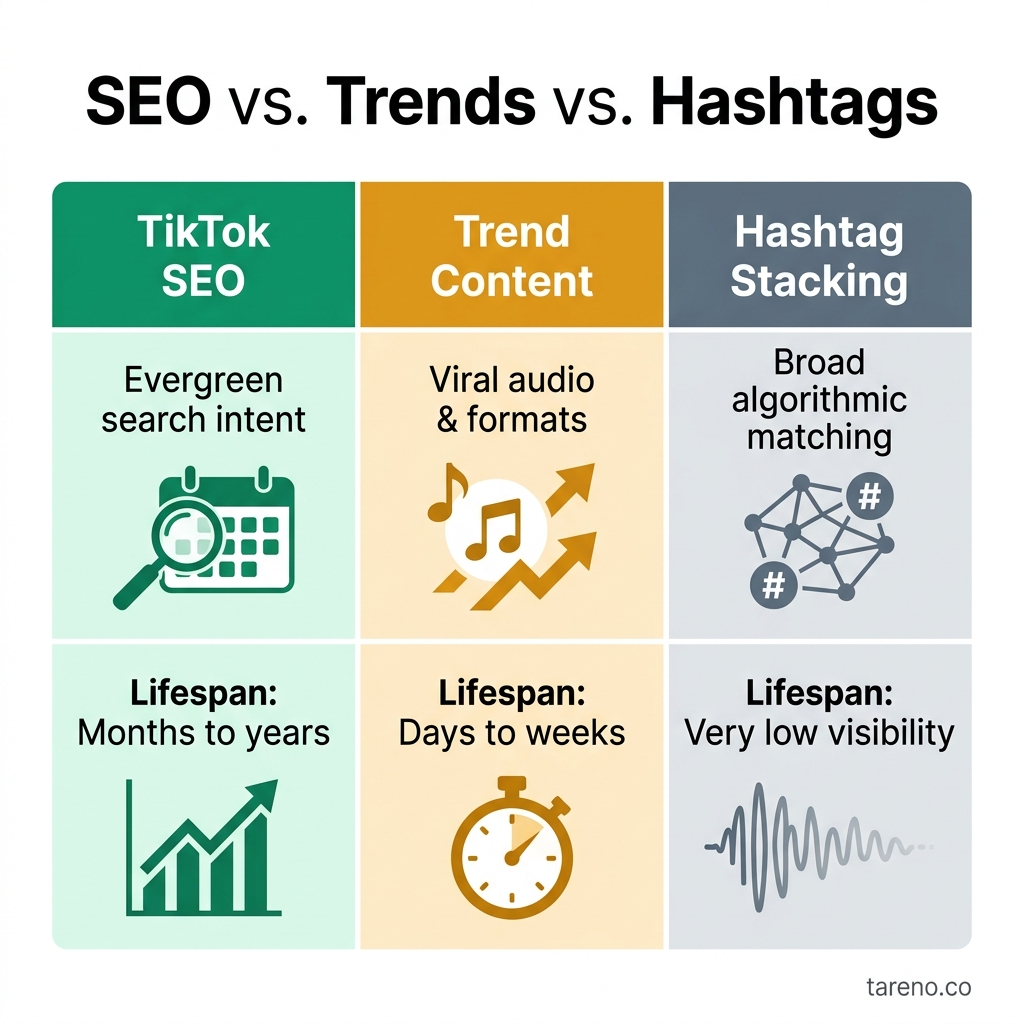
SEO vs. Trends vs. Hashtags
TikTok SEO vs hashtag-only vs trend-only content
Many creators still treat TikTok discoverability as a choice between stuffing hashtags or chasing trends. That framing is too narrow for how-to content.
ApproachMain strengthMain weaknessBest use caseTikTok SEO / search-led packagingStrong intent match for tutorials and evergreen questionsRequires editorial precision and topic clarityHow-to videos, product education, instructional explainersHashtag-only strategyFast to execute, simple to repeatWeak without clear topic packagingSupporting categorization onlyTrend-only strategyCan create broad exposure if the format fits the momentLow control over search intent and shelf lifeEntertainment-led or cultural participation content
If the topic is “how to write hooks for TikTok tutorials,” a search-led setup gives you more control over the promise than a trending audio clip with unrelated captions. By contrast, a meme response about creator life may perform fine without search structure because it is not solving a specific query.
The smartest model is often hybrid. Use trend awareness where it fits, but keep your educational content packaged around the real question a viewer is trying to answer. Hashtags can support that system, but they should not replace it.
When to use TikTok SEO — and when not to
TikTok SEO is most useful when the viewer arrives with a practical question.
Use it when
you publish evergreen tutorials that solve recurring problems,
you create product education or step-by-step demos,
you answer narrow creator questions such as scripting, filming, captioning, or editing,
or you want short-form videos to support a broader discoverability system.
Example: “How to plan a week of TikToks in one afternoon” is a good fit because the promise is concrete, repeatable, and searchable.
Do not treat it as the main lever when
the video is primarily a reaction, meme, or personality-first post,
the main value comes from surprise, humor, or cultural timing rather than instruction,
the topic is so broad that keyword clarity cannot fix weak differentiation,
or the video becomes robotic because every line was forced around a phrase.
Example: a behind-the-scenes joke about agency life may perform because it feels human and timely, not because it was optimized for a specific search phrase.
Search-led packaging helps when the audience needs clarity. It helps less when the audience needs emotion, novelty, or entertainment first. The goal is not to optimize every TikTok the same way. The goal is to choose the right packaging logic for the job.
A practical workflow for ranking tutorial-style TikToks
A workable TikTok SEO process is usually simpler than creators expect.
1) Start with one query, not one vague theme
Pick one searchable question such as “how to batch record TikToks” or “how to write TikTok hooks for tutorials.” Specificity makes every later decision easier.
2) Draft three hook angles
Write three openings that all confirm the same topic from slightly different angles: direct, benefit-led, and curiosity-led.
3) Build the tutorial around explicit steps
Make the structure visible. “Three mistakes,” “two edits,” “one workflow,” or “before/after” logic helps both comprehension and retention.
4) Repeat the topic naturally across layers
Use the topic in the spoken intro, one on-screen label, and the caption. The goal is consistency, not repetition for its own sake.
5) Publish, review, and refine
Look for patterns: which openings produced better viewer alignment, fewer confused comments, and stronger completion on similar topics?
A creator targeting “how to write a TikTok hook” might draft three openings before filming, choose the clearest one, place the phrase on the first screen, and write a caption that matches the same promise. If your team also works with platform-native content distribution, this is closely related to the same clarity-first logic behind zero-click content.
Where a tool can help
A tool like TikTok Hook Generator (Free Tool) can help at the drafting stage by turning one tutorial topic into several opening-line options. That is useful when you want to test direct, benefit-led, or curiosity-led intros around the same keyword. The value is speed and variation, not a ranking guarantee.
Used conservatively, it is a workflow aid rather than a shortcut. It helps creators avoid weak first lines and explore clearer search-aligned phrasing before recording.
Common mistakes that weaken TikTok search visibility
1) Treating hashtags as the whole strategy
Hashtags can support categorization, but they rarely fix vague teaching, mismatched captions, or unclear intros.
2) Hiding the topic behind a clever opening
A hook can still be interesting while staying clear. If the viewer cannot tell what the video teaches, the search match is weaker.
3) Saying one thing and teaching another
If the caption promises “how to grow with tutorials” but the video becomes a generic mindset talk, the content package loses coherence.
4) Targeting topics that are too broad
“TikTok growth” is too wide for most practical videos. Narrower instructional phrases create better packaging discipline.
5) Forcing keyword repetition until the script sounds unnatural
Search clarity helps. Robotic delivery hurts. The best tutorial videos still sound like a person made them.
FAQ
What is TikTok SEO?
TikTok SEO is the process of making a video easier to understand and retrieve inside TikTok by aligning the topic across the hook, speech, on-screen text, caption, and supporting context.
Do hashtags still matter on TikTok?
Yes, but mainly as supporting labels. They work best when they reinforce a clear topic instead of trying to replace one.
How many keywords should I target in one video?
Usually one main tutorial topic is enough. Closely related language can support it, but one clear query angle is easier to package than several competing ones.
Should I say the keyword out loud?
For how-to videos, that is often helpful because it confirms the topic quickly for both viewers and platform interpretation.
Can a small TikTok account rank for search?
A smaller account can still match a specific query if the video is clear, relevant, and useful. Account size may affect distribution context, but specificity still matters.
Is TikTok SEO better than trends?
Not universally. TikTok SEO is stronger for instructional and evergreen content. Trends are often stronger for cultural participation or broad entertainment.
Does a hook generator help with TikTok SEO?
It can help you draft clearer opening lines around a topic. It cannot replace the rest of the content package or guarantee results.
Conclusion
TikTok SEO for how-to content is not about hiding keywords in one field. It is about making the tutorial promise obvious early, consistent across layers, and useful enough to earn attention.
That makes TikTok SEO less mysterious than it sounds. The real job is to make the video easy to classify and easy to trust. When the query, opening line, spoken explanation, on-screen text, and caption all point to the same problem, tutorial content has a better chance to meet the right viewer at the right moment.
That does not mean every video should be engineered for search. It means tutorial videos should stop pretending clarity is optional. On TikTok, the fastest way to look less relevant is to make the viewer work too hard to understand what you teach.
Key Takeaways
TikTok SEO works best for how-to content when the topic is explicit and tightly packaged.
Search visibility comes from multiple layers working together, not one hidden setting.
Spoken phrasing, on-screen text, captions, and hooks should reinforce the same tutorial promise.
Hashtags help as support signals, not as the full strategy.
A hook generator can speed up draft creation, but clarity and usefulness still decide the outcome.
Sources
TikTok creator and business educational resources on search, captions, and discoverability
Google Search Central guidance on helpful, people-first content
Internal Tareno articles on hashtag strategy, zero-click content, and broader discoverability systems