TL;DR
Many business-facing social media profiles aimed at the German market should provide an easily identifiable legal notice path.
The “5-second rule” is a practical shorthand, not the wording of the law.
A direct profile link to the website legal notice is usually cleaner than hiding the legal notice behind a link maze.
Link-in-bio tools are not automatically forbidden, but they become risky when the legal notice is hard to find.
Teams should treat social profile compliance as a governance issue, not a one-time text problem.
Quick Definition
A social media legal notice, often called an Impressum, is the provider-identification information that users should be able to reach from a business-facing profile. In Germany, the core issue is not whether a legal notice exists somewhere on the internet, but whether the provider information is easy to identify and directly accessible from the profile context. The “5-second rule” is best understood as a usability shorthand for that expectation, not as a literal statutory phrase.
Social Media Legal Notice: The 5-Second Rule Explained
If you use social media as part of your business presence, the legal notice question is not a niche technicality. It is basic compliance hygiene. A profile that markets services, represents a company, or supports customer acquisition should not force users to guess who is behind it or where the provider information lives.
That is where the so-called 5-second rule comes in. People often repeat it as if German law literally requires an Impressum to be found within five seconds. That is too simplistic. The stronger legal idea is that the legal notice must be easy to identify and directly accessible. The five-second formula is a practical way to test whether your profile setup feels obvious or confusing.
In practice, this means three things:
commercial profiles deserve an Impressum review,
direct and clearly labeled paths are safer than clever link architecture,
consistency across all active business profiles matters.
This article explains who actually needs a social media legal notice, what the 5-second rule really means, where the legal notice should live, how link-in-bio pages change the risk, and how teams can standardize the setup across multiple accounts.
Who Actually Needs a Social Media Legal Notice?
A social media legal notice usually becomes relevant when a profile is not merely private, but part of a business presence. In Germany, the practical trigger is often simple: if the account represents a company, markets services, attracts leads, handles customer contact, or supports commercial activity, the profile deserves an Impressum check.
That does not mean every personal account automatically needs one. A purely private profile used only for personal communication is a different category. The grey zone is the mixed-use account: the freelancer who posts personal updates but also invites project inquiries, the consultant who shares opinions and books calls, or the creator whose profile combines personality with paid offers. In those cases, the profile may look commercial long before the owner thinks of it that way.
Imagine a freelance designer on Instagram. Her bio includes service keywords, a booking email, portfolio highlights, and client case snippets. Even if the tone feels casual, the account is functioning as business communication. That is exactly the sort of profile where a social media legal notice should be reviewed.
Three practical indicators point toward an Impressum need:
the profile identifies a business, brand, practice, agency, or professional service
the account is used to generate inquiries, bookings, or sales
the content is part of a planned marketing or public-facing communication strategy
A legal notice is also not the same thing as a privacy policy, cookie banner, or AI label. Those solve different compliance problems. If your team is sorting out multiple transparency issues at once, remember that AI disclosure and legal notice are different compliance tasks.
The 5-Second Rule for Legal Notices
What the “5-Second Rule” Really Means
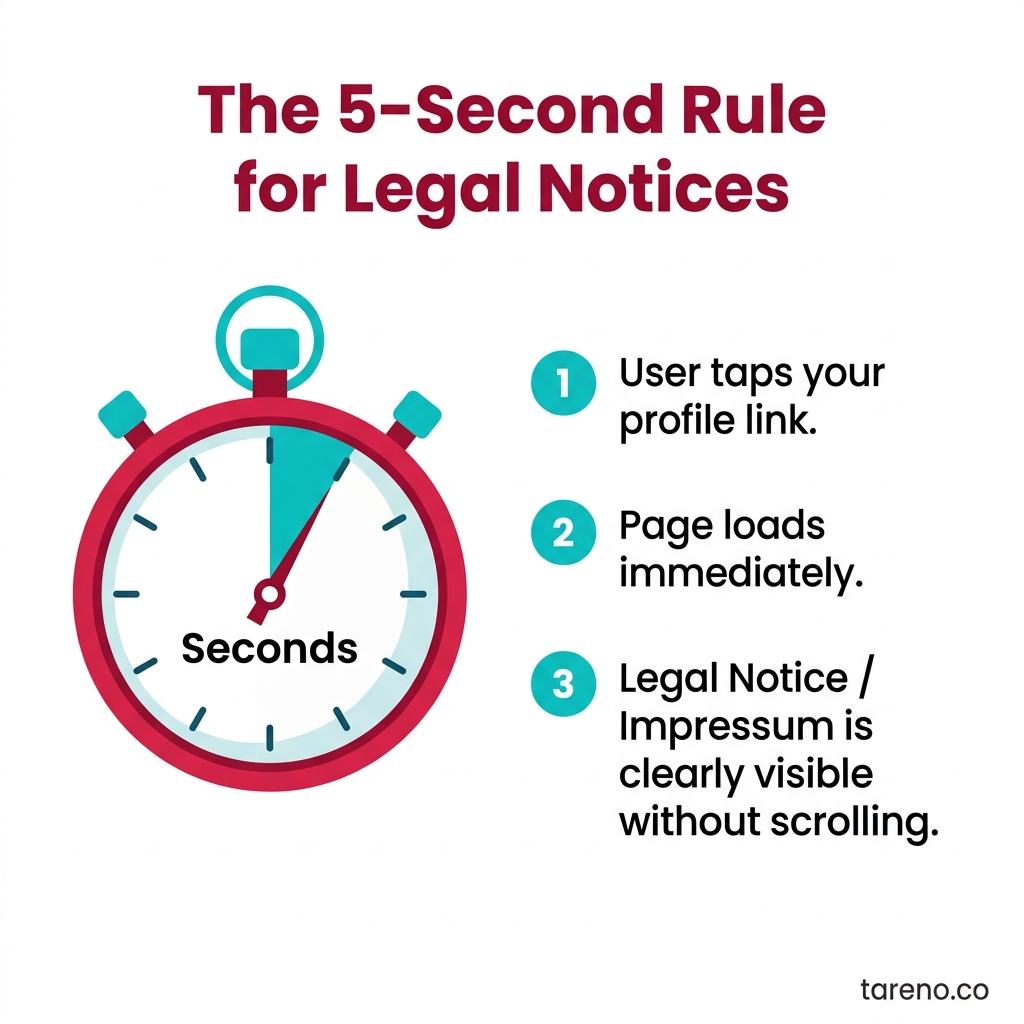
The so-called 5-second rule is best understood as a practical warning sign, not as the wording of a statute. German compliance discussions around the Impressum focus on whether the provider information is easy to identify and directly accessible. The five-second idea is simply a usability shortcut: if a normal user has to hunt for the legal notice, guess where it might be hidden, or click through a maze of generic labels, the setup is probably weak.
That distinction matters because teams often repeat the phrase as if the law literally says “five seconds.” It does not. Treating it as a hard legal timer creates false certainty. The better interpretation is operational: can an ordinary user reach the legal notice quickly, clearly, and without confusion?
Compare two profiles. Profile A has a website field that leads directly to the company’s legal notice, and the bio clearly signals the business identity. Profile B sends users to a link hub with campaign pages, podcast links, and a “More” button that eventually leads to a small “Legal” item. Both technically contain a path, but only one is clearly optimized for recognizability and direct accessibility.
This is why many practitioners work toward a two-click-style setup. Not because every platform is judged by a magical fixed number, but because fewer, clearer steps usually reduce risk. In practical terms, the 5-second rule asks one blunt question: can a user find the legal notice almost immediately, or are you forcing them to solve a puzzle?
The F.A.S.T. Legal Check
The F.A.S.T. Check: A Practical Framework
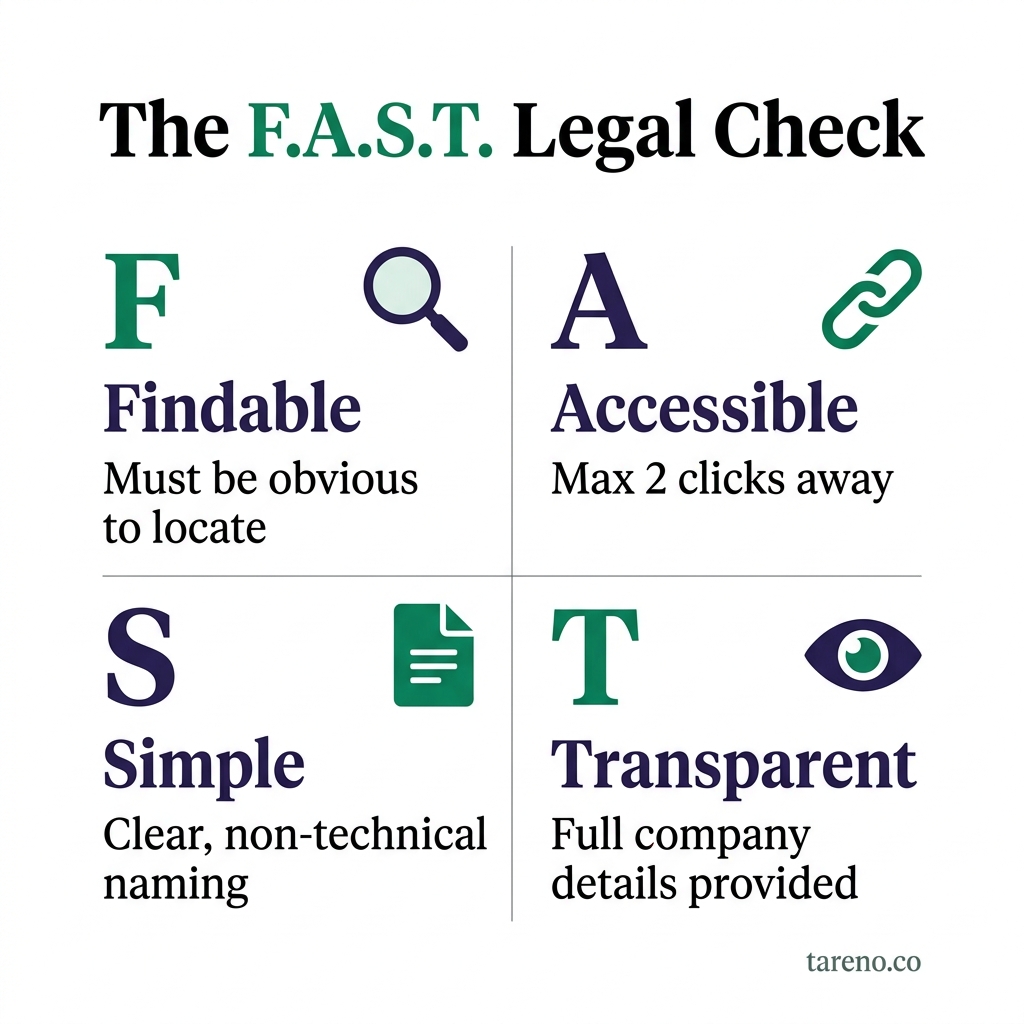
A useful way to review any profile is the F.A.S.T. check:
F — Findable: Can a user spot where the legal notice is located without guessing?
A — Accurate: Does the linked legal notice contain the current provider details?
S — Single-purpose path: Is the route reasonably direct, without unnecessary detours?
T — Tied to every business profile: Is the same approved setup applied across all relevant accounts?
This framework matters because most social media legal-notice failures are not about drafting a new Impressum from scratch. They happen because teams change bios, rotate campaign links, hand accounts to agencies, or launch new channels faster than governance keeps up.
Take a small agency managing five client profiles. One client profile links directly to /impressum, another sends users to the homepage, the third uses a link-in-bio page with no legal label, and the fourth still points to an outdated domain. Legally, these are not all the same quality, even if someone internally says, “There is an Impressum somewhere.”
Use the F.A.S.T. check as a simple workflow:
Open the profile as a normal user.
Try to find the legal notice without prior knowledge.
Count the steps and watch for ambiguous labels.
Confirm that the destination still works and matches the correct company or client.
Repeat this review for every active business-facing account.
If the route is not findable, accurate, direct enough, and consistently applied, fix the profile before you fix anything else.
Where Should the Legal Notice Live?
In most cases, the cleanest setup is not to duplicate legal text on every platform, but to make sure each relevant profile points clearly to the legal notice that already exists on your website. That keeps the source of truth centralized while still giving users a direct route from the social profile.
The strongest option is usually a direct link from the profile to the legal-notice URL itself. A company page linking straight to example.com/impressum is easier to understand, easier to test, and easier to document than a profile that sends users to a generic homepage and hopes they will figure it out.
A homepage link can still work, but only if the legal notice is clearly visible from there. That is where many teams get sloppy. They assume “our website has an Impressum in the footer” solves the issue. Sometimes it does. Sometimes the footer is hard to reach on mobile, buried under app-style overlays, or visually drowned out by campaign elements. The website may be compliant in theory while the social-to-website path remains weak in practice.
A useful decision rule is this:
If the platform gives you one clear website field, prefer the direct legal-notice URL.
If business goals require the homepage or campaign page, make sure the legal-notice path remains immediate and obvious.
If neither is possible cleanly, document the fallback and review it regularly.
The legal notice should live where users can reach it reliably, not where the social team happens to have leftover link space.
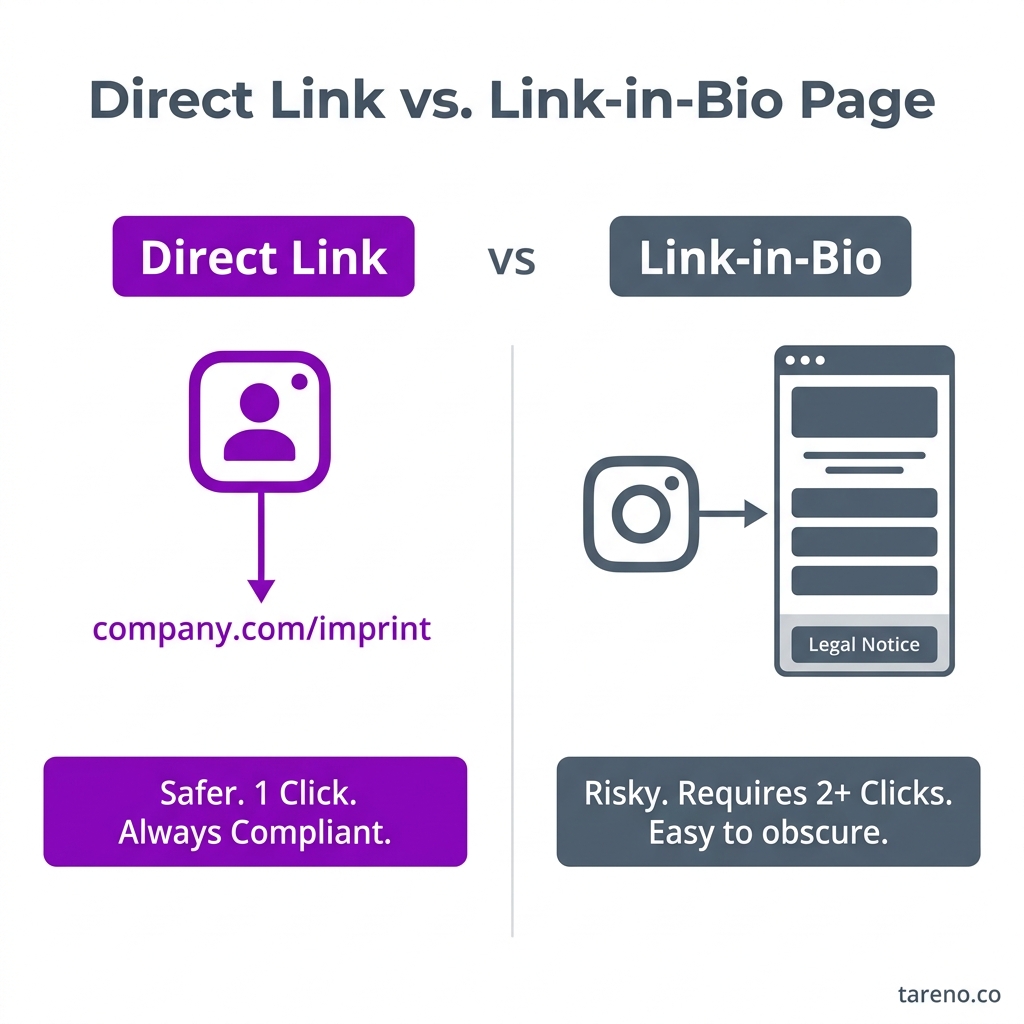
Direct Link vs. Link-in-Bio Page
Direct Link vs Link-in-Bio Page: Which Is Safer?
For most business profiles, a direct link to the legal notice is safer than routing users through a link-in-bio page. The reason is not that link hubs are automatically non-compliant. The reason is that every extra step adds ambiguity, and ambiguity is exactly what a legal-notice setup should avoid.
A direct link has three advantages. First, it reduces click depth. Second, it removes guesswork about which item contains the legal notice. Third, it is easier to audit when multiple people manage profiles. If a business account points straight to the correct legal-notice URL, the path is obvious.
A link-in-bio page can still work, but only if the legal notice is clearly labeled and quickly reachable. Problems begin when the page is optimized purely for marketing: newsletter signup, shop, latest campaign, podcast, lead magnet, webinar replay, and then somewhere near the bottom a tiny “Legal” item that looks optional. At that point, the route may exist technically while failing the real-world accessibility test.
Comparison: direct link vs link hub
SetupStrengthMain riskBetter use caseDirect profile link to /impressumclearest and easiest to auditcompetes with marketing link spacebest default for many business accountsProfile link to homepage with visible legal noticeworkable if homepage is clearhomepage may hide legal links on mobileacceptable fallbackLink-in-bio page with clear Impressum itemflexible for multi-link needsextra click and label dependenceonly if design stays obviousLink-in-bio page with vague navigationweakest optionuser confusion and click mazeavoid
The better question is not “Can Linktree be legal?” but “Does this exact path remain easy to identify and directly accessible for a normal user?” If the answer is shaky, use the simpler route.
Platform-by-Platform Reality Check
The legal principle stays fairly stable across platforms, but the implementation quality changes because profile fields, labels, and link options vary. That is why social media legal-notice work is partly a legal issue and partly a platform-operations issue.
Instagram gives limited profile real estate, so clarity matters. If the website field points directly to the legal notice, the route is easy to understand. If the profile uses a link-in-bio page instead, the legal notice should still be clearly labeled and easy to reach. A business account that treats the bio as a mini landing page must be careful not to bury the compliance path.
LinkedIn company pages often look more formal, which can make teams complacent. But the same question applies: does the page route users clearly to the provider information? For B2B firms that use LinkedIn as a lead channel, this is not a cosmetic detail. The account is often part of the commercial front door.
Facebook pages generally offer more fields and structured business information. That helps, but it does not remove the need for review. Old pages, duplicated pages, regional pages, or inherited agency setups often carry outdated links. A stale legal-notice path is still a failure.
TikTok, Threads, and other fast-moving platforms
Newer or lighter-profile platforms create the hardest practical edge cases because link options may be limited. That does not remove the underlying compliance expectation. It simply means businesses should choose the clearest available path and review the profile whenever platform UI changes.
YouTube
YouTube channels often combine branding, editorial content, and external links. For businesses using YouTube commercially, the profile and channel metadata should be reviewed with the same findability mindset.
The operational lesson is bigger than any single platform: platform-native publishing still needs governance. If your brand publishes across several networks, profile compliance cannot depend on whoever last edited the bio on a Friday evening.
How Teams Keep Social Profiles Legally Consistent
The hardest part of social media legal-notice compliance is usually not creating the legal notice. It is keeping every active profile aligned as campaigns change, contributors rotate, and platforms evolve. In practice, this is a governance problem.
A small team can often manage the issue with a simple checklist:
approved legal-notice URL
approved label wording
approved fallback path if a direct URL is impossible
owner responsible for checking profiles after major edits
Larger teams and agencies need stronger controls. Client accounts, regional profiles, franchise pages, and platform-specific bios drift fast when no shared standard exists. One editor prioritizes campaign CTR, another uses a link hub, and a third copies an old profile template from a different client. The result is inconsistency, which is exactly what the F.A.S.T. check is designed to expose.
A shared Brand Kit (Legal) can help teams document the canonical legal-notice URL, approved link labels, and profile conventions for each channel. That is useful because it turns “someone should remember the right setup” into “the approved setup exists in one shared reference.”
The correct framing is operational, not promotional. A Brand Kit does not replace legal review, does not guarantee compliance, and does not solve edge cases automatically. What it can do is reduce avoidable inconsistency across managed profiles.
At scale, this links directly to the broader truth that social media automation needs compliance checkpoints. The more repeatable your publishing system becomes, the more dangerous undocumented profile changes become.
When Not to Rely on a Quick DIY Decision
Most ordinary business profiles can improve their position with a clearer legal-notice path and a simple audit. But some cases deserve more than a fast internal check.
One category is the editorial-journalistic or publisher-like account. If a channel regularly publishes commentary, reporting, or media-style content, additional information duties may become relevant. Another category is the regulated business: healthcare, finance, legal services, or sectors where profile statements intersect with stricter compliance expectations. A third category is the complex corporate structure, where the visible brand, operating company, and local entity are not the same.
There is also a softer reason not to over-trust DIY shortcuts: platform design changes. A profile that looked fine six months ago can become weaker after a redesign, a link-field change, or a new mobile interface. That is why legal-notice maintenance should be reviewed periodically, not only during website relaunches.
A final warning: simplicity beats cleverness. If your setup requires a paragraph of explanation to justify why users can eventually find the legal notice, the setup is already too fragile. Good compliance architecture is boring on purpose.
When to Use This Approach — and When Not To
Use the practical framework in this article when you need to assess business-facing profiles, compare direct links with link hubs, or standardize legal-notice handling across multiple social accounts. It is especially useful for agencies, in-house marketing teams, solo consultants, and brands active on more than one platform.
Do not rely on this article alone when your case involves complex media-law questions, regulated-sector rules, disputed company identities, or unusual editorial setups. In those situations, the right next step is legal review, not a more creative bio link.
FAQ
Do all social media profiles need an Impressum?
No. The issue is most relevant for profiles used commercially or as part of a public business presence. Purely private accounts are a different case, while mixed-use accounts should be reviewed carefully.
Is the 5-second rule an actual law?
No. It is better understood as a practical shorthand for easy recognizability and direct accessibility. The phrase is useful, but it should not be treated as the exact wording of the statute.
Is a Linktree page enough for a legal notice?
Sometimes, but only if the legal notice is clearly labeled and easy to reach. A crowded link hub with vague navigation creates more risk than a direct link.
Can one website Impressum cover all accounts?
Often yes, if it is the correct legal notice for the business and each relevant profile links to it clearly. The existence of the website notice alone is not enough if the profile path is confusing.
What is the difference between a legal notice and a privacy policy?
A legal notice identifies the provider behind the offer. A privacy policy explains how personal data is processed. They solve different compliance problems and should not be confused.
What should agencies do for client profiles?
Agencies should document the approved legal-notice URL, test each profile path, and treat bio or profile-link edits as a controlled change. The biggest agency risk is inconsistency across accounts.
Key Takeaways
A social media legal notice is mainly an accessibility problem, not just a text problem.
The 5-second rule is a practical shorthand, not the text of the law.
Direct and clearly labeled routes are usually safer than multi-step link mazes.
Link-in-bio pages can work, but only when the legal notice remains obvious and easy to reach.
Teams reduce risk when they standardize legal-link conventions across all active business profiles.
Quotable Passage
If users must guess where your legal notice lives, your social profile is already doing compliance the hard way.
Sources
§ 5 DDG (Digitale-Dienste-Gesetz), official text: https://www.gesetze-im-internet.de/ddg/__5.html
§ 18 MStV (Medienstaatsvertrag), official publication: https://www.gesetze-bayern.de/Content/Document/MStV-18
Editorial Note
This article is practical guidance for operators, not individual legal advice. Borderline cases and sector-specific questions should be reviewed with qualified counsel.