How to go viral on Instagram comes down to one job: get a Reel in front of people who do not follow you, and give them a reason to watch it to the end and send it to someone. Nobody can guarantee that, and as far as the sources we found show, Instagram does not publish a view count that counts as "viral". What you can do is set a threshold on your own account, avoid what Instagram says reduces visibility, make the Reel worth forwarding, and test your opening with Trial Reels.
Tareno publishes this guide and offers a product discussed here. The worked examples are illustrative; this article does not report a connected-account test or measured customer results.
TL;DR
- Define "viral" relative to your own account and fix the threshold before you post.
- Instagram ranks each part of the app separately and publishes no weights.
- It says it shows watermarked and already-posted Reels, among others, less; see the checklist.
- Test one message with three openings as Trial Reels and read the numbers after about 24 hours.
- If you sell locally, count enquiries as well as views.
Quick definition: A Reel is "viral" for your account when it clearly beats your usual Reels in reach and in sends per view, mostly among non-followers. The threshold is yours to set (three conditions below).
What "viral" should mean on your account
A fixed number such as 100,000 views is useless to a small account and trivial to a large one. Crown Media's creator guide makes the point with 10,000 views on 500 followers against 50,000 on 200,000; it is commentary, not a study (April 2025, updated September 2026), so take the principle, not the numbers.
Three conditions, measured against your recent posts:
- Size: views at least 3x the median of your last 10 Reels. The 3x is a choice, not an Instagram rule; pick a multiple you would be pleased by.
- Audience: most views come from non-followers.
- Quality of attention: sends per view (or per reach, if your Insights show it) above your usual. Raw counts grow with reach, so compute a ratio.
Adam Mosseri, Instagram's head, has described watch time, likes and sends as the top three ranking signals and advised creators to watch "average watch time, likes per reach, and sends per reach", according to Social Media Today's January 2025 summary of his video series. The summary adds that likes count a little more for connected viewers (people you already have a relationship with) and sends a little more for unconnected ones. That is a press account with no weights: track ratios, not a formula.
What Instagram says it rewards, and which claims have no source
Instagram's own ranking explainer (Mosseri, May 2023) says there is no singular algorithm: Feed, Stories, Explore and Reels each rank differently. For Reels it describes predicting whether you will reshare, watch to the end, like, or visit the audio page. It also says it aims to make low-resolution, watermarked, muted, bordered, majority-text and already-posted Reels less visible.
| Claim you will hear | Status | What to do with it |
|---|---|---|
| Instagram ranks Reels on predicted watch-through, likes, sends | Stated by Instagram (explainer) | Design for watching to the end and for being sent |
| Watch time, likes, sends are the top three signals | Mosseri, reported by press | Track all three, weight none |
| Watermarked or reposted Reels are shown less | Stated by Instagram | Export clean, film your own footage |
| A hook must land in 1 to 2 seconds | Rule of thumb, for example in this agency guide, without data | Treat as a prompt to test |
| Hashtag counts, best posting times, ideal frequency | No source found | Skip until your own data says otherwise |
| Which signal is strongest, or any weighting | Not published | Do not trust anyone who quotes one |
The test: one message, three openings
The rest of this article follows one worked example. The shop, the Reel and every number are invented for illustration; this is not a real account or a real test.
The account: a bike repair shop in a mid-sized city. The owner films herself, has about 3,200 followers, and her last 10 Reels have a median of 600 views. Her goal: local riders who do not follow her sending the Reel to a cycling friend, and a few booking a repair.
The idea: "When your chain skips under load, a worn cassette is a common cause, not only the chain." It is a frequent repair question with someone to forward it to: the friend whose bike does exactly that.
What makes a Reel send-worthy
The press summary reads sends as a sign that people think a post deserves a wider audience (the author's interpretation, not Mosseri's words); neither it nor Instagram's pages say what makes a Reel sendable, so the rest is a testable idea, not a finding. People may send a Reel when it is addressed to someone they can name. The bike Reel has that: "send this to the friend whose bike does this". Two more things that could work: a mistake the viewer may be making right now (buying a chain that will not fix the problem) and something they will want to find again. Before filming, ask who you would forward it to.
Watch time is the first of Mosseri's three signals, but the sources give no recipe for it. These prompts are equally untested:
- Promise one payoff in the opening and deliver it in the last seconds.
- Cut any beat that restates the previous one; below, the 6-11 s gauge beat is the first candidate if it drags.
Step 1: Write the definition before you post
Her conditions, fixed in advance:
- Views of at least 1,800 (3 x 600).
- Mostly from non-followers.
- Shares per view above her usual. From her last 10 Reels, in normal Insights, she calculates 0.6%.
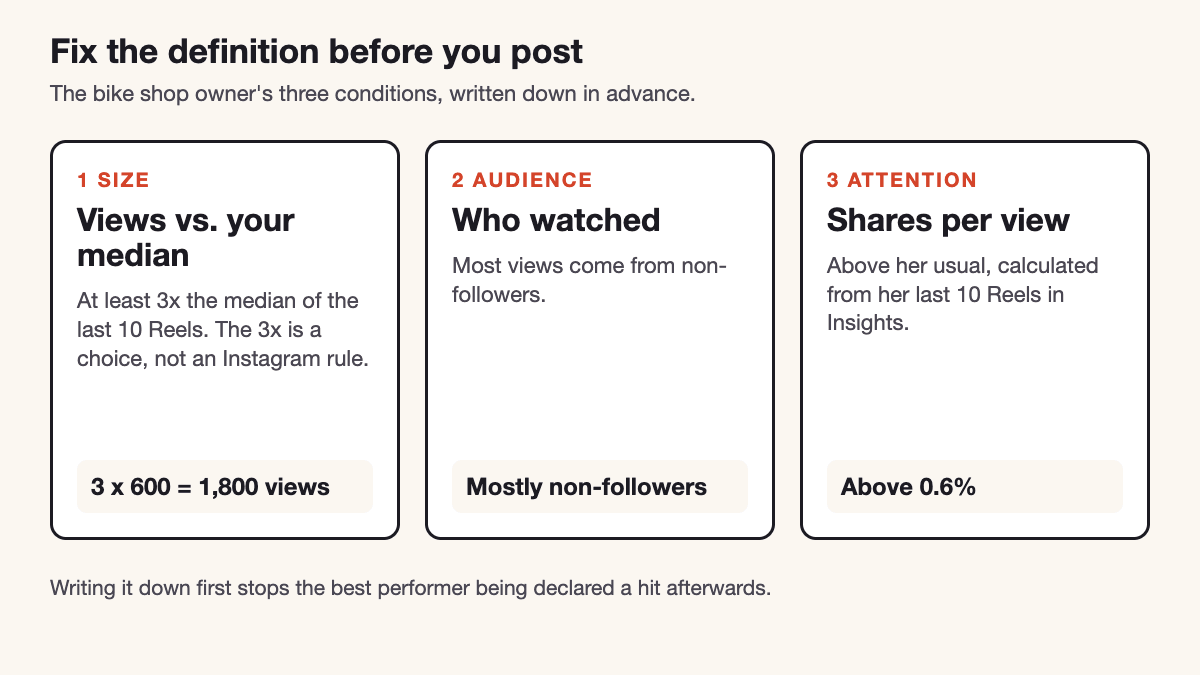
Writing it down first stops the best performer being declared a hit afterwards. One catch: those baselines come from normal Reels, which reach followers and others, while a Trial Reel is shown to non-followers first, so they are not like-for-like. The Trial viewer's "shares" is also assumed, not verified, to be the same count as the shares or sends behind her 0.6%. Instagram's viewer does not make this comparison; it is her own. She compares the three trials with each other first, treats 1,800 and 0.6% as orientation only, and tests her definition after the winner is shared normally (Step 6).
Step 2: Three openings, same message
The 22-second Reel is identical after the first two seconds.
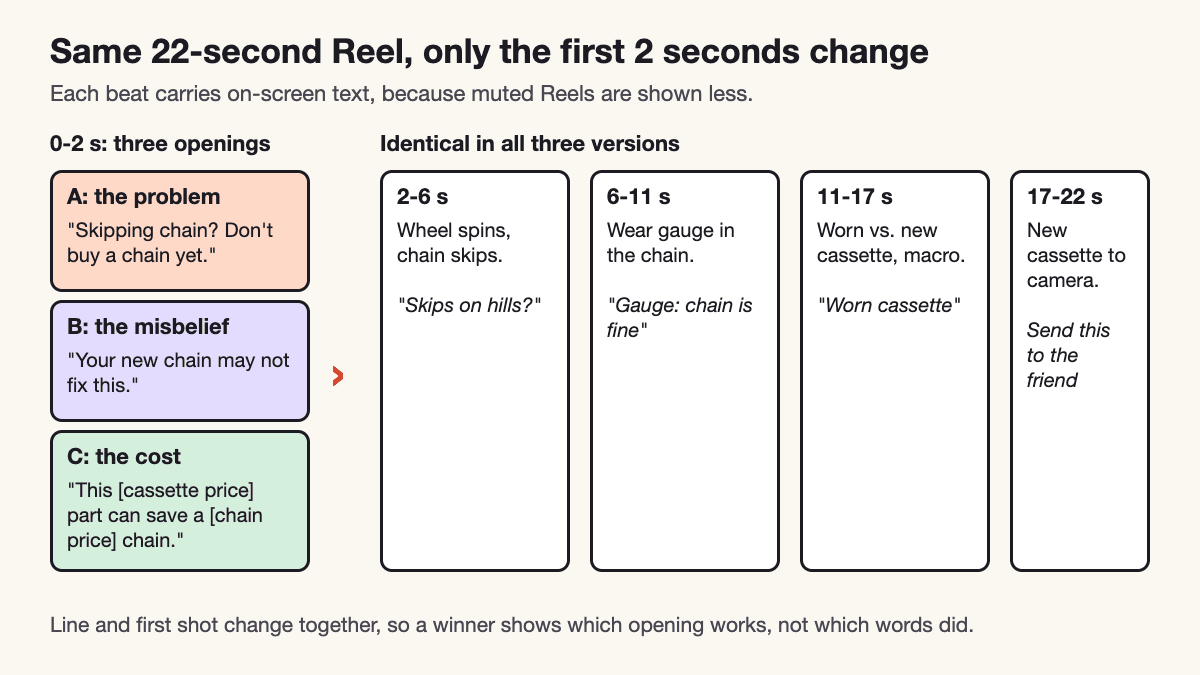
| Variant | On-screen text and spoken line | First shot | What the viewer is asked to notice |
|---|---|---|---|
| A: the problem | "Skipping chain? Don't buy a chain yet." | Close-up of the chain jumping under pedal pressure on a repair stand | A fault they have felt, shown |
| B: the misbelief | "Your new chain may not fix this." | Hand holding a new chain still in its box | Doubt about an assumption |
| C: the cost | "This [cassette price] part can save a [chain price] chain." | Cassette in one hand, chain in the other | A saving, both parts in view |
The brackets in variant C stand for the shop's own current prices.
Line and first shot change together, so a winner shows which opening works, not which words did. Use original or licensed sound and on-screen text that remains understandable with sound off. Text is an accessibility aid, not a workaround for recommendation rules.
Step 3: The shot list for the rest of the Reel
0-2 s    Opening (variant A, B or C, see table)
2-6 s    (written to follow any of the three openings)
         Wheel spinning on the stand, chain skipping under hand pressure on the pedal.
         Text: "Skips on hills?"
         Voice: "A chain that skips on hills isn't always the chain."
6-11 s   Wear gauge dropped into the chain; reads within limit.
         Text: "Gauge: chain is fine"
         Voice: "Check wear with a gauge. This one is fine."
11-17 s  Side-by-side macro: worn cassette teeth (hooked, shark-fin profile)
         next to a new cassette. Text: "Worn cassette"
         Voice: "The cassette teeth are worn, so even a good chain can jump."
17-22 s  Mechanic's hand holds the new cassette to camera.
         Text: "Gauge fine + still skipping = check the cassette"
         Voice: "Send this to the friend whose bike does this."
The caption:
Chain skipping when you push hard? Before you buy a chain, measure its wear
with a gauge. If the chain is within limits and it still jumps, a worn
cassette is a common cause, and a new chain on a worn cassette can skip again.
Send this to the friend who keeps saying "it only does it on hills".
Want it checked? Message us "CHAIN" or book via the link in our bio.
The footage is her own. The Instagram caption generator can draft a caption, but a mechanic must confirm the technical claim.
Check the export separately with the Instagram image resizer when preparing still covers. A correctly sized cover does not establish recommendation eligibility or improve reach by itself.
Step 4: Post them as Trial Reels, spaced out
Instagram's Trial Reels (Meta’s December 2024 announcement) are shown first to people who do not follow you. About 24 hours after sharing, the viewer shows views, likes, comments and shares and compares it with your earlier Trial Reels. With automatic sharing on, Instagram judges success by views in the first 72 hours; the page names no threshold, so we infer it is not published. Followers can still meet a trial via DM or the audio page, so the audience is mostly, not strictly, non-followers.
She posts A on Monday, B on Wednesday and C on Friday. Instagram's originality guidelines (April 2024, German version) say that for identical posts it recommends only the original, if that is relatively recent and audiovisual signals confirm the match. Three near-identical Reels on the same day are a poor test. Spacing has a cost: different weekdays and a fixed order may favour C or A, so the result is a hint, not proof. Next round she rotates the order.
The Trial page does not name reach, watch time or sends per reach, so the test uses only the numbers below. "Booking messages" is the shop's own count, not an Instagram metric.
Step 5: Read the numbers
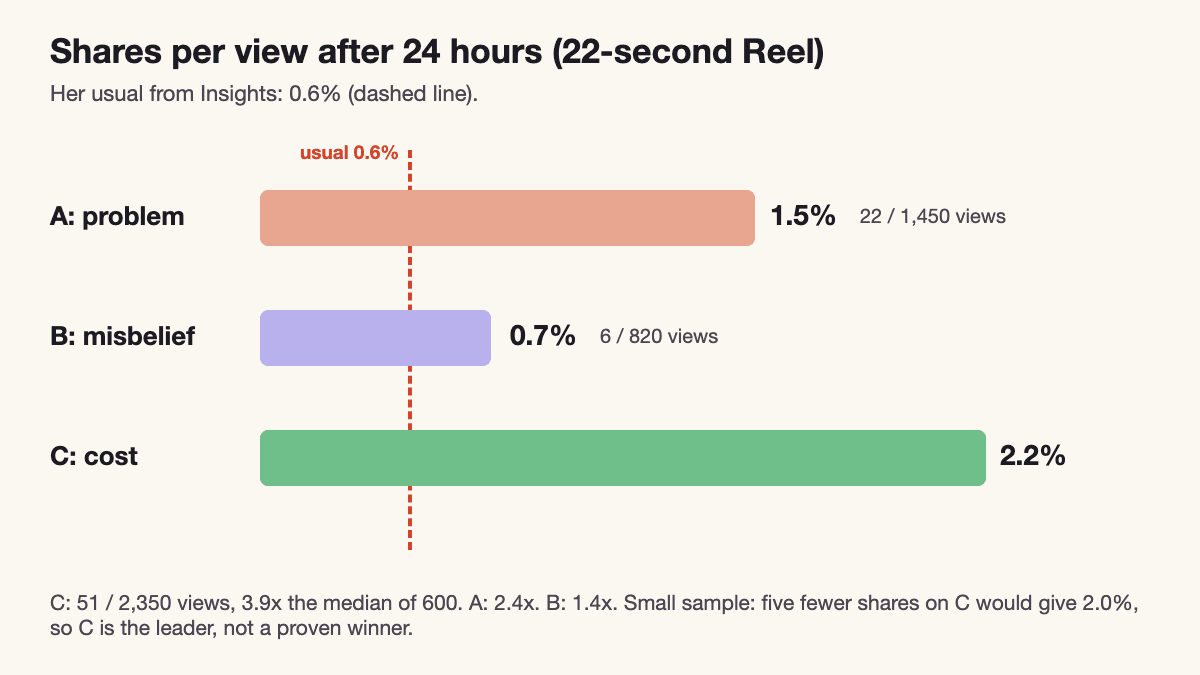
After 24 hours each trial shows these figures for the 22-second Reel:
| Views | Shares | Likes | Booking messages (shop's own count) | |
|---|---|---|---|---|
| A: problem | 1,450 | 22 | 51 | 2 |
| B: misbelief | 820 | 6 | 30 | 0 |
| C: cost | 2,350 | 51 | 68 | 5 |
The arithmetic:
Views vs. median (600):  A 1,450 / 600 = 2.4x    B 820 / 600 = 1.4x    C 2,350 / 600 = 3.9x
Shares per view:         A 22/1,450 = 1.5%       B 6/820 = 0.7%        C 51/2,350 = 2.2%
Likes per view:          A 51/1,450 = 3.5%       B 30/820 = 3.7%       C 68/2,350 = 2.9%
Her usual (Insights):    0.6%
- C clears the orientation numbers: 3.9x the median and the highest shares per view (2.2% against 0.6%). That does not yet meet her definition, which is only tested once C is shared normally and Insights show the follower split.
- A is good but short of 1,800 views: 2.4x, with shares above 0.6%.
- B is flat: likes per view match the others, but almost nobody forwarded it and it barely cleared 0.6%.
Likes per view barely separates the three (2.9% to 3.7%); shares per view does (0.7% to 2.2%). The sample is small: with 22 and 51 shares, one local rider group moves the ratios. Five more shares on A would give 27/1,450 = 1.9%; five fewer on C, 46/2,350 = 2.0%. She treats C as the leader, not a proven winner.
Step 6: Decide, then change one thing
- Share C with her followers manually. Automatic sharing follows Instagram's own view threshold, not her 1,800. Afterwards she checks C against her definition in normal Insights: follower split, reach, watch time.
- The next test keeps C's line and changes only the first shot, for example the cassette alone in macro against both parts in hand.
- Check the business question separately: 5 booking messages from C, 2 from A, 0 from B. Views without messages would mean spectators, not customers.
Before you post: what removes a Reel from recommendations
The originality page says accounts that repeatedly post others' content without substantial editing, 10 or more times in the last 30 days (a rolling count), lose recommendations. It also says content that qualifies for recommendation must carry no visible watermarks. TechCrunch reported in April 2026 that Instagram extended the originality rules from Reels to photos and carousels, and that adding a watermark or changing playback speed does not count as a substantial edit (TechCrunch). Followers still see the posts; only recommendation is withheld.
- Footage is yours, exported without a visible watermark.
- Full resolution, sound on, text that works muted, no borders, not mostly text.
- Not a repost of something already published, apart from a real edit.
- Account Status in the app lists no ineligible content; the originality page says you can appeal there.
Where research on other people's Reels fits
Studying which Reels in your niche beat their account's usual is a sound way to find topics and openings to test. Tareno's Get Viral Now page describes pasting a video link or surfacing outliers in a niche, and breaking a video down into hook, scenes, B-roll, on-screen text and dialogue. Analysis consumes credits; check Business access and the currently available discovery sources before starting a run. It supplies reference material; topic, footage and test stay with you.
For an agent-assisted research pass, the research-before-writing workflow shows how to keep sources attached to a brief. The agent can prepare ideas; the Trial Reel test and the account’s actual metrics still have to be checked in Instagram.
One card per variant on a Content Boards board (check current plan limits before organizing a larger campaign) keeps the variants straight. Trial Reels are created and read inside Instagram; this article does not cover scheduling them from Tareno. Related: post scheduling, analytics reports.
When to use this approach, and when not
Use it when you can make several Reels on one topic, have a median to compare against, and want to reach strangers. It fits poorly when your audience is already your list (Stories and DMs serve existing clients better), when you film less than one Reel a month, or when you need leads from a small area: for a bike shop, 2,350 national views are worth less than 400 within cycling distance.
Key takeaways
- Fix your own "viral" threshold before posting.
- Test the opening with Trial Reels, one change per round.
- Judge on shares per view and enquiries.
FAQ
How many views do you need to go viral on Instagram?
There is no official number. A workable threshold is relative to your account, as set out above: for example 3x your median over the last 10 Reels.
Do sends matter more than likes?
Mosseri named sends as one of three top signals, slightly more important for unconnected viewers (press summary). No weights are public, so measure both ratios.
What are Trial Reels, and do they help a small account?
Trial Reels are shown to non-followers first and report views, likes, comments and shares after about 24 hours, per Instagram's creator blog. They let a small account compare openings without showing each to its followers first.
Am I shadowbanned if my Reel got few views?
Low views alone do not establish an account restriction. Social Media Today's coverage of Instagram's 2023 explainer says the company does not use a shadowban as such; the practical step is to open Account Status in the app and check for listed issues.
What is the best time to post a Reel, and how often?
The editorial team found no source that supports a specific time or frequency, so none is given here.
Conclusion
Going viral on Instagram is a result you measure, not a setting you switch on. Set your threshold, make the Reel something a specific person would forward, and test one change per round.