A high-performing video contains more than a good topic. Its result may depend on the opening, tension, pacing, evidence, payoff, and fit with the audience. The useful question is not "How do I copy this video?" but "Which transferable pattern can strengthen an original brief?"
Look for:
a strong opening sentence
a clear tension point
fast pacing
a curiosity gap
a pattern interrupt
a useful story
a strong payoff
a memorable CTA
a structure that keeps viewers watching
The difficult part is separating meaningful structure from coincidence. Copying the visible surface creates derivative content, while starting from zero ignores useful evidence.
Get Viral Now can discover public short-form references across supported sources, while Quick Blueprint currently analyzes public YouTube URLs. This guide follows that YouTube path with the YouTube transcript extractor, a source-bound credit quote, explicit approval, and an original production brief.
Use the patterns as evidence for a new brief—not as copy.
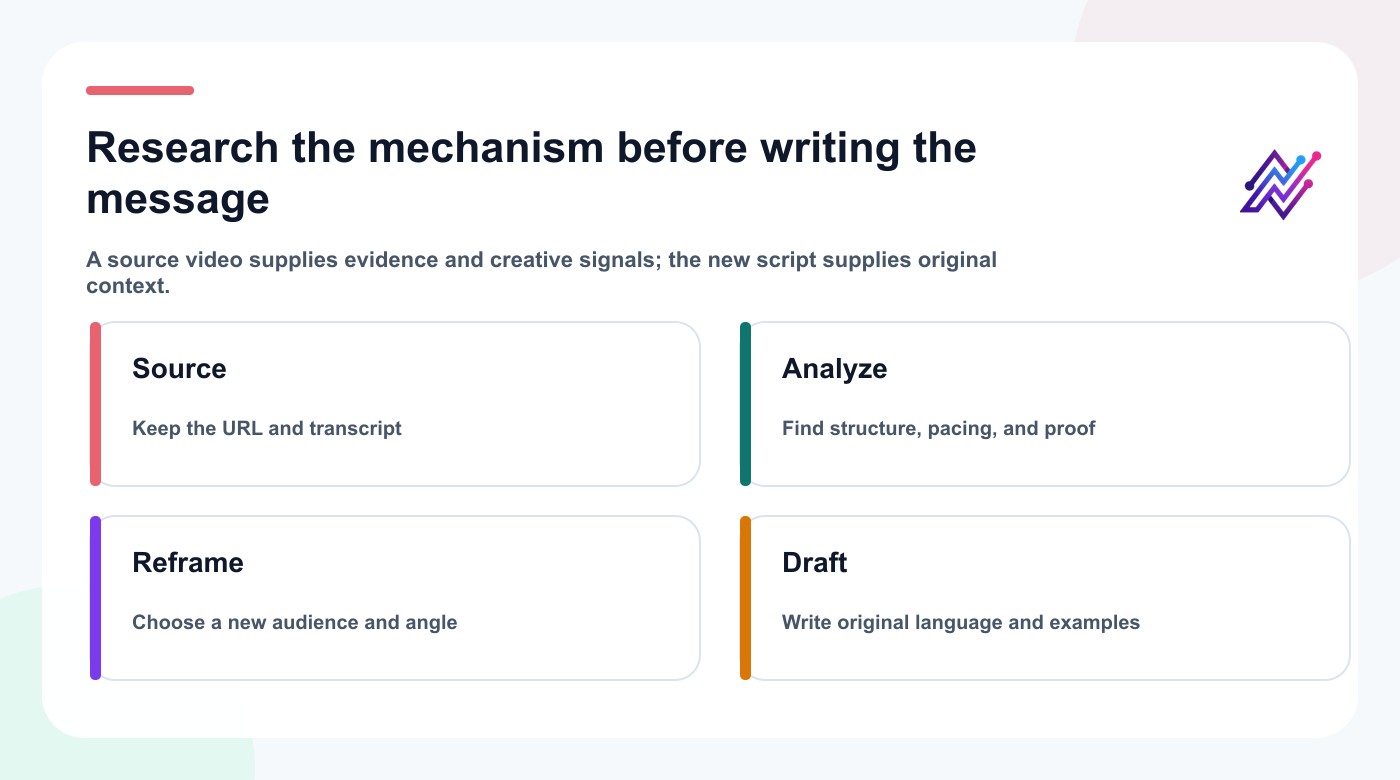
The source informs the mechanism; the new brief owns the audience, angle, evidence, and wording.
The output should be an original script built around your topic, product, perspective, audience, and voice—not a reproduction of another creator’s words.
This guide explains how the workflow should be used, what to analyze, how to avoid shallow copying, how to adapt a script for TikTok, Instagram Reels, YouTube Shorts, LinkedIn video, Bluesky, Mastodon, and other channels, and how to move the final script into Tareno’s content workflow.
TL;DR
A practical Get Viral Now workflow looks like this:
Choose a relevant YouTube video.
Paste the video URL into Tareno.
Let the system retrieve and analyze the transcript.
Review the hook, structure, pacing, tension, proof, and CTA.
Choose the part worth learning from.
Define your own audience, topic, and angle.
Generate several original script options.
Edit the strongest version in your own voice.
Adapt it for the target platform.
Save it as a Tareno draft.
Route it through approval if needed.
Publish, measure, and repurpose the result.
The key rule is:
Learn from the structure, not the wording.
A good research-to-script workflow should make your content more informed, not more derivative.
From source video to original script
Get Viral Now turns a video URL into a structured content research workflow.
At a high level, the feature can:
accept a YouTube URL
retrieve the transcript where available
analyze the content
identify structural patterns
surface the main idea
detect the opening strategy
map the content flow
identify tension and payoff
suggest original angles
generate a new script
adapt the script for different platforms
save the result into the Tareno workflow
The workspace keeps the source, research brief, creative blueprint, and handoff context together so the new script remains traceable to its evidence.
The strongest product positioning is not:
Paste a video and copy the script.
The stronger positioning is:
Paste a video, understand why it works, and turn that insight into an original script for your audience.
That distinction matters for both quality and trust.
Why transcript analysis is useful
A transcript makes the hidden structure visible.
When you only watch a video, you may remember the topic or personality.
When you read and analyze the transcript, you can inspect:
the first sentence
the first promise
the first moment of tension
sentence length
pacing changes
examples
transitions
proof
objections
emotional shifts
payoff
CTA
This helps answer better questions.
Instead of:
Why did this go viral?
You can ask:
What happened in the first three seconds?
What information was delayed?
What did the viewer want to know?
How often did the script change direction?
Was there a story?
Was there a clear enemy or mistake?
Did the creator make a bold claim?
How quickly did the script provide proof?
What made the ending satisfying?
Was the CTA connected to the topic?
These questions are more actionable than raw view count.
The six layers of a viral script
A useful analysis should separate the script into layers.
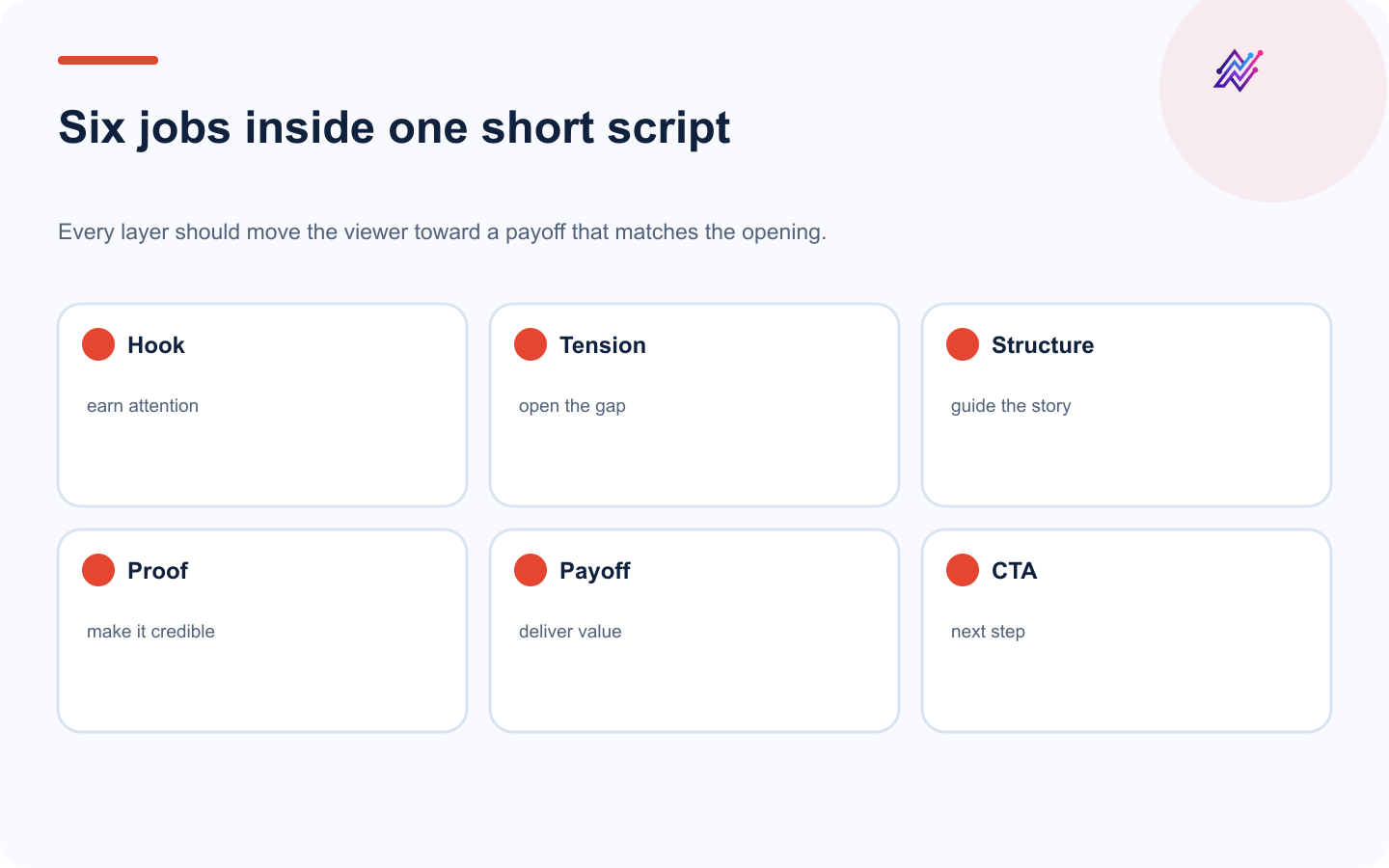
A strong script aligns the hook, proof, and payoff instead of optimizing the opening alone.
1. Hook
The hook creates the first reason to stay.
Common hook types:
surprising claim
painful problem
direct promise
unpopular opinion
question
contradiction
before-and-after
proof first
mistake
story opening
Example:
Most creators do not have a content problem. They have a distribution problem.
The hook is not only the first line.
It also establishes the expectation.
2. Tension
Tension creates a gap between what the viewer knows and what they want to know.
Examples:
a mistake that has not been explained
a result without the method
a claim without proof
a story before the outcome
a problem that appears difficult to solve
Tension keeps the script moving.
3. Structure
The structure is the order of information.
Common structures:
problem → reason → solution
result → explanation → method
mistake → consequence → fix
story → lesson → action
myth → truth → example
list → escalation → strongest point
before → turning point → after
Two videos can discuss the same topic but feel completely different because of structure.
4. Proof
Proof reduces skepticism.
Proof can include:
demonstration
example
number
screenshot
story
process
comparison
observable result
A bold hook without proof may create clicks but weak trust.
5. Payoff
The payoff answers the question created by the hook.
The viewer should feel that staying was worth it.
Weak scripts create tension but deliver a generic conclusion.
Strong scripts deliver a specific lesson, method, reveal, or example.
6. CTA
The CTA should follow naturally.
Examples:
try the method
save the checklist
comment with a question
watch the next part
visit the tool
use the template
compare the options
create your first draft
A CTA works better when it feels like the next step rather than an interruption.
How to choose the right source video
Do not use any high-view video.
Choose one that is relevant to the content you want to create.
A good source video should have:
a relevant audience
a useful topic
a clear structure
a format you can adapt
an angle that fits your brand
enough spoken content for analysis
a transcript that can be retrieved
a result worth studying
Avoid choosing a source only because it has many views.
A video may perform because of:
creator fame
controversy
trend timing
paid distribution
audience size
thumbnail
external event
existing community
The script may not be the main reason.
Use the source as evidence, not proof that one structure will always work.
Classify the source as use, use with constraints, or reject. Use it when the transcript and mechanism are inspectable; constrain it to reliable timestamps and independently checked claims when only part is useful. Reject sources whose result depends on celebrity, controversy, paid distribution, private context, unverifiable claims, or an unusable transcript. Save the reviewer, reason, allowed evidence, and decision with the source snapshot.
Step-by-step: create a script with Get Viral Now
Step 1: Create the Quick Blueprint project
For a source-grounded Quick Blueprint, add one primary public YouTube source and, when they add useful contrast, up to four supporting YouTube sources. The primary source anchors the structure; supporting sources should each contribute a specific hook, retention, visual, or CTA pattern. Set the target as TikTok, Instagram Reels, YouTube Shorts, or YouTube long-form; choose short-form or long-form; choose the output language; and set a realistic duration. Short-form targets are limited to 90 seconds. Tareno also supports a topic-only Quick Blueprint when no reference analysis is needed, but that is a different brief from the source-grounded workflow in this guide.
Before analysis, confirm:
the video is public
the video is relevant
the requested Quick Blueprint output language is English, German, French, Spanish, Portuguese, or Russian
a transcript is available
the content is not private or restricted
you have a legitimate reason to analyze it
the source has a recorded use, constrained-use, or reject decision
any allowed timestamps and unresolved claim checks are attached to the source snapshot
Before analysis, request the short-lived, source-snapshot-bound credit quote. Starting the run requires the project ID, quote ID, and a stable idempotency key for that intended run. It creates a dashboard approval; only approval may reserve the quoted credits and enqueue the analysis exactly once. If the quote expires or the source set changes, request a new quote instead of reusing stale approval data.
After approval, track the run by its run ID and retrieve the completed blueprint at the level you need—summary, script, production, or full—before creating downstream drafts.
Keep a compact evidence packet with the source URLs, quote ID and expiry, approval action ID, stable idempotency key, run ID, blueprint ID, retrieval detail, and the source snapshot used for the brief. For each factual claim that survives into the new script, record whether it is supported by the source, supported by your own evidence, or still requires verification. This makes review about evidence and originality instead of memory.
Accept the blueprint before derivative drafting. Bind its ID and source snapshot, mechanism, exclusions, unresolved checks, audience, proof, destination, reviewer, and acceptance time to the draft revision. Reopen acceptance when the source set, evidence boundary, or audience changes.
Bind a claim ledger to each variant: classification, evidence, owner, allowed wording, and recheck rule. Exclude unresolved claims, label examples, and never attribute creator proof to the source.
Do not reproduce copyrighted scripts word for word.
Use it for research, structure, and original ideation.
Step 2: Review the transcript
Read the transcript before generating anything.
Look for:
transcript errors
missing sections
incorrect names
repeated words
timestamps
speaker changes
irrelevant introduction
sponsor section
CTA section
Transcript quality affects analysis quality.
If the source transcript is weak, the generated structure may also be weak.
Step 3: Review the analysis
A useful analysis should identify:
core topic
target viewer
hook type
first promise
main tension
structure
key examples
emotional progression
proof
payoff
CTA
likely retention moments
parts that can be adapted
parts that should not be copied
Do not accept a generic summary.
The useful output explains how the script moves.
Step 4: Define your new angle
Before generating the new script, provide:
your audience
your topic
your offer
your point of view
your desired platform
your tone
your CTA
your target length
claims to avoid
examples you can support
Example:
Audience:
Solo SaaS founders who struggle to publish consistently.

Topic:
Why AI agents still need approval gates for social media.

Point of view:
Automation should remove repetitive work without removing accountability.

Platform:
TikTok and YouTube Shorts.

Tone:
Direct, practical, slightly opinionated.

CTA:
Try a draft-only Tareno MCP workflow.

Claims to avoid:
Do not promise guaranteed virality or fully autonomous safety.
This context creates originality.
Step 5: Generate multiple script options
Do not generate only one script.
Ask for:
one direct version
one story version
one contrarian version
one educational version
one fast-paced version
Then compare them.
The best version may combine two approaches.
Step 6: Edit in your voice
Review:
opening
sentence length
natural language
proof
unsupported claims
CTA
brand voice
originality
platform fit
Remove phrases you would never say.
Add your own experience, product details, examples, and opinion.
AI should provide a strong starting point.
It should not erase the creator.
Step 7: Save to Tareno
Save the selected version as a draft.
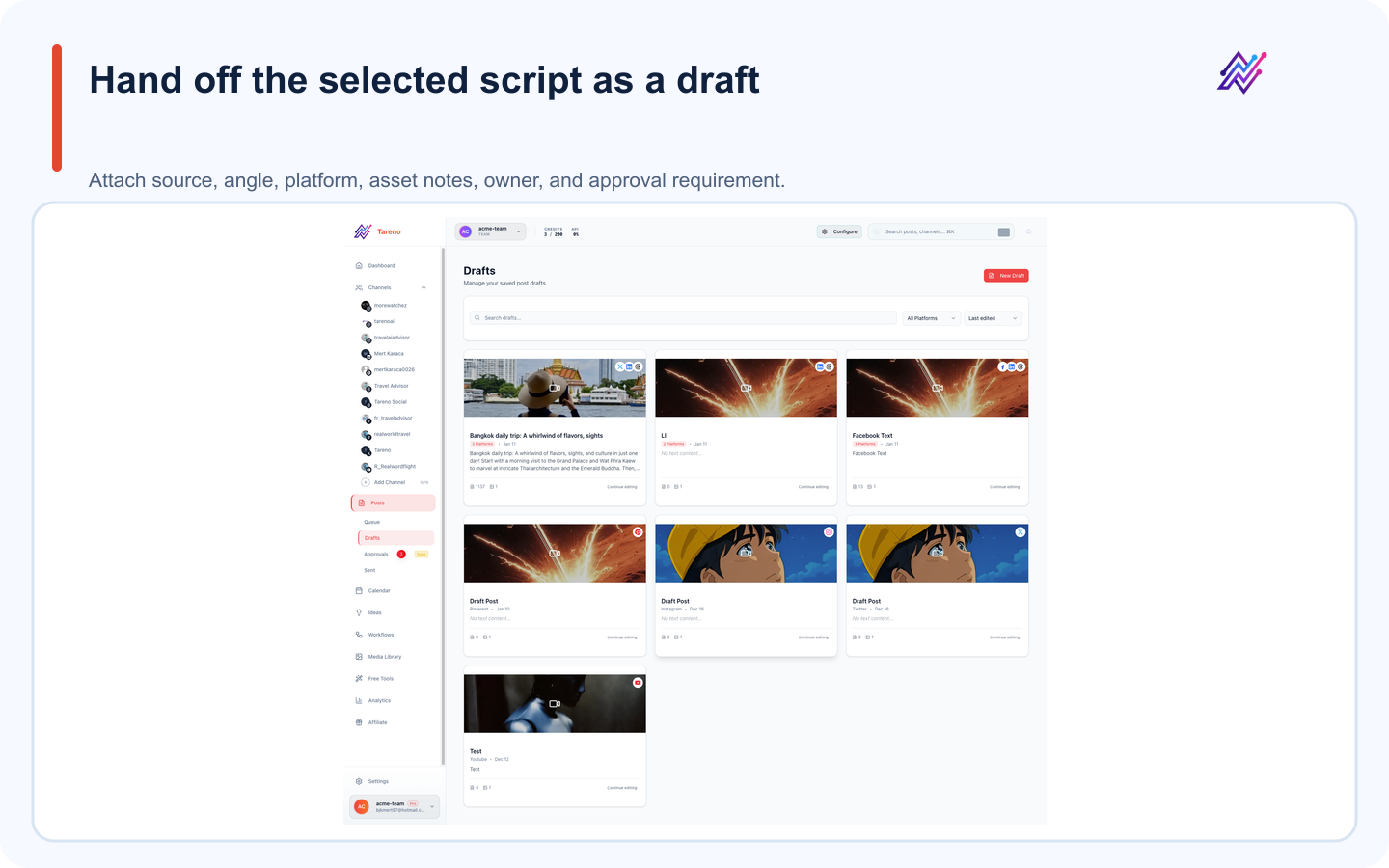
A draft is the reversible checkpoint between creative research and publishing.
Add:
target platform
campaign
source URL
script angle
asset notes
approval requirement
measurement goal
evidence packet and unresolved claim checks
repurposing potential
This connects content research to the production workflow.
Worked examples: from source pattern to new message
Assume the source video explains why people fail to stay consistent.
The transcript analysis reveals this structure:
bold statement
common mistake
hidden cause
simple system
example
action
Do not copy the wording.
Transfer the structure.
Original subject
Personal productivity.
New subject
Social media consistency for SaaS founders.
New script
Most founders do not stop posting because they run out of ideas.
They stop because every post starts from zero.
You open five tabs, look for inspiration, write a caption, resize the asset, and then forget to schedule it.
The fix is not more motivation.
It is a workflow where one idea becomes drafts for every platform, approvals happen in one place, and your best posts return to an evergreen queue.
Consistency becomes much easier when the system remembers what worked.
Start with one repeatable workflow before trying to post every day.
The structure is inspired by the pattern.
The words, topic, examples, and conclusion are original.
That is the right use of transcript analysis.
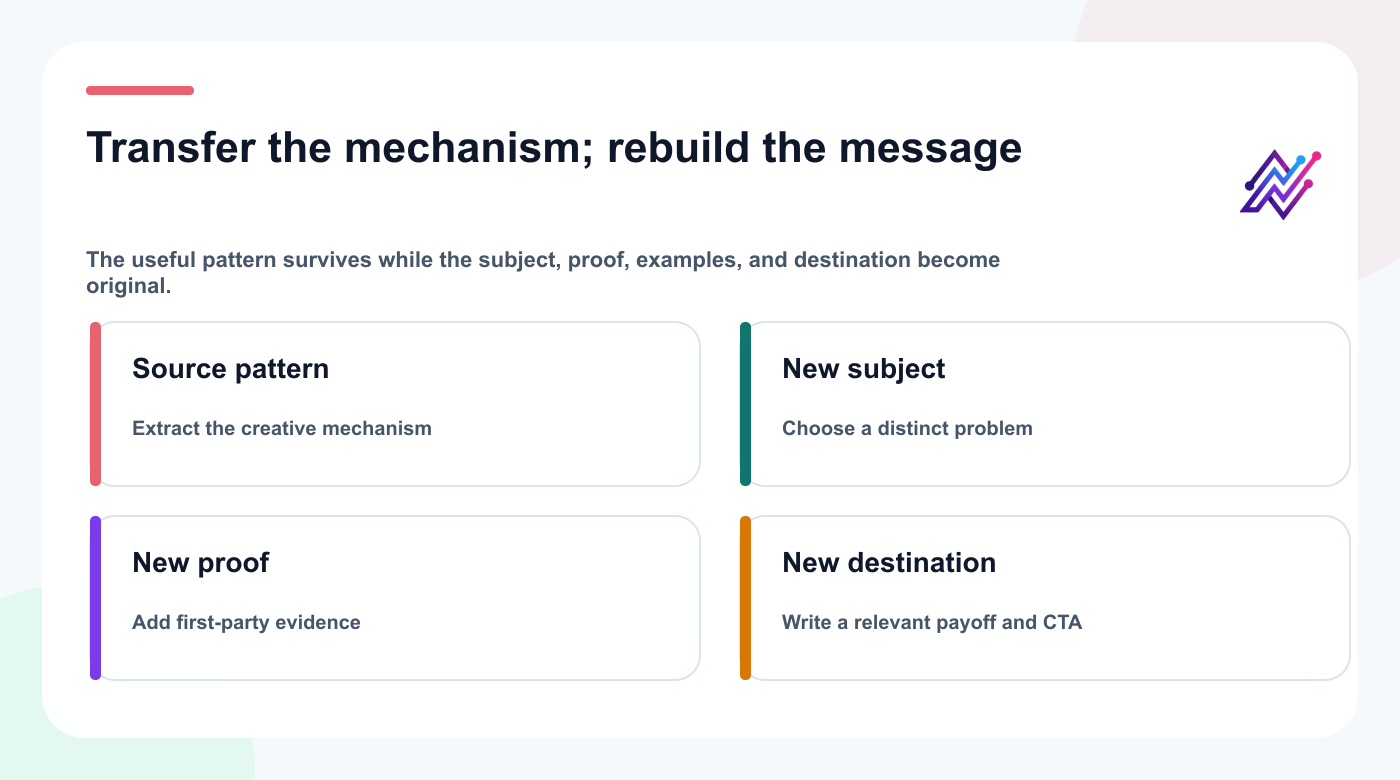
Pattern transfer is ethical and useful when the new script supplies its own subject, evidence, and conclusion.
Platform adaptation
One script should not be published everywhere unchanged.
DestinationAdaptation priorityTikTokImmediate spoken hook, fast pacing, visual interruption, concise payoff.Instagram ReelsVisual hook, subtitle-friendly lines, saveable takeaway, native CTA.YouTube ShortsClear topic, retention, satisfying ending, connection to longer content.LinkedIn videoProfessional context, concrete example, business lesson, discussion CTA.BlueskyConcise insight or short thread with less promotional language.MastodonMore context, community-aware phrasing, and content warnings when needed.
Keep every version connected to the same approved source idea, but review it as a destination-specific draft.
Build a research, testing, and measurement loop
A reviewed source can support several assets, but each one should answer a distinct audience need. Start with a short-form script, a LinkedIn post, a carousel outline, a short thread, and one FAQ idea; keep the core lesson, replace the examples, and preserve the same evidence boundary. Fewer purposeful derivatives are easier to review than a long list of generic outputs.
Measure whether the generated script worked
Do not judge only by views.
Measure based on the goal.
If the goal is attention
Track:
views
reach
first-second retention
watch time
completion rate
If the goal is engagement
Track:
comments
saves
shares
replies
If the goal is traffic
Track:
clicks
profile visits
landing page visits
If the goal is conversion
Track:
signups
trials
demo requests
purchases
qualified messages
Then compare the new script with:
your normal baseline
the original content format
other generated variations
the same topic on other platforms
The feature should help you build better hypotheses.
It cannot guarantee virality.
No responsible tool can guarantee that a script will go viral.
Multilingual viral script workflows
Quick Blueprint currently returns English, German, French, Spanish, Portuguese, or Russian output. After the source-grounded master brief is approved, Tareno’s broader content workflow can localize it into Italian, Polish, Japanese, and Arabic as separately reviewed drafts.
Approve one original master script before localization. Then create each market version as a separate draft, adapt phrasing, formality, rhythm, CTA, typography, and spoken delivery, and require native review where risk or nuance warrants it. Do not translate hooks literally: a sharp English line may feel unnatural or too aggressive elsewhere. Japanese and Arabic also need deliberate layout review for line length, typography, directionality, and formality. Compare outcomes by language only after destination and measurement rules are recorded.
Get Viral Now and AI agents
The feature becomes more powerful when connected to agent workflows.
Example with Tareno MCP:
Create a Quick Blueprint project from this primary YouTube source and up to four relevant supporting sources. Show the current credit quote and ask for dashboard approval before analysis. After the blueprint is complete, use its evidence to draft three original scripts, save the selected revision as a draft, and do not schedule anything.
Example with a currently documented Tareno MCP client such as Codex, Claude Code, or Cursor:
Review the transcript analysis, compare the proposed hooks with recent analytics, and save the strongest option as a draft. Do not publish or schedule it.
The AI agent can orchestrate.
Choose a documented client workflow such as Claude with Tareno and use the current MCP reference to check the available Quick Blueprint tools. The ability to draft through a client does not grant approval for analysis credits or publishing.
Get Viral Now performs the source analysis.
Tareno manages the draft and publishing workflow.
Get Viral Now vs a generic AI script generator
A generic script generator usually starts with a prompt.
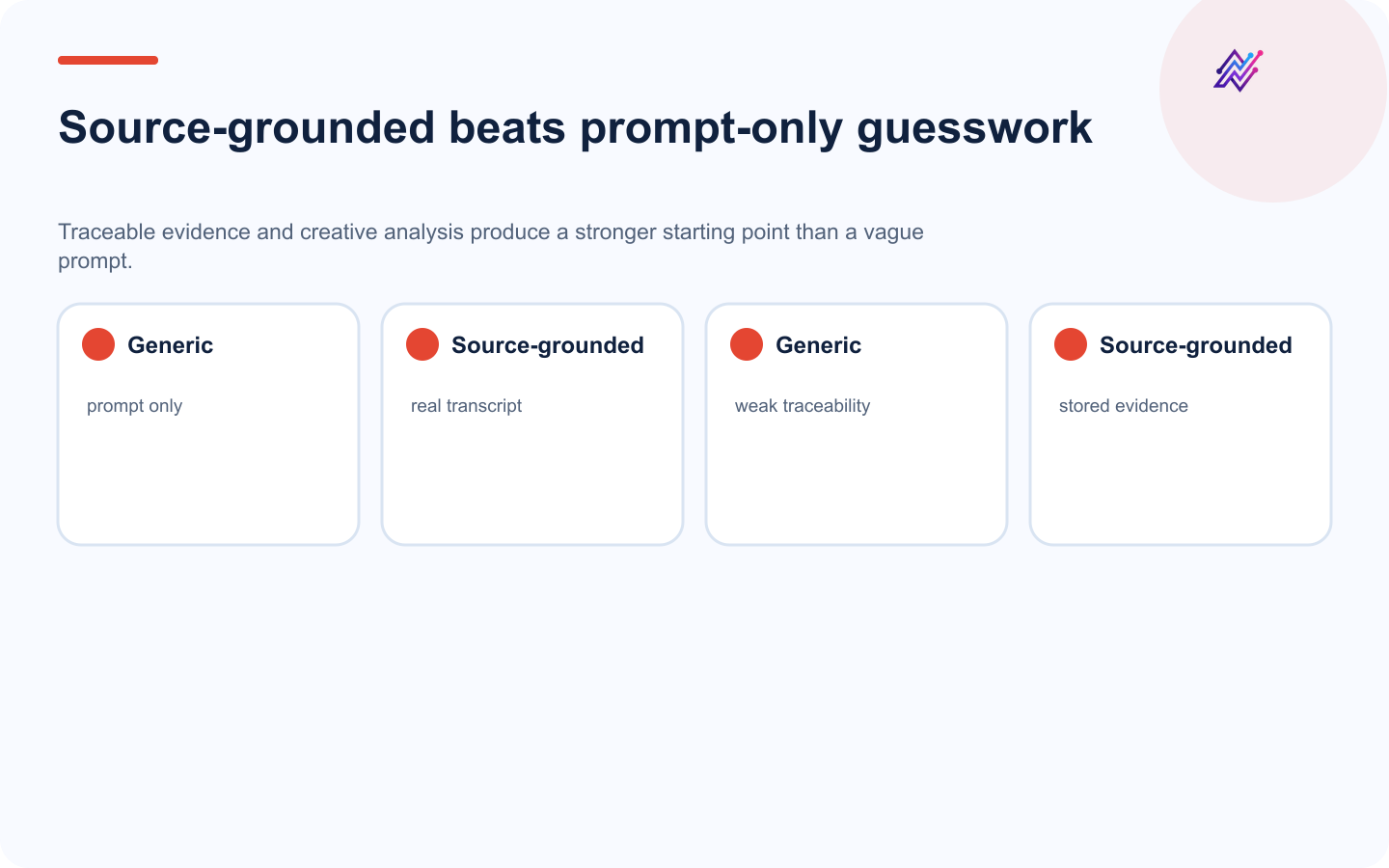
The advantage is the connection between evidence, creative analysis, and production—not a promise of virality.
Example:
Write a viral TikTok script about social media automation.
The output may be usable, but it lacks evidence.
Get Viral Now starts with an actual content source.
The workflow can analyze:
real structure
real pacing
real examples
real sequence
real audience expectations
Then it creates an original script for a new context.
Comparison:
Generic generatorGet Viral Now workflowStarts from a promptStarts from source contentOften genericEvidence-informedLimited structural insightTranscript and pattern analysisOne-off outputConnected to Tareno workflowWeak traceabilitySource URL and analysis can be storedOften copy-focusedResearch, strategy, and repurposing
The value is not only generation.
It is the research-to-production connection.
Ethical quality checks and troubleshooting
Before publishing:
- [ ] The new script uses original wording
- [ ] The source is used for research, not copying
- [ ] No unique story is presented as your own
- [ ] No unsupported claim is added
- [ ] Product details are accurate
- [ ] The hook fits your actual content
- [ ] The payoff delivers on the hook
- [ ] The CTA is relevant
- [ ] The platform version is adapted
- [ ] Human review is complete
- [ ] The script is saved with source notes
- [ ] Measurement is planned
A useful rule:
Borrow the mechanism. Build your own message.
Common mistakes
Reject sources chosen only for view count, never copy wording, and provide enough audience and brand context to prevent generic output. Generate alternatives, edit the winner in the creator's voice, adapt it for each destination, avoid virality promises, and use the published result as evidence for the next brief.
Troubleshooting
The transcript is incomplete
Possible causes:
no transcript available
automatic captions are poor
language detection issue
private or restricted video
unusual audio
multiple speakers
Choose another source or correct the transcript where possible.
The analysis is generic
Use a source with a clear spoken structure.
Add a more specific objective:
Analyze the retention structure, not only the topic.
The generated script sounds copied
Change:
audience
topic
examples
point of view
proof
CTA
structure order
Ask for a stronger originality constraint.
The script is too long
Specify:
target duration
approximate word count
maximum number of sections
speaking pace
Example:
Create a 35-second version with fewer than 95 spoken words.
The script sounds unnatural in another language
Request localization rather than translation and add native review.
Related Tareno resources
YouTube title generatorCreate title variants after the script and video promise are aligned.Social media repurposing workflowTurn one researched message into channel-native assets.Analytics reportsCompare hooks and scripts against useful performance signals.Post schedulingMove approved scripts into a controlled publishing calendar.
FAQ
What is Get Viral Now?
Get Viral Now combines discovery with production planning. Through MCP, Quick Blueprint can start from a topic alone or from one primary public YouTube source plus up to four supporting sources. A source-grounded run quotes the current source snapshot, waits for dashboard approval, and then produces its blueprint. A Recreation Pack is a separate follow-on job for a completed blueprint, not part of the initial Quick Blueprint run.
Does it copy the original video?
It should not be used to copy the original wording. The intended workflow is to learn from structure, pacing, hook, and payoff while generating an original angle and script.
Can it guarantee that my video goes viral?
No. No tool can responsibly guarantee virality. It can help improve research, structure, and script generation.
Can I create TikTok and Reels scripts?
Yes. The generated idea can be adapted for TikTok, Instagram Reels, YouTube Shorts, LinkedIn video, and other formats.
Can it analyze videos in different languages?
Transcript availability depends on the public source and its captions; localization should still receive native review. Tareno supports multilingual content workflows across English, German, French, Spanish, Portuguese, Russian, Italian, Polish, Japanese, and Arabic.
Can I save the result as a Tareno draft?
That is the intended workflow: analyze the source, generate the script, review it, save it as a draft, and move it through approval and scheduling.
Can AI agents use Get Viral Now?
The feature can sit inside a broader Tareno agent workflow, while the current MCP and API references remain the source of truth for available actions.
Is this only for creators?
No. Agencies, SaaS teams, educators, marketers, and brands can use transcript analysis for content research and repurposing.
Final thoughts
Study the source without copying it: identify the mechanism, define a new audience and message, generate original options, edit the strongest in your voice, adapt it for the destination, publish through a controlled workflow, and use the measured result as evidence for the next brief.
That is how Get Viral Now can turn one YouTube URL into a real content research and production system.
Create a Quick Blueprint from one relevant primary YouTube source, review the credit quote, and approve the source-grounded production brief.
Turn the approved brief into an original Tareno draft, then adapt that draft for the destination platform.