Publishing in multiple languages is easy to underestimate.
At first, the workflow looks simple:
write one post
translate it
publish the translations
That process works for basic information.
It breaks down when the content needs to persuade, explain, entertain, build trust, fit a platform, reflect a brand voice, and produce measurable results.
A literal translation may preserve the words while losing:
tone
rhythm
humor
formality
urgency
cultural context
CTA strength
platform fit
visual readability
product terminology
That is why multilingual social media should be treated as a content operations system, not a translation task.
Tareno supports workflows across English, German, French, Spanish, Portuguese, Russian, Italian, Polish, Japanese, and Arabic.
The value is not only that a caption can exist in ten languages.
The value is that teams can create one master campaign, localize it carefully, route sensitive versions through review, schedule every market from one calendar, and compare performance by language.
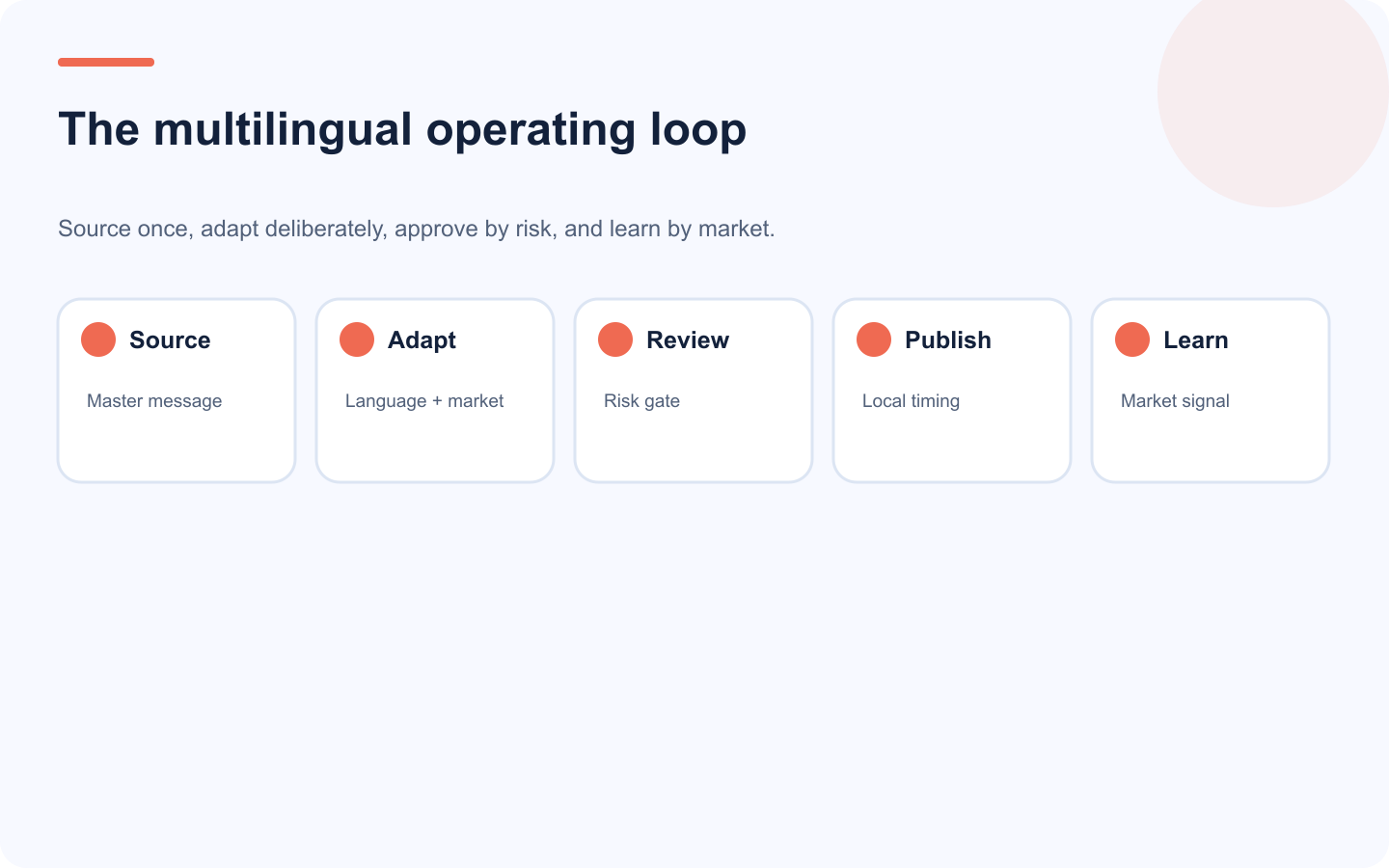
A multilingual system coordinates shared meaning and local judgment in one repeatable loop.
AI can accelerate the first draft.
Tareno can organize the workflow.
Humans can protect quality.
This guide explains how to build that system.
TL;DR
A practical multilingual workflow looks like this:
Create an approved master message.
Define the market, not only the language.
Add terminology, tone, CTA, and cultural notes.
Generate localized drafts with AI.
Run automated quality checks.
Route important markets to native or expert review.
Review visuals, directionality, and line length.
Approve each language version separately.
Schedule through Tareno.
Compare results by language and market.
Repurpose the strongest local insights.
Update the localization memory.
The key rule is:
Translate the meaning. Localize the execution.
A multilingual campaign should feel as if it was created for the market, not exported into it.
Translation vs localization vs transcreation
These terms are often used interchangeably.
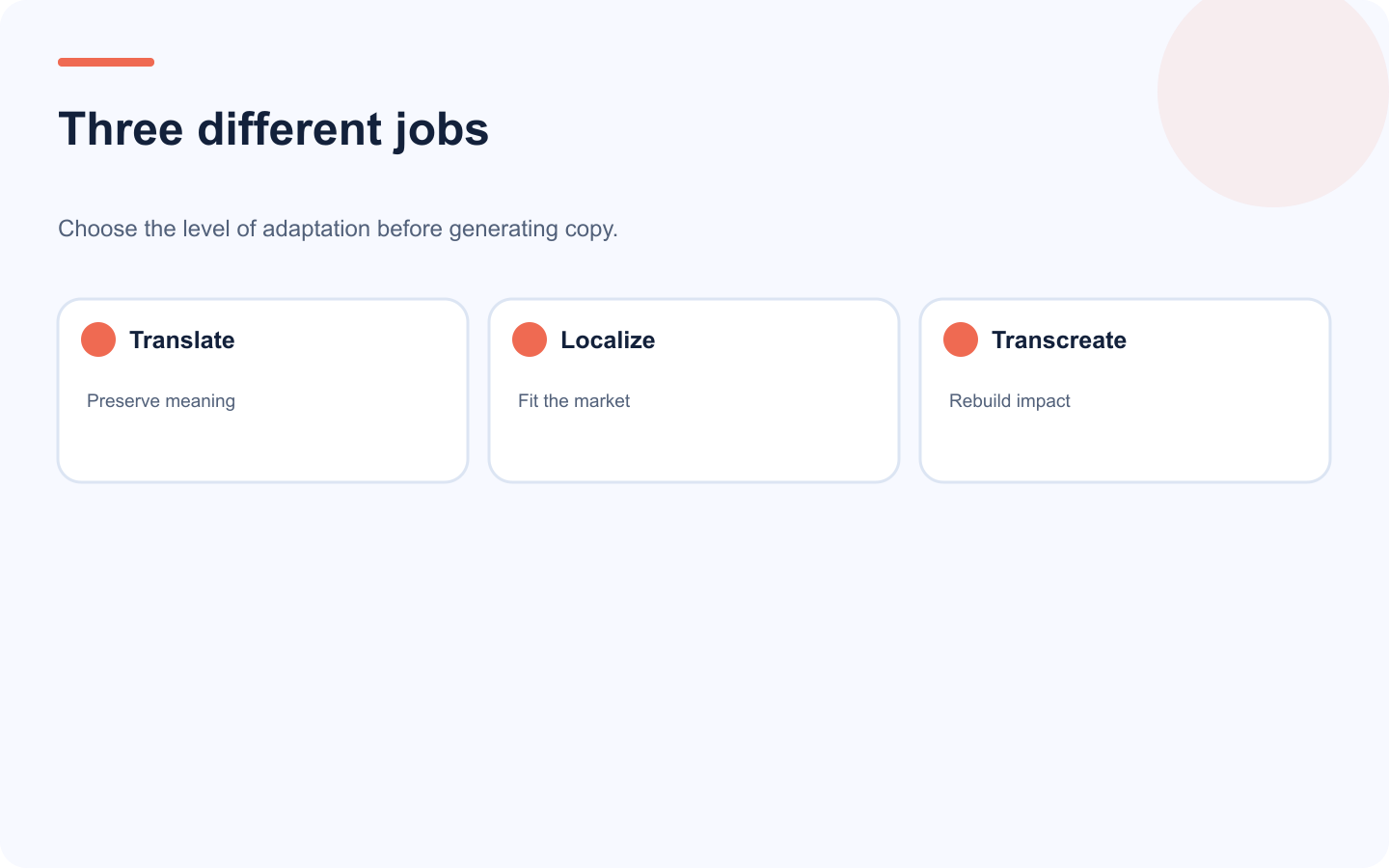
Translation preserves meaning; localization fits context; transcreation rebuilds impact.
They describe different levels of work.
Translation
Translation changes the language while preserving the meaning.
Example:
English:
Schedule your social posts in one place.
German:
Plane deine Social-Media-Beiträge an einem Ort.
This is useful for clear product information.
Localization
Localization adapts the language for a specific market.
It may change:
wording
formality
examples
date format
currency
CTA
terminology
sentence length
product references
A Portuguese version for Brazil may differ from one intended for Portugal.
A Spanish version for Spain may differ from one intended for Mexico.
Transcreation
Transcreation rebuilds the message to preserve the emotional or persuasive effect.
It is useful for:
campaign slogans
humor
hooks
creator content
short-form video
emotional ads
culturally specific examples
A viral hook often needs transcreation, not translation.
The workflow should decide which level each asset needs.
Why one translation prompt is not enough
A prompt such as:
Translate this into Japanese.
does not provide enough context.
The model does not know:
target market
audience
formality
platform
CTA
product terminology
brand voice
forbidden wording
visual limit
review requirement
A better prompt is:
Localize this LinkedIn product announcement for Japanese social media managers at small agencies. Use professional but accessible language. Keep the product name in English. Avoid exaggerated claims. Preserve the CTA intent, but adapt the wording naturally. Flag anything that should be reviewed by a native speaker.
The second prompt is longer because the task is more specific.
That specificity improves quality.
What Tareno adds to multilingual operations
Tareno can serve as the central operating layer.
Relevant capabilities include:
multilingual content drafts
platform-specific versions
workspaces
content boards
content calendar
roles and permissions
activity visibility
AI captions and ideas
reports
repurposing queue
API
MCP
n8n
Make
Zapier
AI-agent workflows
The architecture becomes:
Approved master message
  ↓
Language and market matrix
  ↓
AI localization
  ↓
Automated checks
  ↓
Native or expert review
  ↓
Tareno approval
  ↓
Market-specific schedule
  ↓
Analytics by language
  ↓
Local repurposing
Step 1: Create the master message
Approve an immutable master revision before localization begins. Record its source links, claim set, glossary version, CTA, target markets, approver, and timestamp; any material source change creates a new master revision and invalidates downstream approvals.
Include:
campaign goal
audience
offer
core message
proof
CTA
source links
product terminology
claims allowed
claims prohibited
visual notes
measurement goal
Master message template:
Campaign:
Goal:
Audience:
Offer:
Core message:
Primary proof:
Primary CTA:
Secondary CTA:
Product names:
Claims allowed:
Claims to avoid:
Source links:
Target platforms:
Visual requirements:
Do not localize an unclear source.
A weak master creates ten weak versions.
Step 2: Define language and market separately
Language is not the same as market.
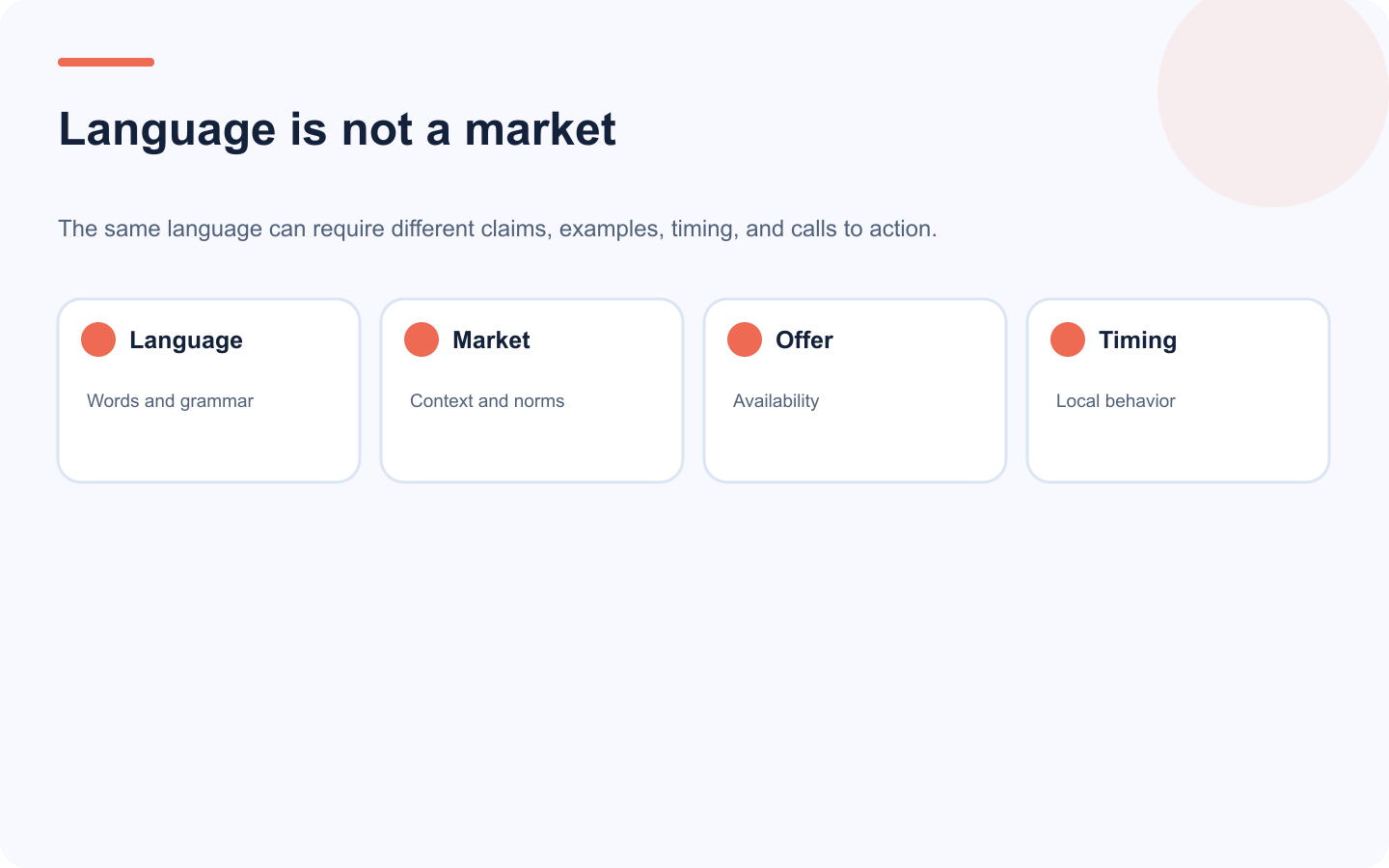
Separating language from market prevents one translation from pretending to fit every audience.
Examples:
Portuguese → Brazil or Portugal
Spanish → Spain, Mexico, Argentina, or another market
English → United States, United Kingdom, India, or global
Arabic → different countries and regional expectations
French → France, Canada, or other Francophone markets
Use a market matrix.
LanguageMarketToneCTA styleNative reviewEnglishGlobalDirectConciseOptionalGermanGermanyClear, precisePracticalRecommendedFrenchFrancePolishedModerateRecommendedSpanishSpainNatural, energeticDirectRecommendedPortugueseBrazilConversationalWarmRecommendedRussianGlobal RUClearDirectRecommendedItalianItalyExpressive but clearNaturalRecommendedJapaneseJapanProfessionalSoftRequired for major campaignsArabicTarget marketRespectfulMarket-dependentRequired for major campaigns
This matrix can become structured input for AI and automation.
Step 3: Build a terminology glossary
A glossary protects consistency.
Include:
product name
feature names
integration names
technical terms
preferred translations
terms that should remain English
forbidden translations
capitalization
CTA wording
competitor names
Example:
Source termGermanJapaneseArabicRuleTarenoTarenoTarenoTarenoNever translateMCP serverMCP-ServerMCPサーバーخادم MCPKeep MCPWorkflow BuilderWorkflow BuilderWorkflow BuilderWorkflow BuilderProduct labelApprovalFreigabe承認موافقةContext-dependent
The glossary should be updated after native reviews.
Step 4: Add brand voice by language
A brand voice can change slightly by language.
The core identity should remain.
But sentence structure and formality may differ.
Define:
formal or informal
first person
second person
use of humor
use of emojis
directness
sentence length
technical vocabulary
banned phrases
Example:
German:
Direct, practical, no inflated claims, use “du” for creator audience.

French:
Professional but accessible, avoid literal English business phrases.

Japanese:
Polite, concise, avoid aggressive urgency.

Arabic:
Clear and respectful, verify regional wording, review mixed-language product names.
This gives the localization model a usable style guide.
Step 5: Generate localized drafts
Create one structured input per language.
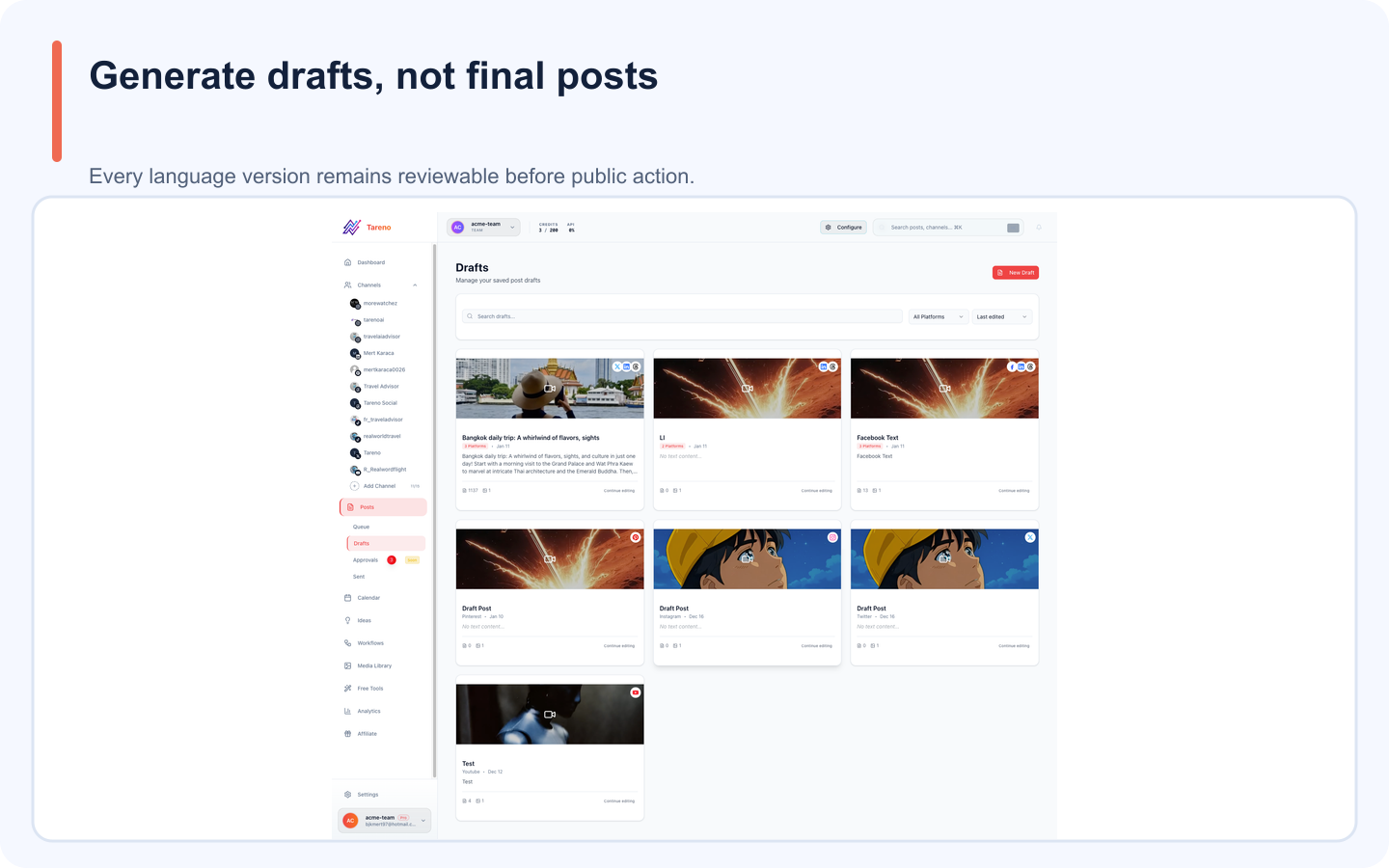
Draft-first localization creates a reversible checkpoint before publishing.
Example object:
{
  "language": "ja",
  "market": "Japan",
  "platform": "LinkedIn",
  "tone": "professional and concise",
  "ctaIntent": "encourage a product trial",
  "keepEnglishTerms": ["Tareno", "MCP"],
  "nativeReviewRequired": true
}
Prompt:
Localize the approved master message.

Language:
Japanese

Market:
Japan

Platform:
LinkedIn

Audience:
Social media managers at small agencies.

Tone:
Professional, clear, and concise.

Rules:
- Keep Tareno and MCP in their official form.
- Do not translate literally.
- Avoid aggressive urgency.
- Preserve the product claim exactly.
- Adapt the CTA naturally.
- Flag uncertain terminology.
Save the result as a Tareno draft.
Do not schedule it yet.
Step 6: Run automated quality checks
AI can perform a second-pass review.
Check:
wrong language
untranslated fragments
product-name changes
missing CTA
unsupported claim
inconsistent terminology
wrong URL
incorrect currency
excessive length
draft copy
duplicated sentence
accidental source-language phrase
Quality-check prompt:
Compare the localized draft with the approved master. Identify missing information, added claims, altered product names, inconsistent terminology, and unnatural literal translations. Do not rewrite until the issues are listed.
This separates detection from rewriting.
Step 7: Add native review strategically
Not every post needs the same review depth.
Low-risk content
Examples:
evergreen tip
simple product instruction
event reminder
Review:
automated check
internal multilingual reviewer
Medium-risk content
Examples:
product education
campaign post
creator content
customer example
Review:
fluent or native reviewer
High-risk content
Examples:
pricing
legal-sensitive claim
competitor comparison
customer result
sponsored content
major product launch
humor
emotionally sensitive topic
Review:
native reviewer
domain reviewer
final approver
Use risk-based routing in Tareno.
Step 8: Review visuals and layout
Localization affects design.
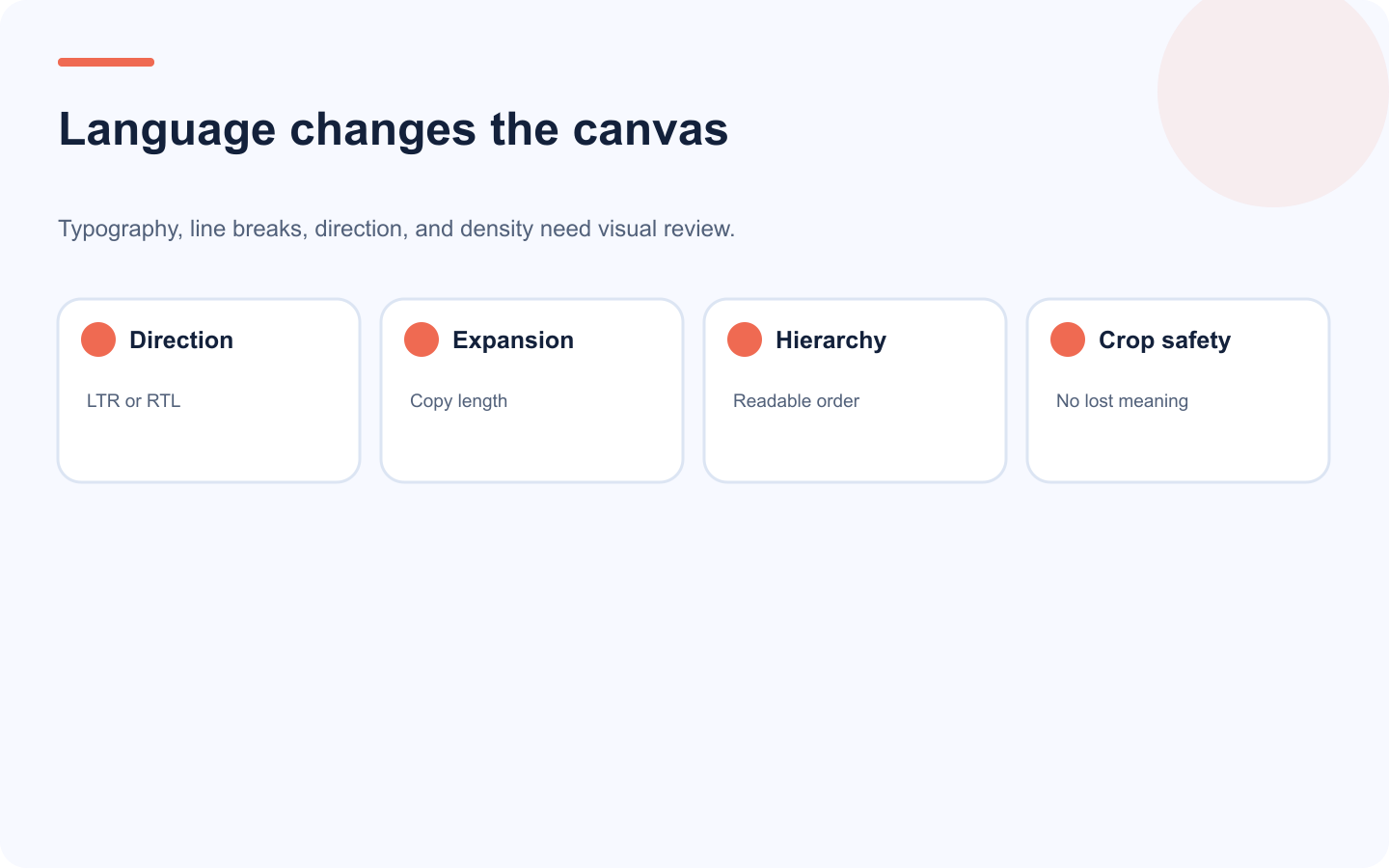
Localized copy is only ready after the actual layout has been inspected.
Check:
text length
line breaks
image text
subtitle length
right-to-left direction
font rendering
punctuation
text alignment
CTA button size
thumbnail readability
mixed-language product names
alt text
A caption may be correct while the visual is unusable.
Arabic visual review
Check:
right-to-left direction
alignment
punctuation
numerals
mixed Arabic and Latin text
product-name order
subtitles
UI screenshots
Japanese visual review
Check:
line breaks
character density
punctuation
font support
formality
CTA length
subtitle speed
Tareno’s approval workflow should review caption and asset together.
Step 9: Adapt by platform
A localized LinkedIn caption should not automatically become a TikTok script.
Each platform needs its own version.
professional context
clear lesson
credible proof
restrained CTA
TikTok
spoken rhythm
immediate hook
simple sentence structure
subtitle-friendly pacing
visual hook
saveable takeaway
shorter CTA
asset consistency
Bluesky
concise
self-contained
low-hype
community conversation
Mastodon
more context
community-aware phrasing
content warning where relevant
natural hashtags
search-oriented title
clear value
useful description
localized keywords
The workflow has two dimensions:
language
platform
That means ten languages across five platforms can produce 50 variants.
Automation and structure become essential.
Step 10: Use a localization matrix in Tareno
Recommended fields:
campaign
language
market
platform
account
source version
localized caption
asset
glossary version
reviewer
approval status
publish date
measurement date
repurposing status
Example:
LanguageMarketPlatformReviewerStatusGermanGermanyLinkedInGerman reviewerApprovedFrenchFranceLinkedInFrench reviewerReviewJapaneseJapanLinkedInNative reviewerDraftArabicUAEInstagramArabic reviewerAsset review
This gives the campaign an operational view.
Step 11: Schedule by market
Do not publish every language at the same UTC time. Store an IANA timezone such as Europe/Berlin, keep the resolved UTC instant visible, and revalidate future schedules after daylight-saving changes.
Consider:
local timezone
working hours
audience behavior
campaign date
local holidays
reviewer availability
support coverage
landing-page readiness
The calendar should display:
local time
timezone
language
market
platform
account
approval status and revision ID
resolved UTC instant
A global campaign needs local timing and an auditable conversion to UTC.
Step 12: Connect n8n
n8n is useful for complex multilingual workflows.
Example:
Approved master campaign
  ↓
Load language matrix
  ↓
Loop through languages
  ↓
AI localization
  ↓
Quality check
  ↓
Create Tareno drafts
  ↓
Route native-review languages
Add conditions:
If language = ja or ar
then native review required.
Use source IDs and language codes to prevent duplicates.
Step 13: Connect Make
Make can use an iterator.
Approved master message
  ↓
Language array
  ↓
Iterator
  ↓
Localization module
  ↓
Router by review requirement
  ↓
Tareno draft
Make is useful when the team wants a visual representation of all language branches.
Use a Data Store to save:
campaign ID
language
market
Tareno draft ID
status
Step 14: Connect Zapier
Zapier is useful for simpler language workflows.
Example:
New approved campaign in Airtable
  ↓
AI localizes German version
  ↓
Tareno creates German draft
  ↓
Repeat for selected priority languages
  ↓
Notify reviewers
For ten languages and many branches, Make or n8n may be easier.
Zapier works well when the process is straightforward.
Step 15: Use MCP and AI agents
An AI agent can coordinate drafts and analytics through Tareno; public actions need approval.
Prompt:
Create localized drafts for English, German, French, Spanish, Portuguese, Russian, Italian, Polish, Japanese, and Arabic. Keep the offer and product claims consistent. Adapt tone and CTA by market. Save drafts only and flag Japanese and Arabic for native review.
Another prompt:
Compare performance by language over the last 30 days. Identify which topics transfer globally and which are market-specific.
Agents are useful for interpretation.
Tareno remains the approval and publishing layer.
Step 16: Use Codex for product-led localization
Codex can connect release notes, product documentation, and social drafts.
Prompt:
Read the approved release notes, create social drafts in ten languages through Tareno, preserve technical terminology, and flag any sentence where the product claim changes during localization.
This is useful for SaaS teams.
The product source remains visible.
The social drafts remain controlled.
Step 17: Verify the agent connection
Use Codex, Claude Code, or Cursor with a revocable key; verify tools and accounts, grant narrow scopes, and keep output draft-only.
Prompt:
Review our recent English content and identify three evergreen posts worth localizing. Choose target languages based on the available accounts and past performance. Create drafts only.
This is better than translating every post.
The agent selects content with evidence.
Language-specific operational notes
English
Use English as the master language only when it reflects the source market.
Avoid assuming global English is culturally neutral.
Define:
US or UK spelling
global terminology
date format
CTA tone
German
Common needs:
directness
precision
compound terms
appropriate use of “du” or “Sie”
less exaggerated marketing language
Review literal translations of English SaaS phrases.
French
Common needs:
natural sentence flow
formality
avoidance of English business jargon where unnecessary
localized CTA
Do not overuse literal English structure.
Spanish
Define the market.
Spanish for Spain may differ from Latin American markets.
Review:
pronouns
regional vocabulary
formality
CTA
product terminology
Portuguese
Separate Brazilian Portuguese and European Portuguese where the campaign matters.
Differences can affect:
vocabulary
sentence rhythm
pronouns
CTA
tone
Russian
Review:
case endings
natural word order
formality
borrowed technical terms
platform tone
Avoid machine-like literal phrasing.
Italian
Review:
natural expressiveness
sentence flow
formality
product terminology
CTA
Do not translate every English noun phrase mechanically.
Polish
Review:
case endings around unchanged product names
formal versus conversational address
natural word order
English loanwords and technical terms
CTA tone
Keep the approved glossary explicit so inflected terms remain consistent across captions and visuals.
Japanese
Review:
politeness
brevity
subject omission
line breaks
CTA softness
product-name handling
visual density
Native review is valuable for important campaigns.
Arabic
Define the target market and variant.
Review:
Modern Standard Arabic vs local dialect
right-to-left design
product names
punctuation
mixed-language text
CTA
cultural context
Native review is strongly recommended for high-value campaigns.
Build a localization memory
After each campaign, save:
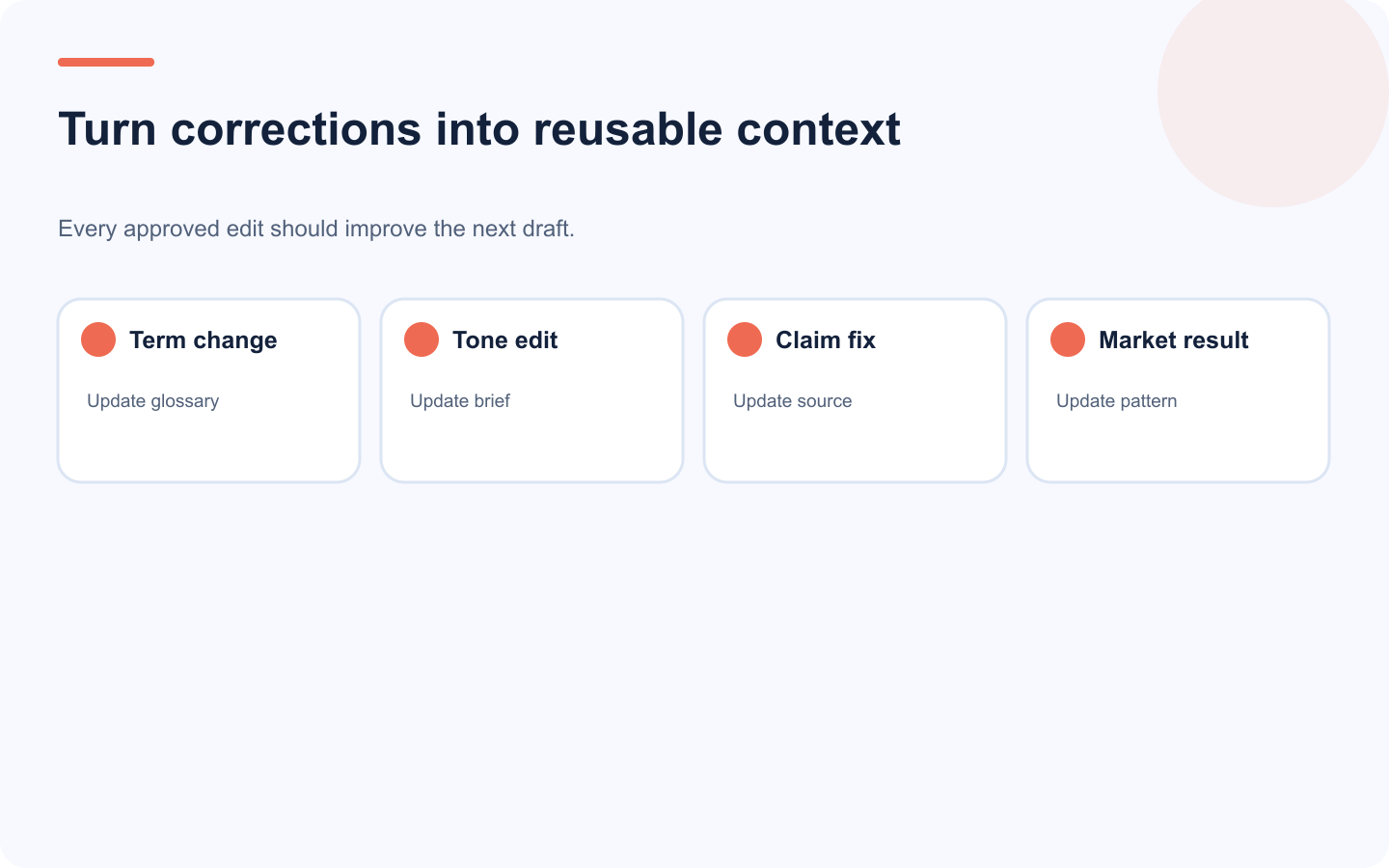
A localization memory converts one-off corrections into system quality.
approved master and local revision IDs
glossary version
approved translations
corrected terminology
rejected wording
preferred CTA
tone decisions
reviewer notes
market-specific examples
performance result
This becomes a localization memory.
The next campaign can reuse approved patterns as suggestions, but market owners should still verify claims, offers, dates, and local context against the new source revision.
Example:
German:
Use “Freigabe-Workflow,” not literal “Approval Workflow.”

Japanese:
Keep “MCP” and “Tareno” unchanged.

Arabic:
Use approved product category term from campaign 04.
The memory reduces repeated corrections.
Measure performance by language
Do not compare languages only by raw reach.
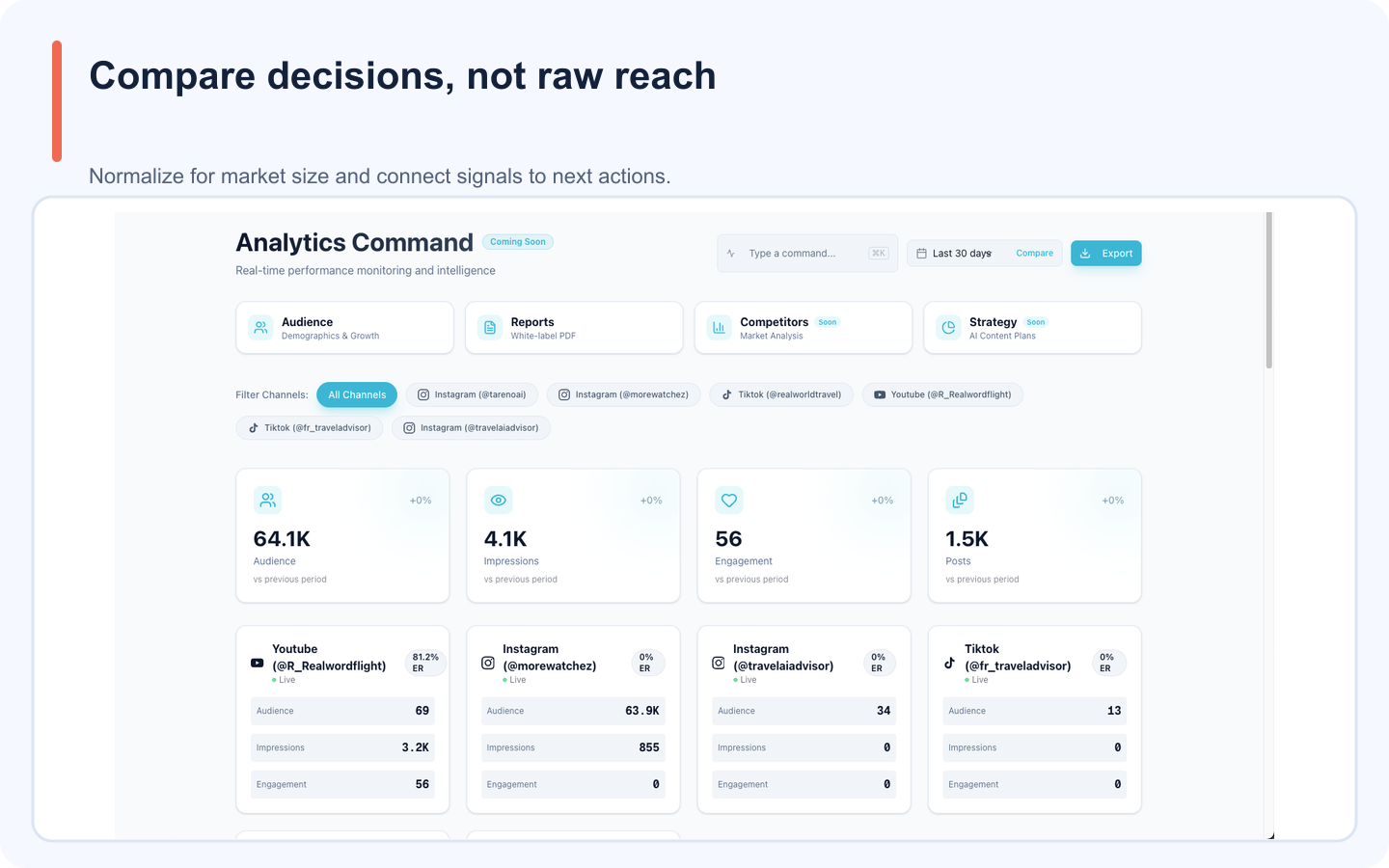
Market analytics is useful when each signal changes the next local content decision.
Market size, account age, posting frequency, and platform maturity differ.
Track:
reach
engagement rate
saves
shares
comments
clicks
conversion rate
follower growth
review time
content production cost
repurposing success
Compare:
against the language’s own baseline
against the same topic in other languages
against other formats in the same market
Example:
LanguageTopicPlatformStrongest signalNext actionGermanApproval workflowsLinkedInSavesCreate checklistFrenchAI agentsLinkedInCommentsCreate FAQJapaneseMCP tutorialXClicksExpand tutorialArabicContent planningInstagramSharesCreate carousel series
The next action may differ by market.
Analytics-to-local-repurposing
Do not always send the global winner to every market.
A local post may reveal a market-specific opportunity.
Workflow:
Language analytics
  ↓
Identify local outlier
  ↓
Interpret comments
  ↓
Create local follow-up
  ↓
Native review
  ↓
Schedule
Example:
A German approval-workflow post receives high saves.
Create:
German checklist
German carousel
German webinar
German product tutorial
Do not wait for the English version to prove the same topic.
Global campaign governance
Define:
master-message owner
language owner
market reviewer
product reviewer
final approver
asset owner
scheduling owner
analytics owner
Approval matrix:
Content typeReviewEvergreen tipLanguage reviewProduct educationLanguage + productPricingLanguage + finance/productCustomer resultLanguage + customer successSponsored contentLanguage + brandLegal-sensitive contentLanguage + specialistHumorNative market reviewJapanese/Arabic major campaignNative + visual review
This prevents unclear responsibility.
Duplicate prevention
Use a composite key:
campaignId_language_market_platform_account
Track:
master campaign ID
source version
language
market
platform
account
Tareno draft ID
content hash
status
Before creating a draft:
check existing key
compare source version
update if needed
avoid duplicate creation
This is important when automation reruns.
Quality checklist
Use the checklist as one release gate so meaning, market fit, visual integrity, approval, and measurement are reviewed together.
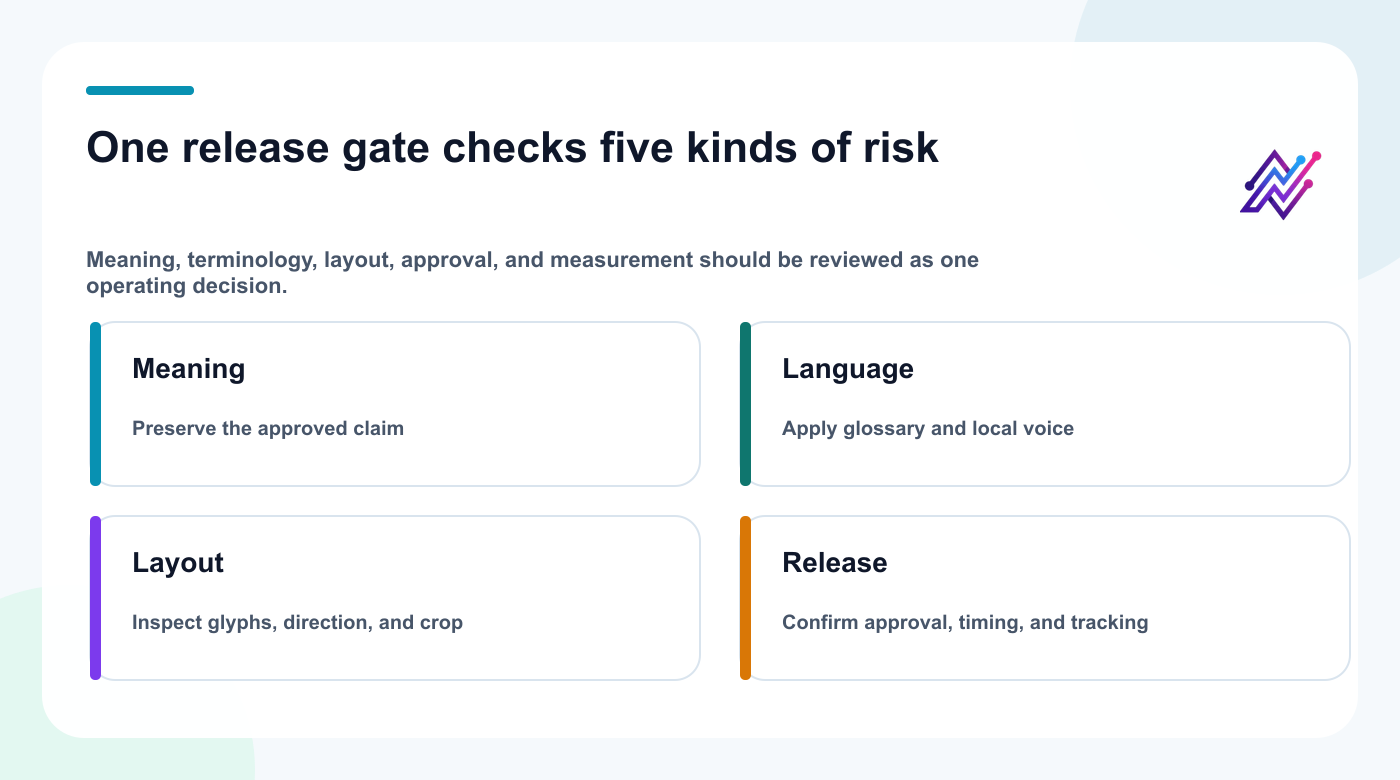
A single release gate prevents language, design, approval, and measurement checks from drifting apart.
## Multilingual Content Checklist

Master:
- [ ] Source message approved
- [ ] Claims approved
- [ ] CTA approved
- [ ] Glossary attached

Localization:
- [ ] Correct language
- [ ] Correct market
- [ ] Natural phrasing
- [ ] Product names unchanged
- [ ] Terminology consistent
- [ ] CTA localized
- [ ] No new claims
- [ ] No missing information

Visual:
- [ ] Text fits
- [ ] Directionality correct
- [ ] Font renders
- [ ] Alt text localized
- [ ] Subtitle timing checked

Approval:
- [ ] Language reviewer complete
- [ ] Domain review complete
- [ ] Final version approved
- [ ] Publish time localized

Measurement:
- [ ] Language baseline selected
- [ ] Campaign label added
- [ ] Measurement date set
Common mistakes
Mistake 1: Translating every post
Localize only content worth distributing.
Mistake 2: Treating language as market
Define the target country or audience.
Mistake 3: No glossary
Terminology becomes inconsistent.
Mistake 4: No native review
Important campaigns need human judgment.
Mistake 5: Ignoring design
Text expansion and directionality affect assets.
Mistake 6: Same CTA everywhere
CTA style varies by market.
Mistake 7: Publishing at one global time
Schedule locally.
Mistake 8: Comparing raw reach only
Use local baselines.
Mistake 9: Literal humor
Humor often needs transcreation.
Mistake 10: No learning loop
Save corrections and performance insights.
Multilingual workflow ideas
Start with the bottleneck that creates the most repeated work or review risk, then expand the system one controlled step at a time.
English master → ten language drafts
Product release → localized launch campaign
Blog post → German, French, and Spanish distribution
YouTube transcript → multilingual short-form scripts
Get Viral Quick Blueprint → localized production brief
LinkedIn winner → market-specific versions
Local customer question → local FAQ post
Japanese product tutorial
Arabic Instagram carousel
Brazilian Portuguese creator campaign
French agency workflow campaign
Spanish comparison article promotion
Native-review notification workflow
Translation QA workflow
Language analytics report
Local winner → repurposing queue
Related Tareno resources
Approval workflowsRoute market-sensitive copy to the right reviewer.Workflow builderTurn localization rules into a repeatable operating flow.Analytics reportsCompare decisions and outcomes by language and market.Repurposing systemReuse proven ideas with local context intact.
FAQ
What is multilingual social media automation?
It is a workflow for creating, reviewing, scheduling, measuring, and repurposing social content across several languages and markets.
Can AI translate social media posts?
Yes, but high-quality campaigns need localization context, terminology, platform adaptation, and human review.
Which languages does Tareno support?
Tareno's current language navigation covers English, German, French, Spanish, Portuguese, Russian, Italian, Polish, Japanese, and Arabic. Generation quality still depends on the model, source material, market brief, and review depth.
Is translation enough?
Not always. Product information may only need translation. Hooks, campaigns, humor, and creator content often need localization or transcreation.
Should Japanese and Arabic content receive native review?
For important campaigns, yes. Both languages may also require extra visual and formatting review.
Can n8n automate multilingual Tareno drafts?
Yes. n8n can loop through language objects, call localization steps, apply review rules, and create Tareno drafts.
Can Make automate the workflow?
Yes. Make can use an iterator and routers for language and approval branches.
Can AI agents manage multilingual campaigns?
Yes. MCP-compatible agents can prepare drafts, inspect accounts, and analyze performance through Tareno. Publishing should remain approval-first.
How should multilingual performance be compared?
Compare each market with its own baseline before comparing languages globally.
Can one post be translated into all languages automatically?
Technically yes, but that is not always the best strategy. Select useful content and localize it intentionally.
Final thoughts
Multilingual social media is not a translation queue.
It is an international content operating system.
Start with an approved master message.
Define the market.
Add terminology and brand voice.
Use AI to accelerate localization.
Use humans to protect quality.
Review the visual execution.
Approve every language version separately.
Schedule locally.
Measure by market.
Repurpose local winners.
That is how Tareno can help teams expand from one-language publishing into a structured global workflow without multiplying chaos.
Primary CTA: Create one approved master campaign in Tareno and localize it into your first three priority markets.
Secondary CTA: Add native review, local scheduling, and language-level analytics before expanding to all ten languages.