Content repurposing is often described as:
Write one post and publish it everywhere.
That is not repurposing.
It is duplication.
A real repurposing workflow preserves the core insight while changing the format, tone, structure, context, CTA, and production style for each platform.
One idea can become:
a LinkedIn post
an Instagram carousel
a TikTok script
a YouTube Short
a Threads post
a Bluesky thread
a Mastodon guide
a Pinterest pin
a Facebook post
an X post
The idea stays consistent.
The execution changes.
That difference matters because every platform rewards different behavior.
A concise opinion may work on Bluesky.
The same idea may need a professional example on LinkedIn.
TikTok needs spoken rhythm and visual pacing.
Pinterest needs search-friendly packaging.
Mastodon may need more context and community awareness.
Tareno can organize these versions inside one campaign, connect them to the source, route them through review, schedule them from one calendar, and compare the result after publishing.
This guide shows how to build that system without producing repetitive AI content.
TL;DR
A practical multi-platform repurposing workflow looks like this:
select one strong source idea
write the core insight in one sentence
define the audience and business goal
identify the proof or example
choose the right format for each platform
generate separate platform-native drafts
review originality, voice, claims, and CTA
attach the right assets
approve every final version
schedule a staggered distribution sequence
compare performance by platform
create a second wave from the strongest result
The key principle is:
Reuse the idea. Rebuild the execution.
Build a reusable source brief
Creators and teams often think consistency requires endless new ideas.
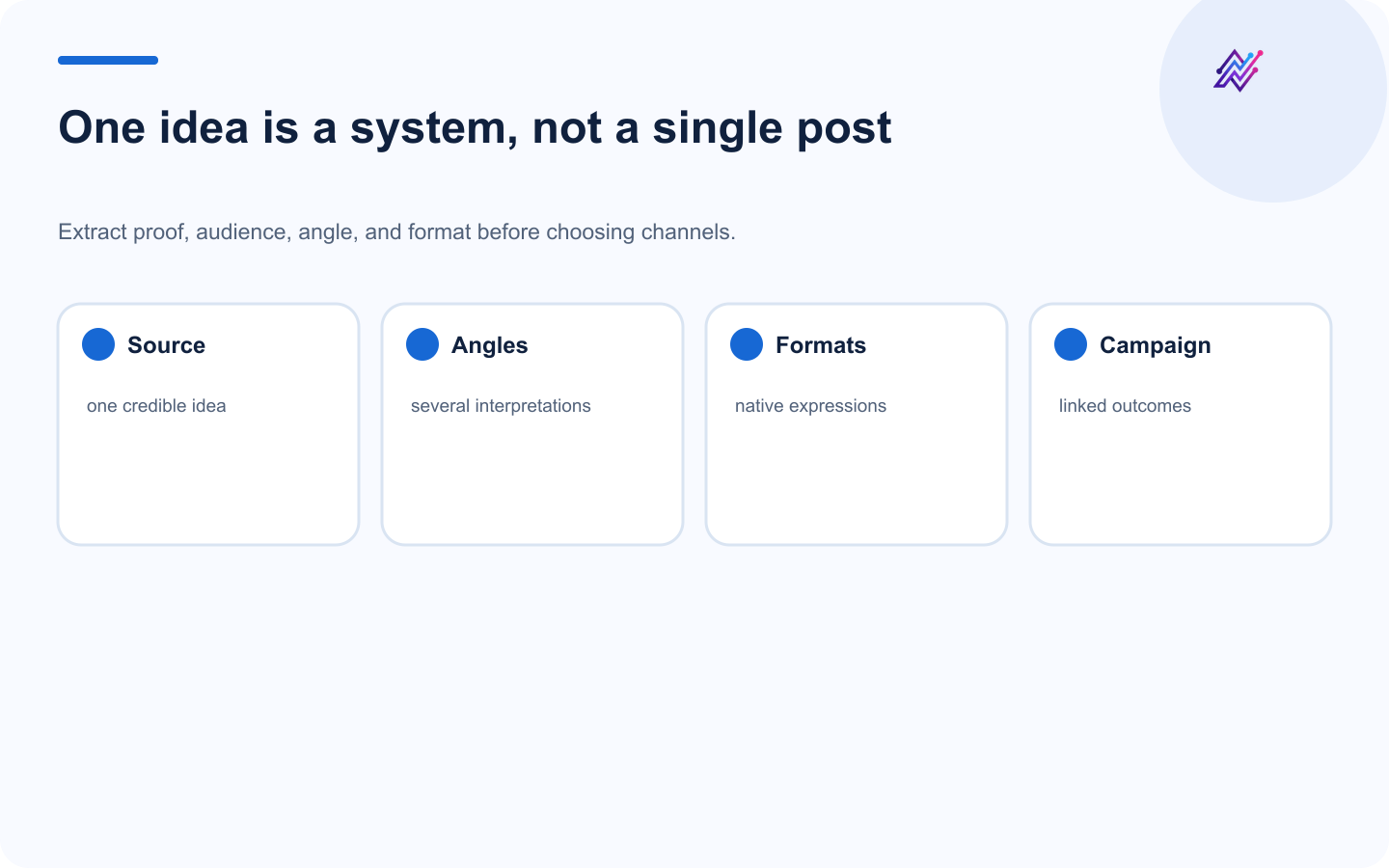
Separate the source, angle, and format before producing channel versions.
It usually requires better extraction.
A strong source idea contains several layers.
Example:
AI agents should automate social media preparation but keep public publishing behind approval.
Possible sub-ideas:
why approval matters
which actions are safe to automate
draft automation vs publishing automation
wrong-account risk
agency use case
creator use case
MCP architecture
content governance checklist
autonomy maturity model
analytics-to-repurposing loop
One idea can support an entire content cycle.
The bottleneck is not ideation.
It is structured transformation.
The difference between source, angle, and format
These three concepts should be separated.
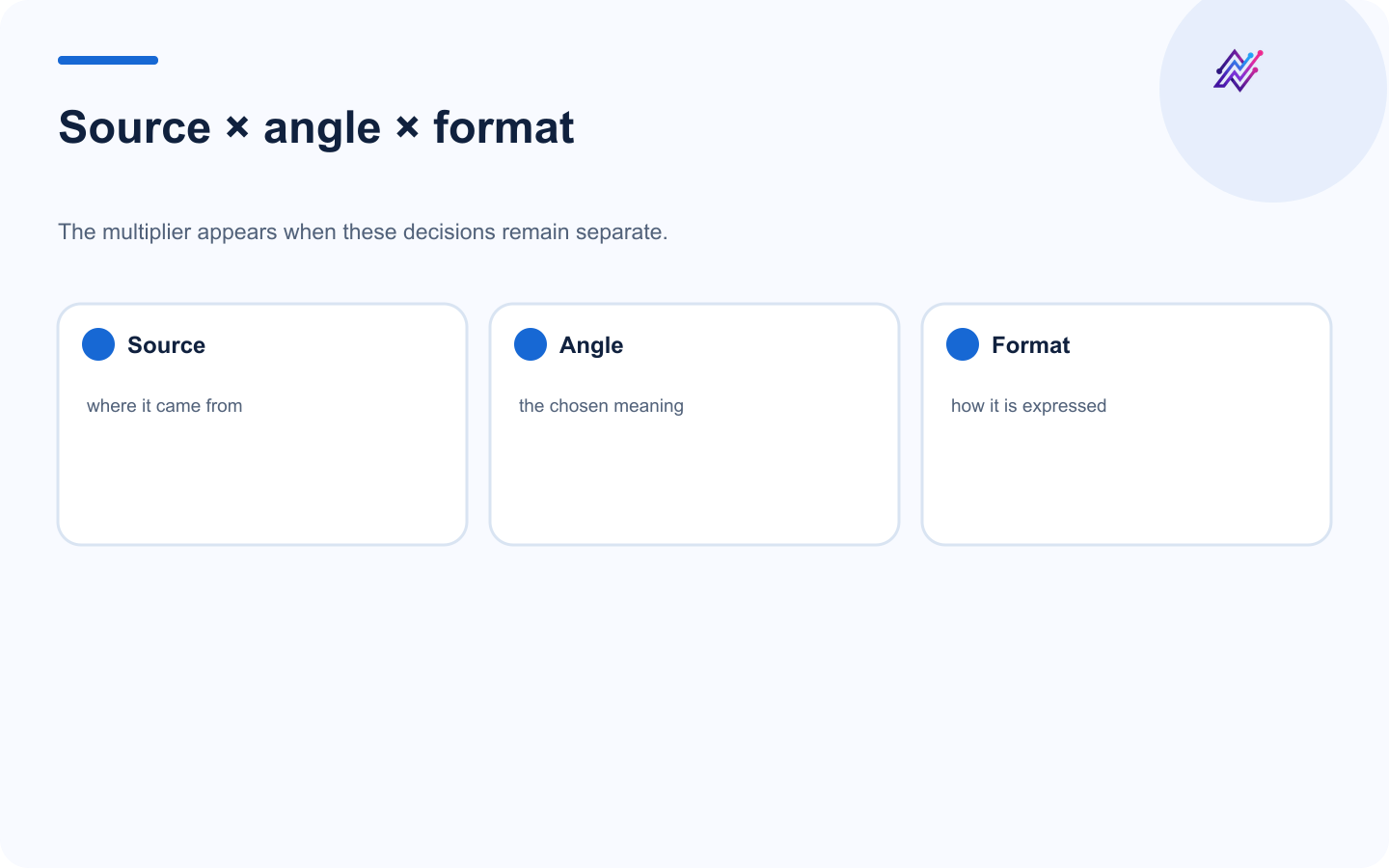
A source can support several angles, and each angle can support several formats.
Source
Where the idea came from.
Examples:
YouTube video
founder note
product release
customer question
podcast
webinar
analytics insight
support ticket
Angle
The specific interpretation.
Examples:
problem
mistake
lesson
contrarian view
case study
checklist
comparison
behind-the-scenes story
Format
How the angle is expressed.
Examples:
text post
carousel
short video
thread
infographic
pin
FAQ
tutorial
The same source can create several angles.
Each angle can create several formats.
This is the repurposing multiplier.
Step 1: select the source idea
Use a scorecard.
AreaScore 1–5Audience relevanceBusiness relevanceOriginal point of viewProof availableEvergreen valuePlatform flexibilityProduction feasibility
A strong source idea should be:
useful
specific
credible
adaptable
connected to a real audience problem
Do not repurpose weak content simply because it already exists.
Step 2: write the core insight
Reduce the source to one sentence.
Example:
The safest AI social media system automates preparation while keeping external publishing behind approval.
That sentence becomes the anchor.
Every platform version should express the same truth.
If a version changes the meaning, it has become a different idea.
That may be useful, but it should be treated separately.
Step 3: define the audience and goal
Audience:
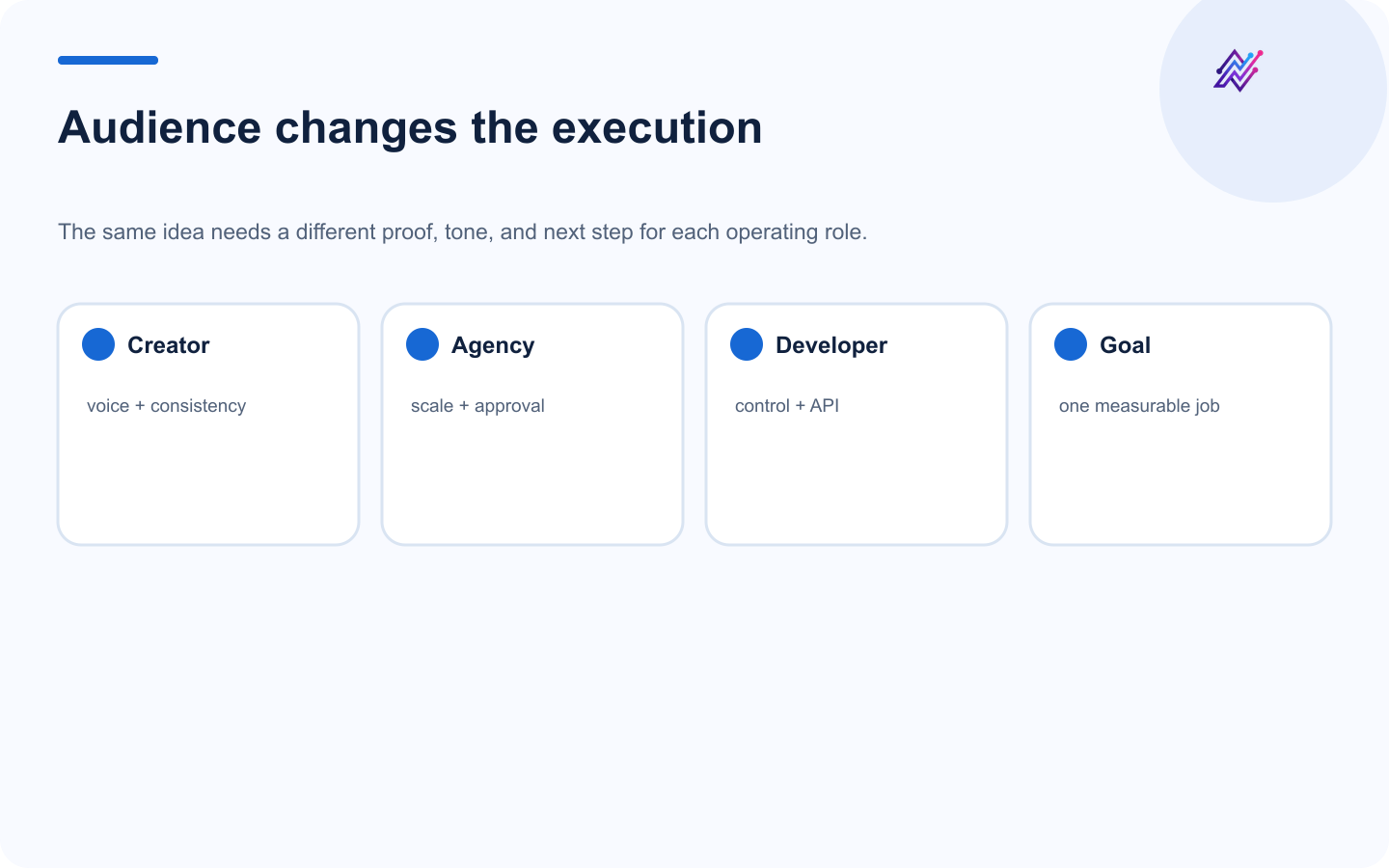
Define the audience and goal before asking AI to produce channel variants.
creators
agencies
SaaS founders
marketing teams
developers
social media managers
local businesses
Goal:
awareness
engagement
saves
traffic
signup
education
product activation
community conversation
The same source idea changes when the audience or goal changes.
Example:
Creator angle
Use AI to remove repetitive work without losing your voice.
Agency angle
Use approval-first AI to scale client work without increasing wrong-account risk.
Developer angle
Use MCP tools and narrow permissions instead of browser automation.
Same category.
Different execution.
Step 4: define the proof
A useful post needs support.
Proof can include:
personal experience
product demonstration
workflow example
customer quote
analytics
screenshot
process
comparison
source document
result
Do not let AI invent proof.
Store the proof source in Tareno internal notes.
This helps reviewers verify the content.
Step 5: create the master content brief
Template:
Source:
Core insight:
Audience:
Goal:
Point of view:
Proof:
Primary CTA:
Claims allowed:
Claims to avoid:
Target platforms:
Asset options:
Language:
Campaign:
The master brief creates consistency across all versions.
It also prevents each AI prompt from drifting in a different direction.
Build ten platform-native versions
Platform 1: LinkedIn
LinkedIn often rewards context, professional relevance, and clear lessons.
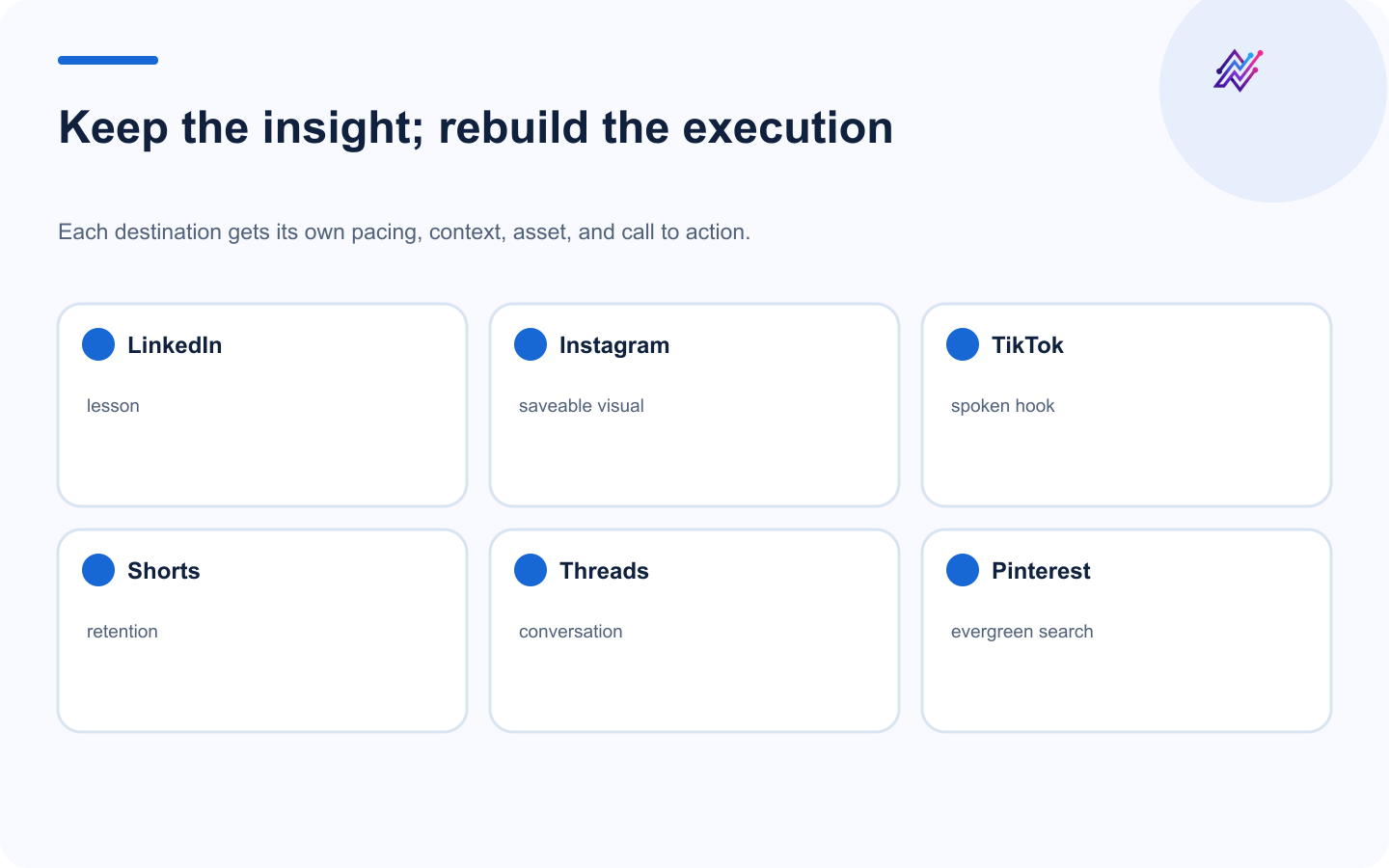
Platform-native repurposing changes the execution while preserving the core truth.
Recommended structure:
strong first line
business problem
explanation
example
lesson
CTA
Example:
AI social media automation becomes risky when the same system can write, choose an account, and publish without a visible checkpoint.
A better workflow separates reasoning from execution.
Let the agent analyze, plan, and create drafts. Let the social platform validate the account and prepare the action. Keep final publishing behind approval.
The result is more automation without removing accountability.
LinkedIn production notes:
use more context
avoid excessive hashtags
show business relevance
include a concrete example
keep the CTA restrained
Platform 2: Instagram
Instagram needs a strong visual concept.
Possible formats:
carousel
Reel
single graphic
story sequence
Carousel structure:
hook
problem
common mistake
better model
workflow
example
checklist
CTA
Example title:
7 Rules for Safe AI Social Media Automation
Caption should support the visual rather than repeat every slide.
Instagram production notes:
prioritize saveable value
use clear slide hierarchy
add alt text
keep CTA simple
design for mobile readability
Platform 3: TikTok
TikTok needs spoken rhythm and immediate tension.
Script structure:
0–3 seconds: Hook
3–10 seconds: Problem
10–20 seconds: Explanation
20–30 seconds: Example
30–40 seconds: Payoff
40–45 seconds: CTA
Example hook:
The most dangerous social media automation is not bad AI writing. It is the AI publishing to the wrong account.
Then explain the approval-first model.
TikTok production notes:
spoken language
short sentences
clear visual change
subtitle-friendly pacing
concrete payoff
no long introduction
Platform 4: YouTube Shorts
YouTube Shorts can use a slightly more complete explanation.
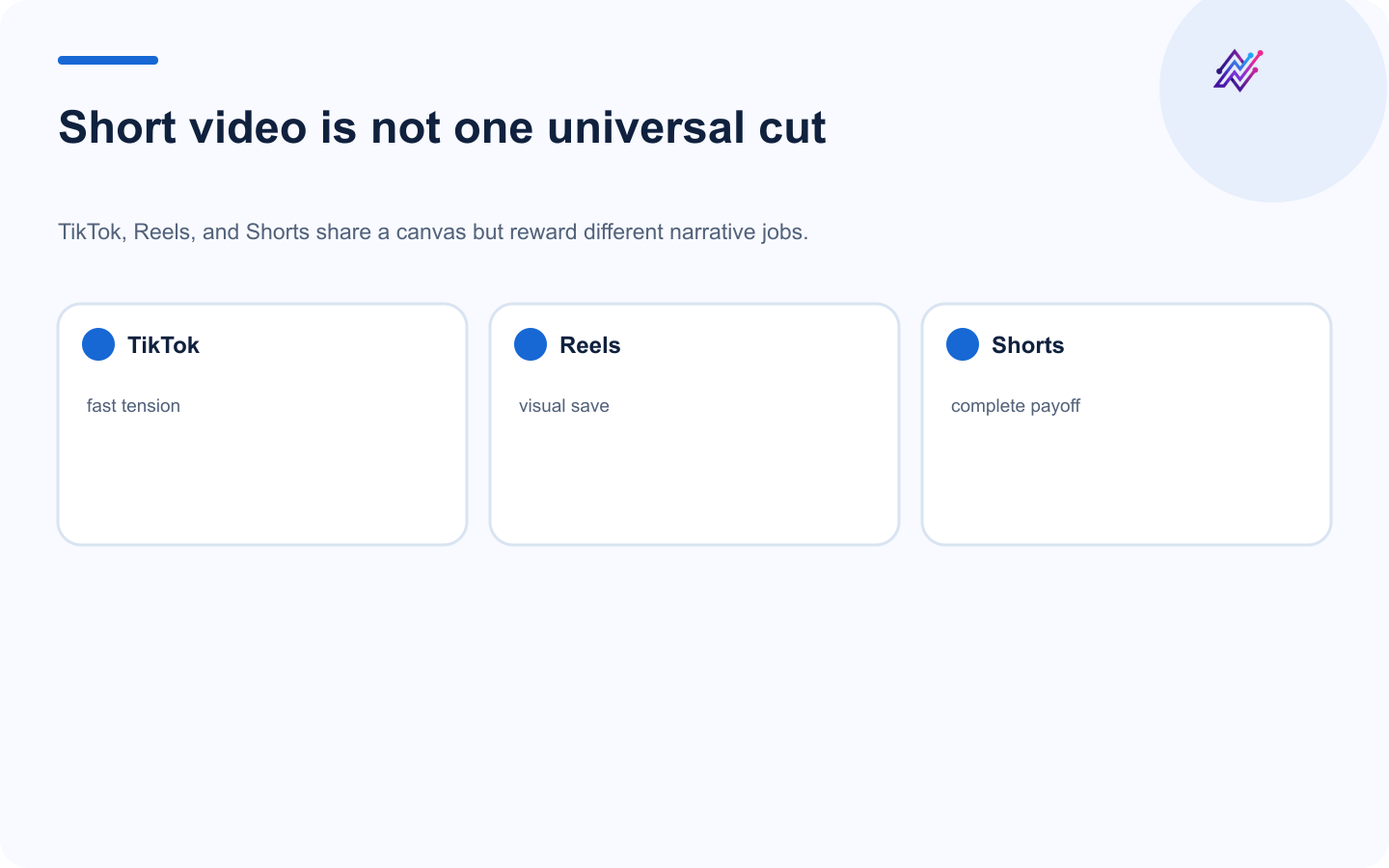
Shared footage still needs platform-native pacing, framing, and payoff.
Possible structure:
topic promise
common mistake
better framework
example
conclusion
Example:
If you are building an AI social media agent, do not start with automatic publishing. Start with read-only analytics, then draft creation, then approval-first scheduling.
YouTube Shorts production notes:
strong title
satisfying ending
possible connection to a longer video
clear description
retention-focused pacing
Platform 5: Threads
Threads can feel more conversational.
Example:
I do not think creators need fully autonomous social media agents.
They need agents that remove the repetitive parts: research, drafts, adaptation, analytics, and repurposing.
Publishing is the one step I would still keep visible.
Threads production notes:
sound like a person
use short rhythm
invite replies
avoid over-polished marketing language
add personal context where real
Platform 6: Bluesky
Bluesky works well with concise, self-contained ideas.
Example:
Automate the social media work. Keep control of the social media consequence.
AI can analyze, draft, and prepare. Public publishing should still be reviewable.
Bluesky production notes:
concise
low-hype
direct
useful without the link
thread only when necessary
Platform 7: Mastodon
Mastodon can support more context.
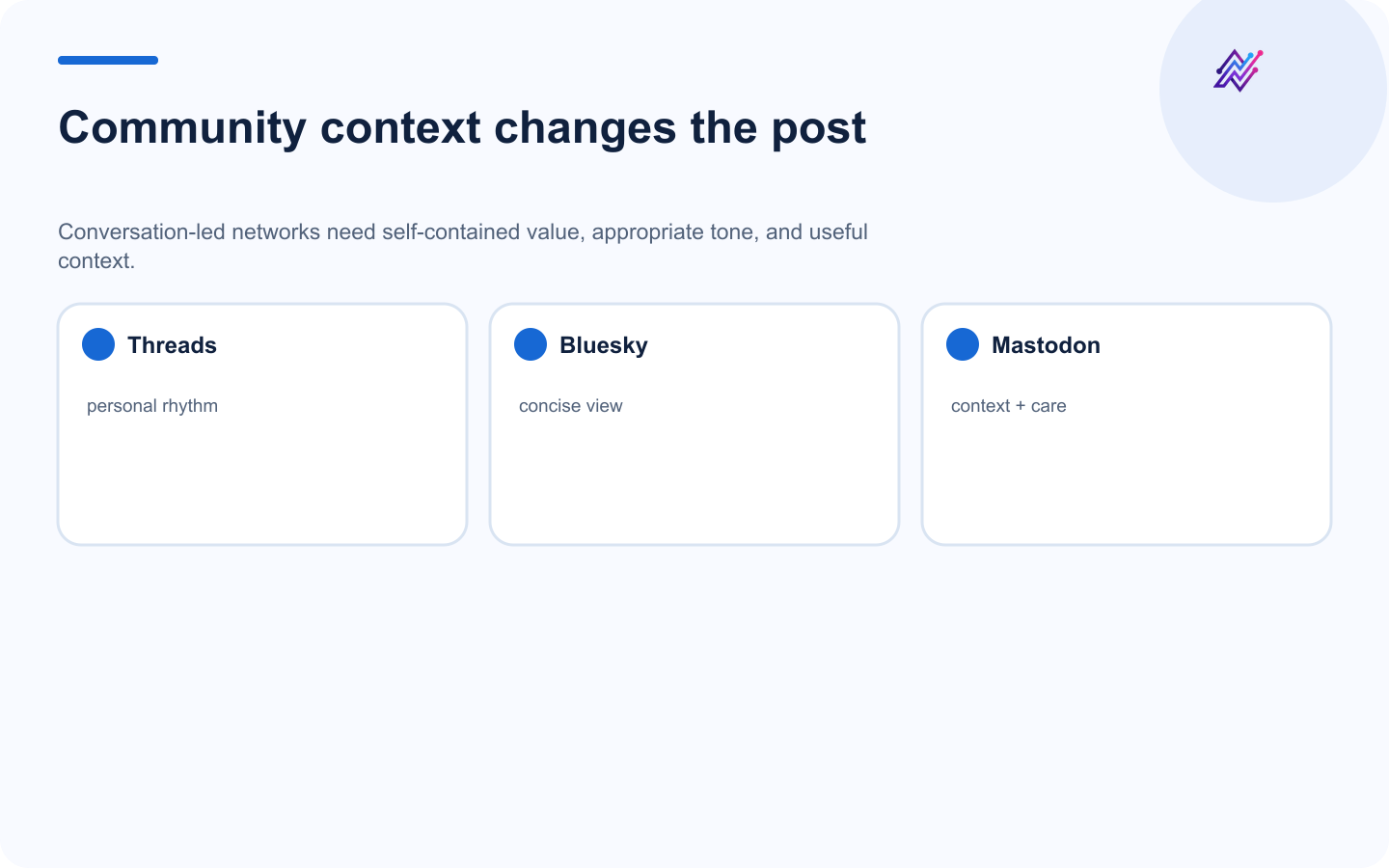
Conversation platforms reward native context more than polished cross-posting.
Example:
AI agents can remove a lot of repetitive social media work: analytics review, draft creation, platform adaptation, and repurposing.
The part worth protecting is the final external action. A draft can be corrected. A public post affects a real account and community.
Approval-first automation is a practical middle ground.
Mastodon production notes:
context
community-aware tone
content warning where relevant
appropriate hashtags
alt text
avoid aggressive growth language
Platform 8: Pinterest
Pinterest is search-oriented and visual.
Possible asset:
AI Social Media Automation Checklist
Pin description:
define the problem
include search-relevant terms
explain the value
point to a useful guide or tool
Pinterest production notes:
evergreen framing
vertical visual
searchable title
useful description
clear landing page
avoid short-lived phrasing
Platform 9: Facebook
Facebook often benefits from accessible context.
Example:
AI can help small teams create and organize more social content, but fully automatic publishing is not always the best first step. A safer workflow creates drafts, checks the correct account, and asks for approval before the post goes live.
Facebook production notes:
broader context
accessible language
community question
visual where helpful
clear link context
Platform 10: X
X needs a fast opening.
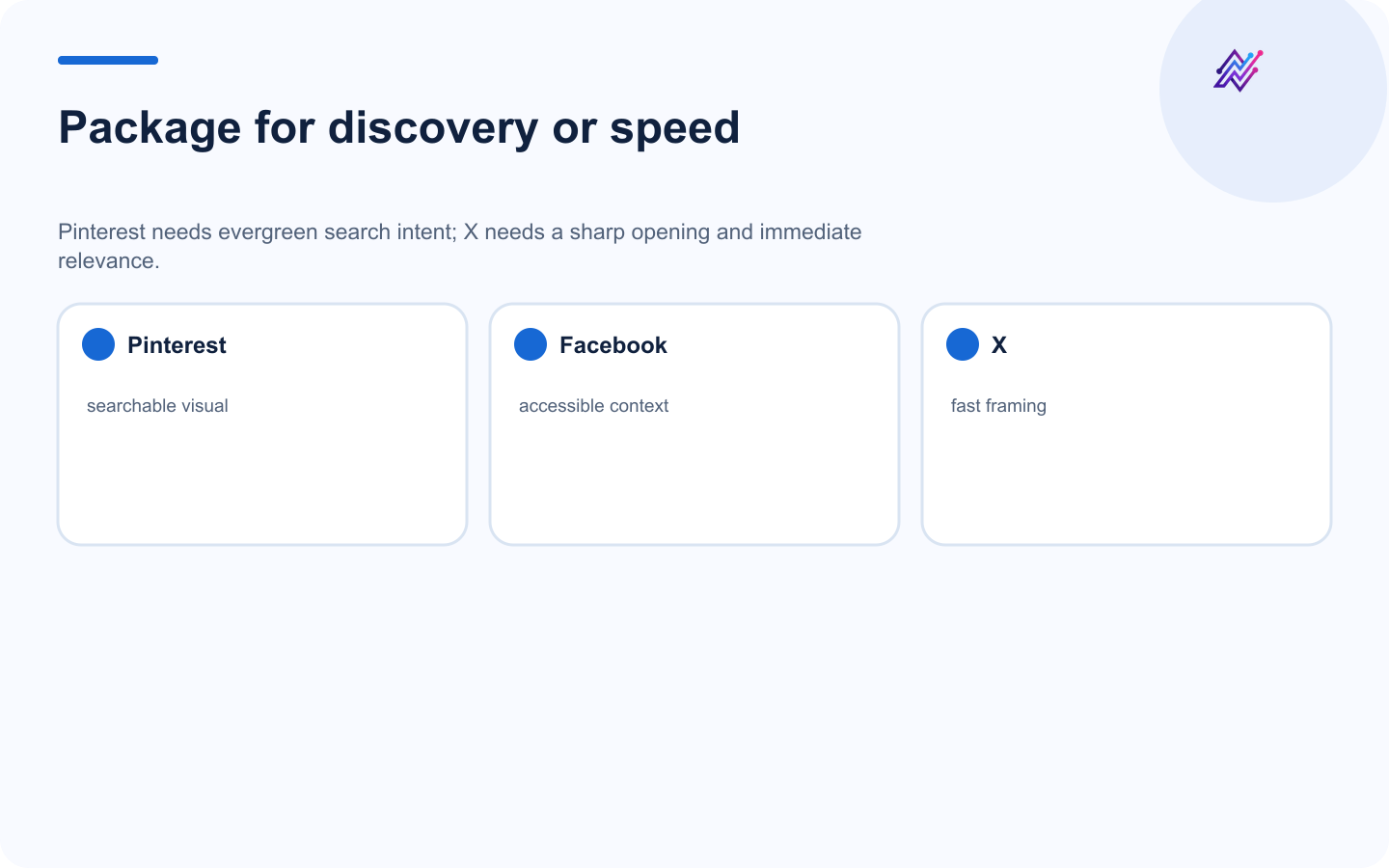
The final three channels need different discovery, context, and speed decisions.
Example:
AI social media automation should be aggressive with drafts and conservative with publishing.
Possible thread:
principle
read actions
draft actions
approval actions
analytics loop
CTA
X production notes:
strong first sentence
concise structure
no filler
thread only when useful
direct CTA
Run the campaign in Tareno
PlatformPrimary strengthBest expressionLinkedInProfessional contextLesson and exampleInstagramVisual savesCarousel or ReelTikTokAttention and pacingSpoken short-formYouTube ShortsRetention and explanationStructured videoThreadsConversationPersonal observationBlueskyConcise insightShort post or threadMastodonContext and communityDetailed postPinterestSearch and evergreenVisual guideFacebookAccessible communityContextual postXSpeed and sharp framingShort post or thread
Use the matrix inside the Tareno brief or AI prompt.
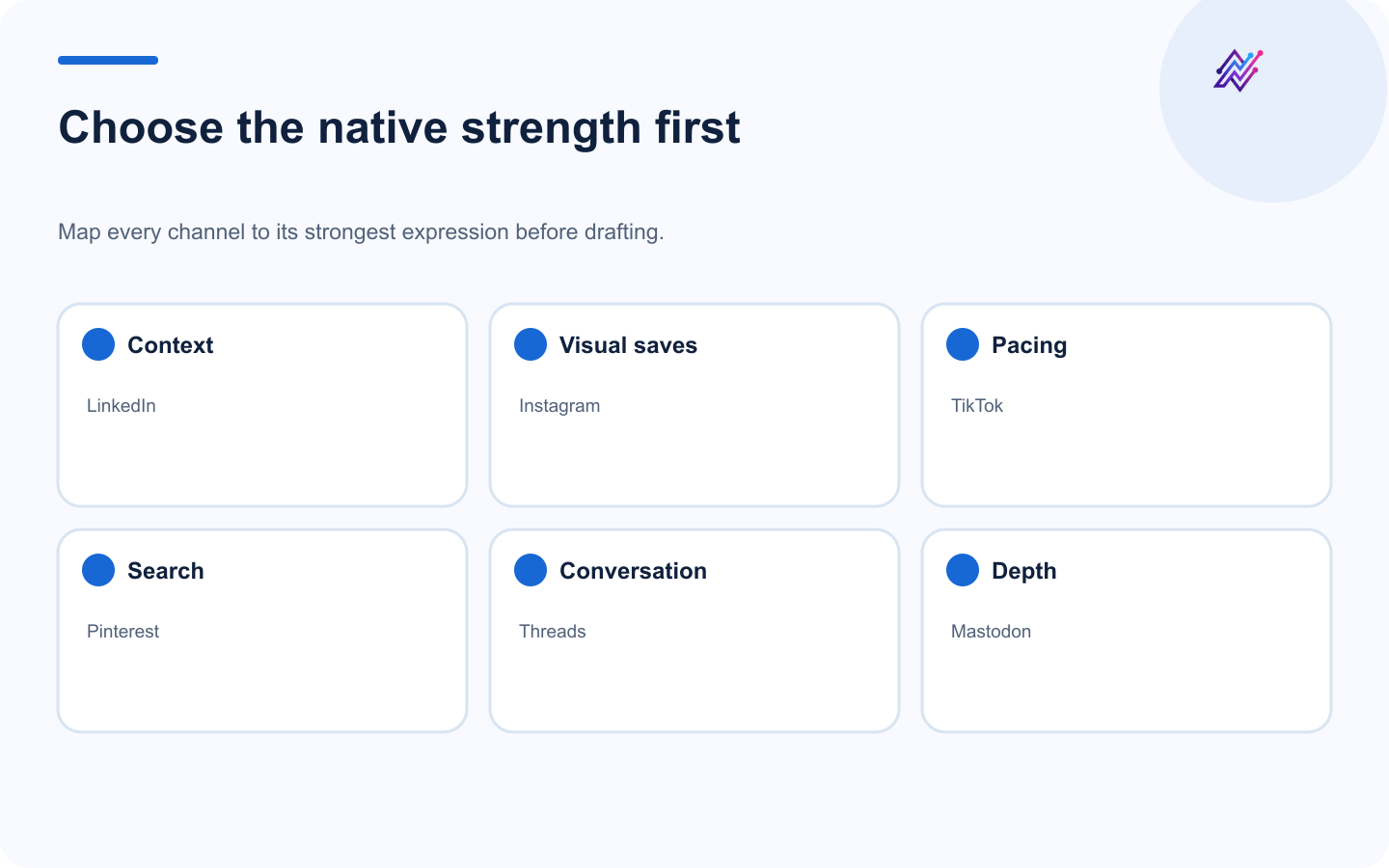
The adaptation matrix prevents one generic asset from becoming ten weak copies.
Step 7: create separate drafts in Tareno
Each platform version should have its own item or structured variation.
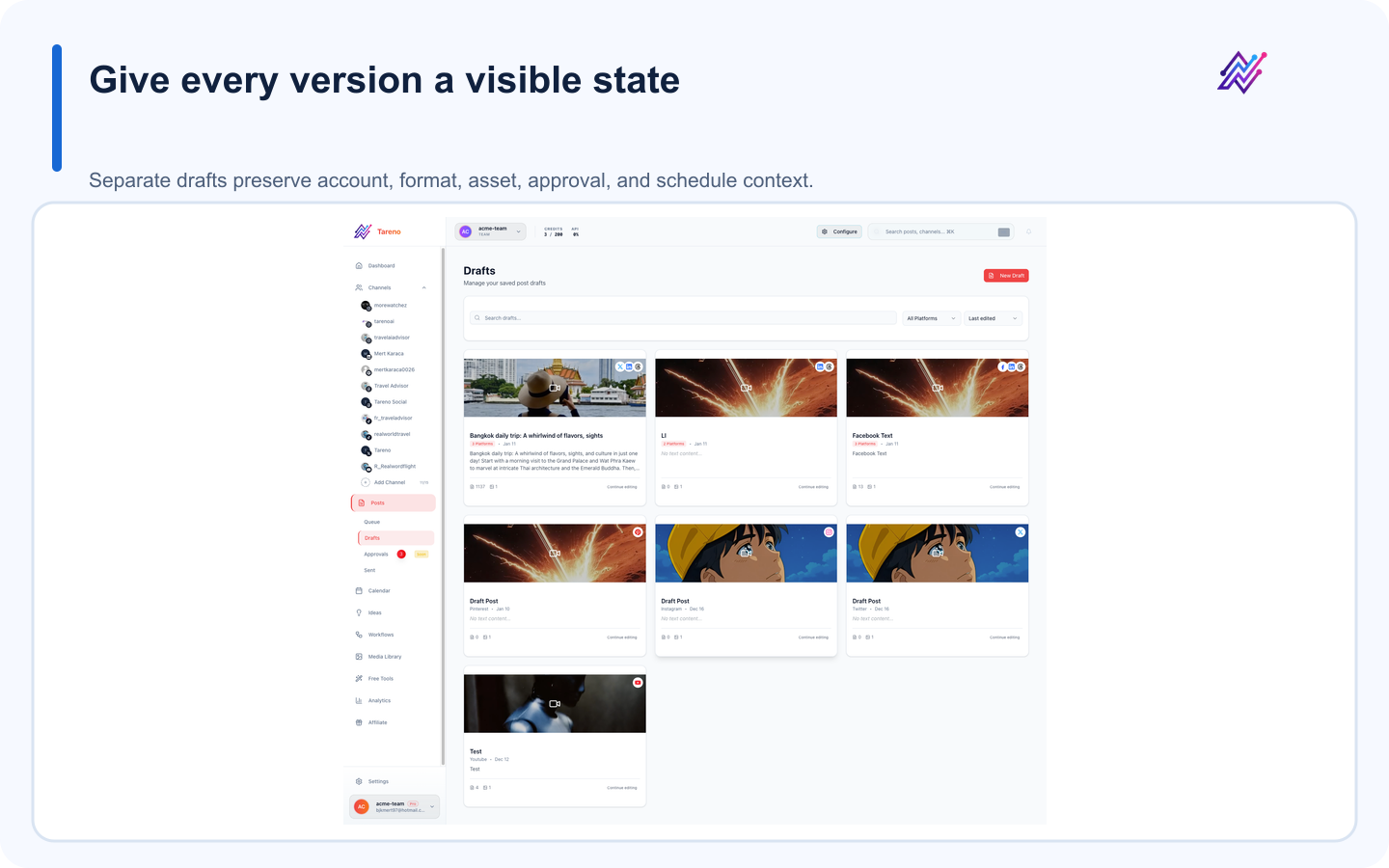
Separate drafts make every channel version individually reviewable.
Store:
source idea
target platform
target account
caption or script
format
asset
CTA
language
risk
approval
schedule
measurement date
Do not store ten versions inside one unstructured document.
The workflow should make each status visible.
Step 8: assign assets
Possible asset map:
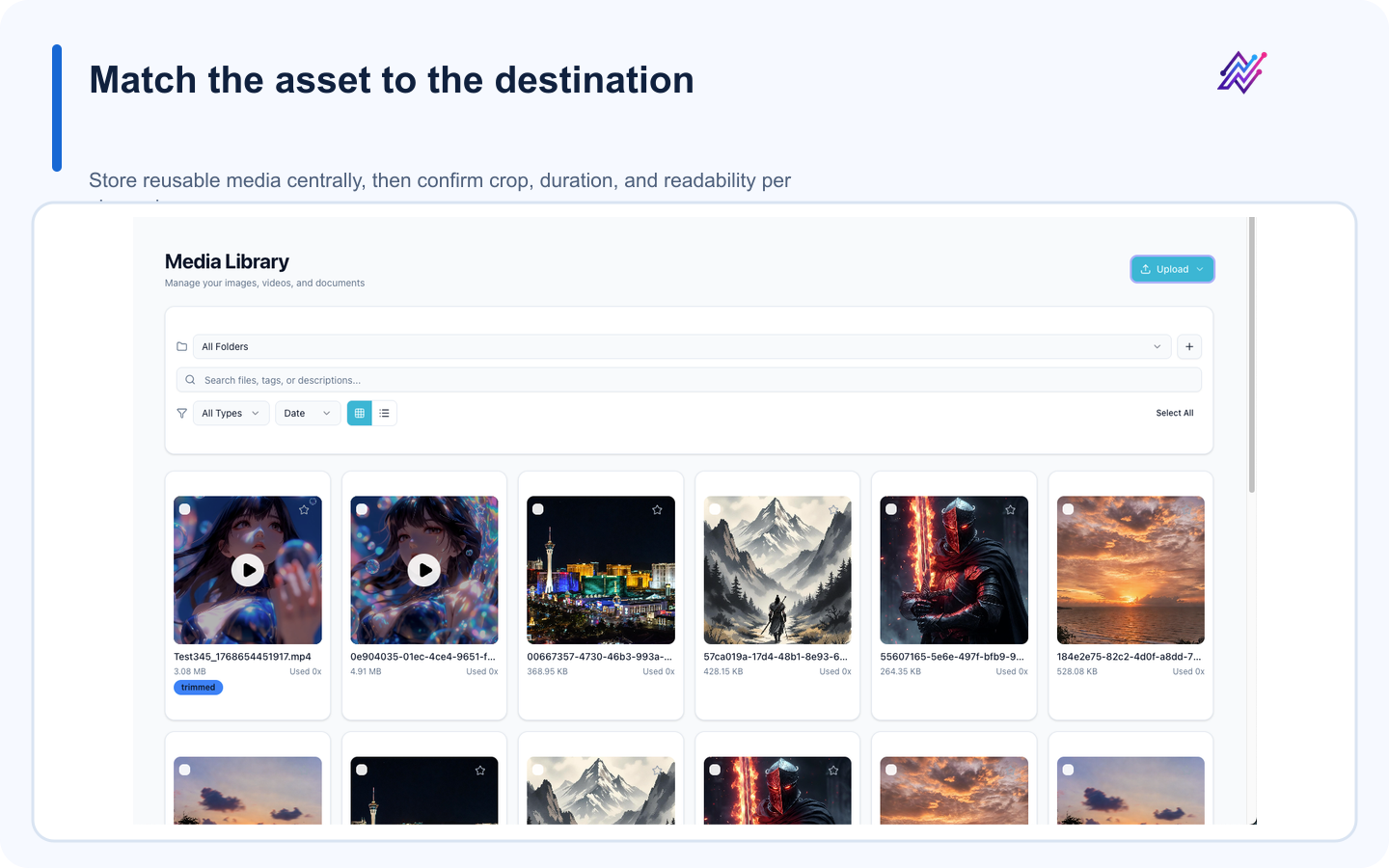
A shared media library supports reuse without skipping platform-specific review.
PlatformAssetLinkedInText or document carouselInstagramCarousel or ReelTikTokVertical videoYouTube ShortsVertical videoThreadsTextBlueskyText or imageMastodonText or image with alt textPinterestVertical pinFacebookText, image, or videoXText, image, or thread
One visual may be adaptable.
It should still be reviewed for each destination.
Step 9: apply quality control
Review:
Message consistency
same core insight
no contradictory claims
CTA remains aligned
Platform fit
format is native
length is appropriate
tone is correct
Originality
no copied wording
no generic AI filler
real proof or example
Accuracy
product claims correct
prices current
platform facts verified
links correct
Accessibility
alt text
subtitles
readable visuals
language and directionality
Step 10: apply approval rules
Low-risk versions may need only owner review.
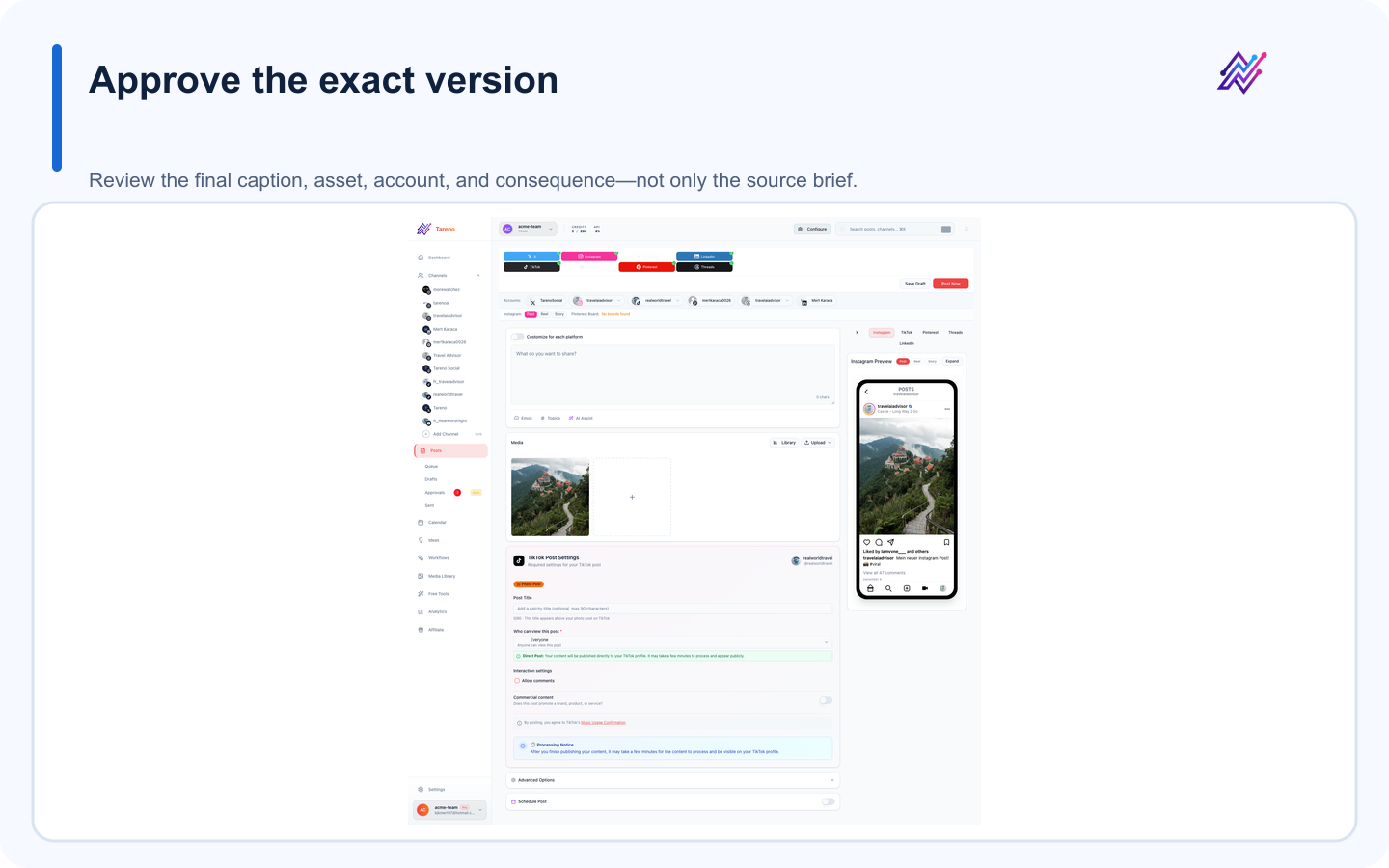
Approval belongs to the exact platform version that will be published.
High-risk versions need additional approval.
Examples requiring stronger review:
product claim
pricing
competitor mention
customer result
sponsored content
translated campaign
immediate publishing
deletion or editing live content
Approval should apply to the exact version.
Step 11: stagger the distribution
Do not publish ten versions at once.
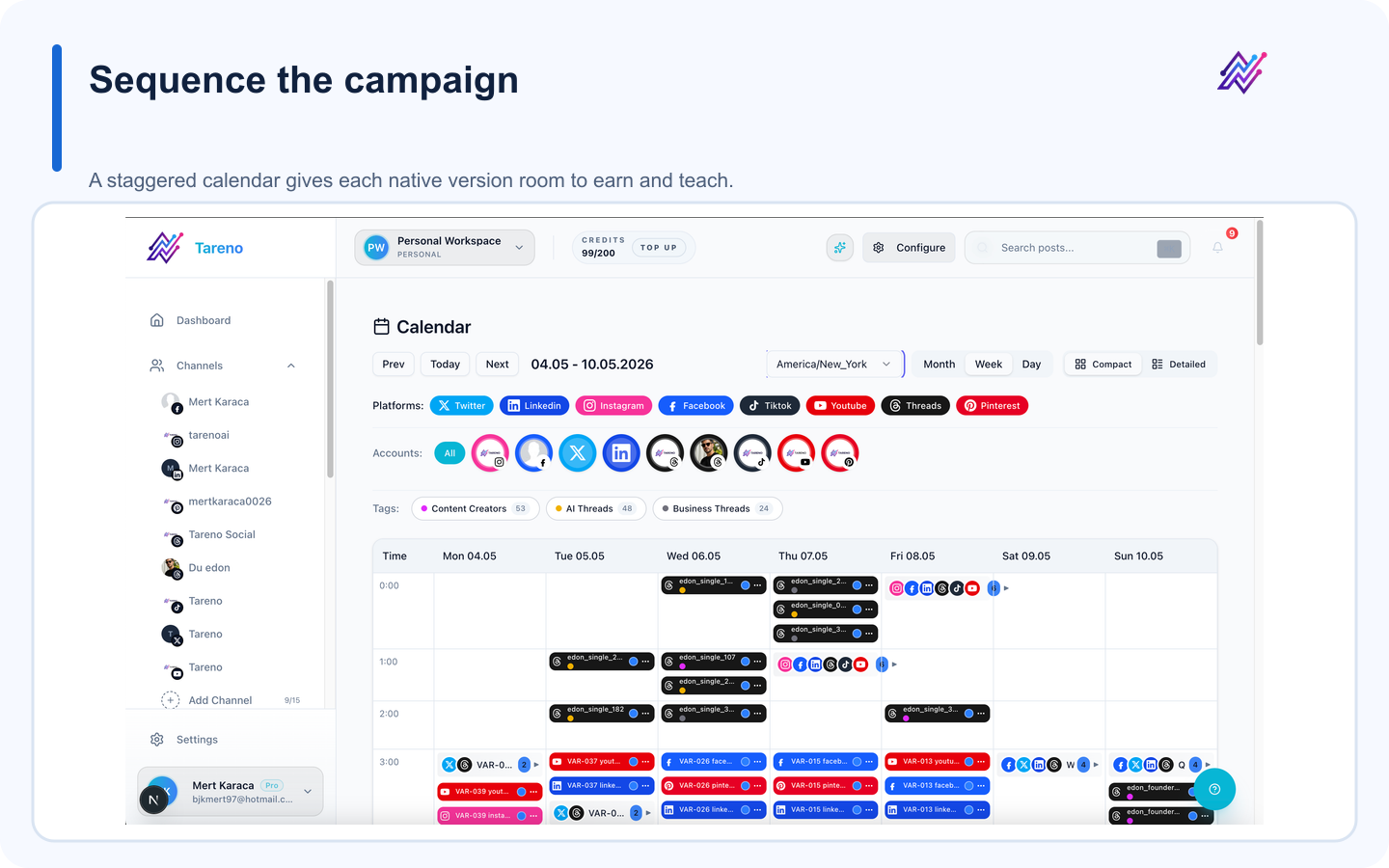
Staggered distribution avoids publishing every adaptation at the same moment.
Example:
DayPlatformAssetMondayLinkedInMain lessonTuesdayTikTokShort scriptWednesdayBlueskyConcise insightThursdayInstagramCarouselFridayMastodonContext-rich postSaturdayThreadsPersonal reflectionMondayYouTube ShortsVideo versionTuesdayPinterestEvergreen pinWednesdayXThreadThursdayFacebookAccessible summary
A staggered sequence gives the idea more time and more learning opportunities.
Step 12: automate the workflow with Tareno
Native Tareno workflow:
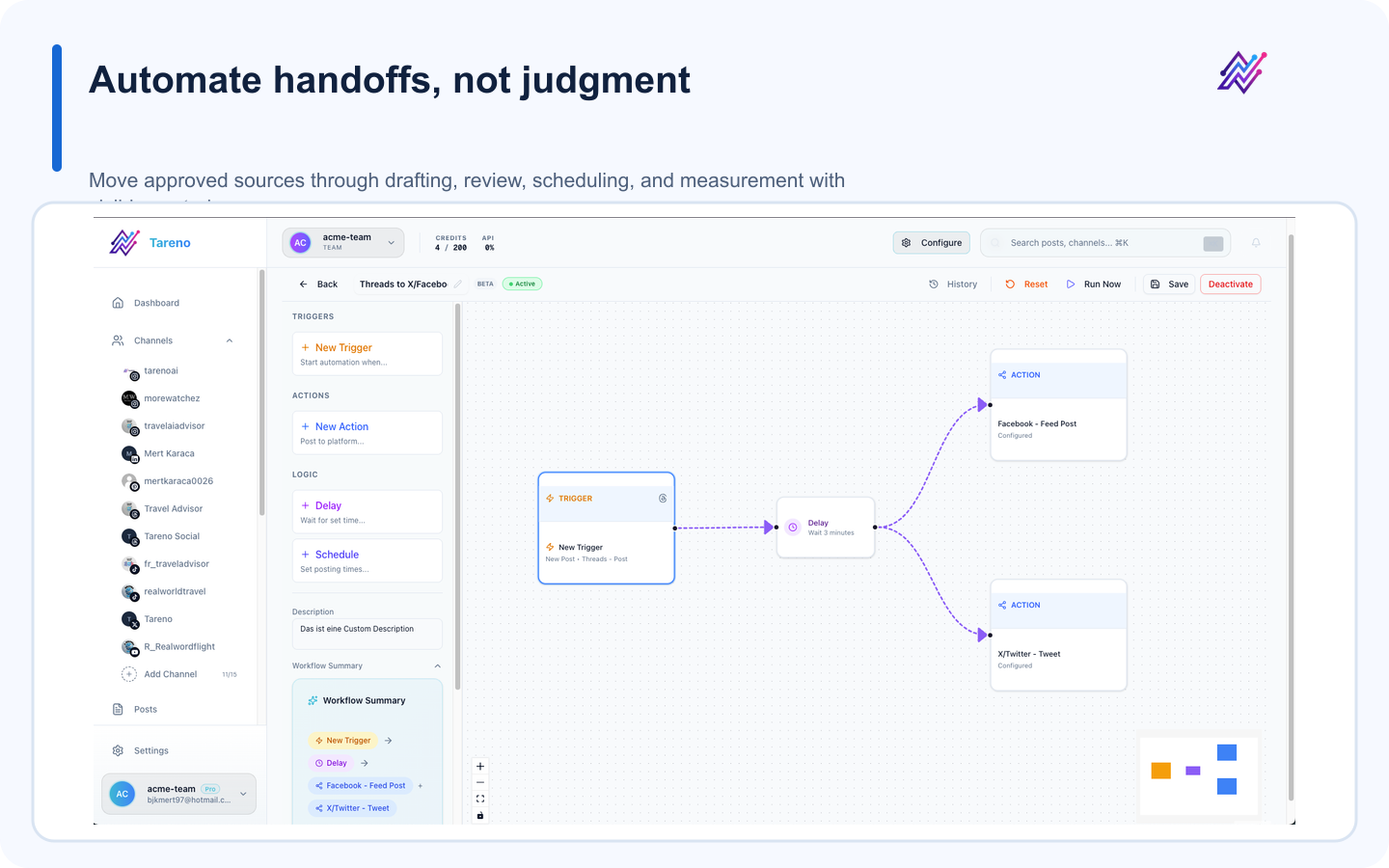
Workflow automation should preserve visible approval and recovery points.
Source idea approved
  ↓
Create platform tasks
  ↓
Generate or attach drafts
  ↓
Request review
  ↓
Schedule after approval
  ↓
Create analytics tasks
  ↓
Move winners to repurposing queue
Conditions:
account connected
source not duplicated
risk below threshold
approval complete
asset available
Connect automation and AI tools
n8n workflow:
Source item approved
  ↓
Load platform matrix
  ↓
Loop through platforms
  ↓
Generate native versions
  ↓
Create Tareno drafts
  ↓
Notify reviewer
Add:
duplicate checks
language loops
risk classifier
source tracking
error routes
Use n8n for technical control and self-hosting.
Step 14: use Make
Make scenario:
Approved source
  ↓
Router
  ├─ LinkedIn
  ├─ Instagram
  ├─ TikTok
  ├─ Bluesky
  ├─ Mastodon
  └─ Other platforms
      ↓
Tareno drafts
Make is useful because the platform branches remain visible.
Use Data Store to track IDs.
Step 15: use Zapier
Zapier works for simpler flows.
Example:
New approved Airtable idea
  ↓
Generate LinkedIn draft
  ↓
Generate Bluesky draft
  ↓
Create Tareno drafts
  ↓
Send review notification
For ten branches, Make or n8n may be easier.
Step 16: use MCP and AI agents
Prompt:
Take this approved source idea and create native drafts for LinkedIn, Instagram, TikTok, YouTube Shorts, Threads, Bluesky, Mastodon, Pinterest, Facebook, and X. Preserve the core insight. Adapt the structure and CTA. Save drafts only.
Then:
Show me the platform versions that contain product, customer, pricing, competitor, or performance claims.
The agent can create and inspect.
Tareno controls the external workflow.
Step 17: use Get Viral Now
If the source is a YouTube video:
analyze transcript
identify content atoms
select strongest angle
create original master script
create text and visual derivatives
save drafts
Do not simply summarize the video.
Extract usable ideas.
Localize, measure, and build the second wave
Do not multiply all ten platforms by nine languages immediately.
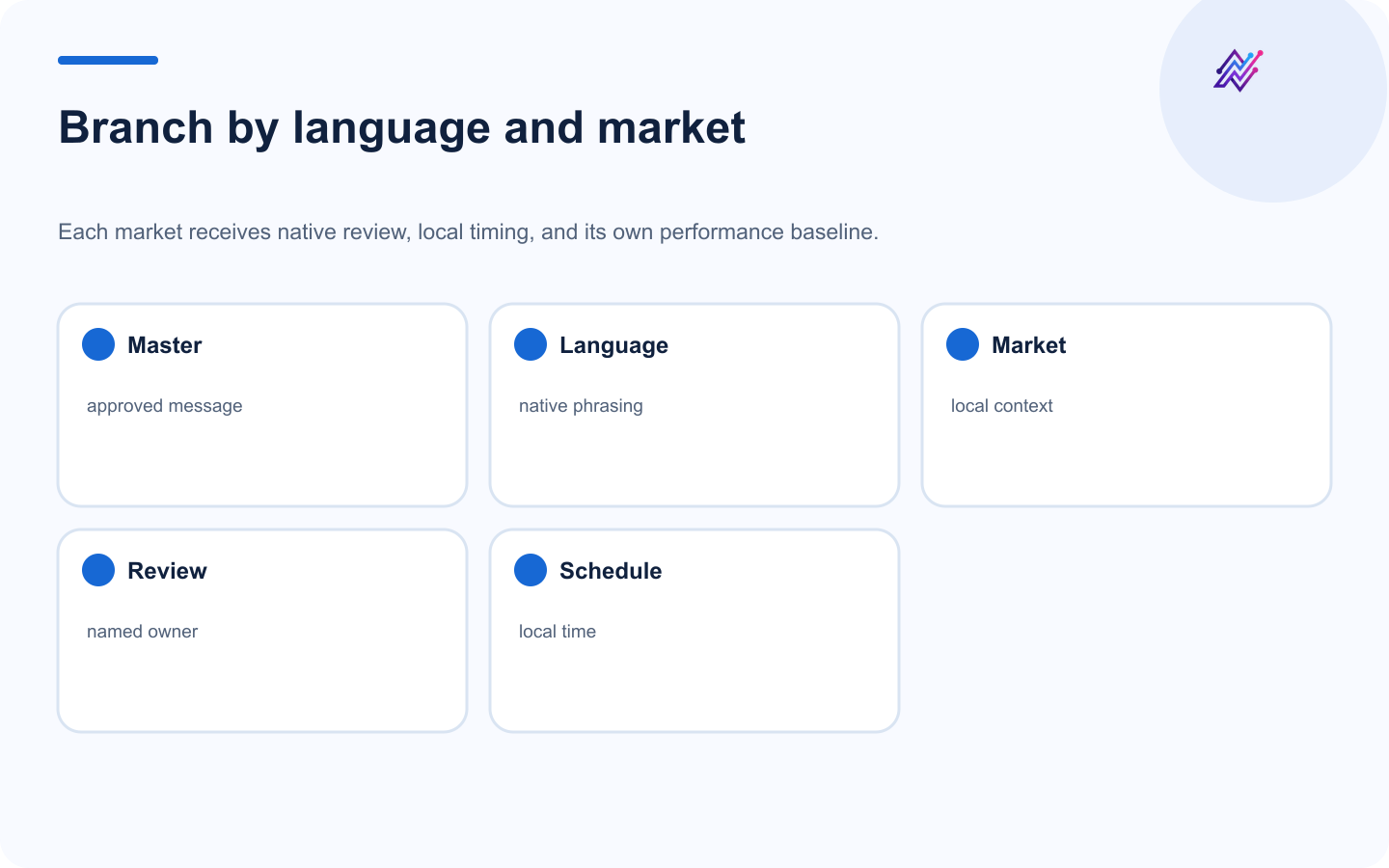
Localization works best when language and market remain explicit workflow data.
That would create 90 assets.
Start with proven formats and priority markets.
Workflow:
Strong platform version
  ↓
Select language and market
  ↓
AI localization
  ↓
Native review
  ↓
Tareno draft
Supported workflow languages include:
English
German
French
Spanish
Portuguese
Russian
Italian
Japanese
Arabic
Confirm language and market support in the current product before committing a campaign plan.
Step 19: measure by platform
Different platforms need different metrics.
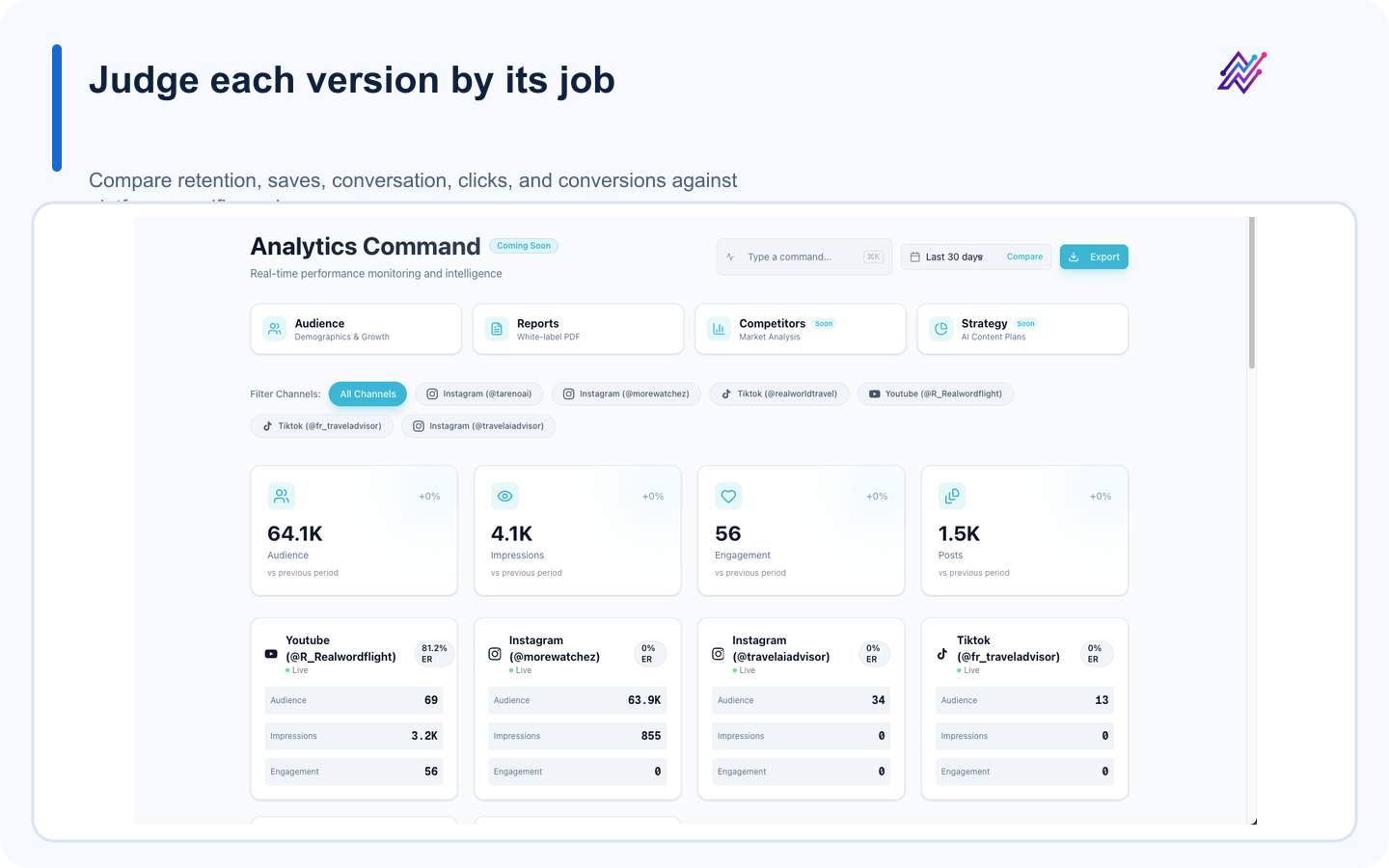
Measure each adaptation against the behavior it was designed to earn.
impressions
saves
comments
clicks
reach
saves
shares
profile actions
TikTok and Shorts
watch time
completion
rewatches
shares
Bluesky and Mastodon
replies
reposts or boosts
link clicks
follower growth
impressions
saves
outbound clicks
Compare against each platform’s own baseline.
Do not declare one version the winner only by raw reach.
Step 20: create the second wave
Example:
Platform resultSecond-wave actionLinkedIn high savesCarouselTikTok strong watch timeSeriesBluesky high repliesFollow-up threadMastodon high boostsDeeper guidePinterest high clicksNew pin seriesInstagram high sharesLocalized carouselX high repostsExpanded thread
The second wave is where repurposing begins to compound.
Step 21: maintain a repurposing map
Store:
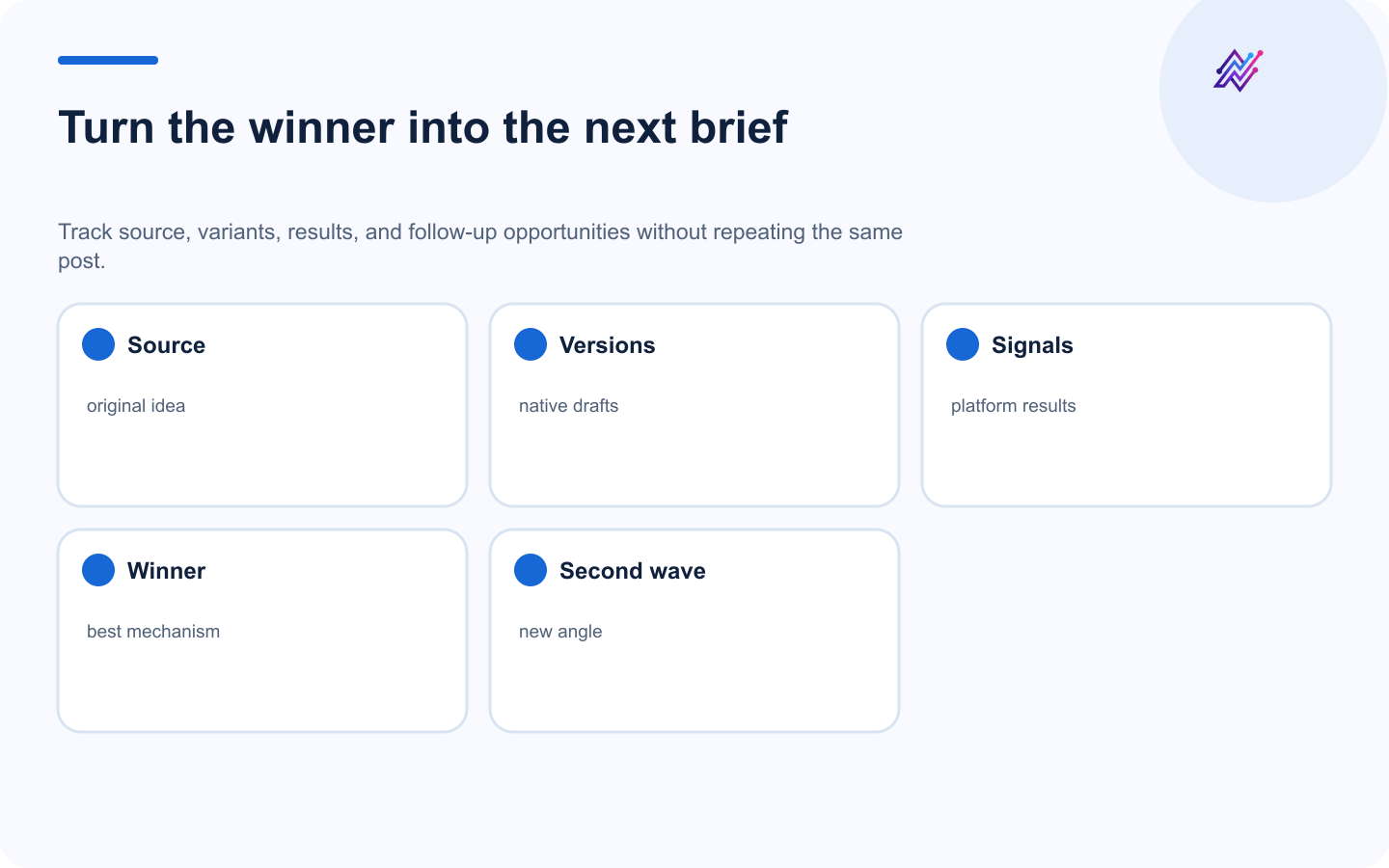
A repurposing map preserves lineage and turns results into the next original angle.
source ID
original platform
derived platform
format
hook
performance
next action
freshness status
repurposing count
Example:
Source:
MCP article

Wave 1:
LinkedIn, Bluesky, Mastodon, TikTok

Wave 2:
Carousel, FAQ, tutorial

Wave 3:
German and Japanese versions
This prevents random repetition.
Step 22: use a freshness review
Before reusing an old idea, check:
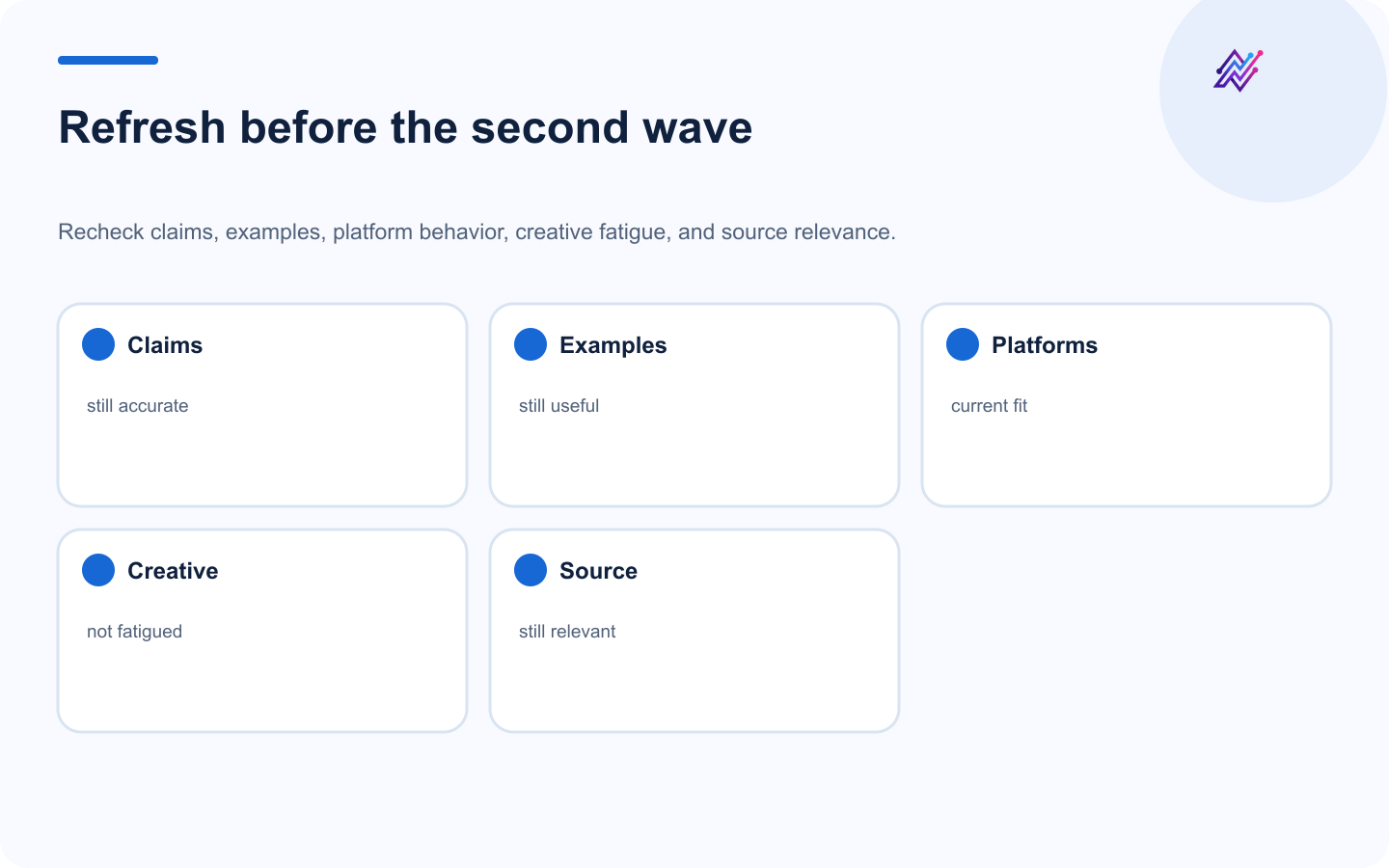
A freshness review protects the second wave from stale facts and tired execution.
product accuracy
pricing
platform behavior
screenshots
dates
links
statistics
sponsor rights
recent duplicates
Evergreen does not mean permanent.
It means reusable after review.
Repurposing quality checks and common mistakes
Source:
- [ ] Core insight clear
- [ ] Proof available
- [ ] Audience defined
- [ ] Goal defined

Platform:
- [ ] Native hook
- [ ] Native format
- [ ] Correct CTA
- [ ] Correct account
- [ ] Appropriate length

Quality:
- [ ] Original wording
- [ ] Accurate claims
- [ ] Brand voice
- [ ] Asset ready
- [ ] Accessibility complete

Workflow:
- [ ] Draft saved
- [ ] Approval assigned
- [ ] Schedule confirmed
- [ ] Measurement date set
- [ ] Source linked
Common repurposing mistakes
Mistake 1: copy-pasting
Rebuild the execution.
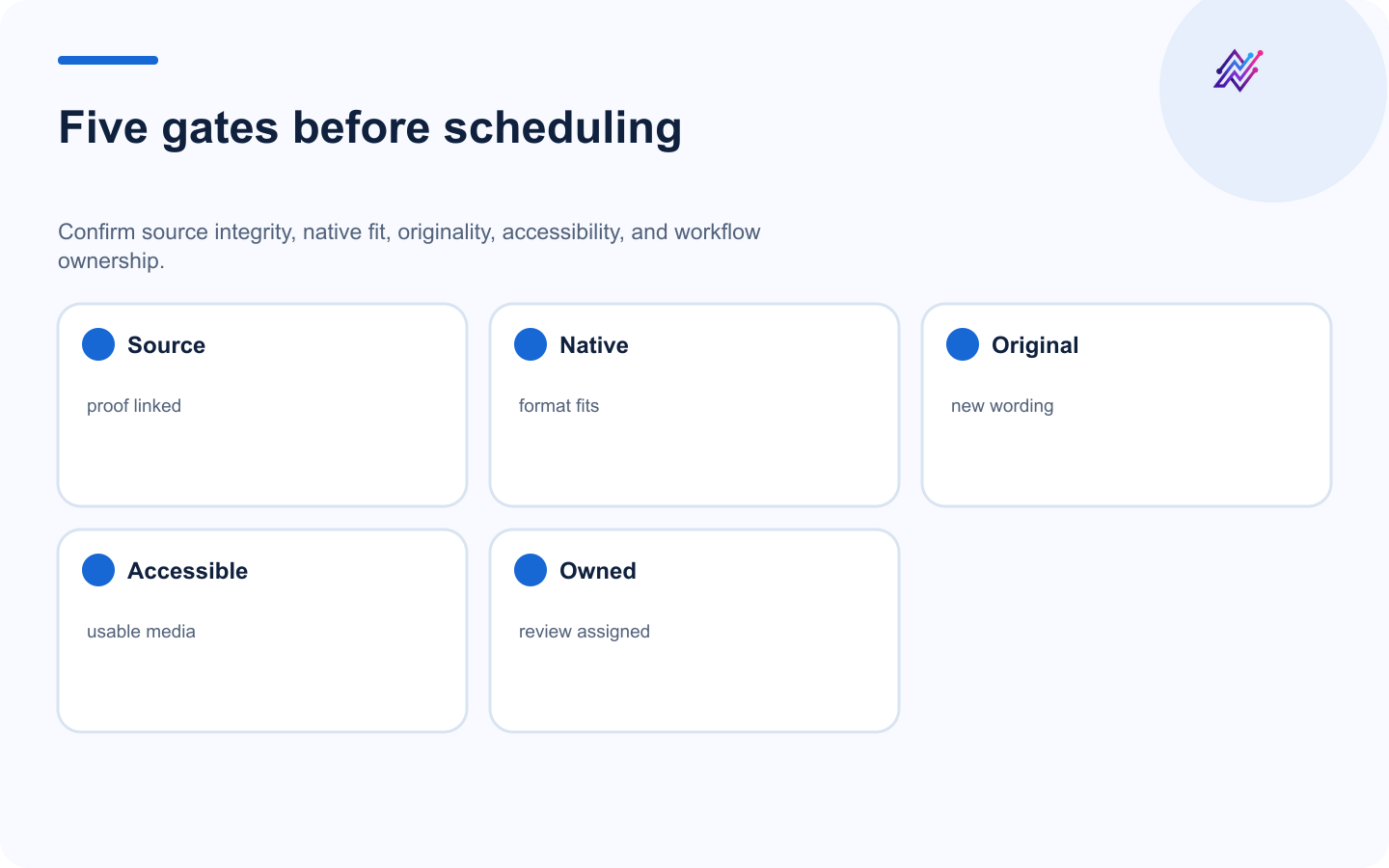
Repurposing quality depends on both creative fit and operational accountability.
Mistake 2: no source brief
The versions drift.
Mistake 3: every format for every idea
Choose strategically.
Mistake 4: all platforms on one day
Stagger distribution.
Mistake 5: no platform-specific assets
Visual formats need separate planning.
Mistake 6: no approval
Claims can change during adaptation.
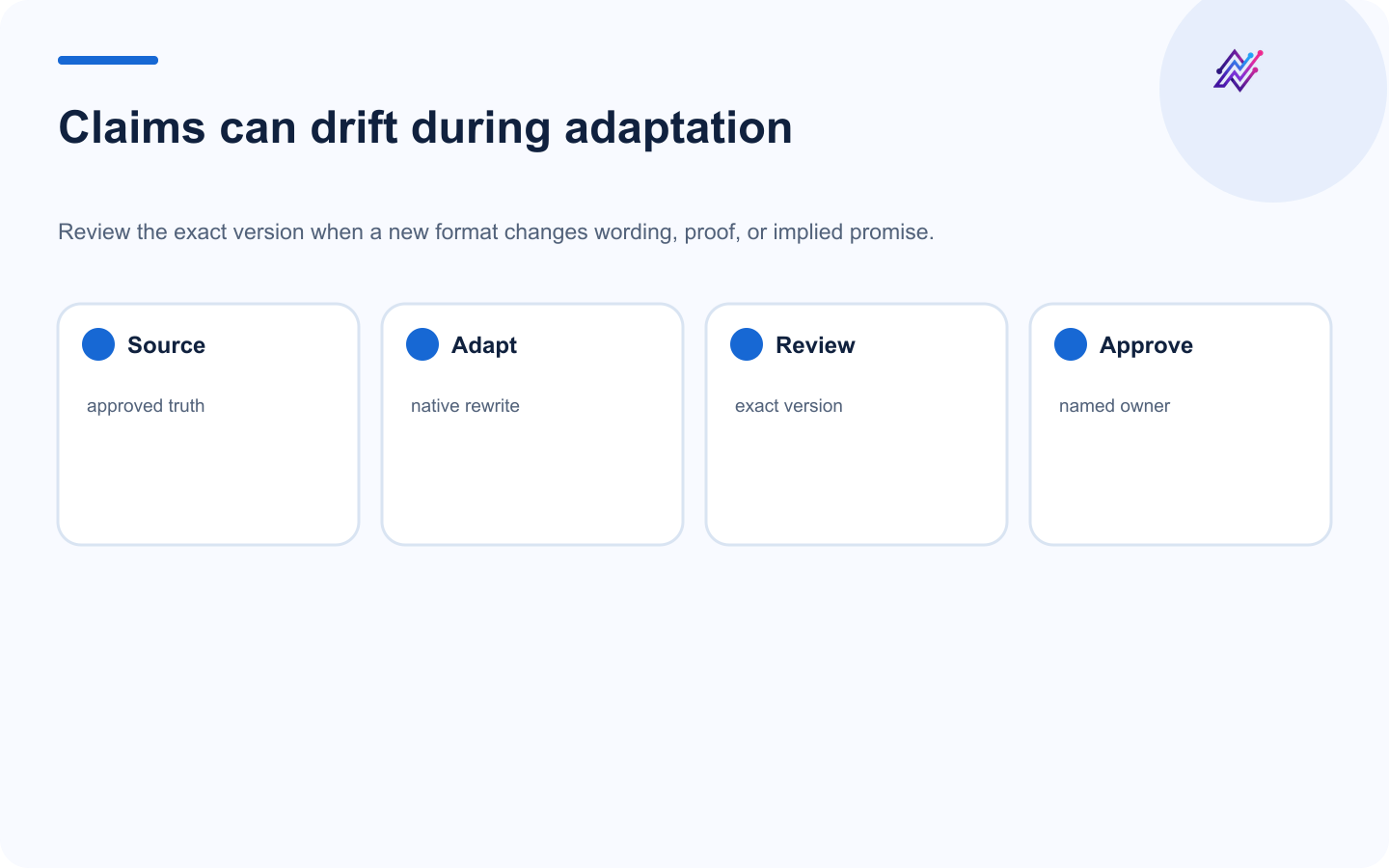
Approval is a content-integrity gate, not only a publishing permission.
Mistake 7: translating before proving the idea
Localize winners.
Mistake 8: no second wave
Use analytics.
Mistake 9: measuring raw reach only
Use platform baselines.
Mistake 10: no duplicate tracking
Use source and draft IDs.
Twenty source-to-platform examples
YouTube tutorial → LinkedIn checklist
Podcast opinion → Threads post
Webinar answer → Mastodon guide
Product demo → TikTok script
Founder note → Bluesky post
Customer question → Instagram carousel
Case study → Facebook story
Blog framework → Pinterest pin
High-save post → YouTube Short
Product release → X thread
Live stream → five short clips
FAQ → LinkedIn post
Support ticket → educational Reel
Newsletter → Bluesky thread
Comment debate → Mastodon response
Release notes → ten-platform campaign
Competitor question → fair comparison
Analytics insight → founder post
Strong English post → Japanese localization
Strong video → Arabic carousel
Related Tareno resources
Post schedulingStagger native versions across one controlled calendar.Analytics reportsCompare each platform against its own goal and baseline.Instagram caption generatorTurn a validated angle into an Instagram-ready caption.Social media tool alternativesCompare broader stacks before adding more workflow tools.
FAQ
Can one idea become ten social posts?
Yes, when each version is adapted to the platform instead of copied.
Should every idea be published everywhere?
No. Select platforms based on audience, format, and goal.
Can AI create all platform versions?
Yes. AI can create first drafts, but human review should protect voice, accuracy, originality, and platform fit.
Can Tareno store every platform version?
Yes. Tareno can organize separate drafts, accounts, approvals, calendar items, analytics, and repurposing tasks, with each version kept as a visible, reviewable item.
Can the workflow include Bluesky and Mastodon?
Yes. Both should receive separate native versions.
Can YouTube videos become social campaigns?
Yes. Get Viral Now can help analyze a YouTube transcript and generate original content directions.
Can n8n automate the workflow?
Yes. n8n can loop through platforms, apply rules, and create Tareno drafts.
Can Make automate it?
Yes. Make can use routers for visual platform branches.
Should the campaign be translated into every language?
Only when the content and market opportunity justify it. Start with proven assets and priority languages.
How should the strongest version be chosen?
Use platform-specific metrics and compare each result against its own baseline.
Final thoughts
One strong idea should not become one disposable post.
It should become a structured content system.
Define the insight.
Choose the audience.
Add proof.
Create platform-native versions.
Attach the right assets.
Review every final version.
Schedule a staggered sequence.
Compare performance.
Build a second wave.
Localize the winners.
Tareno can keep the source, drafts, approvals, calendar, analytics, and repurposing map connected.
AI can accelerate the transformation.
The creator or team keeps the point of view.
That is how one idea can produce ten useful posts without producing ten copies.
Primary CTA: Add one strong source idea to Tareno and create three platform-native drafts.
Secondary CTA: Expand to ten platforms only after the source brief and review workflow are stable.