Social media governance is the operating agreement that lets a team publish quickly without making access, claims, approvals, or AI use ambiguous.
It matters as soon as more than one person can draft, review, schedule, publish, or reply for a brand. Small teams can keep the policy lightweight, but they still need explicit boundaries.
This template defines roles, risk-based approval paths, AI and claim rules, publishing controls, reporting ownership, repurposing checks, and incident response.
Pair the policy with a structured workflow builder so the rules appear at the point of action instead of living in a forgotten document.
TL;DR
A strong social media governance policy includes roles and responsibilities, access and permissions, approval rules, publishing controls, AI content policy, claim verification, client or sponsor review rules, reporting ownership, repurposing rules, automation boundaries, incident response, and activity visibility.
Governance should make safe work faster, not every post slower.
Use risk levels. Not every post needs the same approval path.
What Social Media Governance Controls
Social media governance is the set of rules, roles, and workflows that controls how a brand creates, reviews, publishes, responds, reports, and reuses social media content.
It helps teams avoid wrong-version publishing, unapproved claims, accidental posts, duplicate publishing, inconsistent brand voice, client approval confusion, AI-generated inaccuracies, risky replies, and outdated repurposed content.
Governance is useful at any team size. Set control depth by account access, claim sensitivity, stakeholder count, and publishing consequence—not headcount alone.
The GOVERN Framework
Use the GOVERN framework to keep the policy practical: Grant roles carefully, Organize approval rules, Verify sensitive claims, Establish AI boundaries, Repurpose with review, and Note activity and ownership.
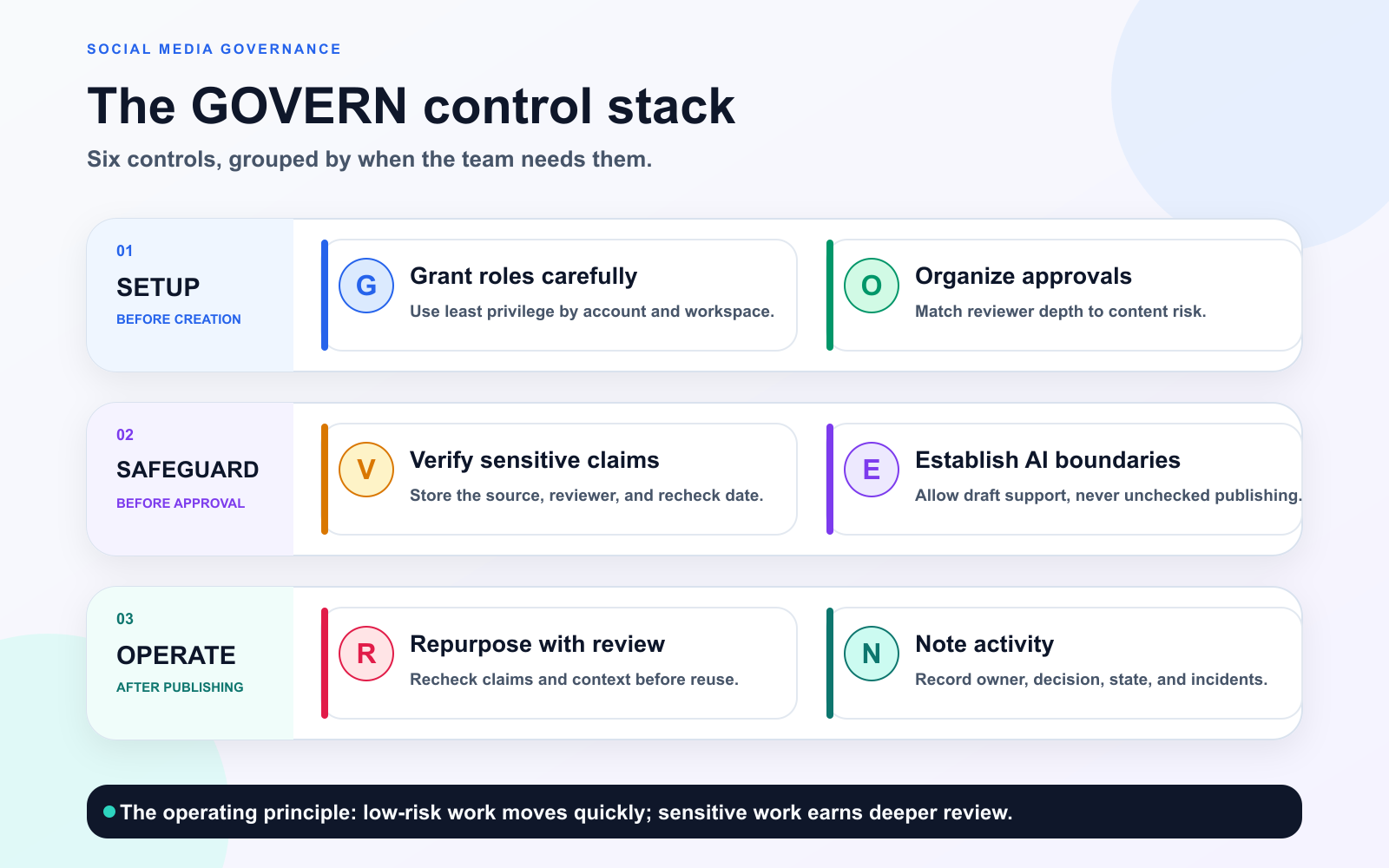
The GOVERN control stack ties each rule to the moment the team needs it.
Roles, Permissions, And Approval Rules
Start with roles and least privilege. Grant only the access required for the current responsibility, name an owner for every privileged account and integration key, review access when someone joins, changes role, or leaves, and run a scheduled recertification for credentials that otherwise remain active indefinitely.
RoleCan draftCan reviewCan approveCan scheduleCan publishCan manage profilesAdminYesYesYesYesYesYesSocial media managerYesYesSometimesYesYesNoCopywriterYesNoNoNoNoNoDesigner/editorYesNoNoNoNoNoReviewerNoYesSometimesNoNoNoClient or stakeholderNoYesYesNoNoNo
Approval rules should be based on risk. Low-risk evergreen tips may need only owner review. Medium-risk product education or campaign posts need internal review. High-risk pricing claims, competitor comparisons, legal-sensitive posts, sponsor content, client content, product launches, crisis responses, and AI-generated technical claims need specialist or final approval.
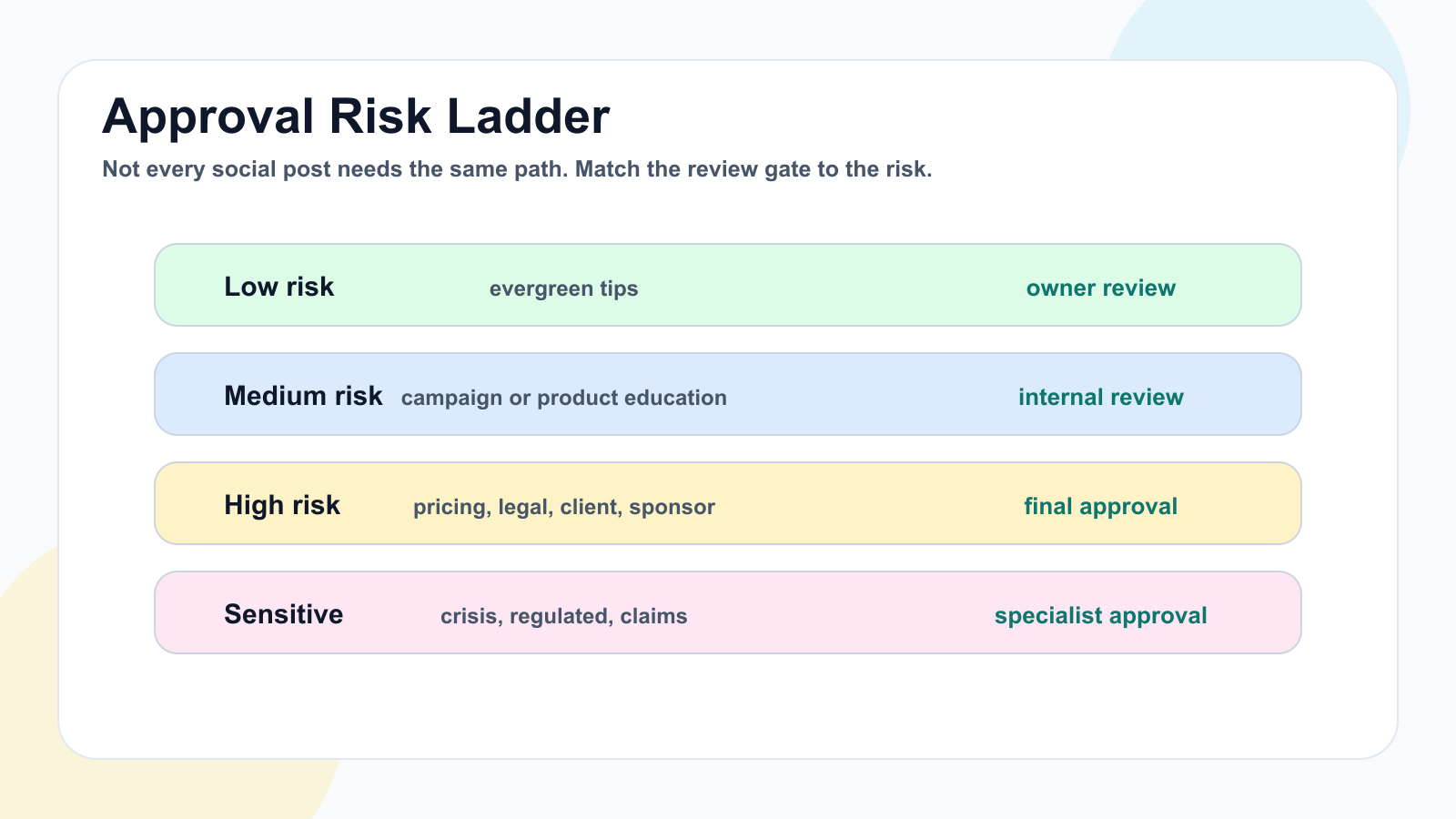
Risk levels let safe content move quickly while sensitive content gets the right review.
A dedicated social media approval workflow keeps this from becoming a loose checklist. The approval must attach to the exact version that will be scheduled.
AI, Claims, And Repurposing Boundaries
AI can help with caption drafts, hook variations, hashtag ideas, platform rewrites, script outlines, carousel outlines, repurposing ideas, report summaries, and turning blog sections into social posts.
AI should not automatically publish product claims, pricing claims, competitor comparisons, legal-sensitive posts, client posts, sponsor posts, risky customer replies, crisis communication, or regulated-topic content. AI output is a draft until a human checks accuracy, brand voice, claims, CTA, platform fit, compliance needs, and client requirements.
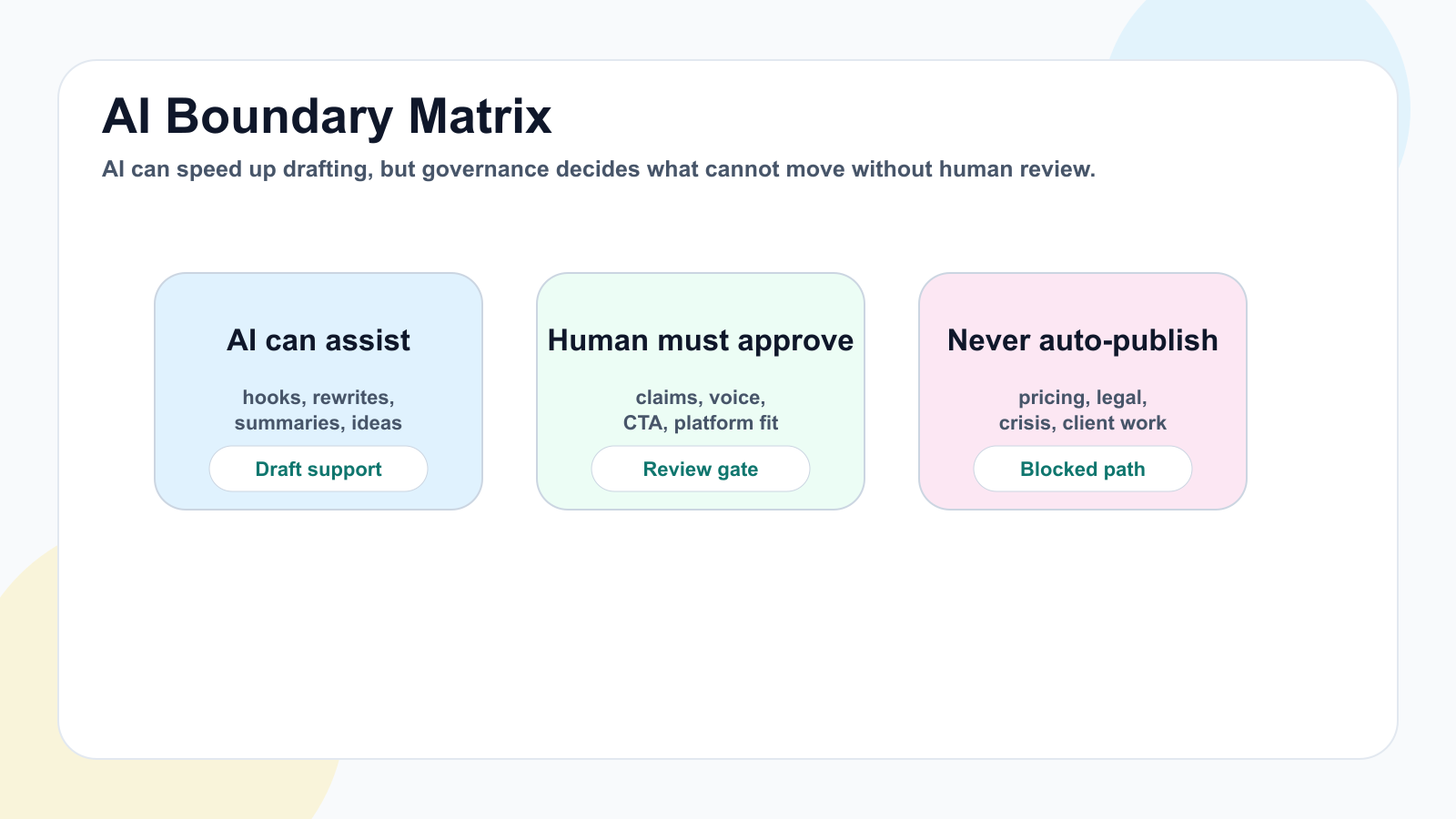
AI can speed up drafting, but governance decides what cannot move without human review.
Sensitive claims need expiry-aware verification. Track the exact wording, source URL or snapshot, reviewer, approval status, last verified date, permitted use, and recheck date. A claim that was accurate three months ago may not be safe to reuse after pricing, product, policy, sponsor, or competitor context changes.
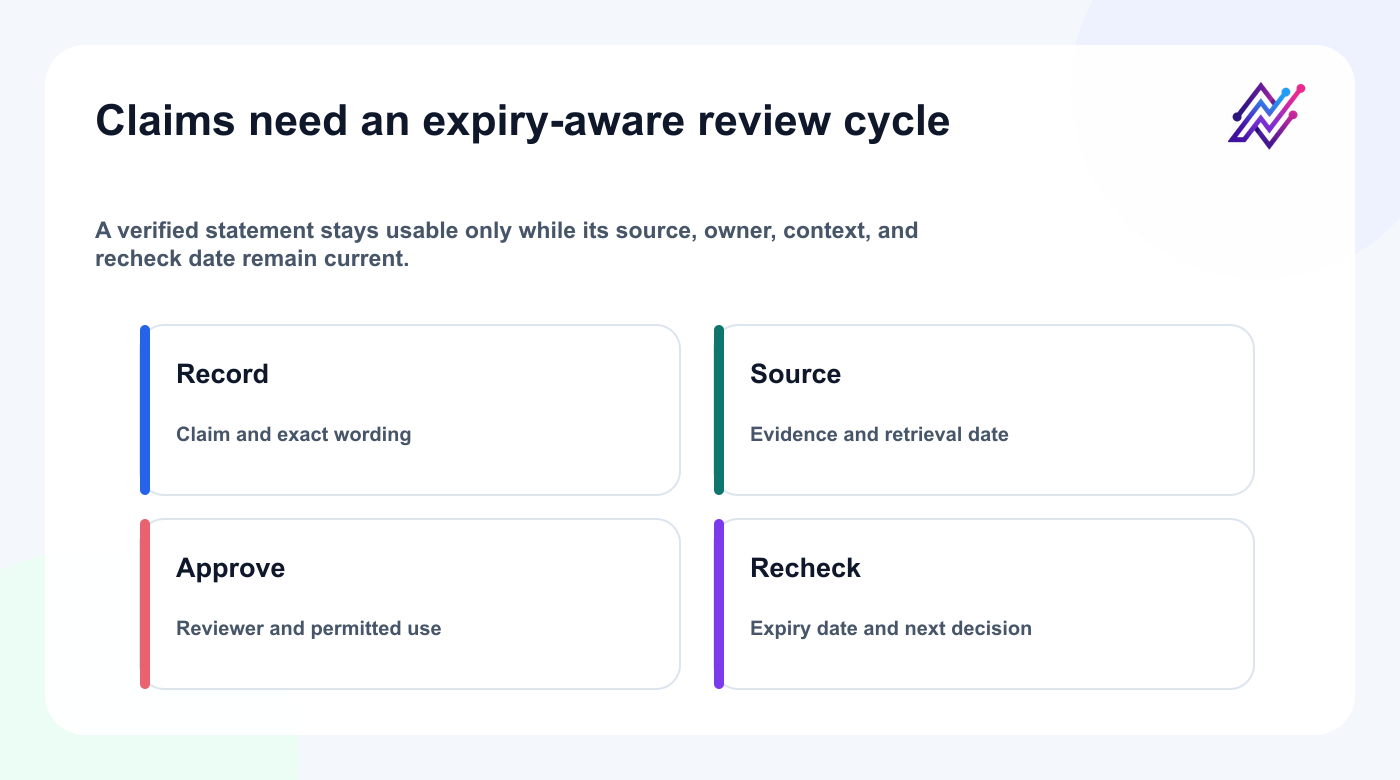
A recheck date prevents accurate old copy from becoming inaccurate reused content.
Repurposing needs governance too. Old content may include outdated claims, expired offers, old screenshots, discontinued features, or old sponsor context. Evergreen low-risk content can get light review; anything with claims, clients, sponsors, or product context should be re-reviewed.
Publishing Controls, Reporting, And Incident Response
Publishing rules should be explicit: only approved users may schedule content, only admins or assigned publishers may publish directly, unapproved content cannot be scheduled as final, and high-risk content must have approval attached to the exact final version. Emergency overrides need a named approver, stated reason, time limit, exact affected accounts, and retrospective review. Record what was bypassed and restore the normal control immediately after the emergency window closes.
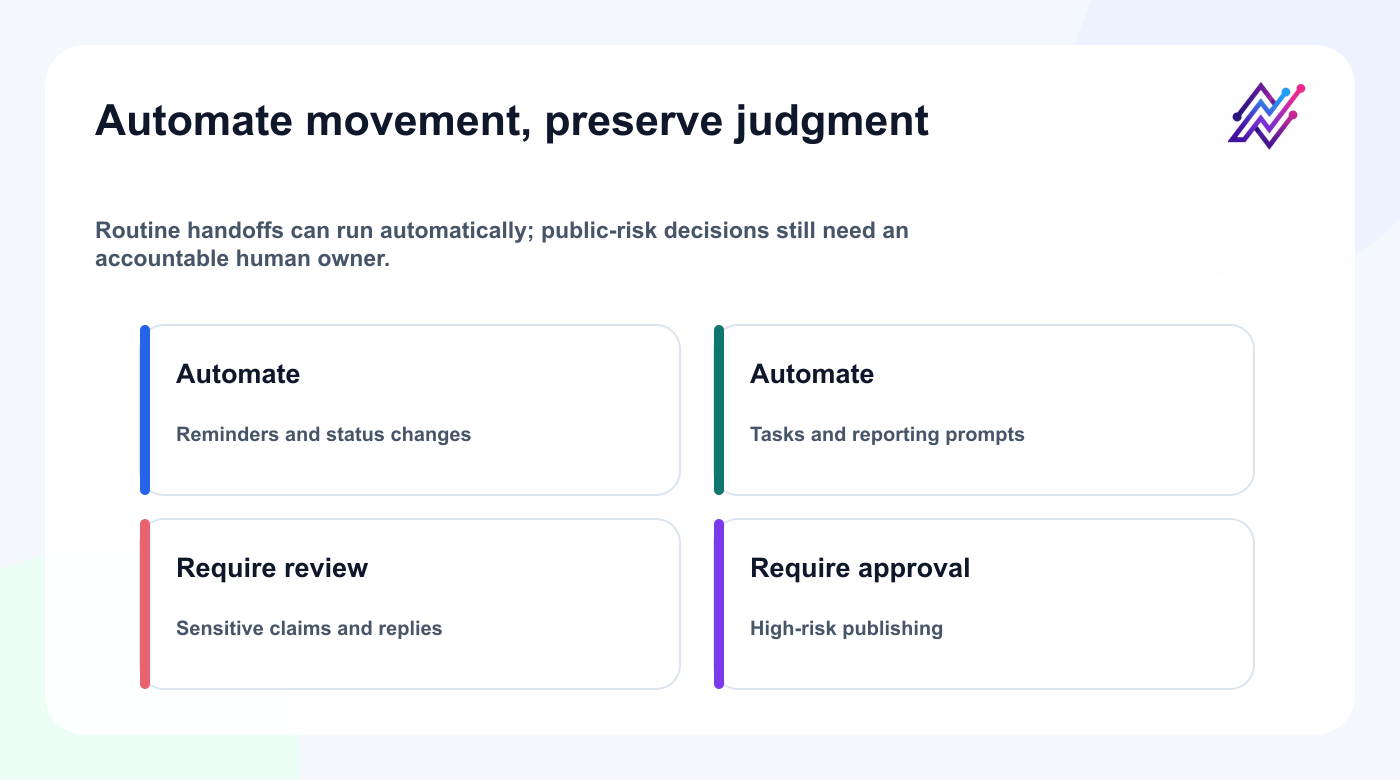
Governance separates reversible workflow movement from consequential public actions.
Reporting ownership should also be explicit. The report owner collects results, records what changed and why, flags risks, recommends repurposing or pause decisions, and feeds the next planning cycle. This makes analytics reports governance evidence instead of a passive dashboard.
Set automation boundaries by reversibility. Automate handoffs, reminders, task creation, status changes, and reporting prompts; keep an accountable human on final approval, high-risk publishing, sensitive replies, legal-sensitive content, and claim verification. Use scoped service credentials, stable event IDs, idempotent retries, and activity logs for every automation that can change public state.
Incident response should define severity levels, who can pause scheduled content, who preserves the affected version and evidence, who revokes compromised access, who approves the response, who posts a correction, and where the timeline and follow-up control are documented. After containment, assign one owner and due date for each corrective action, then verify the control change before closing the incident. Preserve the timeline, affected content revision, live URLs, access changes, and correction evidence as the audit record.
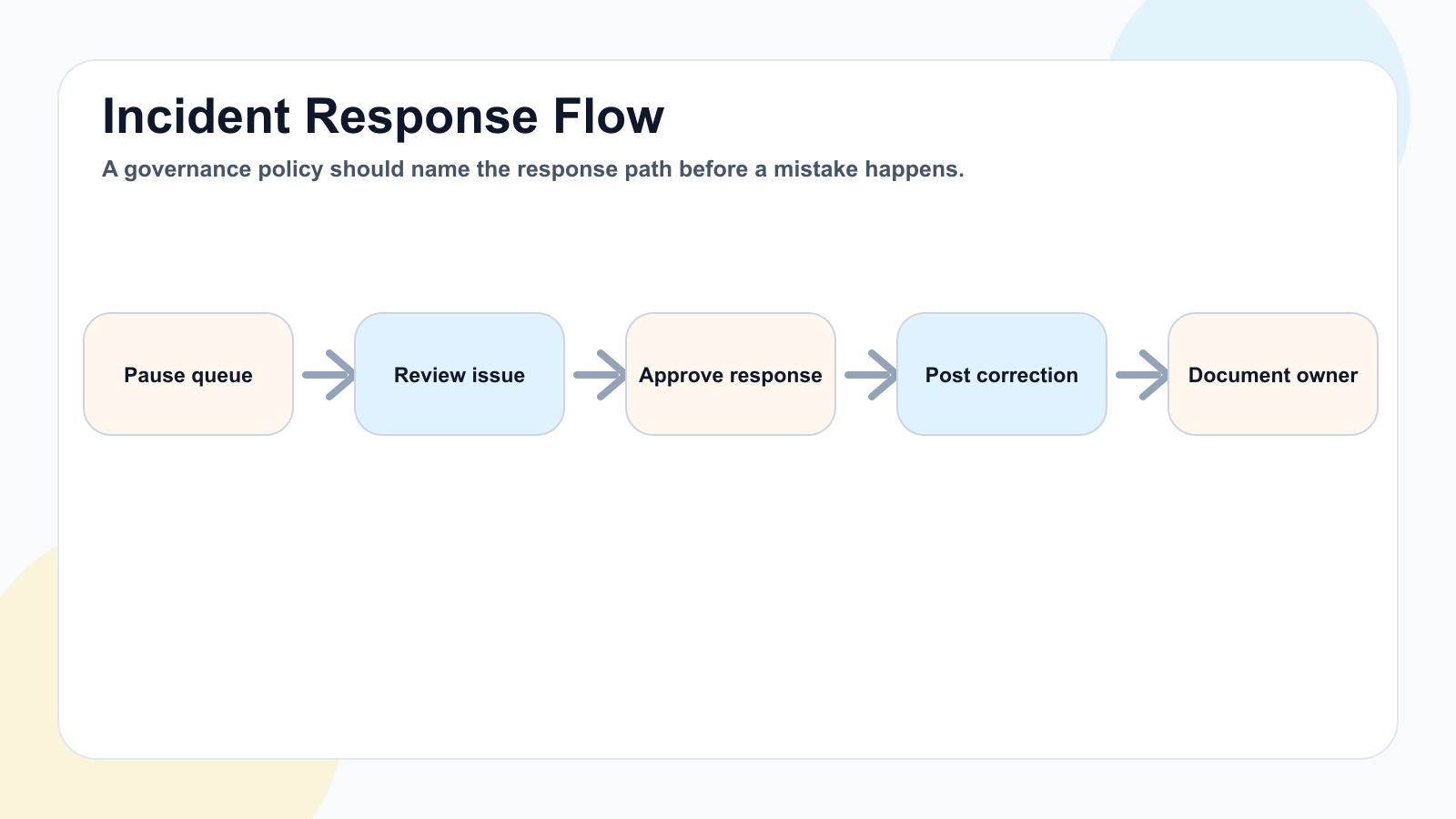
Incident response is faster when the response path is defined before a mistake happens.
How Tareno Supports Governance
Tareno supports governance when policies need to live inside daily work. Teams can connect roles, approval states, activity visibility, workflow automation, reports, and repurposing decisions instead of managing governance in a separate document.
This helps when approval workflows must connect with calendar decisions, profile access, client review, AI drafting, and repeatable reporting.
Related Tareno resources
Keep the workflow moving
Feature Post Scheduling Keep final publishing controlled after reviews are complete. Explore scheduling -> Feature Content Boards Keep requests, drafts, assets, and owners visible before scheduling. View boards -> Solution White-Label Reports Assign reporting ownership and turn performance into decisions. View reports -> Workflow n8n Automation Connect governance rules to automation without losing control. See automation ->
Copy/Paste Governance Checklist
## Social Media Governance Checklist

Roles: assign creator, reviewer, approver, scheduler, publisher, and report owner.
Approval: match review depth to content risk.
AI: allow drafting help, but require human approval before publishing.
Claims: verify product, pricing, competitor, legal, security, and sponsor claims.
Publishing: schedule only approved final versions.
Reporting: assign an owner and turn results into next actions.
Common Governance Mistakes
The first mistake is giving everyone publishing access because it is faster. It may feel faster until one wrong post creates cleanup work.
The second mistake is using vague approval language. "Approved" must mean this exact platform version, with this caption, asset, CTA, link, and publish date.
The third mistake is giving AI no policy. If AI can draft but humans must approve, say that directly. If AI cannot handle claims or replies, define those boundaries.
The fourth mistake is repurposing old content without review. Add a recheck date for product, pricing, sponsor, legal, and competitor claims so reuse never silently inherits stale context.
FAQ
What is social media governance?
It is the operating policy for how a brand creates, reviews, publishes, responds, reports, reuses, and automates social media work.
Do small teams need governance?
Yes, but it can be lightweight. Small teams mainly need role clarity, approval rules, AI boundaries, publishing access controls, and reporting ownership.
What social media posts need approval?
High-risk posts need approval: pricing, product claims, competitor comparisons, sponsor content, client content, legal-sensitive topics, crisis responses, and AI-generated technical claims.
Should AI-generated social media content be approved?
Yes. AI output should be treated as a draft until a human reviews accuracy, brand voice, claims, CTA, platform fit, and compliance needs.
Final Thoughts
Social media governance is not paperwork for its own sake. It is how teams move faster without losing control of approvals, claims, AI usage, publishing access, reporting, and repurposing.