A YouTube video is rarely just one piece of content.
Inside one useful video, there may be:
several short-form hooks
one LinkedIn post
one Bluesky thread
one Mastodon post
multiple TikTok scripts
an Instagram carousel
a Pinterest concept
a FAQ series
an email section
several translated or localized versions
The problem is not content availability.
The problem is extraction and execution.
Most teams publish the YouTube video, share the link once, and move on.
A more effective system turns the source video into a structured content repurposing workflow.
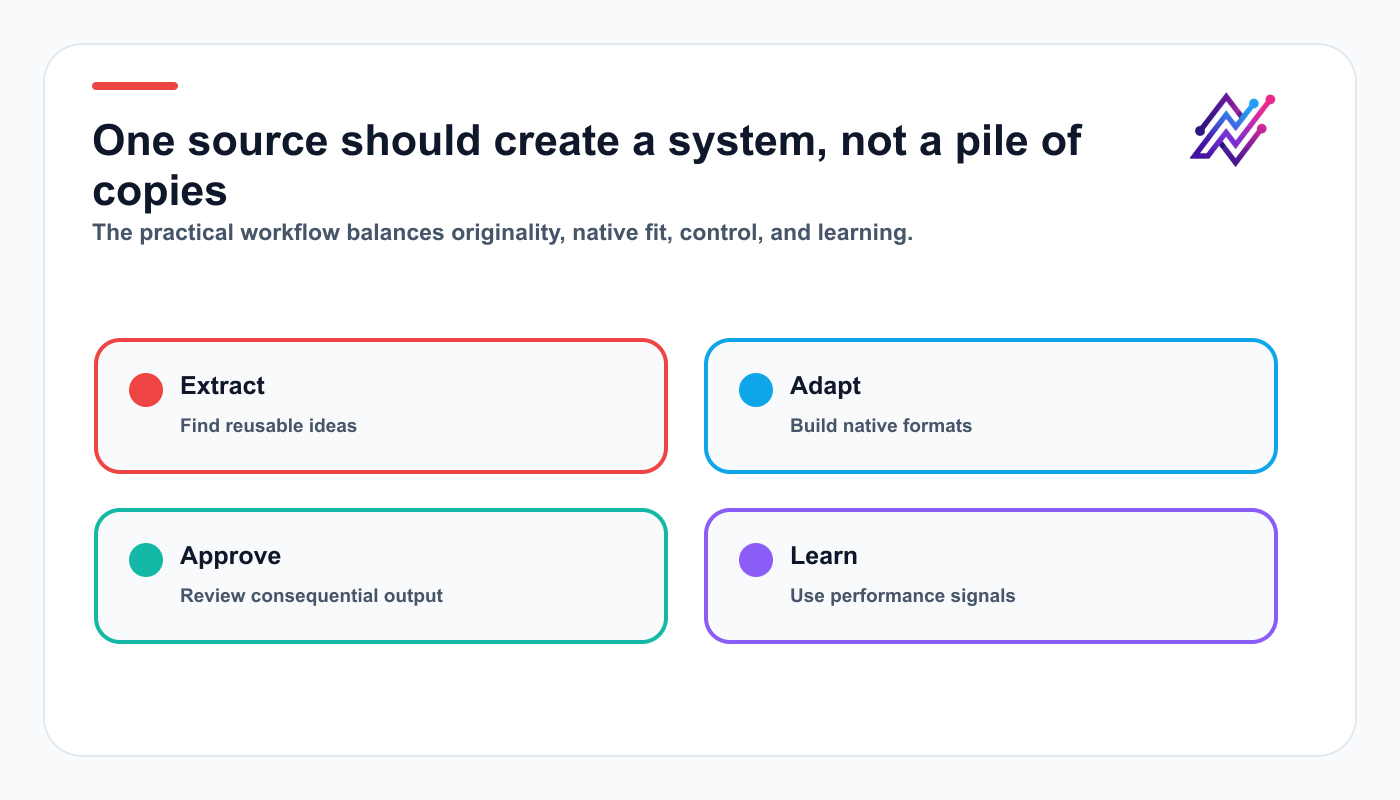
The workflow turns one source into distinct native assets with a controlled feedback loop.
The workflow can:
accept a YouTube URL
retrieve the transcript
identify the strongest ideas
analyze the script structure
create original short-form scripts
adapt the idea for each platform
localize the campaign into several languages
route sensitive drafts through approval
schedule the final versions
measure results
create a second wave from the strongest outputs
Tareno can bring these stages into one operating system.
Get Viral Now turns a public source into a reviewable Quick Blueprint; the standard path uses transcript evidence, while visual reconstruction is a separate Recreation Pack.
Tareno drafts hold the output.
Approval workflows control external actions.
The calendar organizes distribution.
Analytics show what worked.
The repurposing queue creates the next cycle.
This guide explains how to build that workflow without turning every source video into repetitive AI content.
TL;DR
A practical YouTube-to-social workflow looks like this:
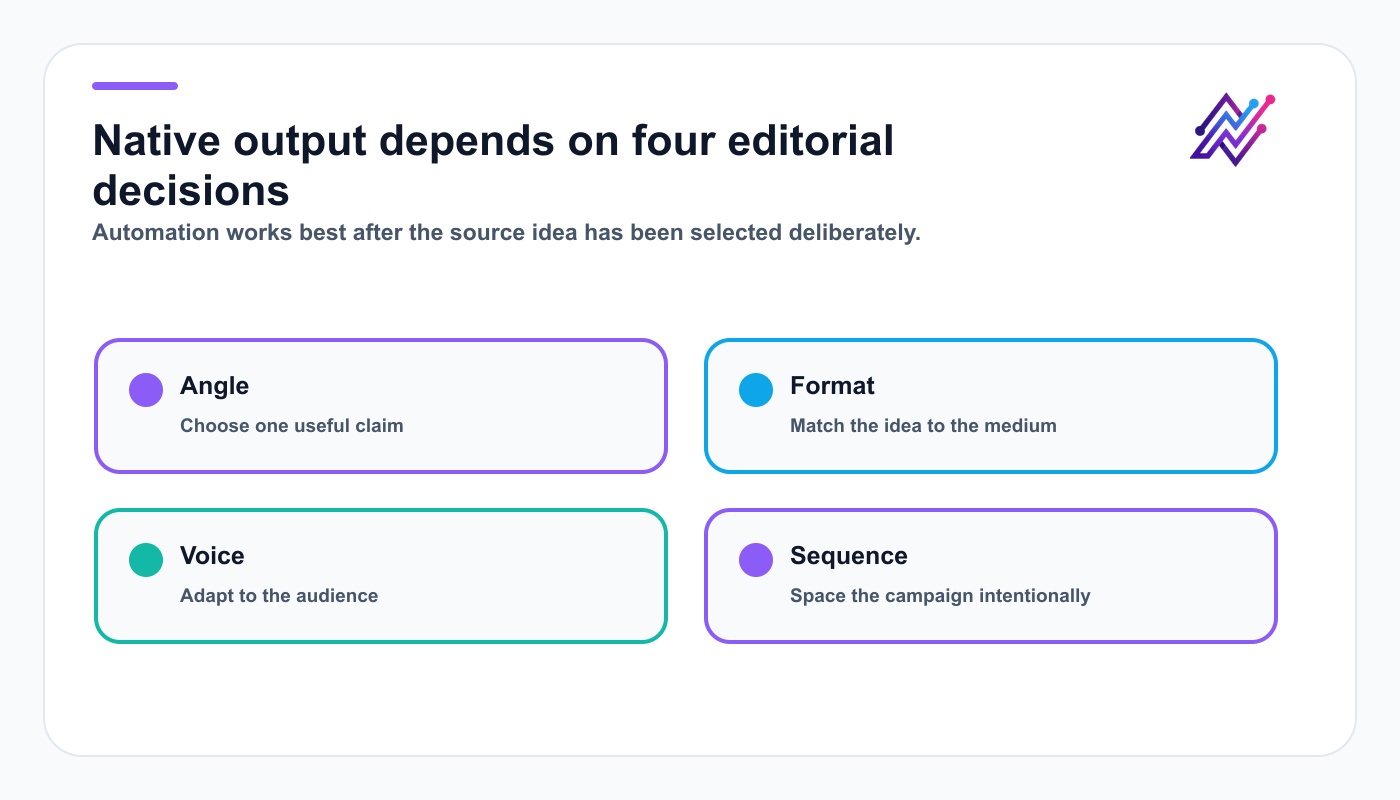
The same source idea should change shape, voice, and timing as it moves across platforms.
Choose a relevant YouTube video.
Add the public URL as the Quick Blueprint primary source.
Review the transcript.
Identify the hook, tension, structure, proof, payoff, and CTA.
Select the ideas worth reusing.
Generate original scripts and posts.
Adapt them by platform.
Localize only the strongest assets.
Save every output as a Tareno draft.
Route high-risk items through approval.
Schedule the approved versions.
Review performance after the measurement window.
Repurpose the strongest second-wave ideas.
The key principle is:
One source should produce many native assets, not many copies.
The source video provides evidence and structure.
Your new content should provide an original message for your audience.
Why YouTube is a strong source format
Long-form video contains context.
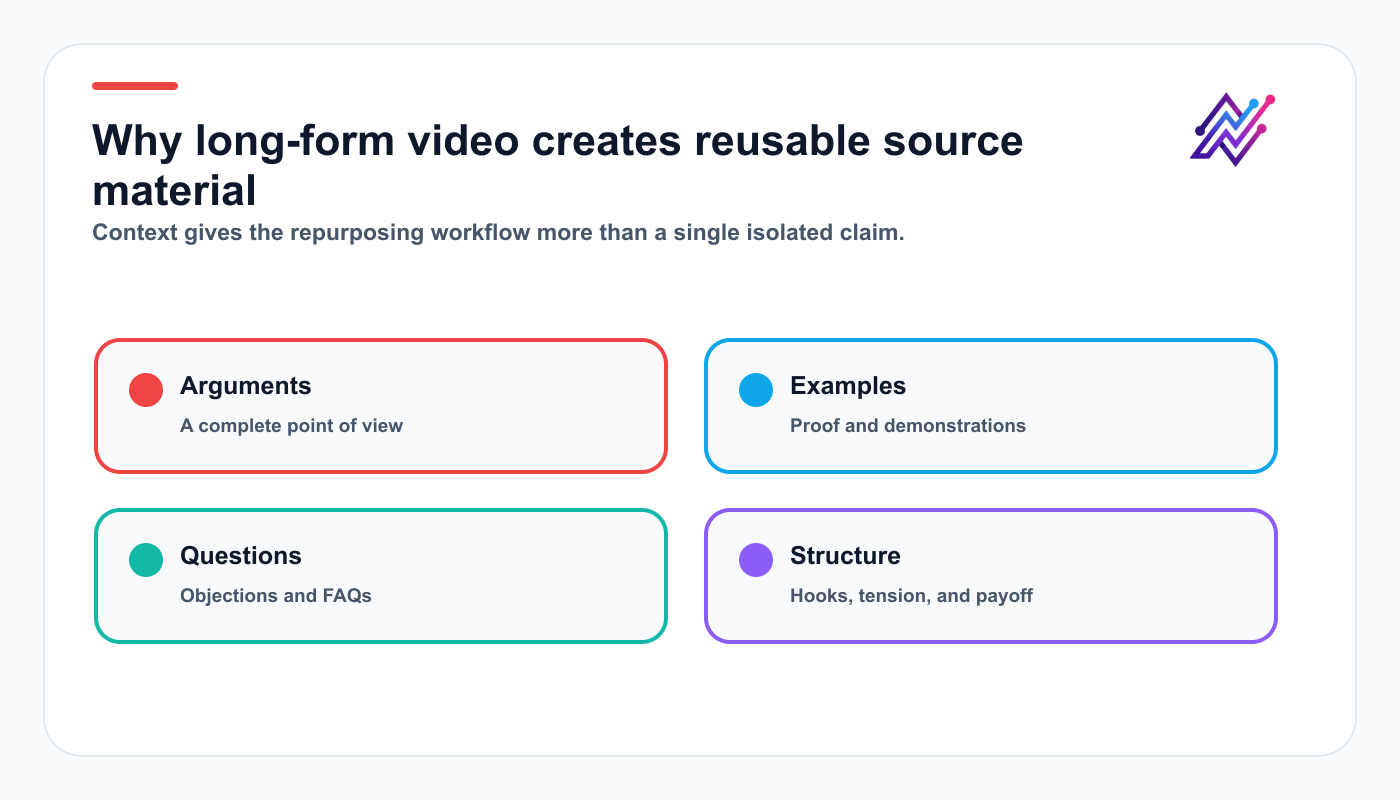
Long-form source material contains the context needed to create several distinct, useful assets.
A short social post may contain one idea.
A YouTube video may contain:
an opening argument
several examples
objections
stories
proof
demonstrations
questions
tactical steps
a final conclusion
That makes it useful for repurposing.
The transcript turns spoken content into searchable material.
Once the transcript is available, the workflow can classify and transform the ideas.
A single 20-minute video may contain enough material for several weeks of social content.
But volume alone is not the goal.
The goal is to identify the parts that deserve a second format.
Source video types
Different source videos produce different outputs.
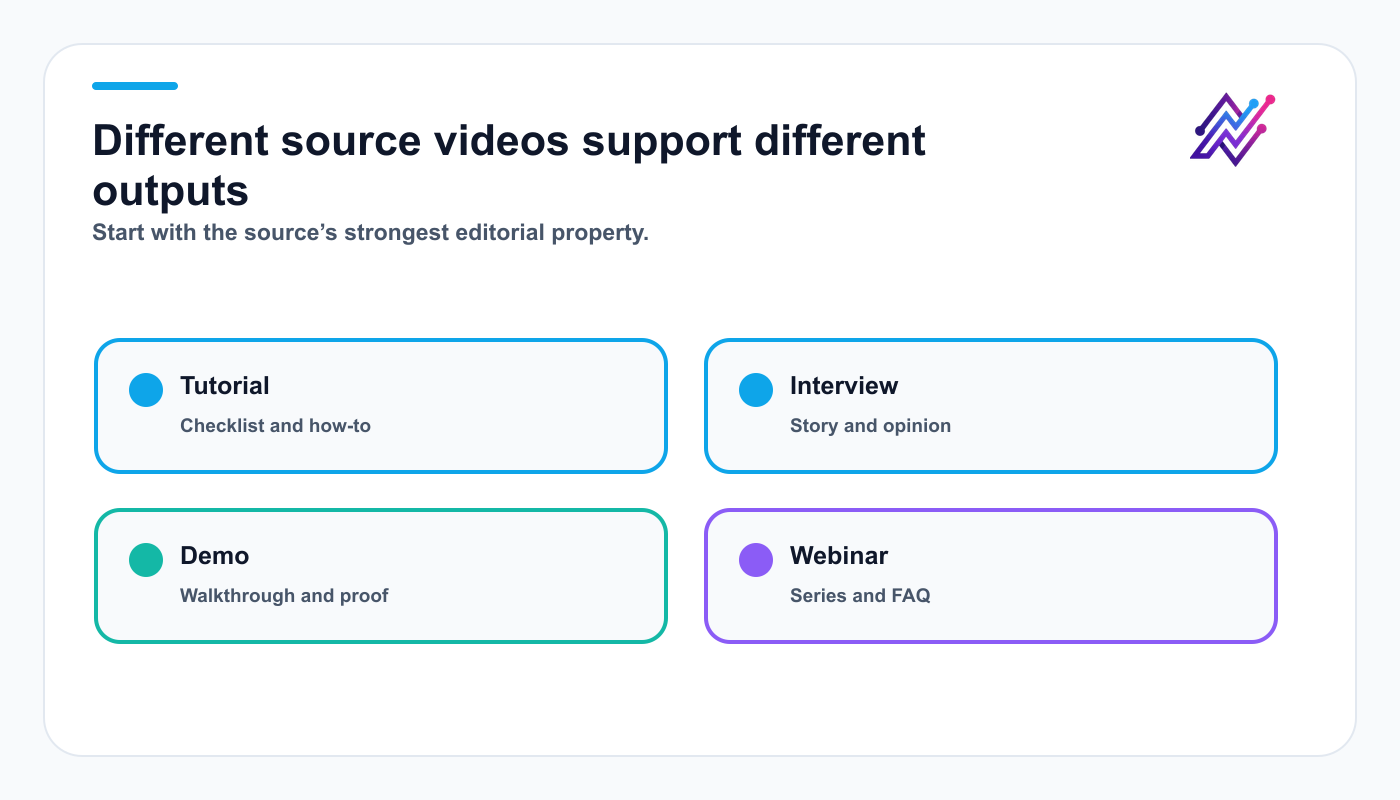
The best output depends on what the source video actually contains.
Educational tutorial
Best outputs:
checklist
carousel
how-to thread
short-form demonstration
FAQ
blog section
Founder interview
Best outputs:
opinion post
story post
lesson
quote-led short video
behind-the-scenes content
Product demo
Best outputs:
feature walkthrough
use-case post
short demo script
FAQ
release announcement
comparison post
Webinar
Best outputs:
educational series
audience-question posts
short clips
summary carousel
email lessons
lead-generation assets
Podcast episode
Best outputs:
narrative posts
quotes with context
debate topics
founder lessons
short-form scripts
Bluesky and Mastodon discussion posts
Competitor or industry video
Best outputs:
market analysis
alternative angle
trend explanation
response post
content-gap idea
When using someone else’s video, create original commentary and wording.
Do not present another creator’s story, research, or example as your own.
The end-to-end architecture
A complete workflow looks like this:
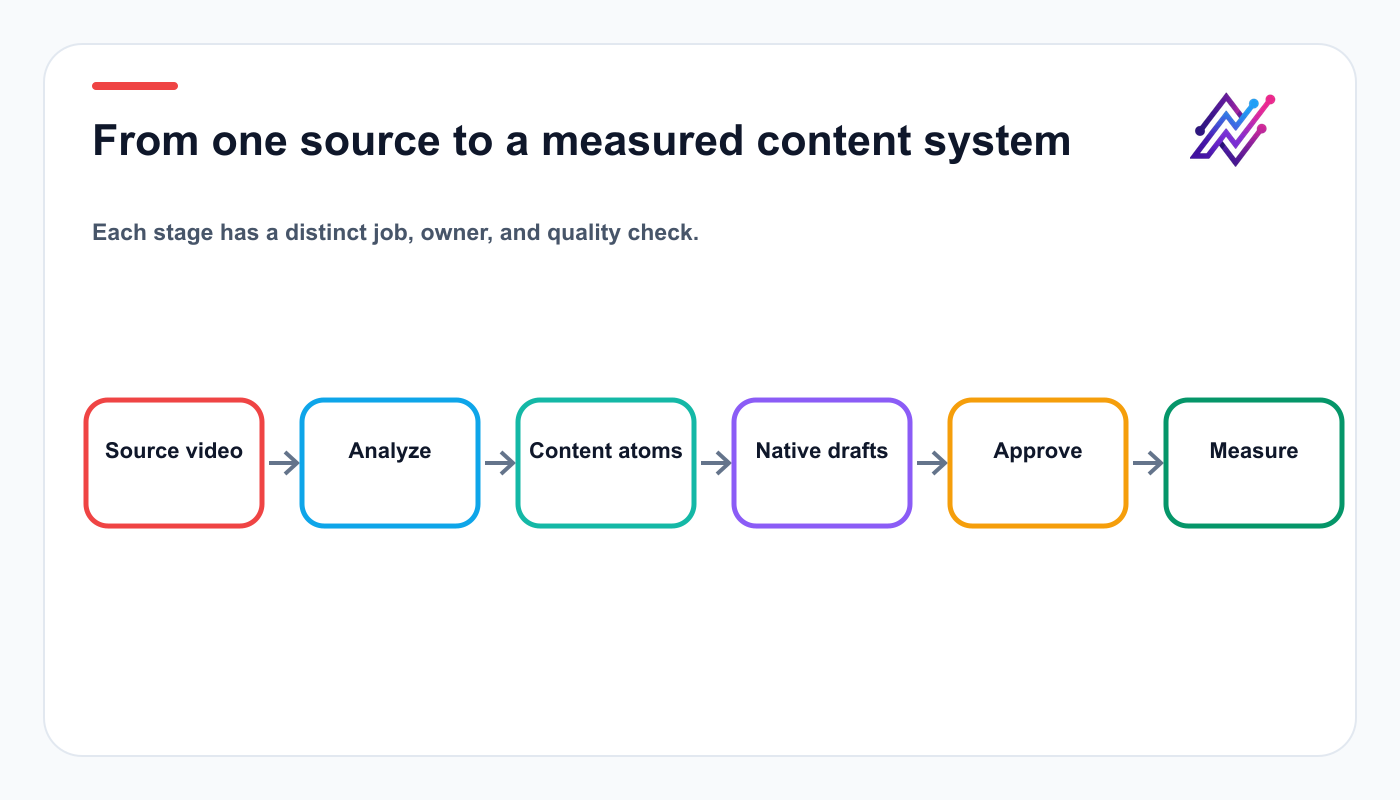
The workflow separates source analysis, original creation, review, distribution, and performance learning.
YouTube video
  ↓
Get Viral Now
  ↓
Transcript retrieval
  ↓
Structure and topic analysis
  ↓
Original angle generation
  ↓
Platform-specific outputs
  ↓
Tareno drafts
  ↓
Human review
  ↓
Language localization
  ↓
Market review
  ↓
Approval
  ↓
Tareno calendar
  ↓
Publishing
  ↓
Analytics
  ↓
Repurposing queue
This architecture separates research, creation, control, and measurement.
That makes the system easier to improve.
Build the source-to-draft workflow
Step 1: choose the right source
Do not select a source only because it has many views.
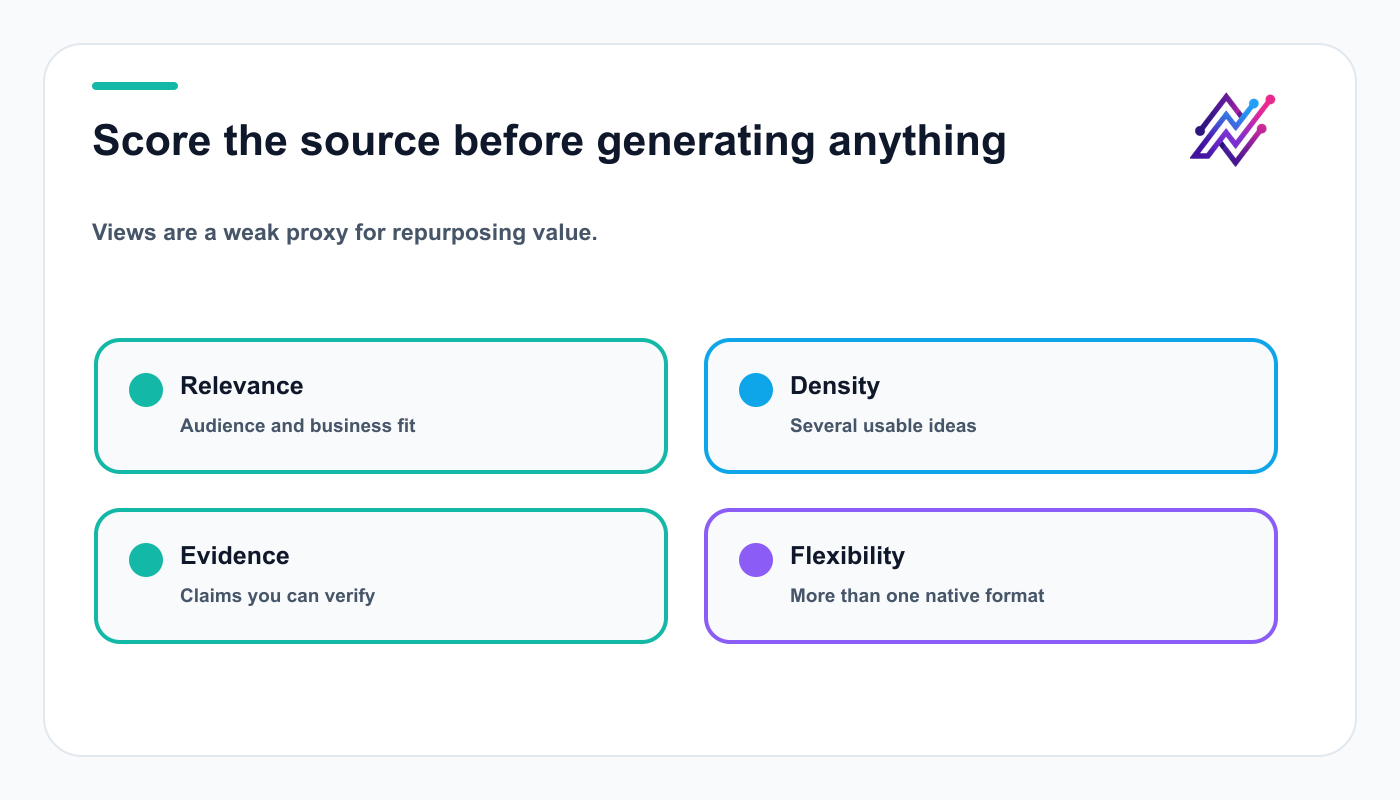
A useful source is relevant, idea-dense, verifiable, and flexible across formats.
A useful source should have:
topic relevance
audience overlap
clear spoken content
transferable ideas
a readable transcript
a structure worth studying
claims that can be checked
enough substance for more than one asset
Use this scorecard.
AreaScore 1–5Audience relevanceBusiness relevanceTranscript qualityIdea densityEvergreen valuePlatform flexibilityOriginal-angle potential
A highly viewed entertainment video may score lower than a smaller, useful tutorial.
Step 2: create a Quick Blueprint from the source
Add one public YouTube URL as the primary source and up to four supporting references only when each contributes a distinct pattern. Request the credit quote after source verification; it is bound to that source snapshot. Starting analysis creates a dashboard approval, and credits are reserved only after approval. If a source changes, request a new quote.
Before starting, check:
video is publicly accessible
URL is valid
transcript is available
language is supported
source is relevant
use is legitimate
output will be reviewed
Stop before generating drafts if the transcript is incomplete, the source is unsupported, or analysis fails.
Step 3: inspect the transcript
Do not skip transcript review.
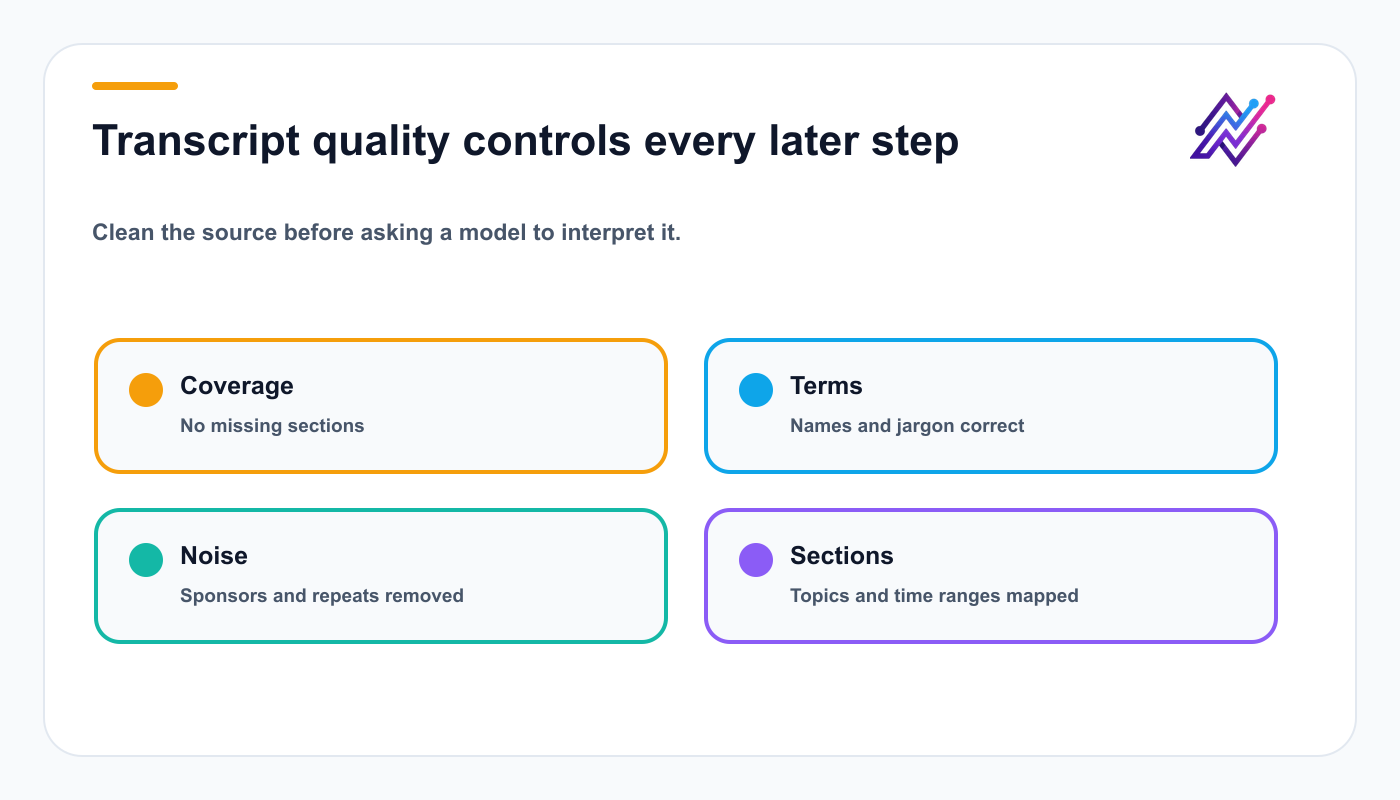
Transcript review prevents source errors from multiplying across every generated asset.
Check:
missing introduction
incorrect speaker names
duplicated phrases
automatic-caption errors
sponsor sections
irrelevant segments
incorrect technical terms
missing punctuation
language detection
A poor transcript can produce weak analysis.
For a long video, separate the transcript into sections.
Example:
Time rangeTopicValue00:00–02:00Main hookHigh02:00–07:00BackgroundMedium07:00–12:00MethodHigh12:00–16:00ExampleHigh16:00–20:00CTALow
This helps select the strongest material.
Step 4: analyze the script mechanics
A useful analysis should include more than a summary.
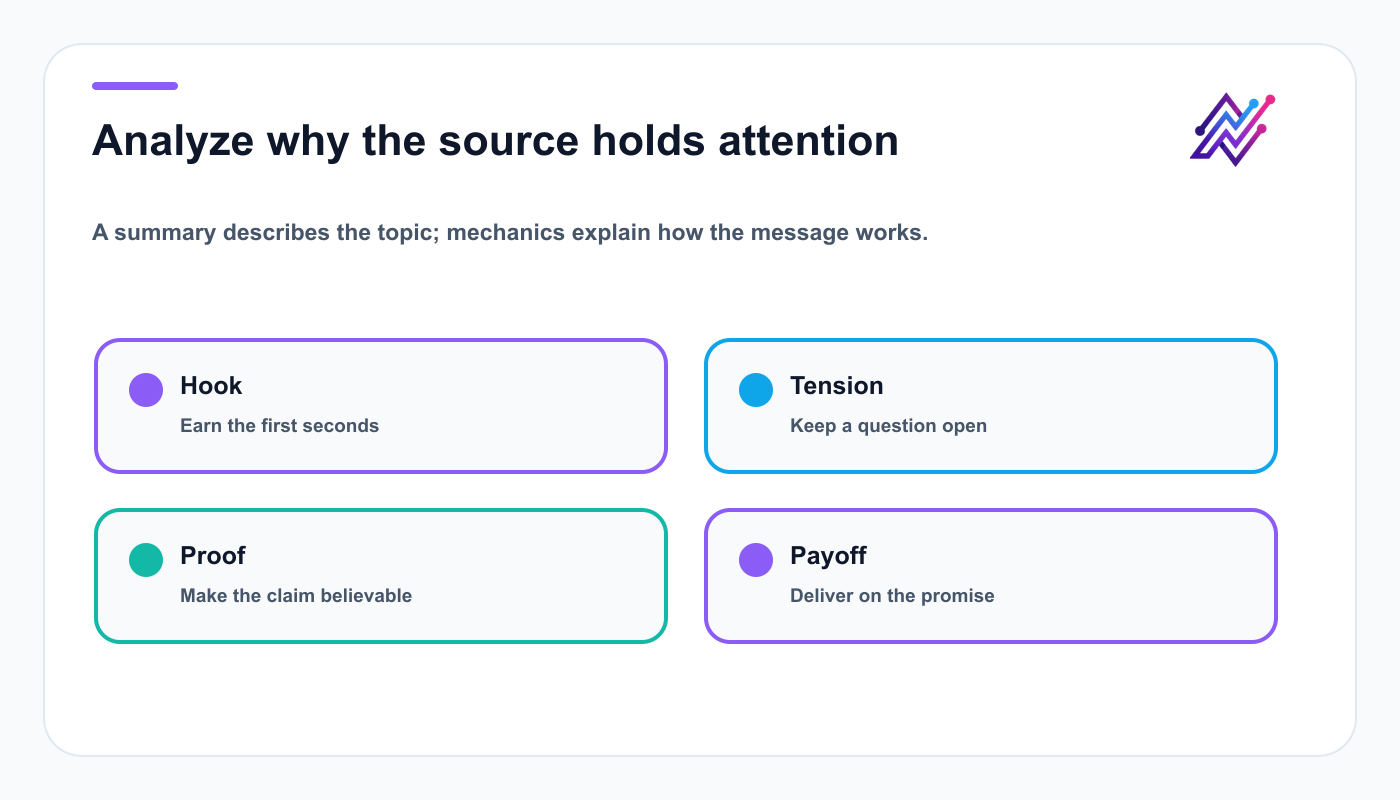
Mechanics reveal which parts of the source are worth adapting and which are only context.
Review:
Hook
What creates attention?
surprising claim
direct promise
painful problem
contradiction
story
proof first
mistake
Tension
What question remains open?
missing explanation
promised result
unresolved problem
delayed method
risk
hidden cause
Structure
What order is used?
problem → cause → solution
result → method → example
story → lesson → action
myth → correction → proof
list → escalation → strongest item
Proof
What makes the message believable?
example
demonstration
number
story
screenshot
process
comparison
Payoff
Does the ending deliver on the hook?
CTA
What action follows naturally?
Get Viral Now should help expose these patterns.
The user then decides which parts are useful for the new content.
Step 5: extract content atoms
A content atom is one reusable idea.
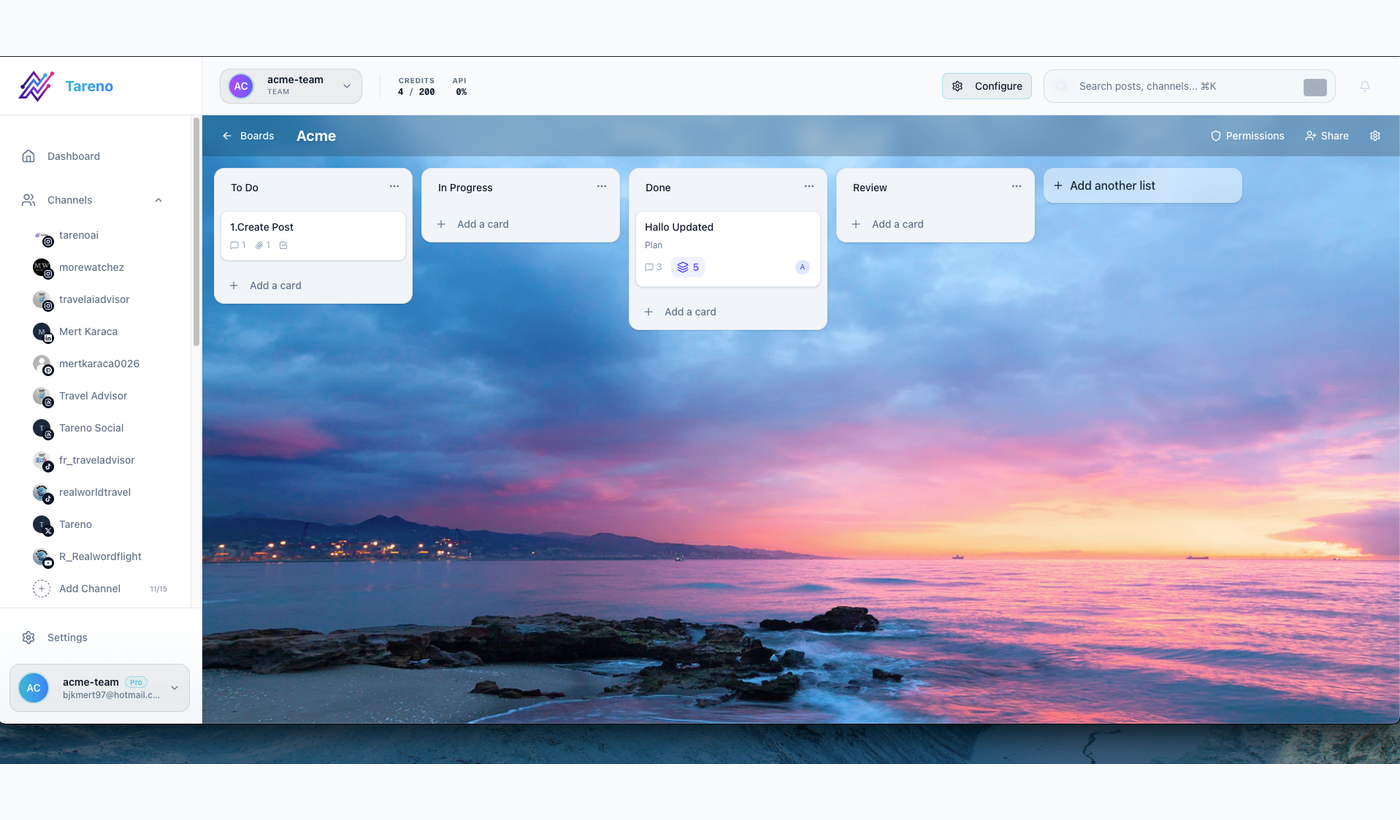
An ideas board keeps each reusable claim, example, question, and format opportunity distinct.
Possible atoms:
one surprising claim
one mistake
one objection
one example
one process
one quote
one question
one framework
one result
one story
Example source section:
Teams often automate publishing before they automate review.
Possible atoms:
Why review should be automated first
The risk of immediate auto-posting
Approval-first architecture
Draft automation vs publishing automation
A checklist for safe AI agents
One sentence can create several distinct assets.
Step 6: choose the target assets
Do not generate every format automatically.
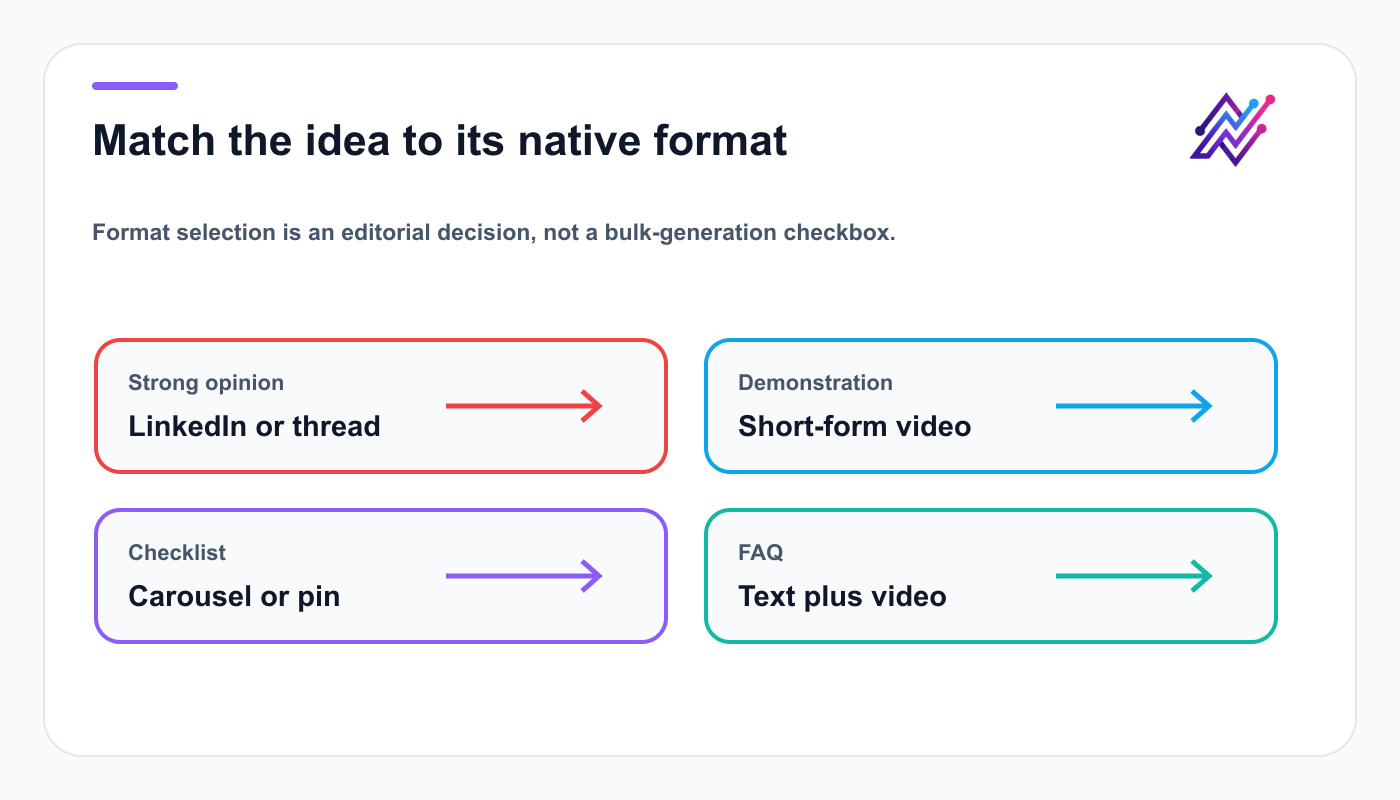
Choose the format that fits the idea instead of forcing every source into every channel.
Choose formats based on the idea.
Content atomGood formatsStrong opinionLinkedIn, Threads, BlueskyStep-by-step methodCarousel, blog, MastodonDemonstrationTikTok, Reel, YouTube ShortFAQText post, video, help articleData pointChart, text post, carouselStoryVideo, LinkedIn, emailChecklistCarousel, Pinterest, downloadable asset
This reduces low-quality output.
Step 7: create an original master script
Provide clear context.
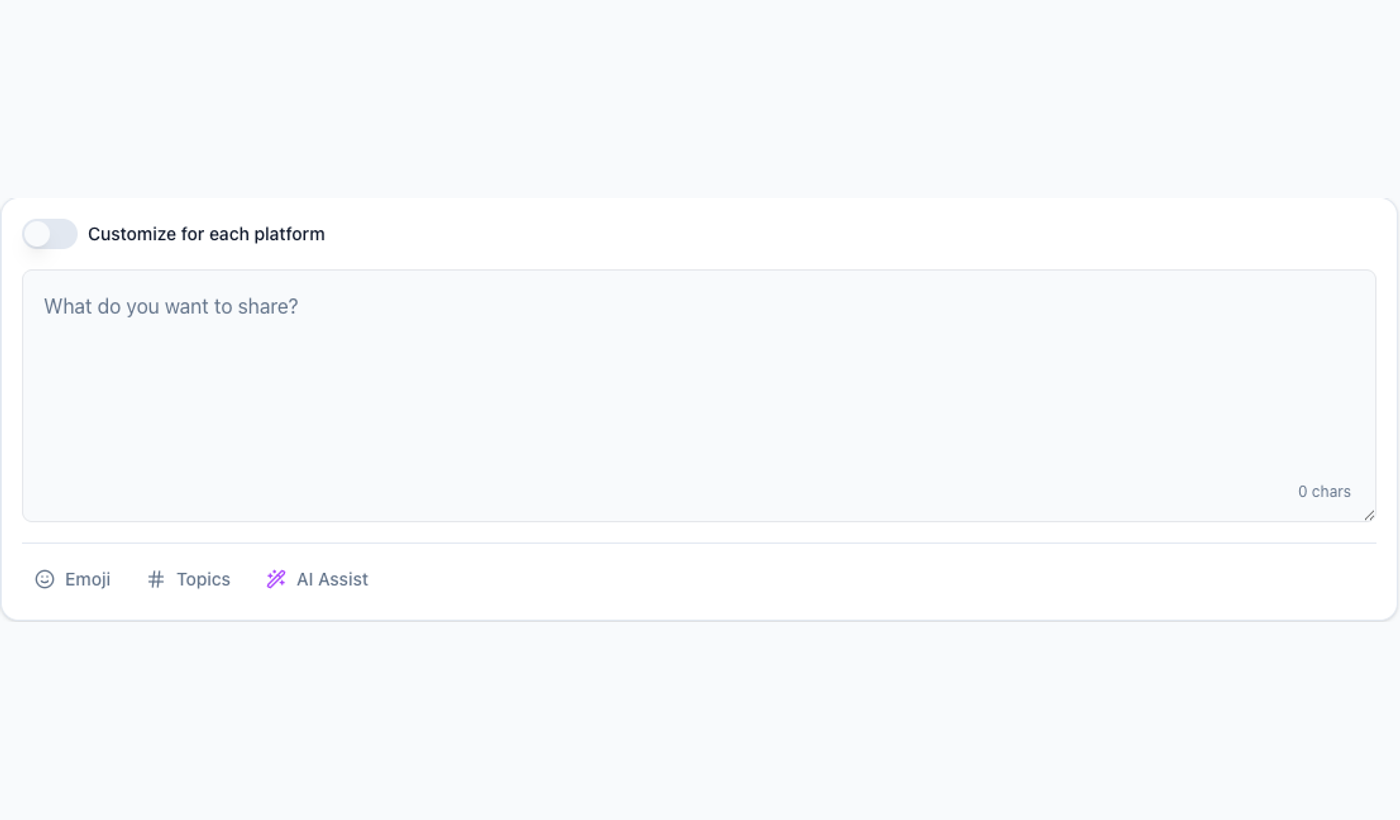
A reviewed master script gives every platform version one approved argument and proof set.
Audience:
Solo SaaS founders.

Topic:
Why AI agents need approval before publishing.

Platform:
YouTube Shorts.

Length:
45 seconds.

Point of view:
AI should automate repetitive work without removing accountability.

Proof:
Tareno can create drafts and pending actions while keeping final publishing reviewable.

CTA:
Try one draft-only workflow.

Claims to avoid:
No guaranteed growth or guaranteed safety.
Ask for several versions:
direct
story-led
educational
contrarian
demonstration-led
Compare them before selecting one.
Step 8: adapt for short-form video
A short-form script needs spoken rhythm.
Check:
first sentence
word count
sentence length
visual opportunities
subtitle readability
pattern interrupts
proof
payoff
CTA
Example structure:
0–3 seconds: Hook
3–10 seconds: Problem
10–22 seconds: Explanation
22–35 seconds: Method
35–42 seconds: Payoff
42–45 seconds: CTA
Pace varies by speaker and platform.
Do not force every idea into 30 seconds.
Step 9: turn the same idea into text posts
Keep the source idea stable, then adapt its rhythm, context, and interaction model for each platform.
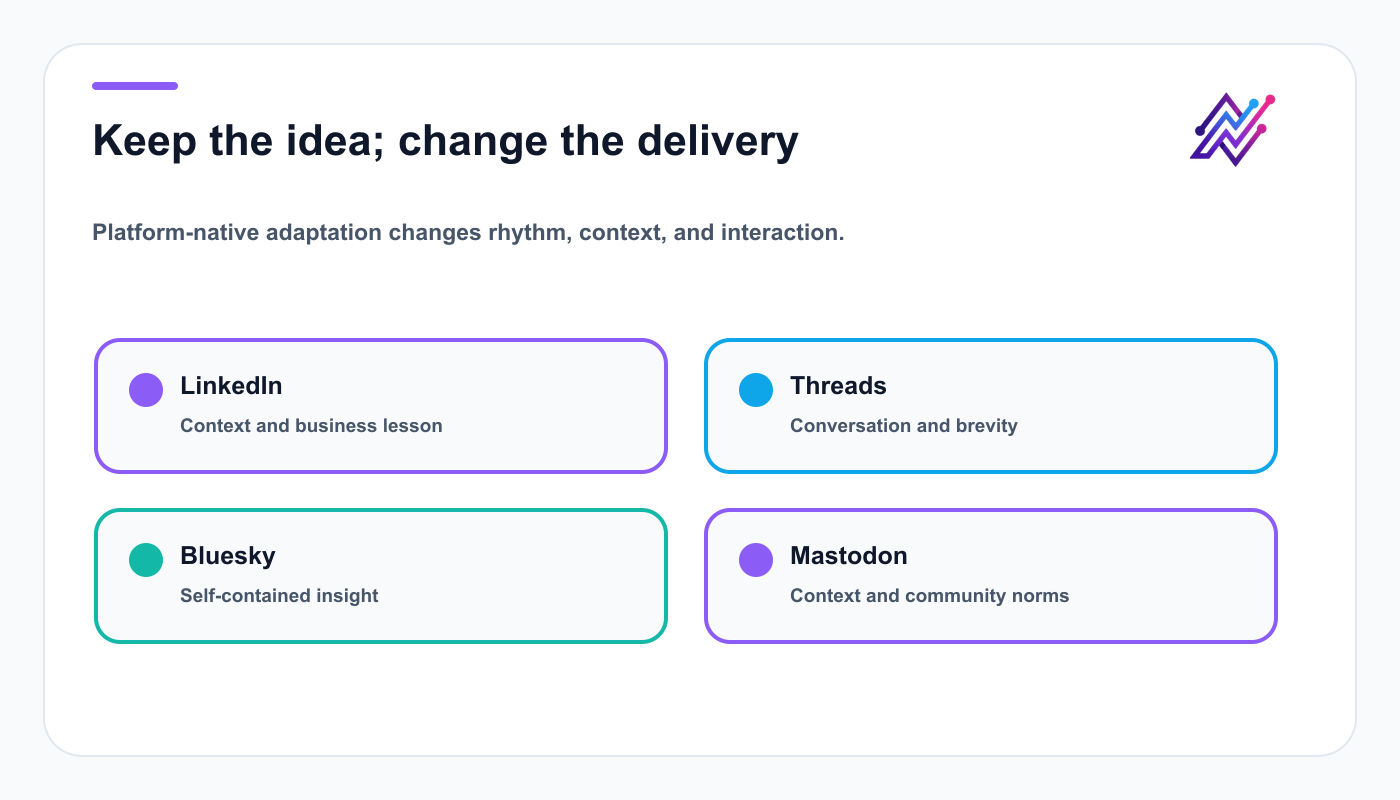
Native versions share one source idea without repeating one caption everywhere.
Use:
professional context
strong first line
practical explanation
example
business lesson
restrained CTA
Threads
Use:
conversational tone
personal observation
short sentences
open ending
Bluesky
Use:
concise idea
low-hype language
self-contained insight
optional thread
Mastodon
Use:
more context
community-aware phrasing
useful hashtags
content warning where relevant
X
Use:
fast opening
concise payoff
optional thread
clear CTA
One source idea becomes separate native assets.
Step 10: create a visual package
A complete content package may include:
primary video
vertical thumbnail
subtitle file
carousel
quote card
screenshot
Pinterest pin
link image
alt text
Store asset requirements in the Tareno draft.
Fields:
format
dimensions
source
owner
due date
usage rights
alt text
language
approval status
This keeps the script and asset connected.
Step 11: create multilingual versions
Do not localize every generated asset.
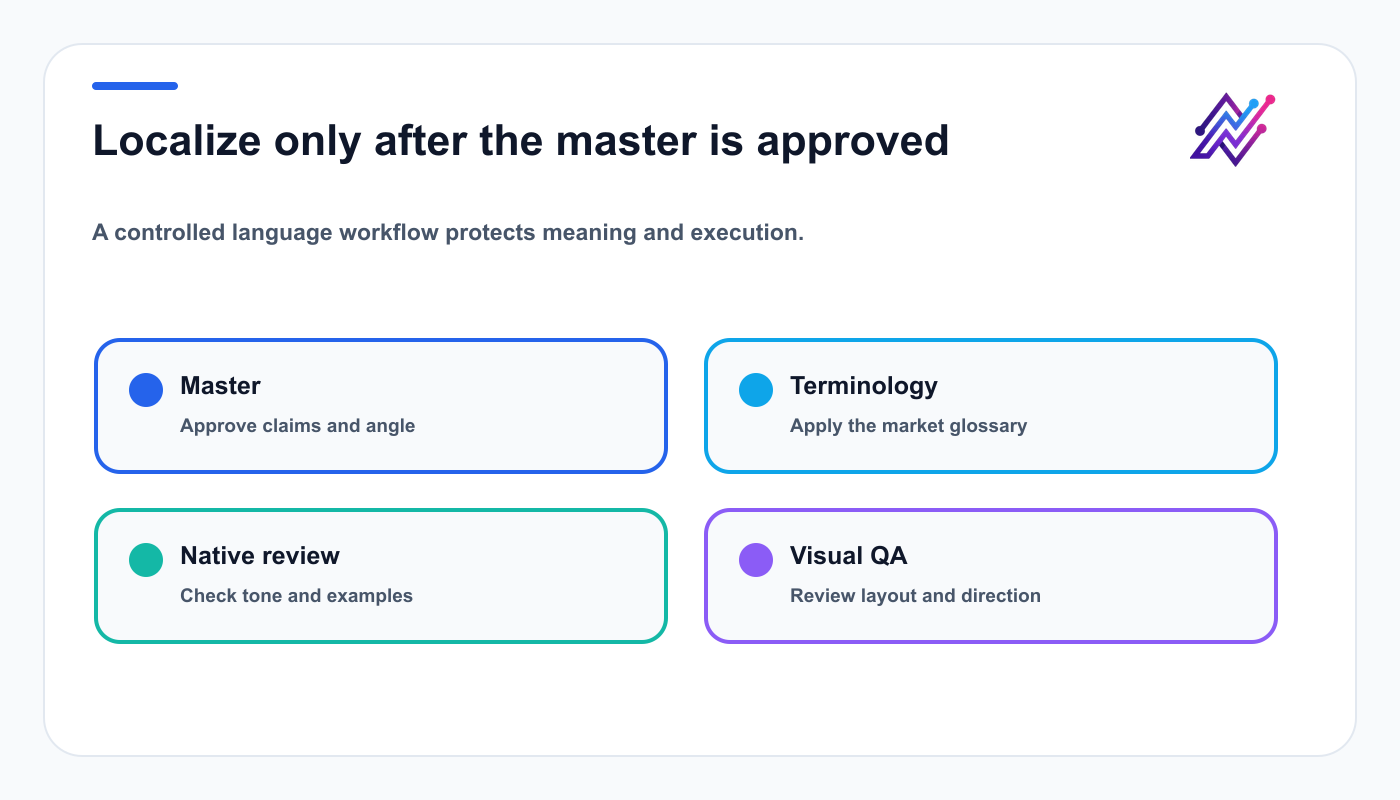
Approval before localization prevents weak drafts from multiplying across markets.
First select the strongest master versions.
Then localize.
Tareno supports workflows across:
English
German
French
Spanish
Portuguese
Russian
Italian
Japanese
Arabic
Workflow:
Approved master asset
  ↓
Language matrix
  ↓
AI localization
  ↓
Terminology check
  ↓
Native review
  ↓
Tareno drafts
Prompt:
Localize this approved short-form script for Germany, France, Spain, Brazil, Italy, Japan, and an Arabic-speaking target market. Preserve the hook mechanism and payoff. Adapt formality, rhythm, examples, and CTA. Do not translate literally.
For Japanese and Arabic, review visual execution as well.
Step 12: save everything as Tareno drafts
Each draft should include:
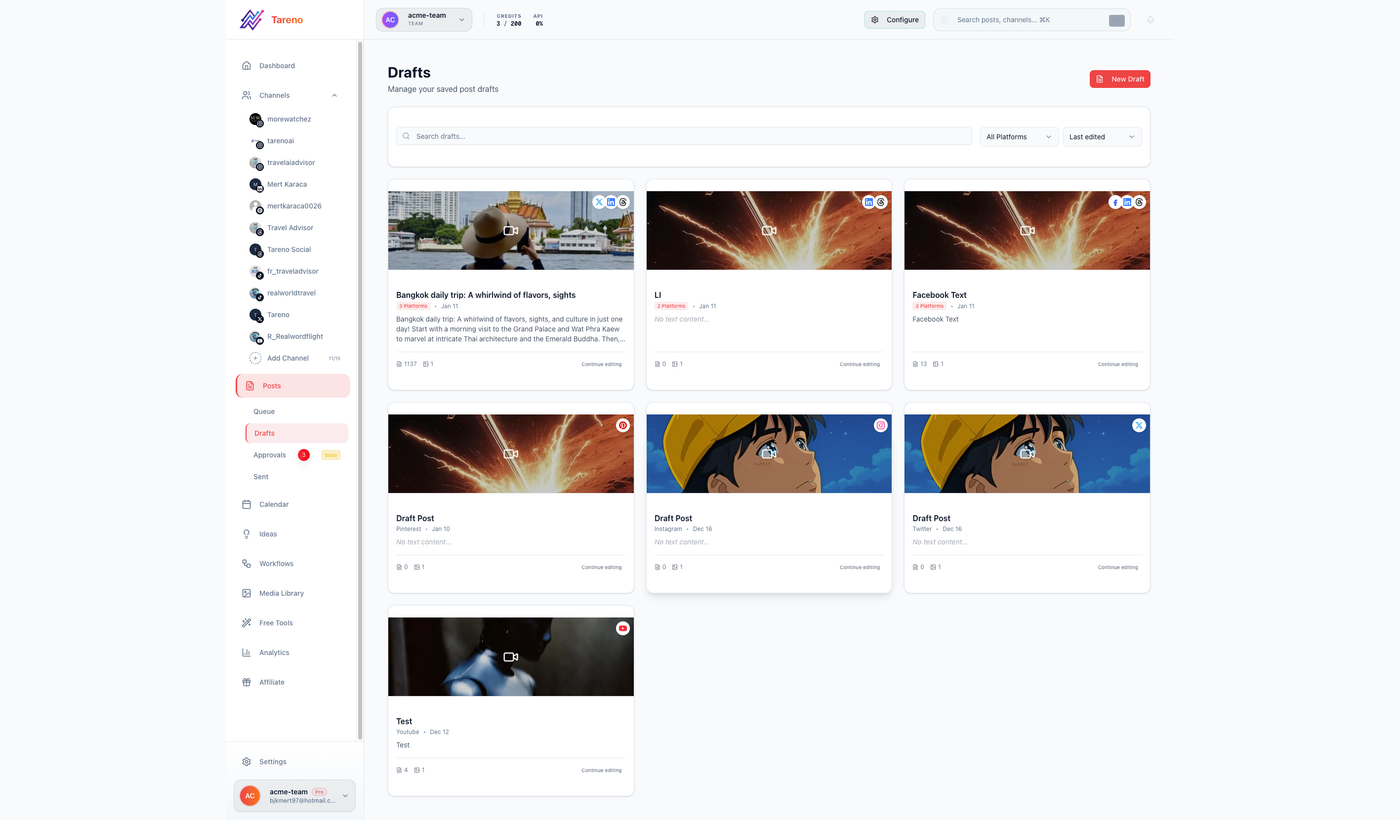
Draft-first storage creates a visible checkpoint for claims, platform fit, assets, and ownership.
source YouTube URL
source title
transcript section
content atom
target platform
language
market
final caption or script
asset
approval requirement
campaign
measurement goal
repurposing potential
This creates traceability.
A reviewer can see where the idea came from without copying the source.
Step 13: apply risk-based approval
Match the review path to the claim, market, account, and consequence of the draft.
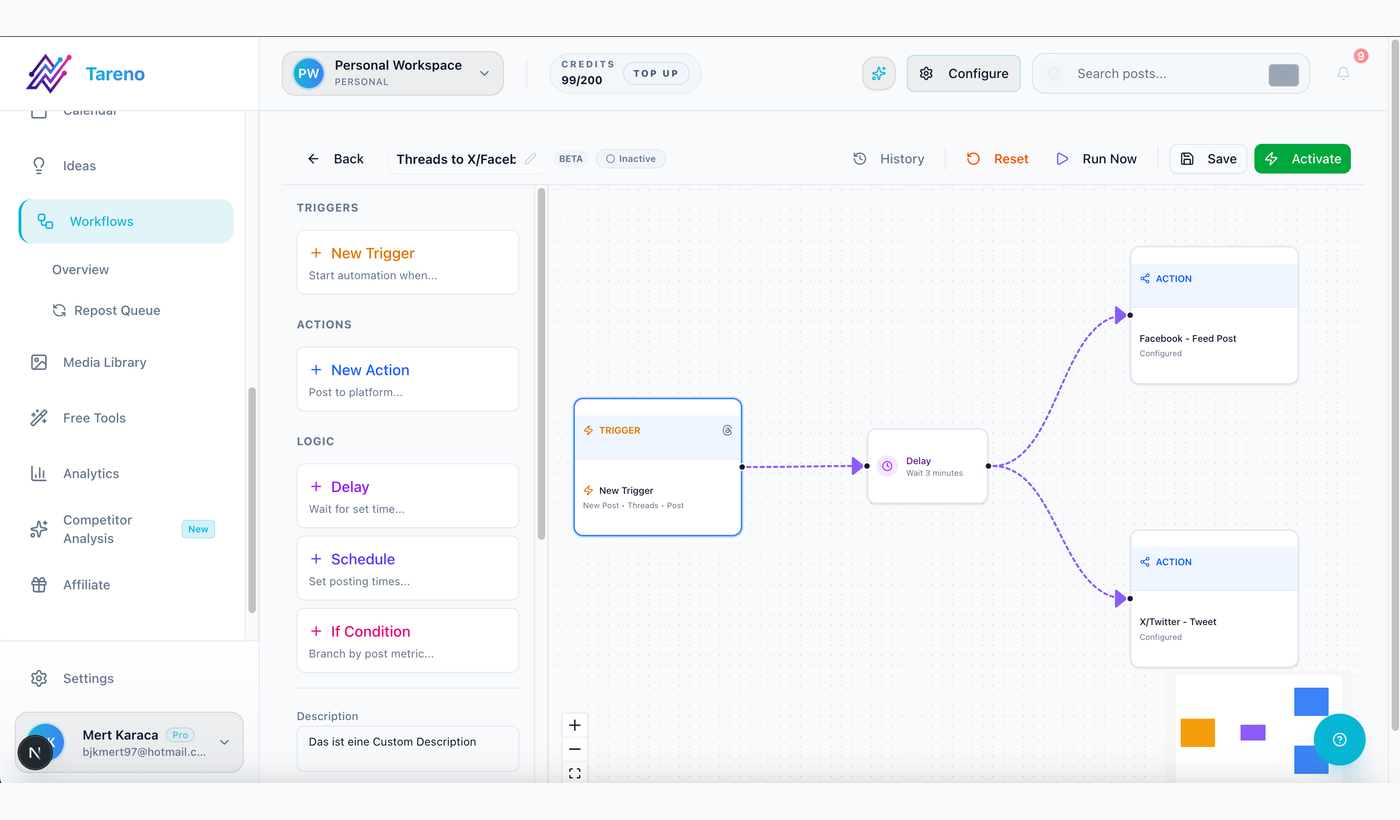
Risk-based routing keeps routine drafts moving while sensitive claims receive the right review.
Low risk
educational tip
general opinion
evergreen checklist
Review:
content owner
Medium risk
product education
campaign content
adapted customer example
Review:
marketing or product
High risk
pricing
customer result
competitor comparison
sponsor content
regulated topic
performance claim
translated high-value campaign
Review:
specialist and final approver
Bind final approval to an immutable revision ID and the exact account, caption or script, asset, CTA, scheduled time, and timezone. Any material change invalidates the earlier approval and returns the new revision to review.
Step 14: schedule a distribution sequence
Do not publish every version at the same time. Treat the sequence below as an illustrative cadence, not a universal performance recommendation; validate each account’s timezone, audience history, platform limits, asset readiness, and approval state before scheduling.
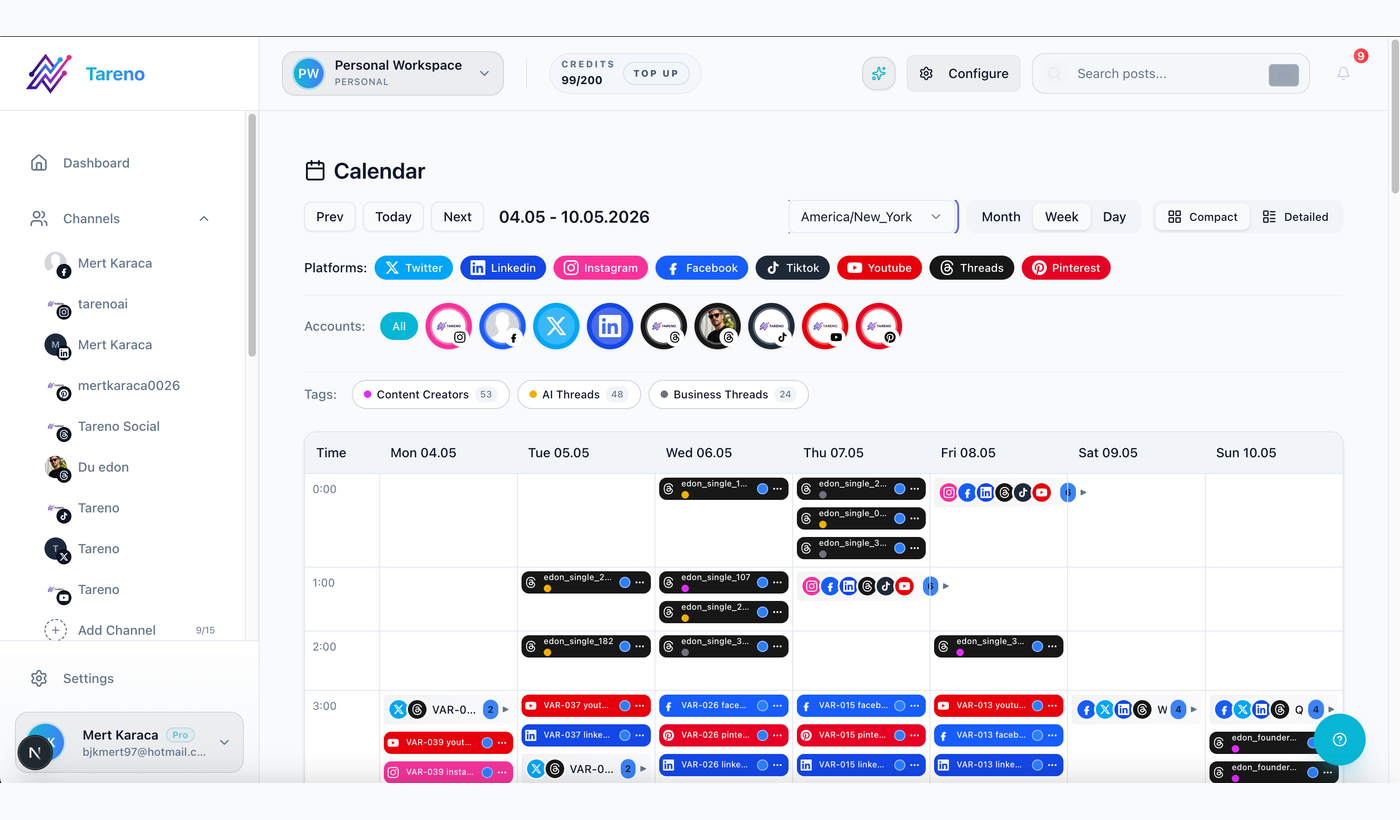
A shared calendar prevents one source video from becoming a burst of repetitive posts.
Example sequence:
DayPlatformAssetMondayYouTube ShortsMain scriptTuesdayLinkedInBusiness lessonWednesdayBlueskyConcise insightThursdayInstagramCarouselFridayMastodonContext-rich guideNext MondayPinterestChecklist pin
The sequence gives the idea multiple chances to work.
It also reduces duplicate-feeling distribution.
Automate and distribute safely
Step 15: automate with n8n
n8n workflow:
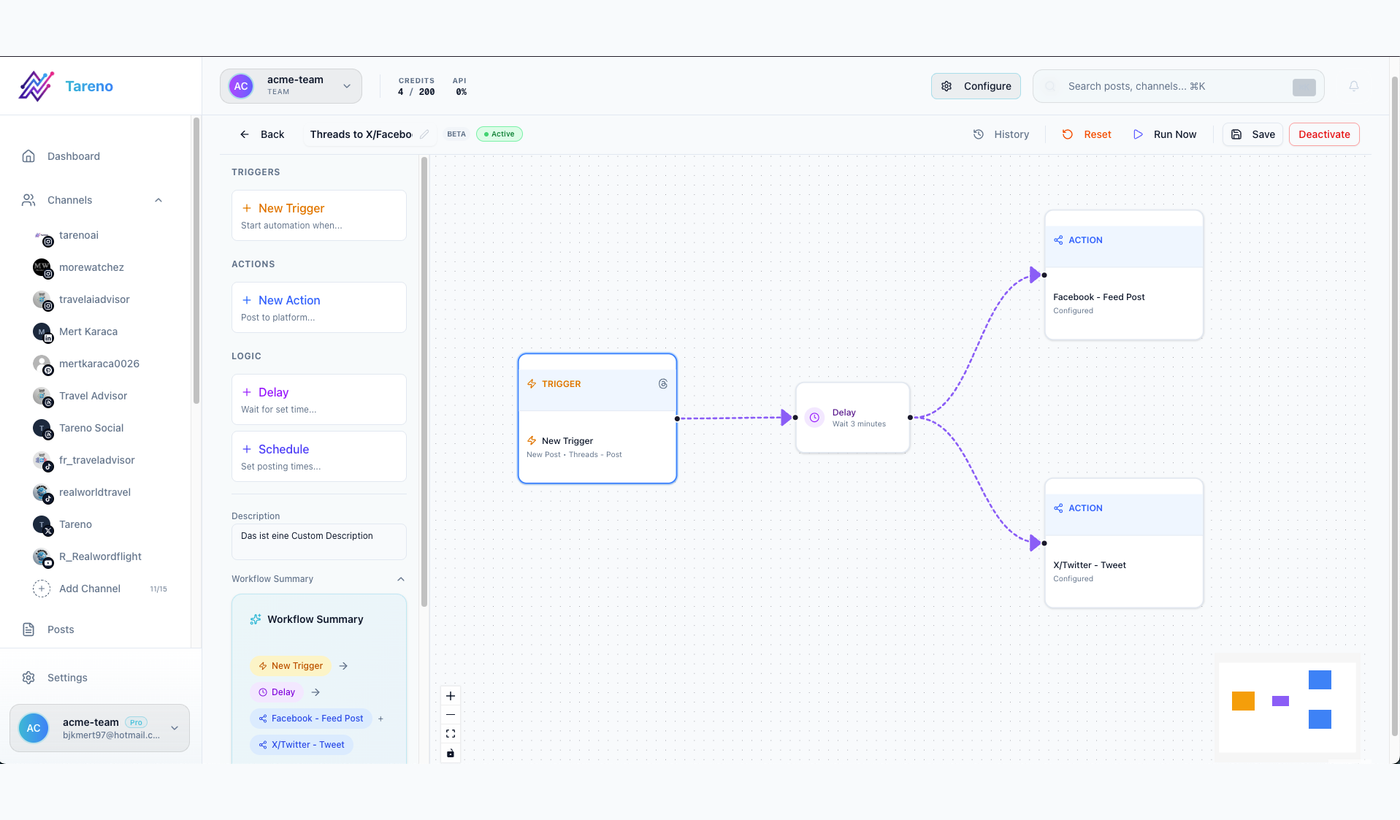
Automation should move structured work between stages without bypassing editorial decisions.
YouTube URL submitted
  ↓
Validate source
  ↓
Get Viral Now analysis
  ↓
Generate content package
  ↓
Create Tareno drafts
  ↓
Notify reviewer
Advanced branches:
language loop
platform loop
risk classification
duplicate check
failed transcript route
analytics follow-up
Use n8n when custom logic and self-hosting matter.
Step 16: automate with Make
Make scenario:
New YouTube video
  ↓
Get transcript analysis
  ↓
Router by content format
  ├─ TikTok script
  ├─ LinkedIn post
  ├─ Bluesky thread
  └─ Mastodon post
      ↓
Tareno drafts
Use iterators for languages.
Use a Data Store for source and draft IDs.
Step 17: automate with Zapier
Simpler Zap:
Approved source brief in Airtable
  ↓
Create Tareno draft
  ↓
Notify reviewer
  ↓
Continue only after review
Zapier beta suits simple draft handoffs; analyze the source first.
Use Make or n8n for branching and richer recovery.
Step 18: use a documented MCP client
Use Codex, Claude Code, or Cursor. Grant viral:read and viral:write for project work; add viral:run only to request analysis, which still waits for dashboard approval.
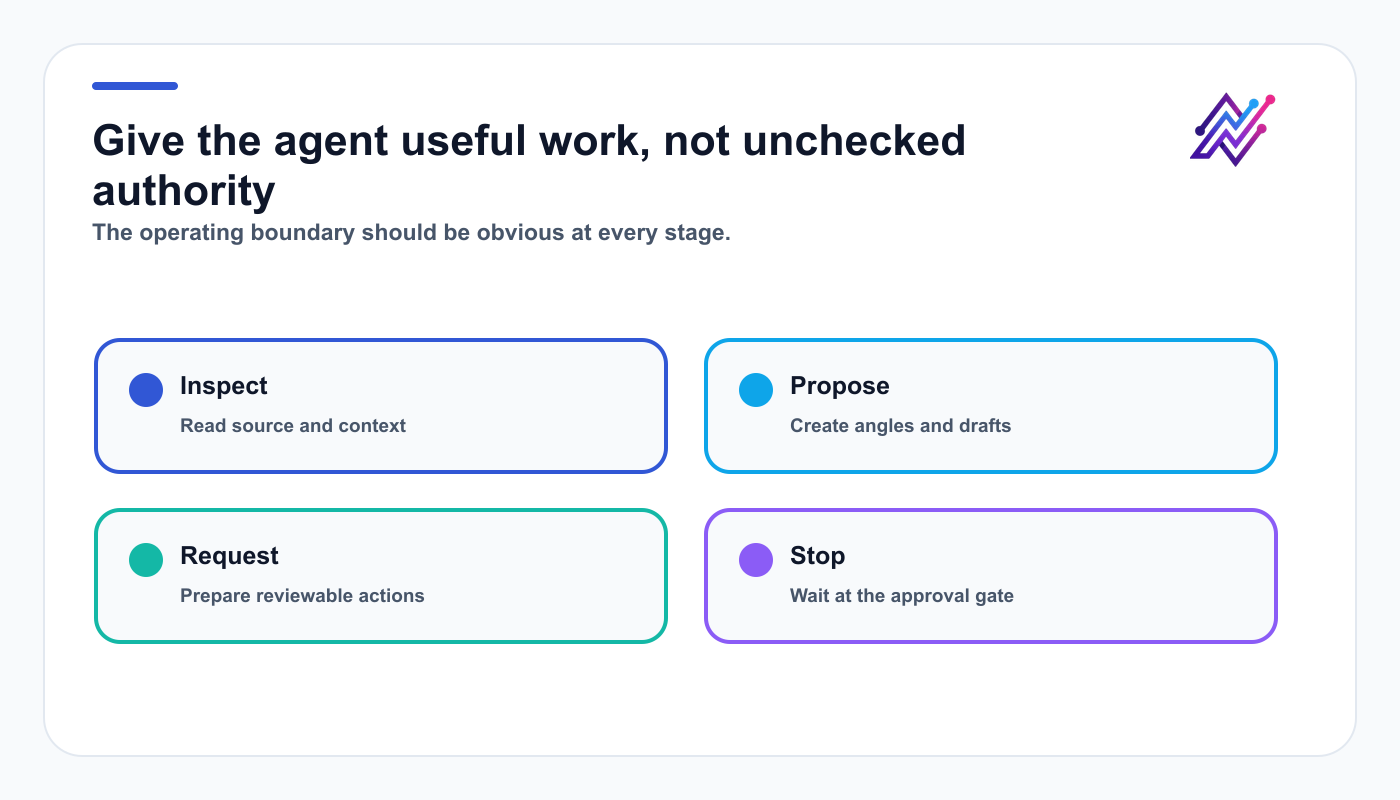
Agents can accelerate the workflow while consequential publishing remains explicitly controlled.
Example client instruction
Analyze this public source, check the transcript for gaps, create platform-native content drafts, and flag uncertain claims or high-risk localizations. Save drafts only; do not schedule or publish.
Tareno remains the execution layer.
Measure and improve the next wave
Step 19: measure the first wave
Track based on format.
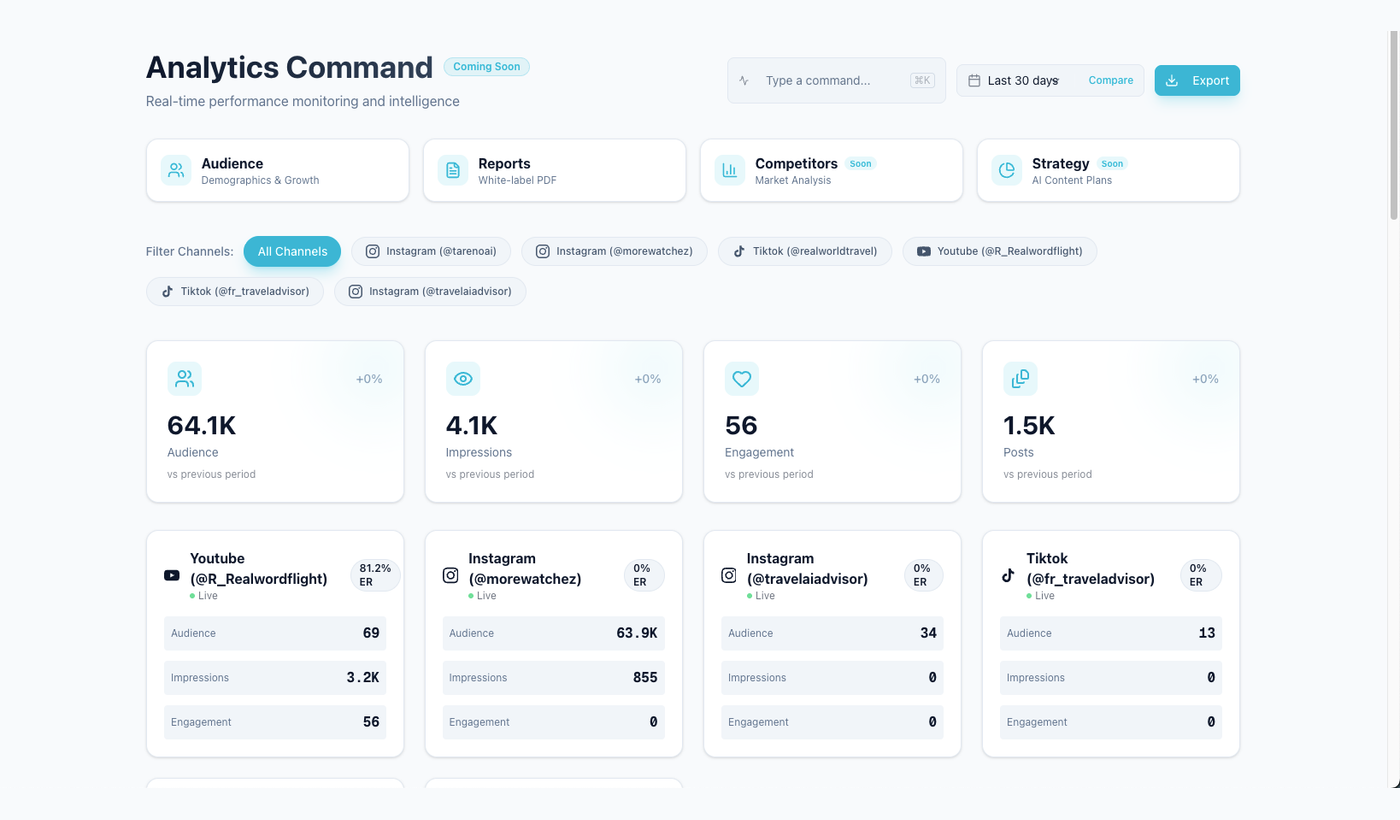
Performance signals determine which angle deserves a second wave and which should stop.
Short-form video
views
watch time
completion
rewatches
shares
comments
Text post
impressions
saves
shares
replies
clicks
Carousel
saves
shares
completion where available
profile visits
Traffic asset
clicks
landing-page engagement
conversions
Do not compare all assets using one metric.
Step 20: create the second wave
After the measurement window:
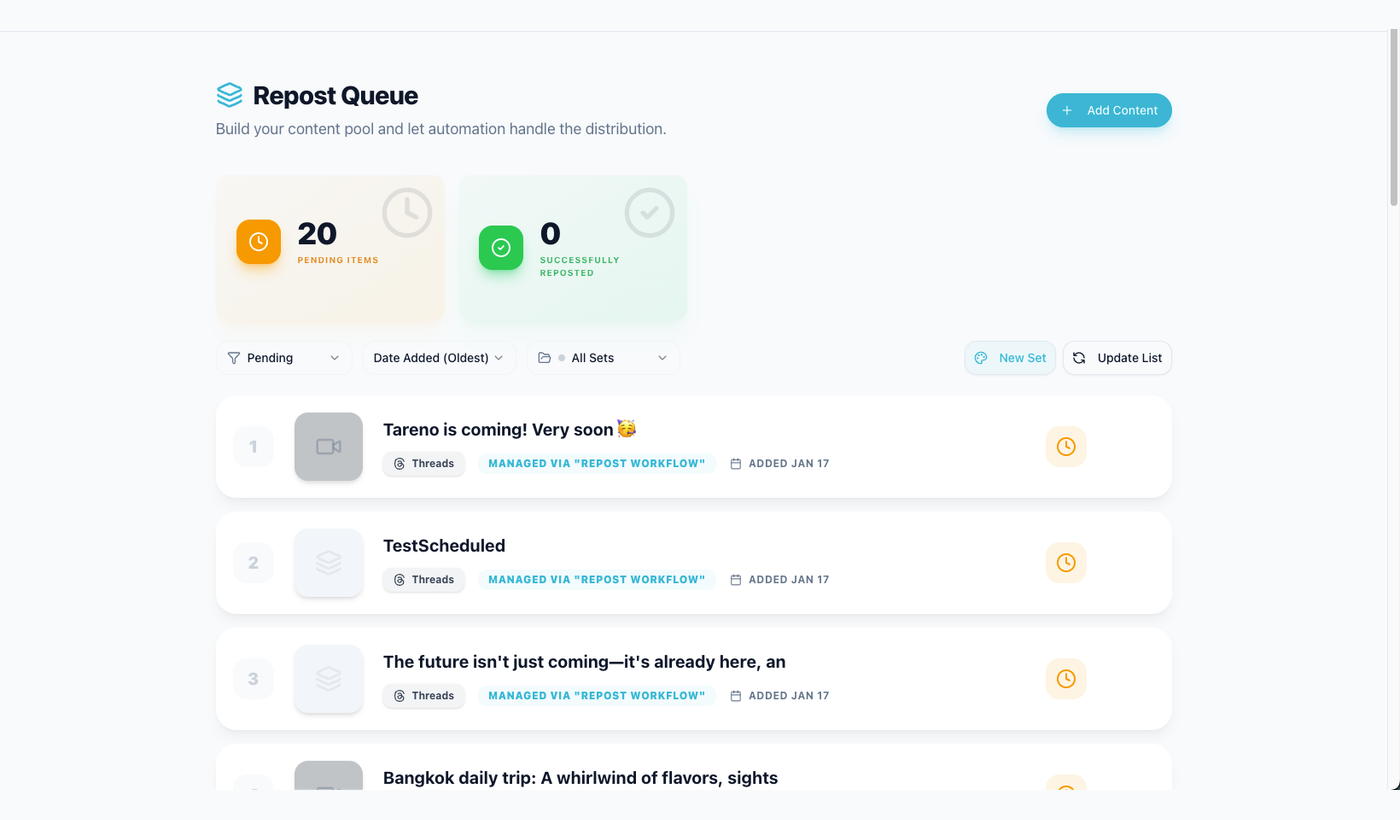
The second wave should reuse the winning signal, not blindly repost the original asset.
identify strongest hook
identify strongest format
identify strongest market
identify strongest platform
review audience questions
create follow-up tasks
Example:
YouTube Short:
High completion, average clicks.

Action:
Create a second video with the same structure.

LinkedIn:
High saves.

Action:
Create a checklist carousel.

Mastodon:
Strong replies.

Action:
Create a deeper community post.
Treat each first-wave signal as a hypothesis, not proof of causation. Change one meaningful variable in the second wave, keep the comparison window and destination comparable, and record the result before scaling.
Duplicate prevention
Use:
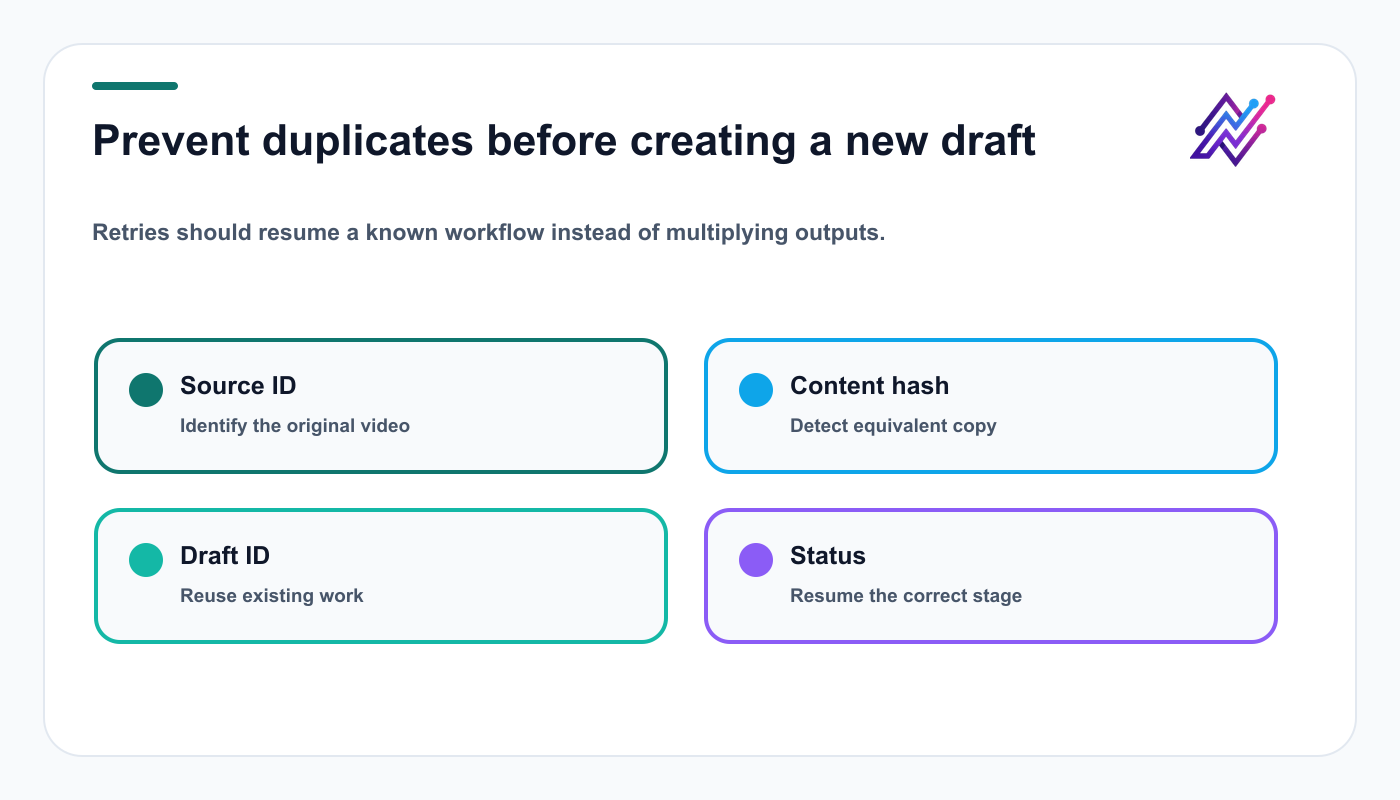
Stable identifiers make retries safe across automation tools and agent sessions.
sourceVideoId + sourceRevision + transcriptSection + platform + language + account
Track:
source URL
content atom
Tareno draft ID
content hash
publish date
status
Before creating a new draft:
search existing drafts
compare content atom
compare platform and language
update or skip duplicates
Automation should not create five versions of the same item accidentally.
Error handling
Handle:
invalid URL
no transcript
unsupported language
incomplete transcript
AI parsing failure
missing account
unsupported media
approval expiration
failed publishing
analytics unavailable
Flow:
Validation error -> return to source
Transcript failure -> manual review
Retryable API error -> wait and retry
Approval expired -> request new approval
Permanent failure -> create incident
Quality-control checklist
Run the same compact quality gate before any generated asset reaches the calendar.
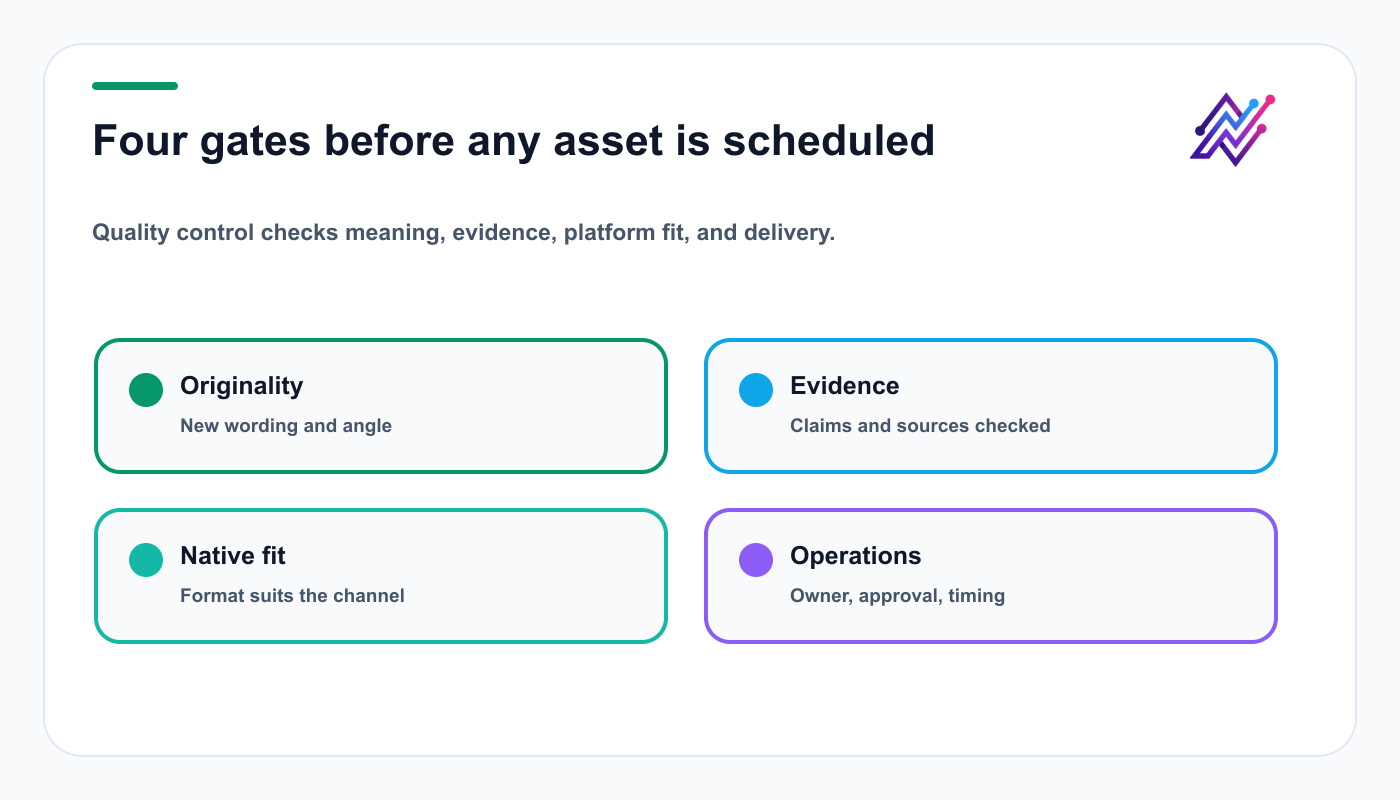
A compact gate catches the highest-impact failures before content enters the calendar.
Source:
- [ ] URL valid
- [ ] Transcript reviewed
- [ ] Relevant section selected
- [ ] Source idea understood

Originality:
- [ ] Original wording
- [ ] Original examples
- [ ] No copied personal story
- [ ] Claims verified

Platform:
- [ ] Native structure
- [ ] Correct length
- [ ] Correct CTA
- [ ] Asset requirements defined

Localization:
- [ ] Market defined
- [ ] Terminology checked
- [ ] Native review complete where required
- [ ] Visual layout checked

Workflow:
- [ ] Draft saved
- [ ] Approval owner assigned
- [ ] Schedule confirmed
- [ ] Measurement date set
- [ ] Repurposing note added
Common mistakes
The most expensive repurposing failures collapse distinct editorial stages into one automated shortcut.
Mistake 1: turning the whole transcript into one post
Extract content atoms.
Mistake 2: copying wording
Reuse structure, not sentences.
Mistake 3: generating every possible format
Select formats strategically.
Mistake 4: one caption across platforms
Adapt by network.
Mistake 5: translating before approving the master
Approve first.
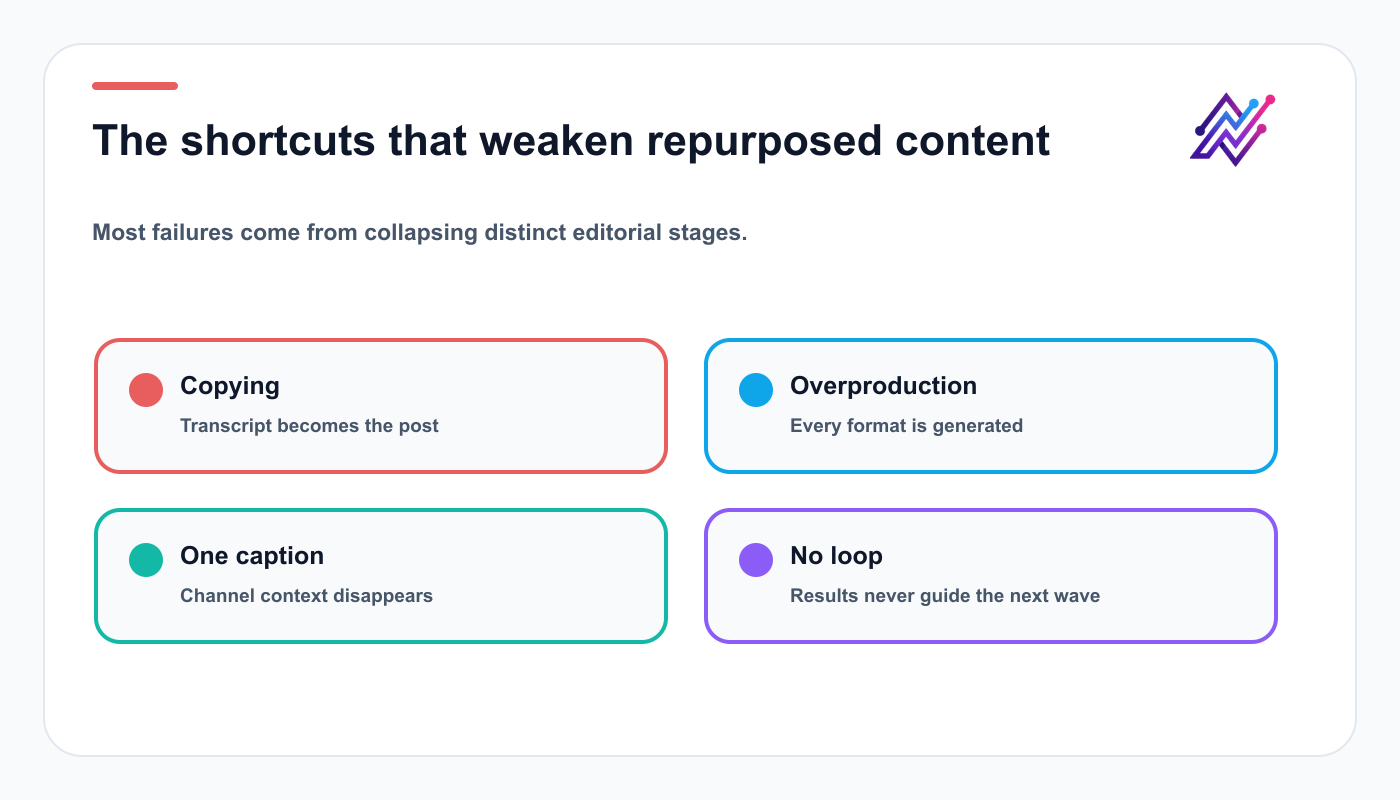
Strong repurposing preserves the idea while changing the expression and learning from results.
Mistake 6: publishing every asset at once
Use a distribution sequence.
Mistake 7: no source traceability
Store the source URL and content atom.
Mistake 8: no performance loop
Measure and create a second wave.
Twenty workflow ideas
Use these ideas as an option set, then choose one workflow with a clear owner, gate, and measurement signal.
Tutorial video → LinkedIn checklist
Founder interview → opinion series
Product demo → short-form scripts
Webinar → FAQ campaign
Podcast → Bluesky thread
Industry video → response post
Customer video → social proof draft
Release video → launch campaign
Educational video → carousel
YouTube Short → Mastodon deep dive
Transcript → ten-language campaign
Transcript → Pinterest series
Video comments → FAQ posts
Video chapter → weekly content series
High-retention section → new hook test
YouTube upload → n8n workflow
YouTube URL → Make scenario
Airtable URL → Zapier draft
Agent-selected video → Tareno draft package
Published derivatives → repurposing queue
The framework below turns this option set into a deliberate starting decision.
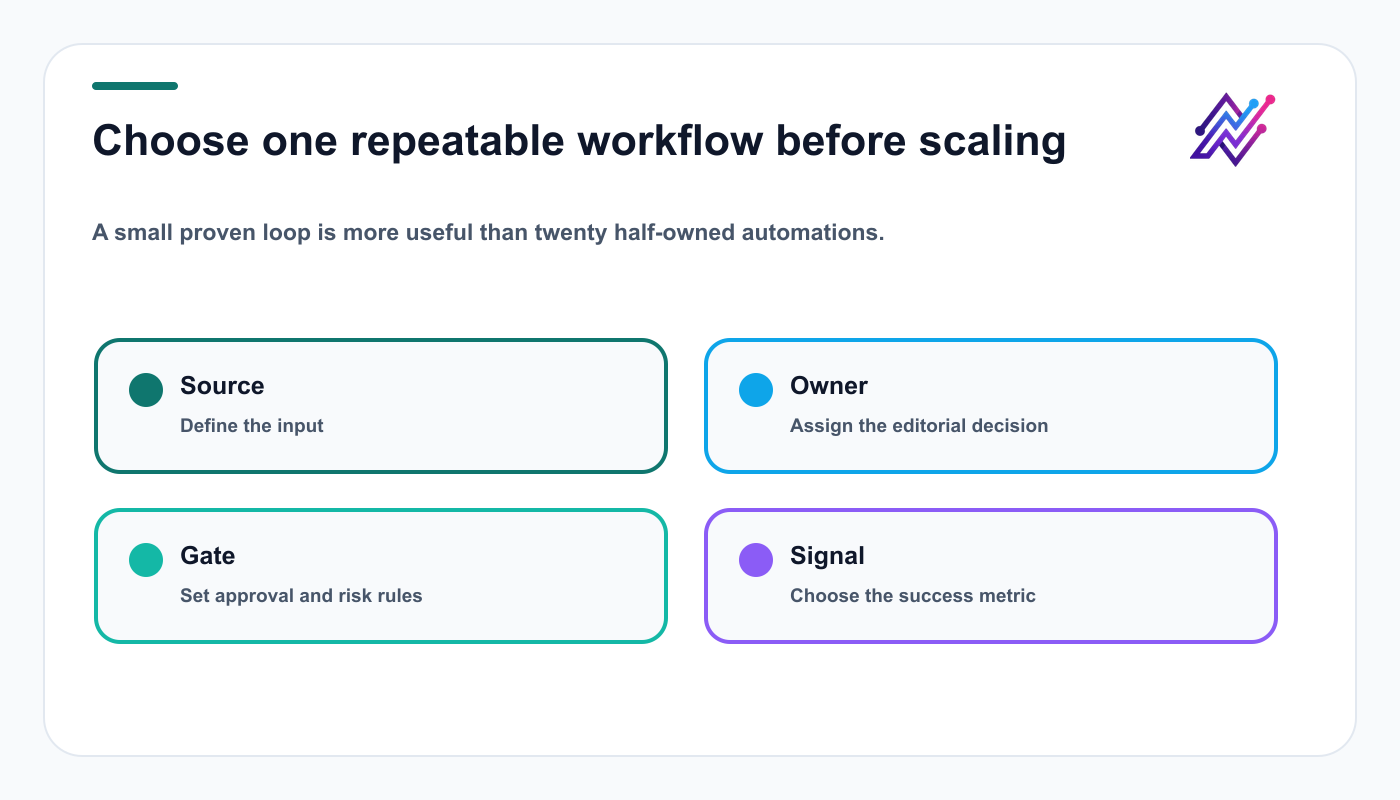
Each workflow needs a clear source, owner, approval rule, and measurement signal.
Related Tareno resources
Continue building this workflow
AI content creationExplore resource →Content calendarExplore resource →Analytics reportsExplore resource →Repurposing queueExplore resource →
FAQ
Can Tareno turn a YouTube video into social posts?
Yes. Use the source to identify ideas and structure, then create original platform-native drafts rather than transcript copies.
Can the workflow create several languages?
Yes. Approve the master first, then localize it with terminology checks and market-appropriate review.
Can n8n, Make, or an AI agent automate the process?
Yes. Automation can move sources, drafts, and status between stages, while publishing actions remain approval-first.
Final thoughts
A YouTube video becomes a durable content asset when the team separates source analysis, original creation, platform adaptation, review, distribution, and measurement.
Begin with one source and one controlled sequence. Let the first wave’s evidence—not the automation’s output volume—decide what deserves a second wave.