Bluesky and Mastodon both offer an alternative to the largest centralized networks, but they reward different voices, context, and community behavior.
A strong cross-network workflow starts with one source idea, creates a native version for each platform, and keeps approval tied to the exact draft and destination.
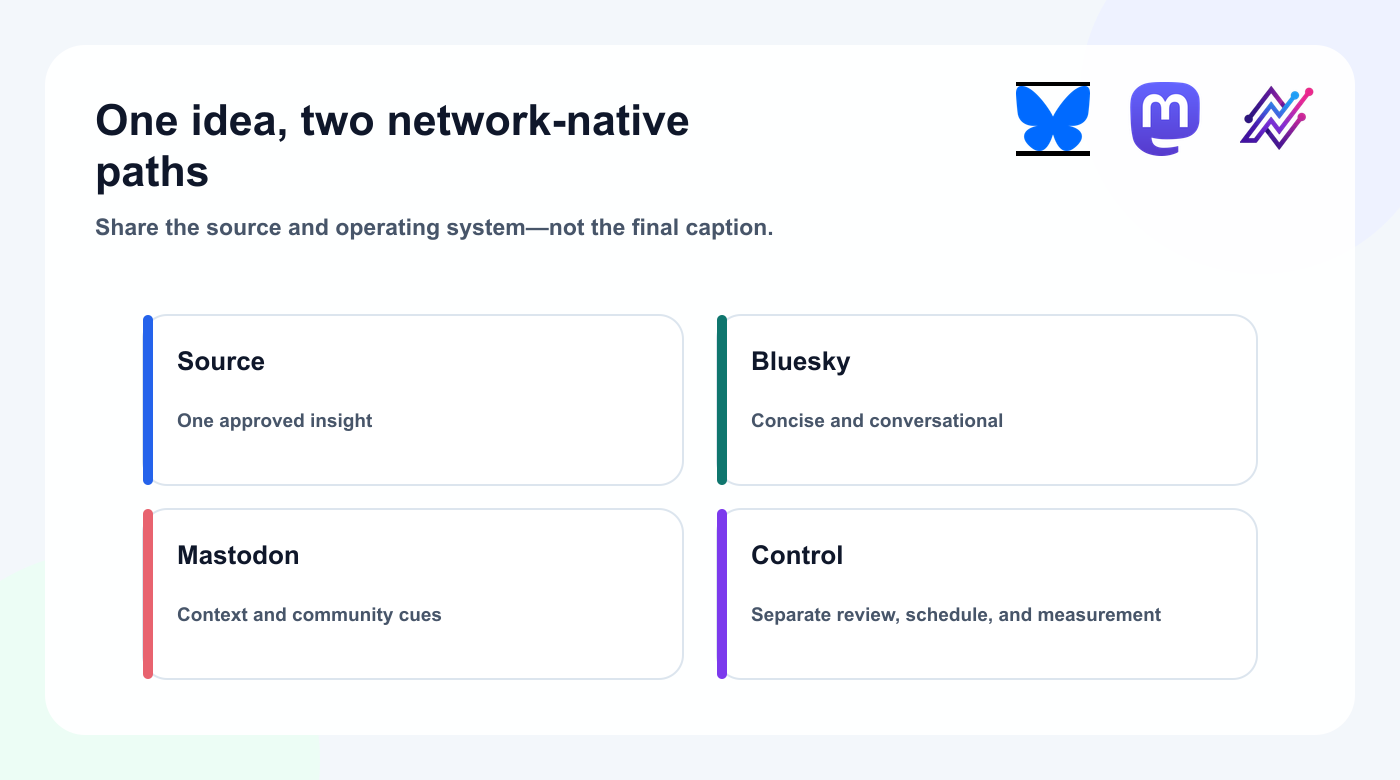
A shared source becomes two native drafts with separate review and measurement.
Tareno brings both networks into the same planning, scheduling, approval, analytics, repurposing, and automation system without flattening them into duplicate distribution channels.
This guide shows how to define each network’s role, adapt the content, automate the handoffs, and measure Bluesky and Mastodon against their own baselines.
TL;DR
A practical Bluesky and Mastodon workflow looks like this:
Create one source idea.
Define the purpose of each network.
Generate separate drafts.
Review tone and context.
Check platform-specific requirements.
Approve the final versions.
Schedule through Tareno.
Monitor responses.
Compare performance by platform.
Repurpose the stronger angle.
The key rule is:
Reuse the idea, not the exact caption.
Bluesky and Mastodon can share the same content system without sharing the same voice.
Why automate Bluesky and Mastodon now?
Teams are expanding beyond a single social platform.
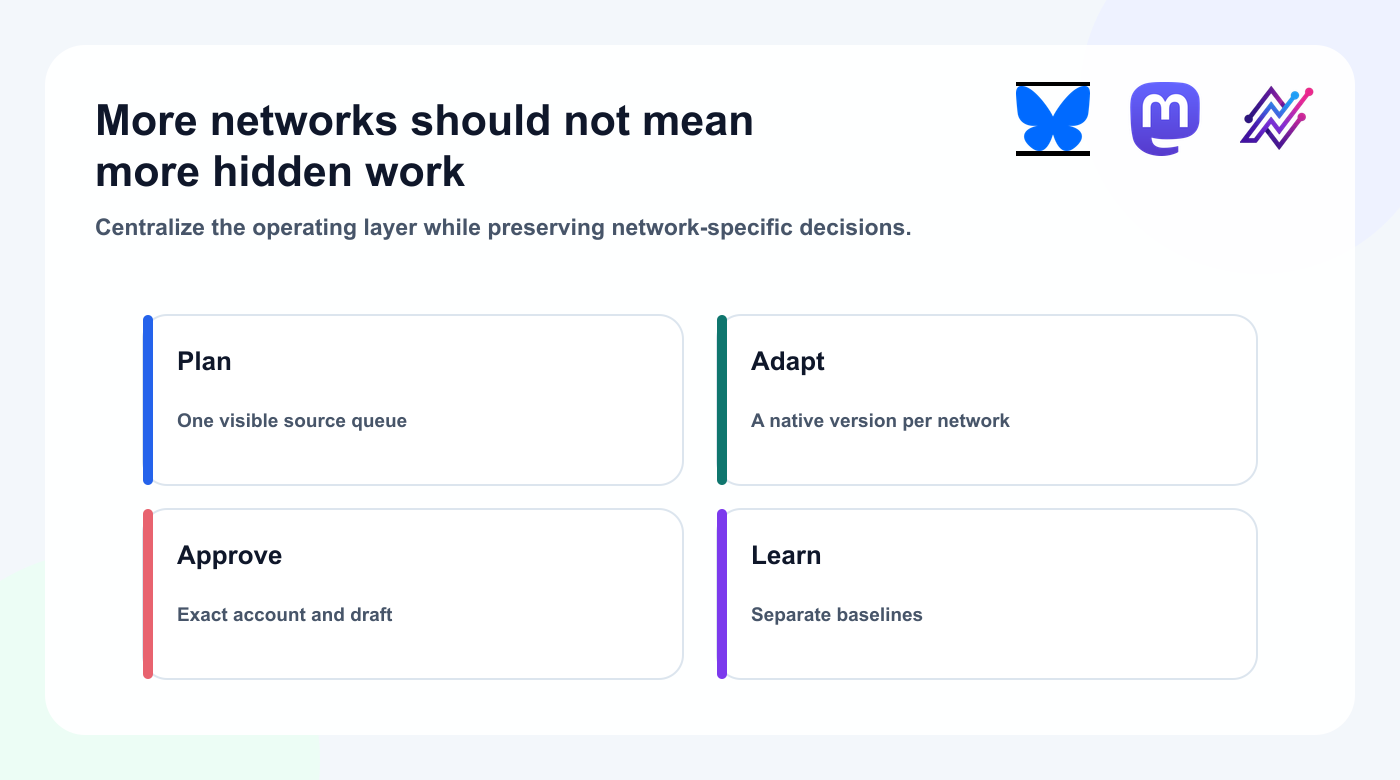
Centralize coordination and control while keeping each network’s content distinct.
The reasons vary:
audience fragmentation
platform risk
desire for open networks
community discovery
lower dependence on one algorithm
new professional and technical audiences
interest in decentralized or protocol-based social media
demand from clients or creators
broader content distribution
The challenge is operational.
Adding two more platforms can create:
two more account logins
two more draft queues
two more scheduling processes
two more approval paths
two more analytics views
more duplicate content
more manual copy-paste
more chances to publish the wrong version
A multi-network workflow solves the operational problem.
It does not mean publishing everywhere automatically.
It means bringing the networks into one controlled system.
Bluesky and Mastodon are not identical
Before building automation, understand the differences.
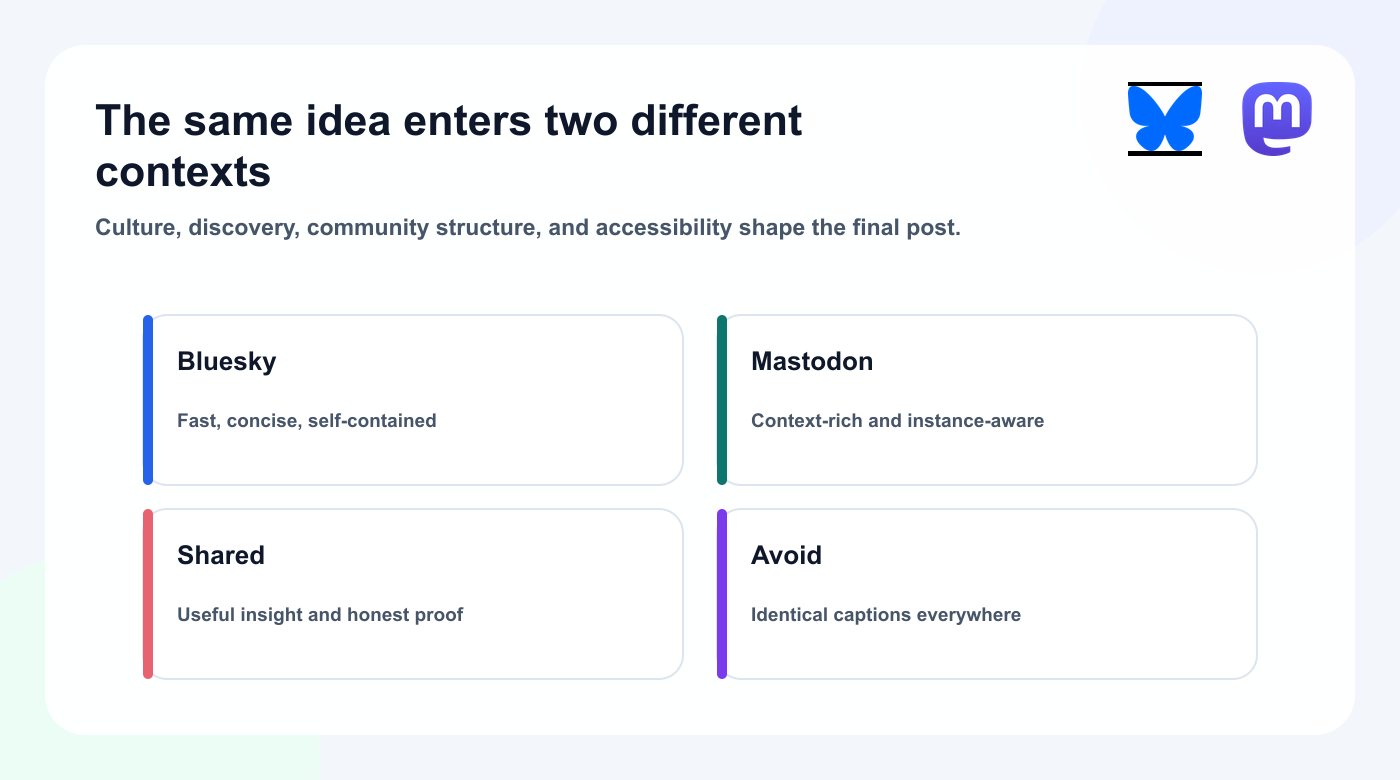
Platform-native adaptation changes context and delivery without changing the underlying truth.
AreaBlueskyMastodonNetwork modelProtocol-based social networkFederated network of instancesTypical post styleConcise, conversational, thread-friendlyContext-rich, community-awareCommunity structureBroad network discoveryInstance and federation contextContent warningsLess central to normal workflowOften culturally importantToneFast, direct, informalVaries by instance and communityCross-posting toleranceDepends on qualityOften lower when content feels automatedHashtag roleUseful but should feel naturalCan be important for discoveryLink behaviorNeeds verification at publicationCan vary by community contextAutomation riskGeneric copy-pasteGeneric or context-insensitive posting
The operational conclusion is simple:
One source workflow is useful. One identical caption is not.
What Tareno adds
Tareno can serve as the shared operating layer for both platforms.
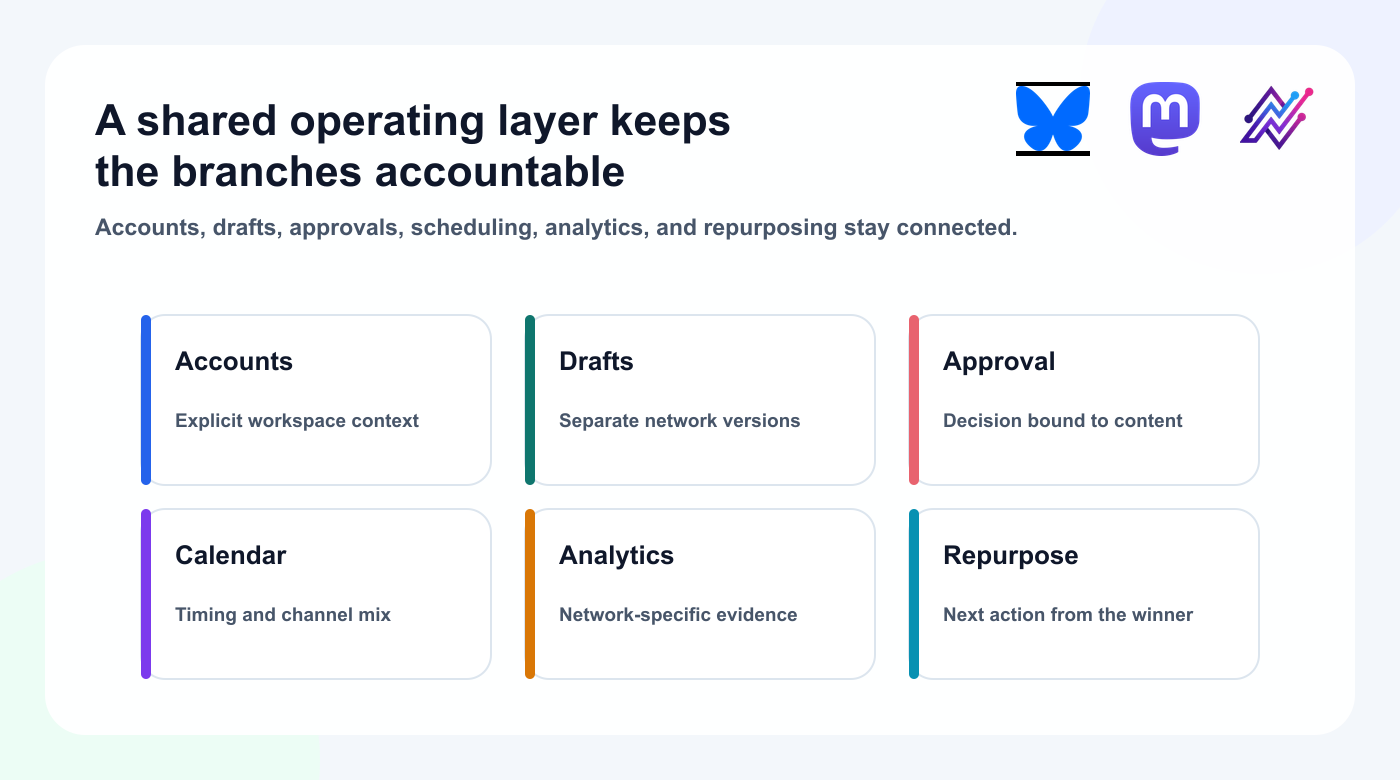
Tareno centralizes state and control without forcing both networks into one voice.
A shared operating layer becomes more useful when post scheduling stays connected to the platform-specific draft.
Relevant capabilities include:
connected Bluesky and Mastodon accounts
platform-specific captions
workspaces
content boards
content calendar
approval workflows
scheduling
roles and permissions
activity visibility
analytics
reports
repurposing queue
workflow builder
API
MCP
n8n integration
Make integration
Zapier integration
AI-agent control
The architecture becomes:
Source idea
  ↓
Tareno board or external automation
  ↓
Platform-specific adaptation
  ├─ Bluesky draft
  └─ Mastodon draft
      ↓
Review and approval
      ↓
Tareno calendar
      ↓
Publishing
      ↓
Separate analytics
      ↓
Repurposing decision
Plan platform-native content
Step 1: Define the role of each platform
Do not add a network only because it exists.
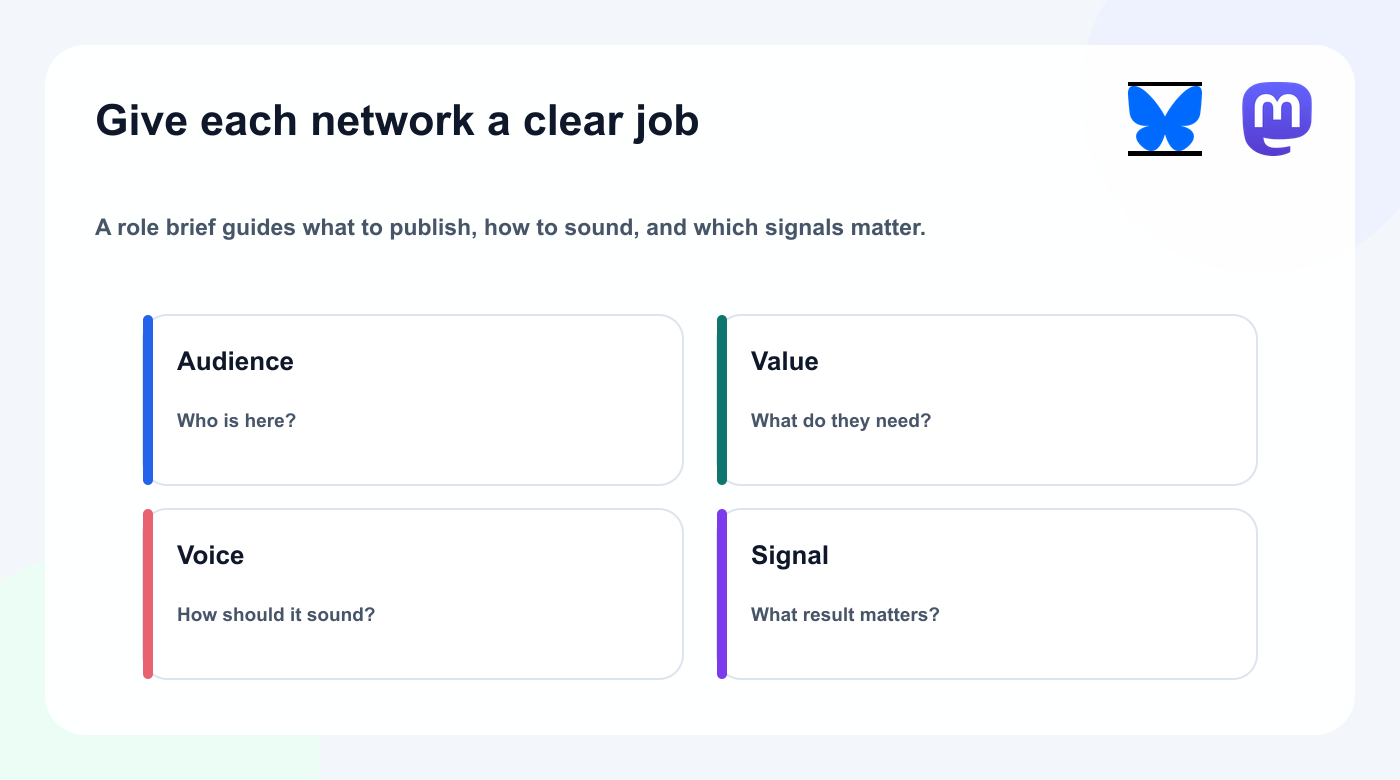
Clear network roles give creators, reviewers, and AI better adaptation criteria.
Give it a job.
Possible Bluesky role
concise industry observations
founder commentary
short educational threads
product updates
conversations with technical or creative audiences
lightweight community engagement
Possible Mastodon role
thoughtful updates
community-specific education
longer context
open-source or technical discussion
local or niche community participation
posts with clear content warnings where relevant
Document the role in your content strategy.
Example:
Bluesky role:
Fast insights, founder opinions, product lessons, concise threads.

Mastodon role:
Context-rich education, community discussion, open-web topics, technical updates.
This gives AI, editors, and reviewers better direction.
Step 2: Create one source idea
Start with the idea, not the caption.
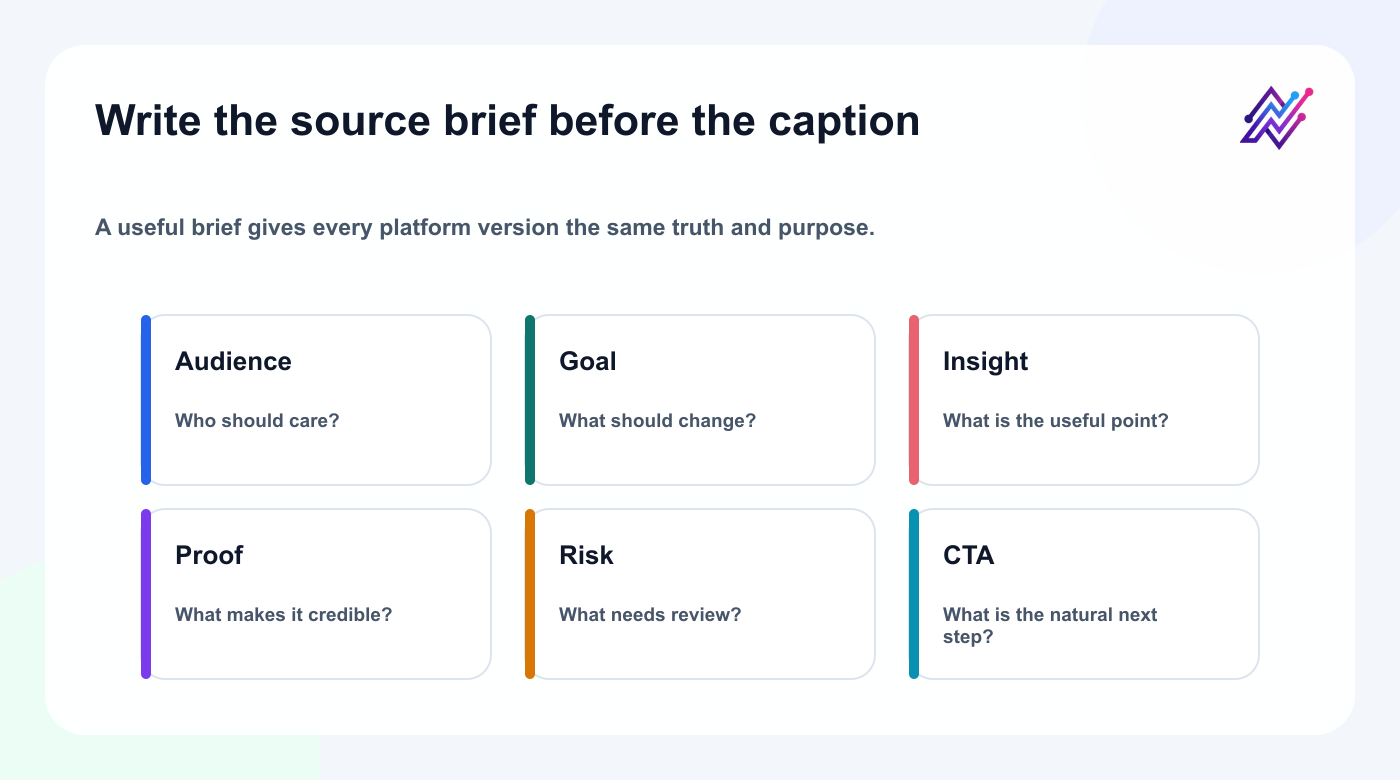
A complete source brief makes platform adaptation more accurate and easier to review.
Source idea fields:
topic
audience
goal
core insight
proof
example
CTA
risk level
source material
Example:
Topic:
AI agents for social media.

Core insight:
The best AI workflow keeps publishing behind approval.

Proof:
Drafts and analytics can be automated safely, while external changes remain reviewable.

CTA:
Try a draft-only Tareno MCP workflow.
This source can become different platform versions.
Step 3: Create a Bluesky-native version
A Bluesky version should usually be concise and self-contained.
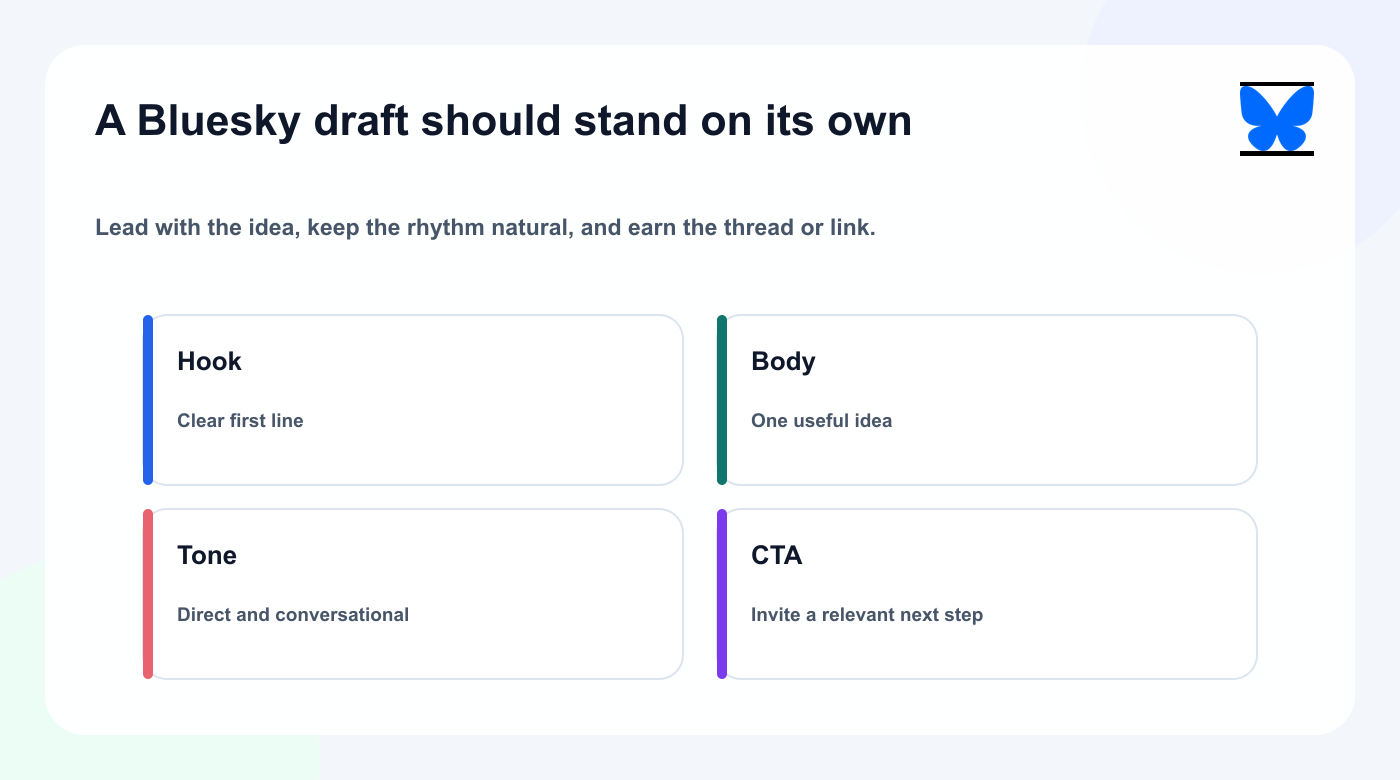
A concise Bluesky draft should feel complete even when the reader never opens a link.
Example:
AI social media automation gets more useful when the agent can analyze and draft freely—but still needs approval before anything goes public.
Automate the work. Keep control of the consequence.
Why this fits:
clear idea
low corporate language
concise rhythm
no unnecessary context
natural discussion potential
A thread can be used when the idea needs steps or examples.
Bluesky checklist
- [ ] Clear first line
- [ ] One main idea
- [ ] Concise language
- [ ] Low-hype tone
- [ ] Link only if useful
- [ ] Thread only if needed
- [ ] CTA fits the conversation
Step 4: Create a Mastodon-native version
A Mastodon version can include more context.
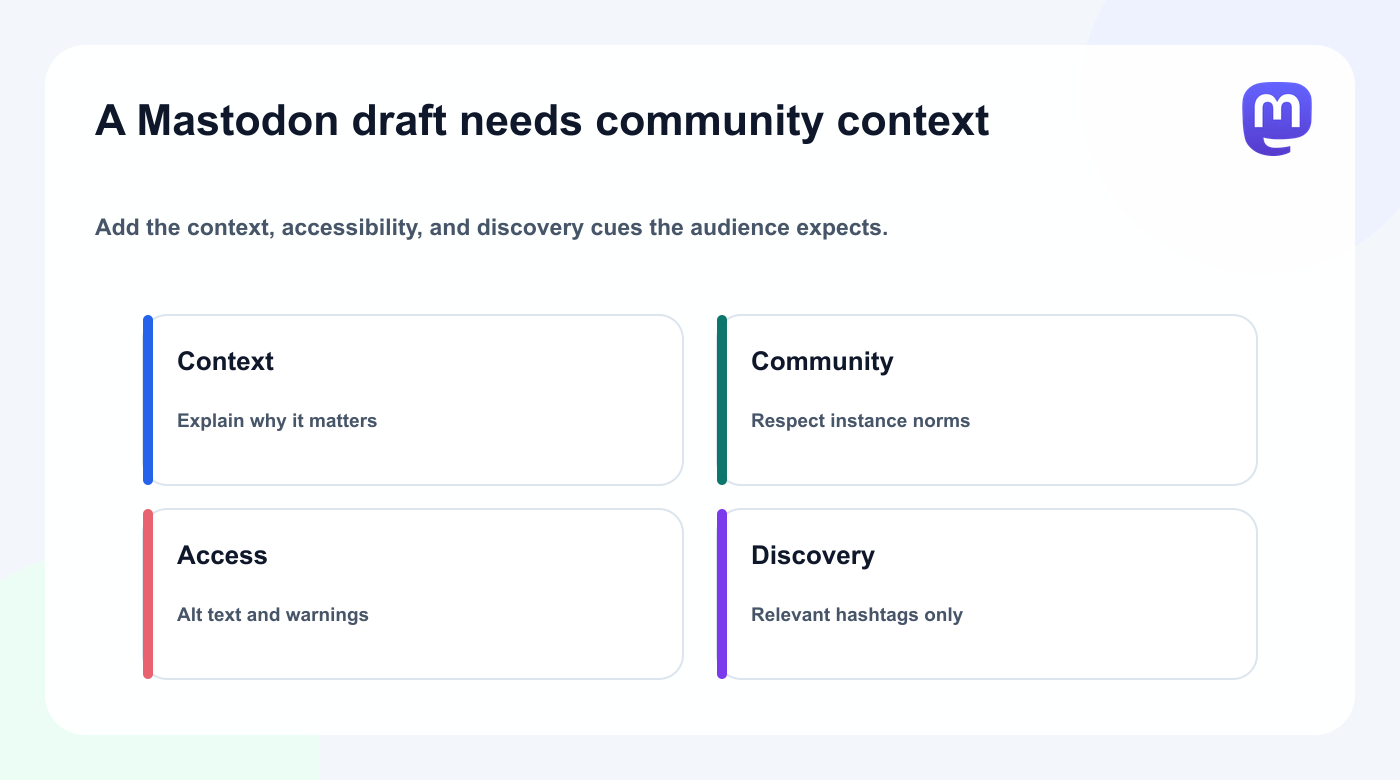
Mastodon adaptation includes community and accessibility decisions, not only extra words.
Example:
AI agents can remove a lot of repetitive social media work: account audits, analytics reviews, draft creation, and repurposing.
The part I would not remove is approval before an external action. A draft can be fixed. A wrong public post affects a real account and audience.
The useful model is agent-assisted, approval-first publishing.
Why this fits:
more context
clear reasoning
community-aware tone
less compressed
not written like an ad
Depending on the instance and topic, the workflow may also need:
content warning
language tag
image description
hashtags
accessibility review
community-specific phrasing
Mastodon checklist
- [ ] Enough context
- [ ] Community-aware tone
- [ ] Content warning checked
- [ ] Hashtags relevant
- [ ] Alt text added
- [ ] No aggressive growth-hacking language
- [ ] Link placement feels natural
Step 5: Use a platform adaptation matrix
Use this table in the workflow.
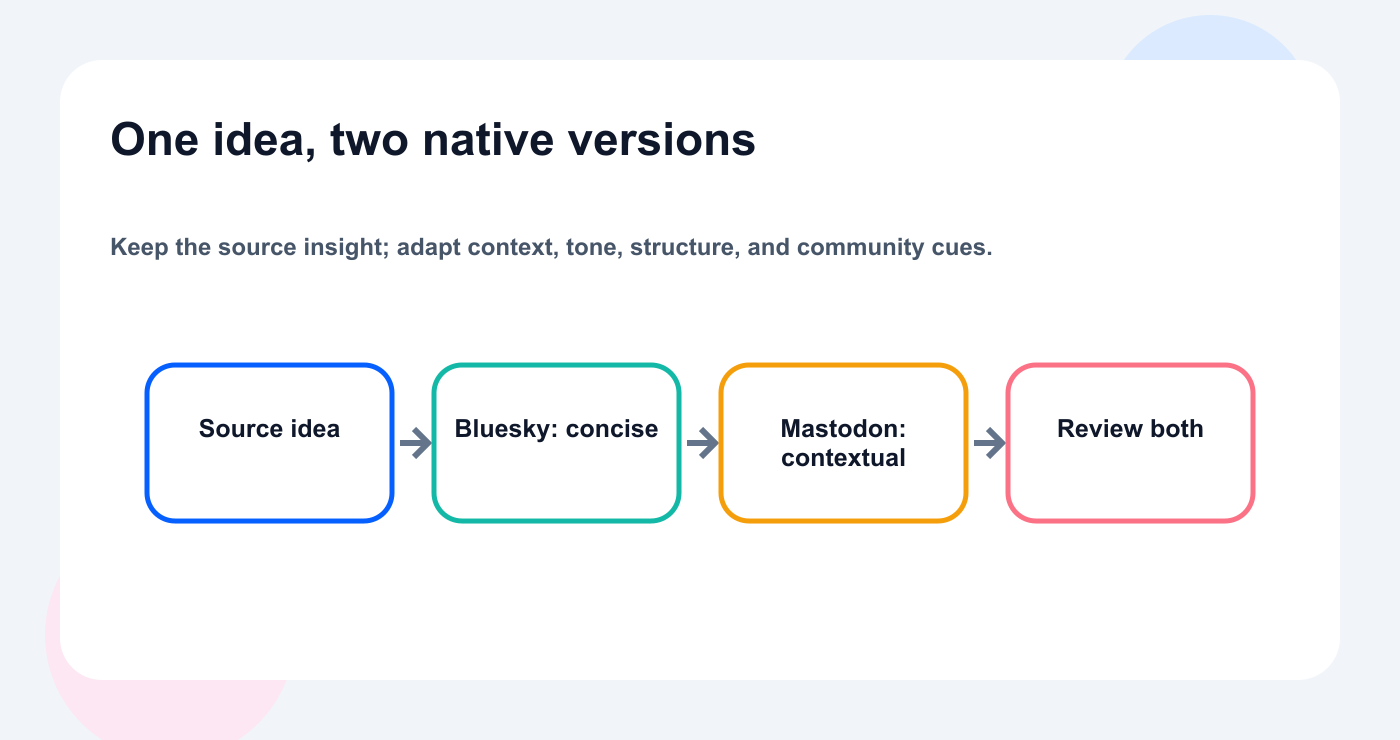
Reuse the insight, then adapt tone and context before either draft reaches approval.
FieldBlueskyMastodonToneConcise, conversationalContextual, community-awareLengthShorter by defaultMore room for explanationThread useUseful for sequencesLess necessary for every ideaHashtagsLight useCan support discoveryContent warningTopic-dependentImportant in many communitiesCTASoft and directUseful and respectfulLinkOnly when usefulContext before linkAccessibilityAlt textAlt text and community norms
This matrix can be embedded in AI prompts and approval templates.
Build the automation workflow
Step 6: Create drafts in Tareno
Inside Tareno, create separate items or platform versions.
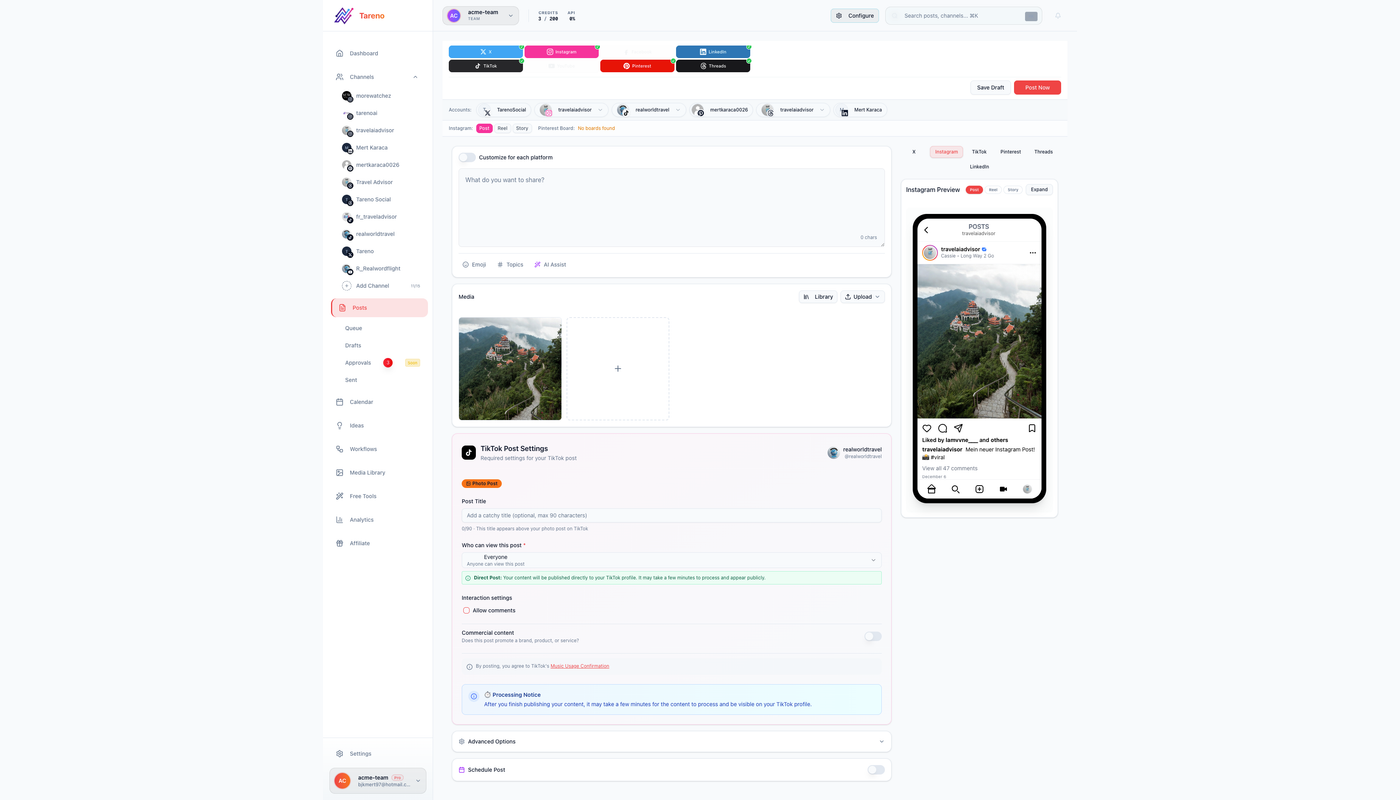
Separate drafts preserve each network’s voice while keeping the source idea connected.
Store:
source idea
platform
caption
account
language
asset
alt text
content warning if needed
approval requirement
publish target
source URL
measurement goal
Do not overwrite one version with the other.
Each platform needs its own final copy.
Step 7: Add approval rules
Not every post needs the same review.
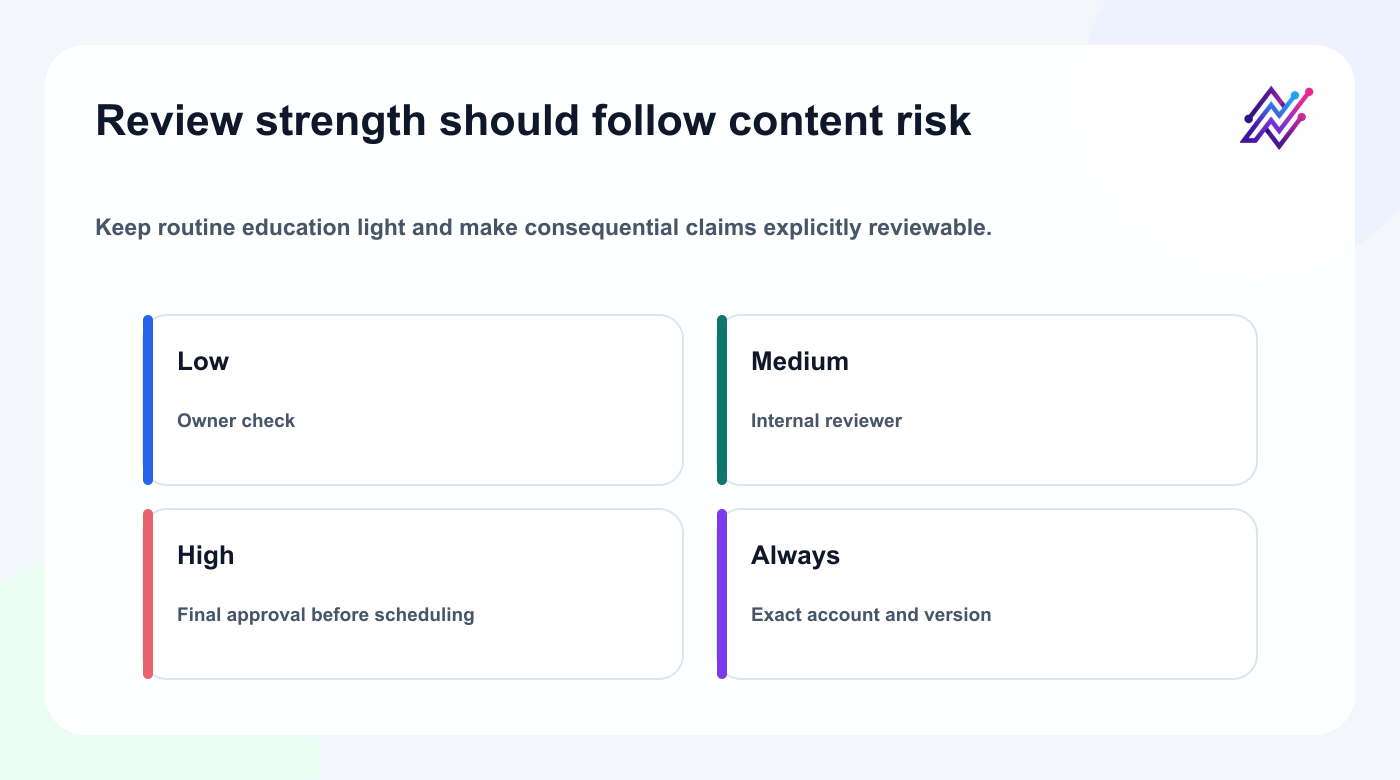
The workflow should add review where the claim or consequence is harder to reverse.
For higher-risk claims, a structured social media approval workflow keeps the exact version and destination reviewable.
Low risk
general tips
educational content
community questions
non-sensitive opinion
Review:
owner check
Medium risk
product education
campaign post
repurposed content
customer example
Review:
internal reviewer
High risk
pricing
competitor comparisons
sponsor content
client content
legal-sensitive topics
performance claims
AI-generated claims
Review:
final approval before scheduling
Tareno’s approval workflow should keep the account, caption, media, time, and platform visible.
Step 8: Schedule from one calendar
The calendar should show both platforms separately.
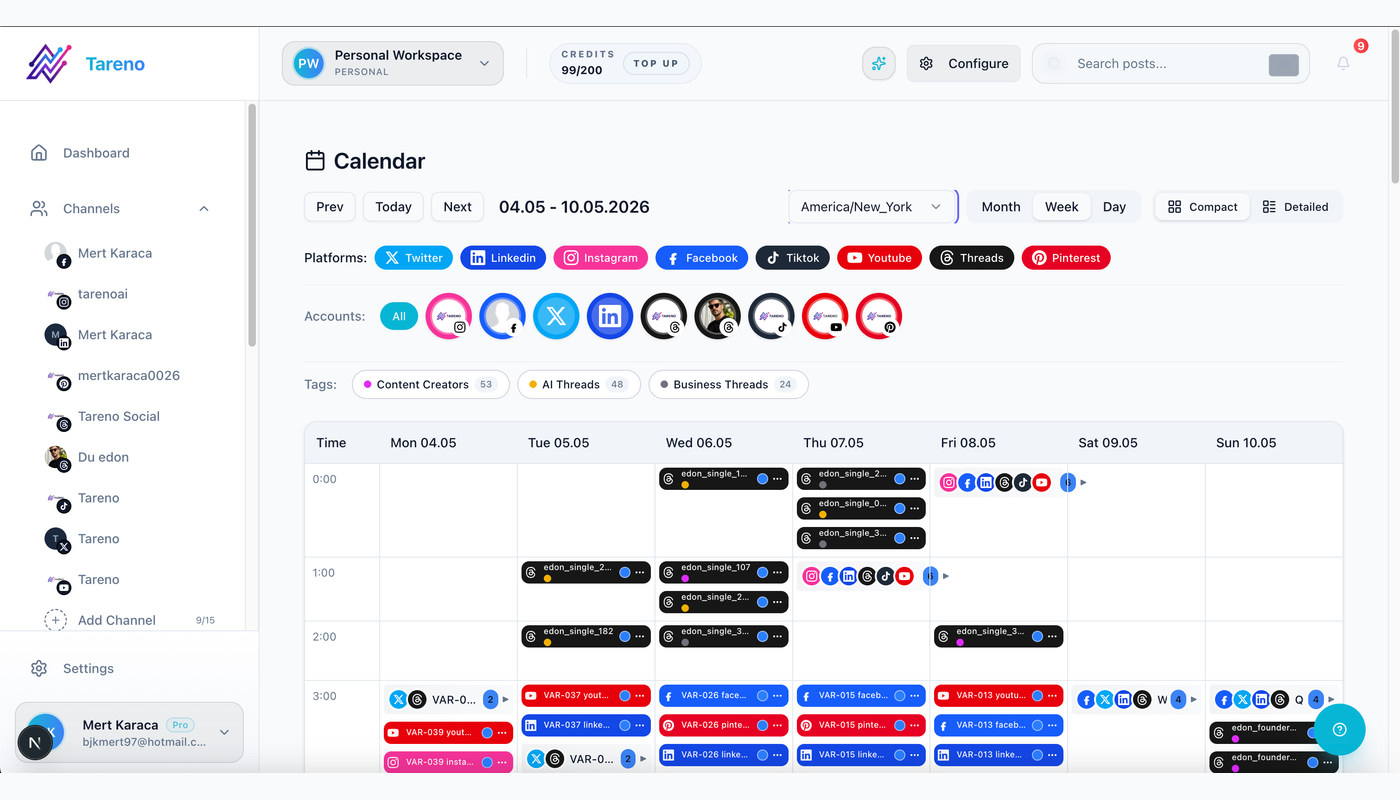
One calendar makes timing visible while keeping Bluesky and Mastodon posts separate.
Example:
DatePlatformTopicVersionStatusTuesdayBlueskyAI approvalConciseApprovedWednesdayMastodonAI approvalContext-richReviewFridayBlueskyProduct lessonThreadDraftFridayMastodonProduct lessonEducationalPlanned
This makes the distribution strategy visible.
It also prevents the same idea from being published too many times without adaptation.
Step 9: Automate with Tareno Workflow Builder
A native Tareno workflow could look like:
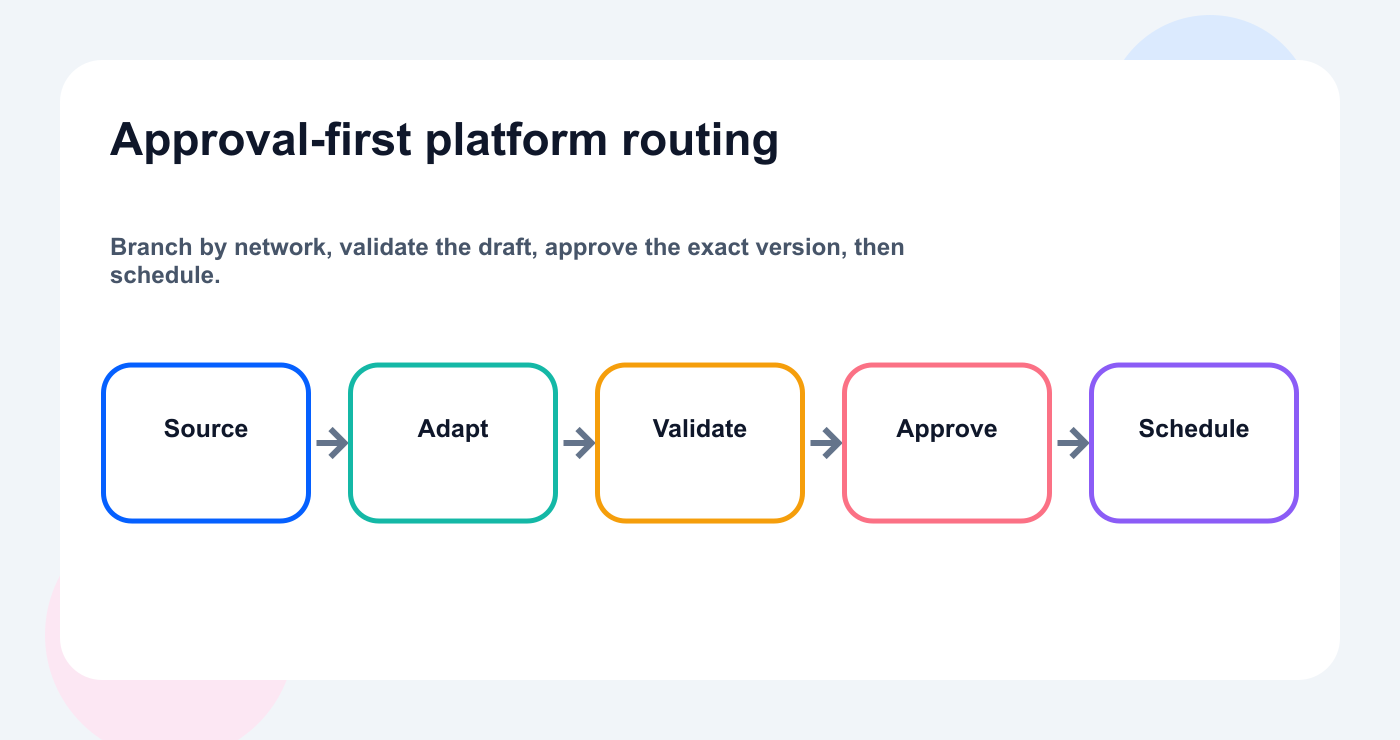
Automation prepares both branches; approval remains tied to the exact version and account.
Map the branch, validation, and human gate in a reusable social media workflow builder.
Source post approved
  ↓
Create Bluesky adaptation
  ↓
Create Mastodon adaptation
  ↓
Request review
  ↓
Schedule after approval
Possible conditions:
if source platform = LinkedIn
if topic is evergreen
if no pricing claim
if account connected
if duplicate not found
Possible delays:
publish Bluesky one day after LinkedIn
publish Mastodon two days later
create analytics task seven days after publishing
Native workflows are useful when the logic remains inside Tareno.
Step 10: Automate with n8n
An n8n workflow can add:
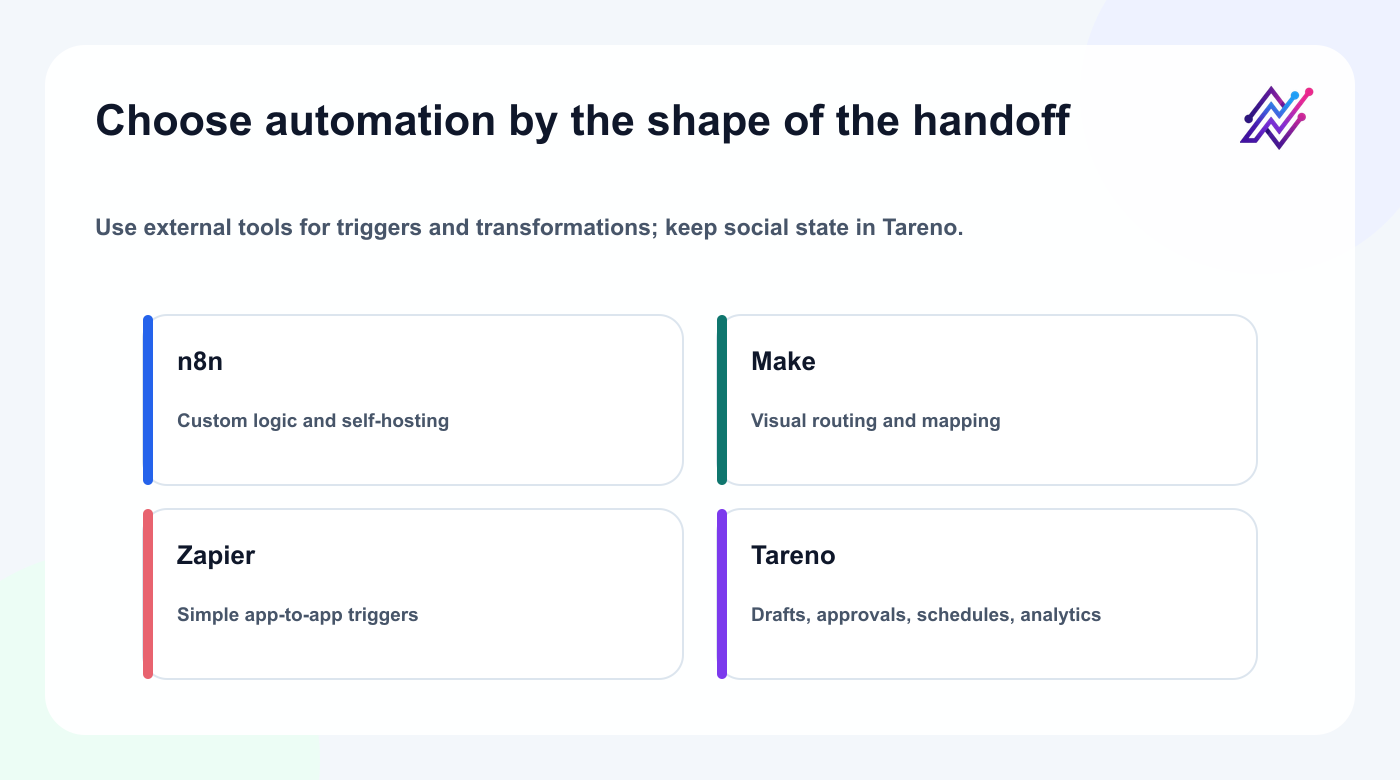
External automation moves the event; Tareno owns the social workflow and its state.
source triggers
AI transformation
custom business rules
self-hosted logic
database sync
retries
approval notifications
Example:
Notion item approved
  ↓
Generate Bluesky version
  ↓
Generate Mastodon version
  ↓
Validate platform requirements
  ↓
Create Tareno drafts
  ↓
Notify reviewer
Add duplicate prevention using:
sourceId + platform + accountId
Step 11: Automate with Make
A Make router is well suited to platform branches.
Approved source content
  ↓
Router
  ├─ Bluesky transformation
  └─ Mastodon transformation
      ↓
Tareno modules
Make is useful for visual mapping and non-technical maintainers.
Store Tareno draft IDs in a Data Store or source system.
Step 12: Automate with Zapier
Zapier works well for simpler flows.
Example:
New approved Airtable record
  ↓
AI creates Bluesky draft
  ↓
AI creates Mastodon draft
  ↓
Tareno creates drafts
  ↓
Slack notification
Keep the Zap simple.
For complex branching, n8n or Make may be easier.
Step 13: Use MCP and AI agents
An AI agent can use Tareno through MCP.
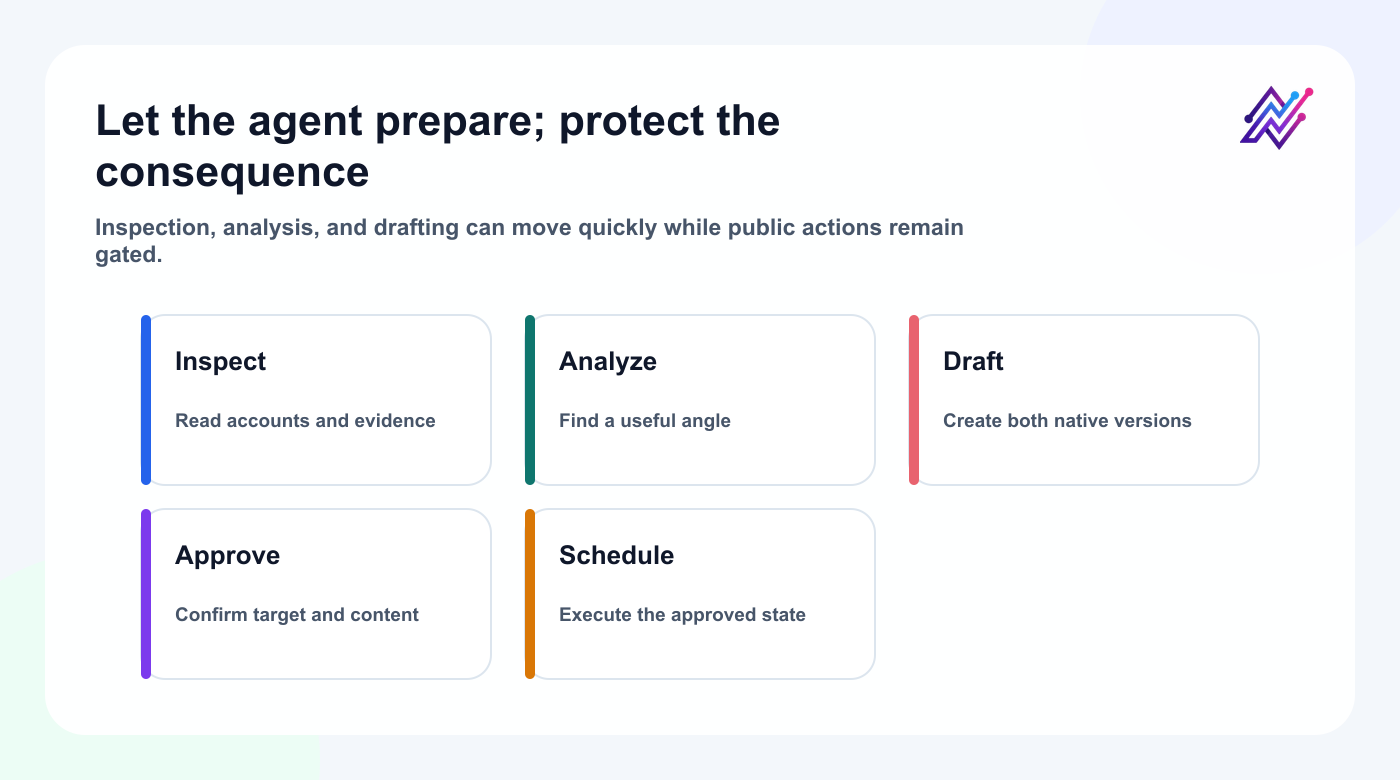
Agent flexibility is safest when scheduling and publishing remain explicit actions.
Prompt:
Review my recent LinkedIn posts and identify three ideas that would fit Bluesky and Mastodon. Create native versions for both networks. Explain the adaptation. Save drafts only.
Another prompt:
Compare the last 30 days of Bluesky and Mastodon performance. Identify which topics transfer across both and which work better on only one network.
Agents are useful when interpretation matters.
Tareno remains the controlled execution layer.
Step 14: Use Codex
Codex can support technical and product-led workflows.
Example:
Read the release notes for this feature, create one Bluesky post and one Mastodon post, and save both through Tareno. Do not schedule until product review is complete.
This is useful when social content connects directly to development work.
Step 15: Use OpenClaw or Hermes Agent
OpenClaw or Hermes Agent can act as the strategist.
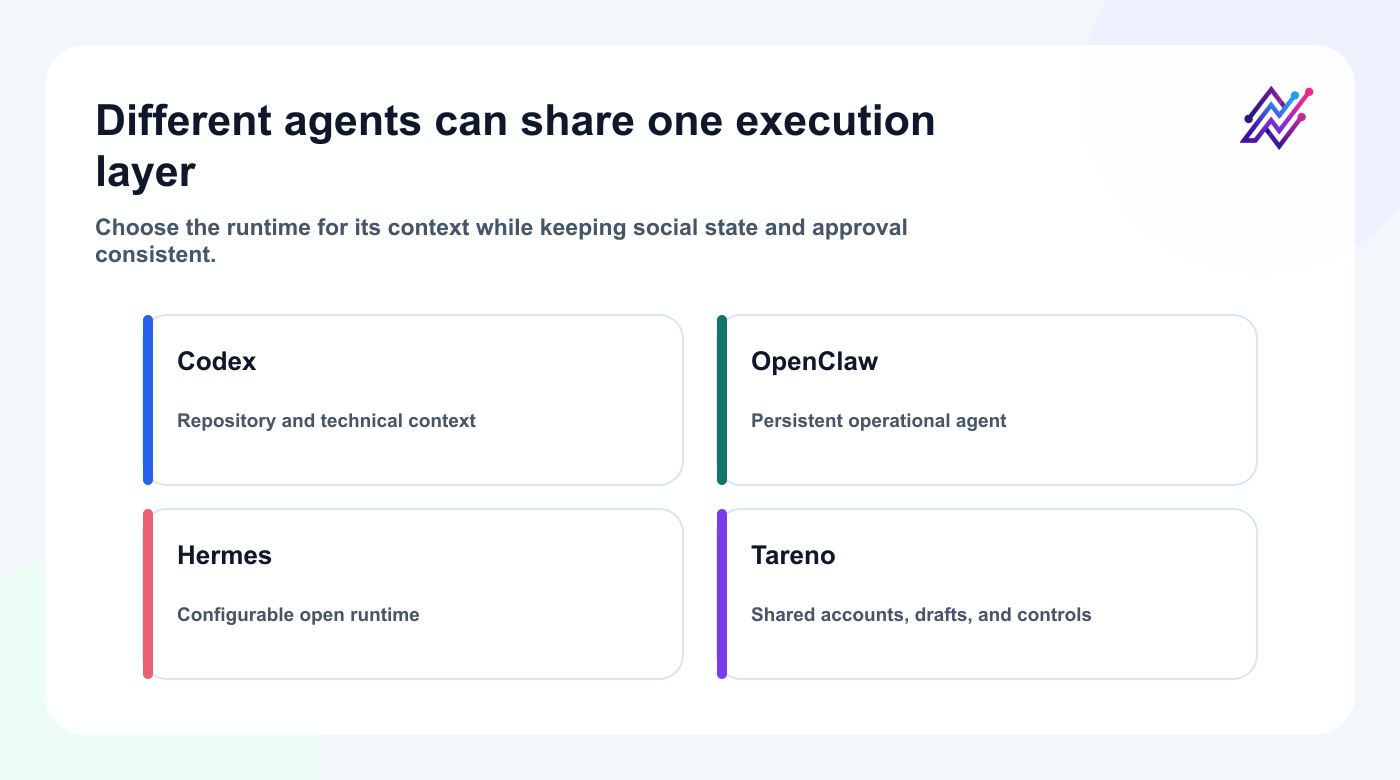
The reasoning client can change while Tareno preserves the same social workflow state.
Prompt:
Review recent account performance, find one underused topic, and create Bluesky and Mastodon drafts with different tone and structure. Save drafts only.
Then:
Prepare the approved drafts for next week and request Tareno approval.
This creates an agent-assisted loop without unrestricted public actions.
Cross-posting vs native adaptation
Cross-posting is efficient when:
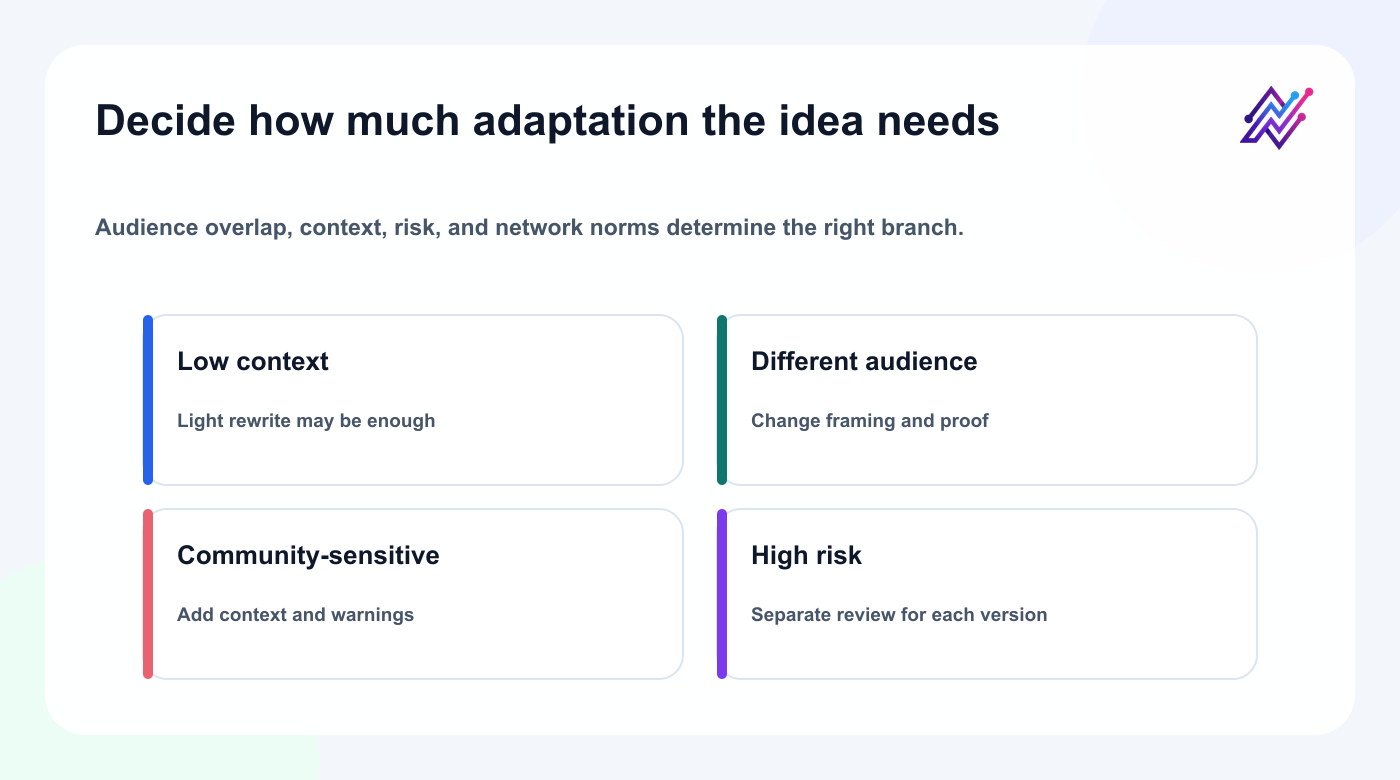
The more context or risk changes by network, the more deliberate the adaptation should be.
the message is simple
the audience overlaps
the content is low-risk
the post is adapted
the timing makes sense
Cross-posting becomes weak when:
the same caption is copied everywhere
the community context is ignored
platform culture is ignored
content warnings are missing
the CTA feels promotional
every network receives the same timing and tone
A better term is:
Cross-platform adaptation.
The idea travels.
The execution changes.
Media and accessibility
For visual posts, review:
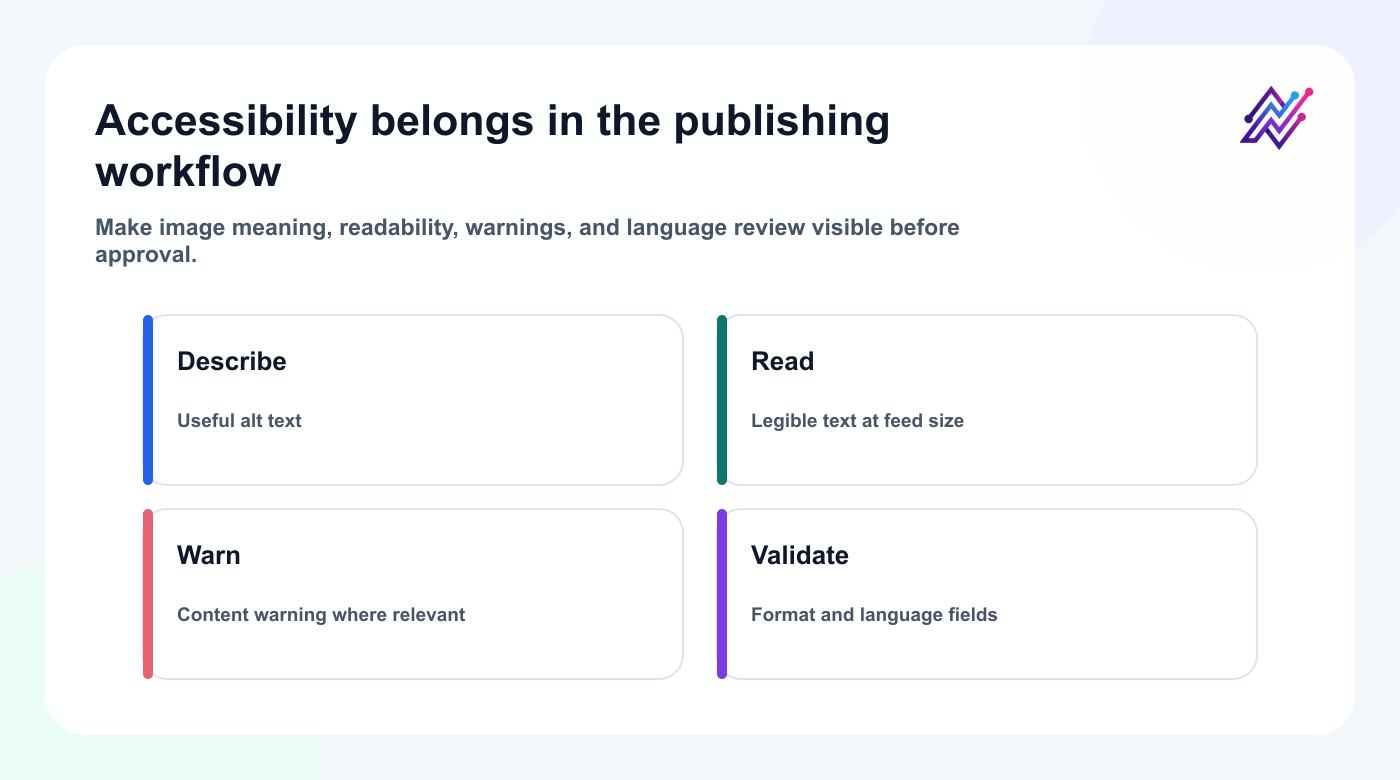
Accessibility checks should be part of the draft state, not a last-minute publishing task.
image dimensions
alt text
file format
thumbnail
link preview
text inside image
readability
copyright
content warning
language
Alt text should describe the meaningful content.
Do not use alt text as another promotional caption.
For multilingual campaigns, localize alt text too.
Measure and improve each network
Analytics: measure each platform separately
Do not combine every metric into one number.
Use platform-level analytics reports to decide what to repeat instead of blending both networks into one score.
Measure:
Bluesky
impressions or reach where available
replies
reposts
likes
link clicks
follows
thread performance
Mastodon
favorites
boosts
replies
link clicks
follower growth
hashtag discovery
community interaction
The available metrics should be verified against the final Tareno integration.
The principle is stable:
Compare against each platform’s own baseline.
A strong Mastodon post may look small compared with LinkedIn reach but create better community engagement.
Analytics-to-repurposing workflow
After seven or fourteen days:
Measure each network against its own baseline before deciding what to repurpose.
retrieve performance
compare with baseline
identify strongest angle
classify result
create next action
Actions:
repeat
expand
repurpose
improve
archive
Example:
Bluesky version:
High replies, low clicks.

Next action:
Create a discussion-oriented follow-up.

Mastodon version:
High boosts and link clicks.

Next action:
Create a longer educational post.
The same source idea can create different next steps.
Operational safeguards and reusable ideas
Content ideas for Bluesky and Mastodon
Use reusable idea categories to keep the source pipeline active without forcing identical posts onto both networks.
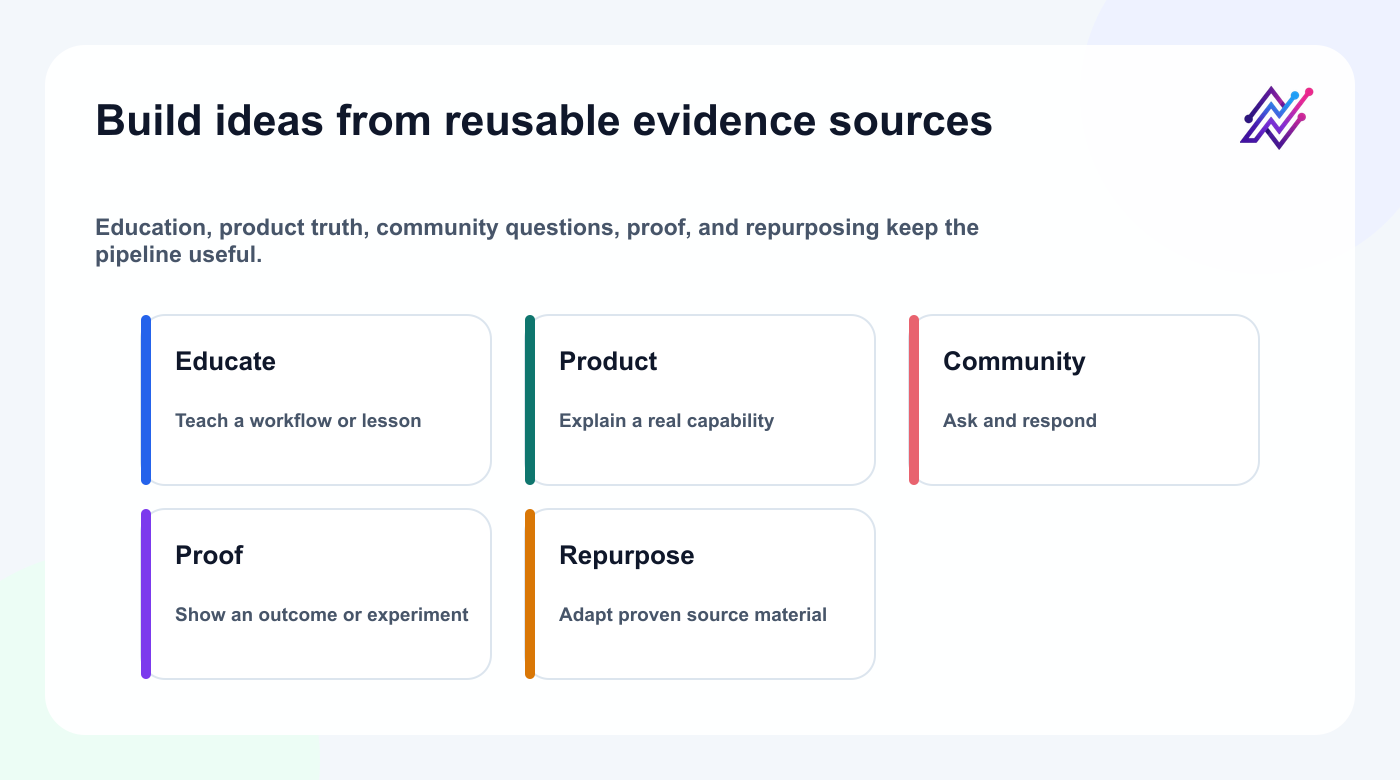
A balanced source pipeline creates variety before network-specific adaptation begins.
Educational
workflow tips
platform-specific lessons
AI-agent safety
content operations
open-network strategy
repurposing methods
Product
feature release
integration walkthrough
use-case example
behind-the-scenes build
API or MCP update
Community
questions
opinions
open-source discussions
creator workflows
federation or protocol topics
Proof
customer outcome
workflow before/after
analytics insight
content experiment
Repurposing
blog takeaway
video transcript insight
product changelog
FAQ
webinar lesson
Multilingual Bluesky and Mastodon workflows
Tareno supports English, German, French, Spanish, Portuguese, Russian, Italian, Japanese, and Arabic content workflows.
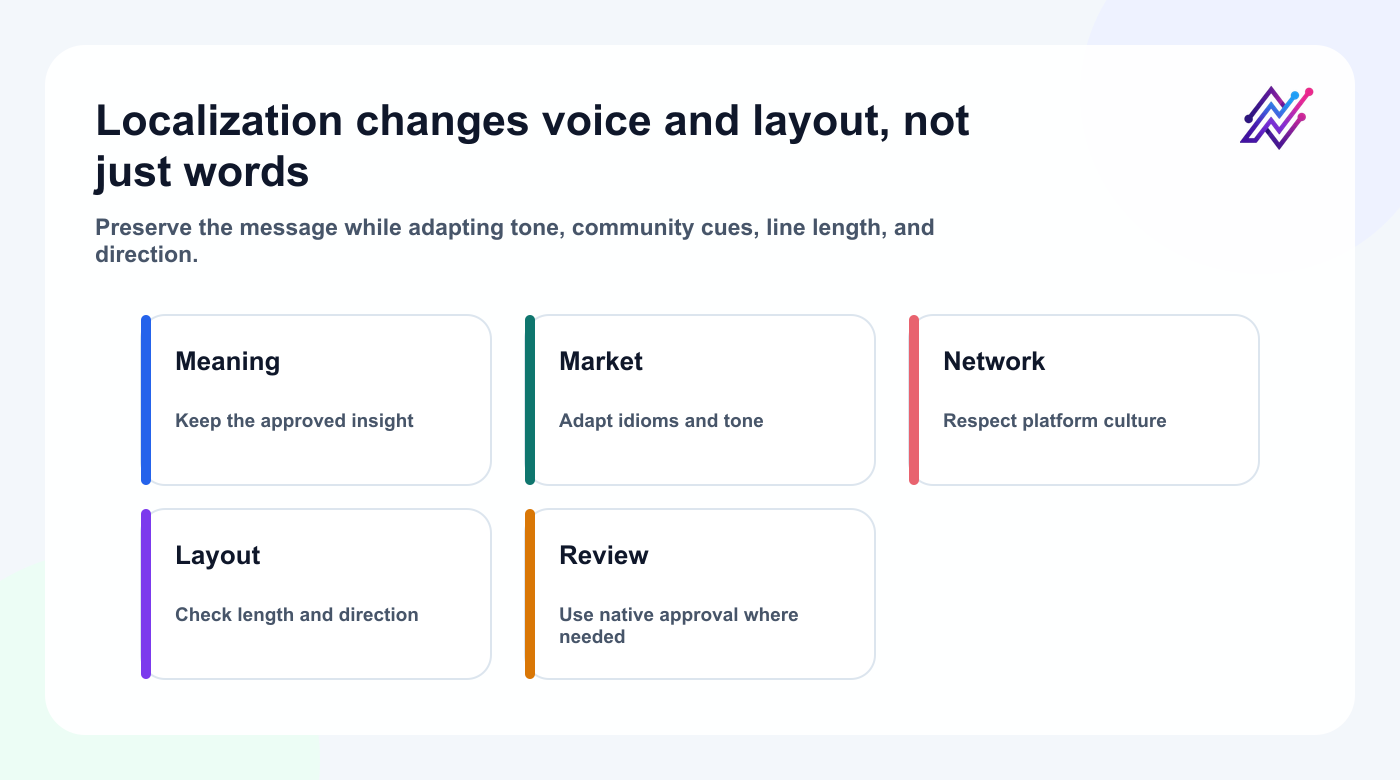
Each language version needs market and network review before it becomes a scheduled post.
Do not create nine literal translations.
Use market-aware versions.
Prompt:
Localize this Bluesky and Mastodon campaign across the supported languages. Keep the core idea consistent. Adapt formality, sentence structure, CTA, and community tone. Flag Japanese and Arabic versions for native review.
For Arabic:
right-to-left design
punctuation
mixed-language names
link placement
tone
For Japanese:
formality
line breaks
concise wording
CTA tone
For Mastodon, community context may matter as much as language.
Duplicate prevention
Track:
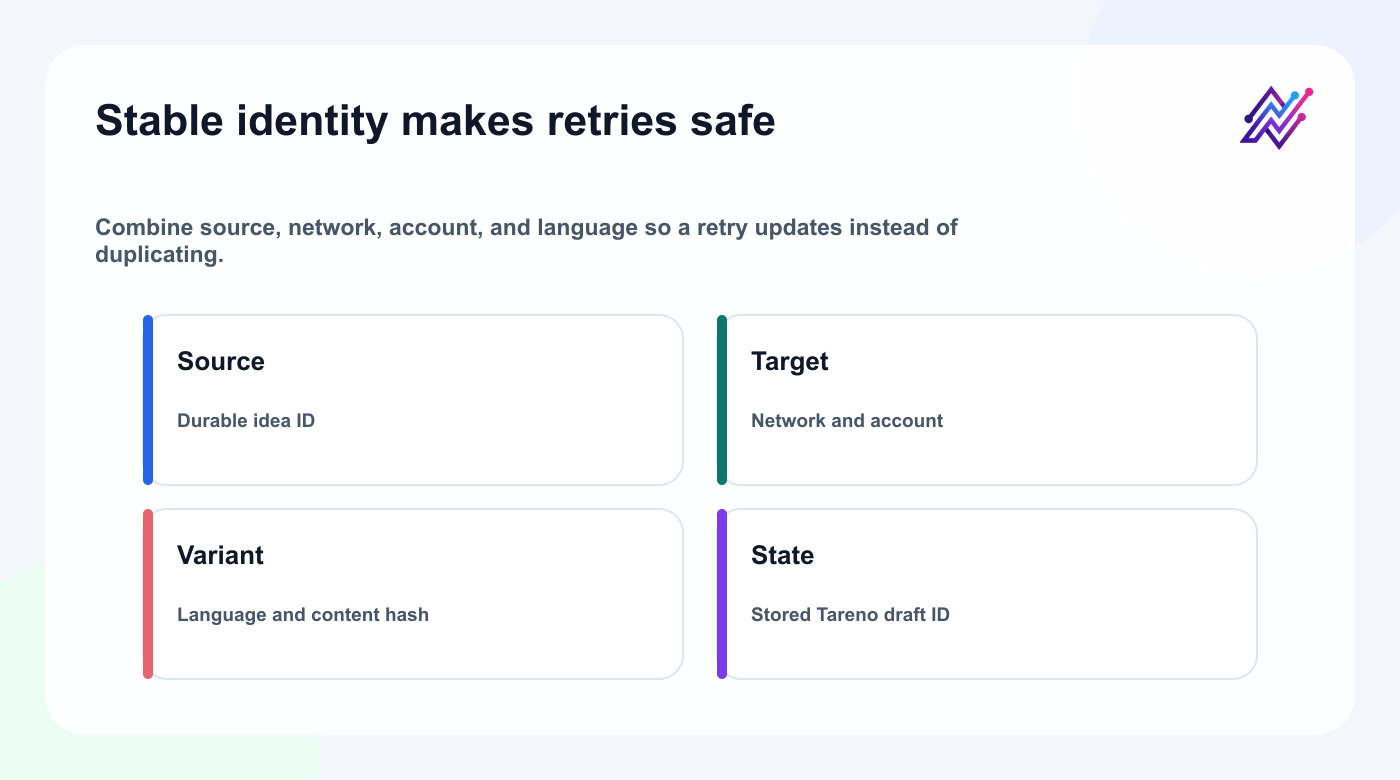
A stable composite key separates a retry from a genuinely new platform draft.
source idea ID
platform
account
language
content hash
Tareno draft ID
publish date
Composite key:
sourceId_platform_account_language
Before creating a new draft:
search existing items
compare content hash
check publish history
confirm status
This prevents automation loops.
Error handling
Handle:
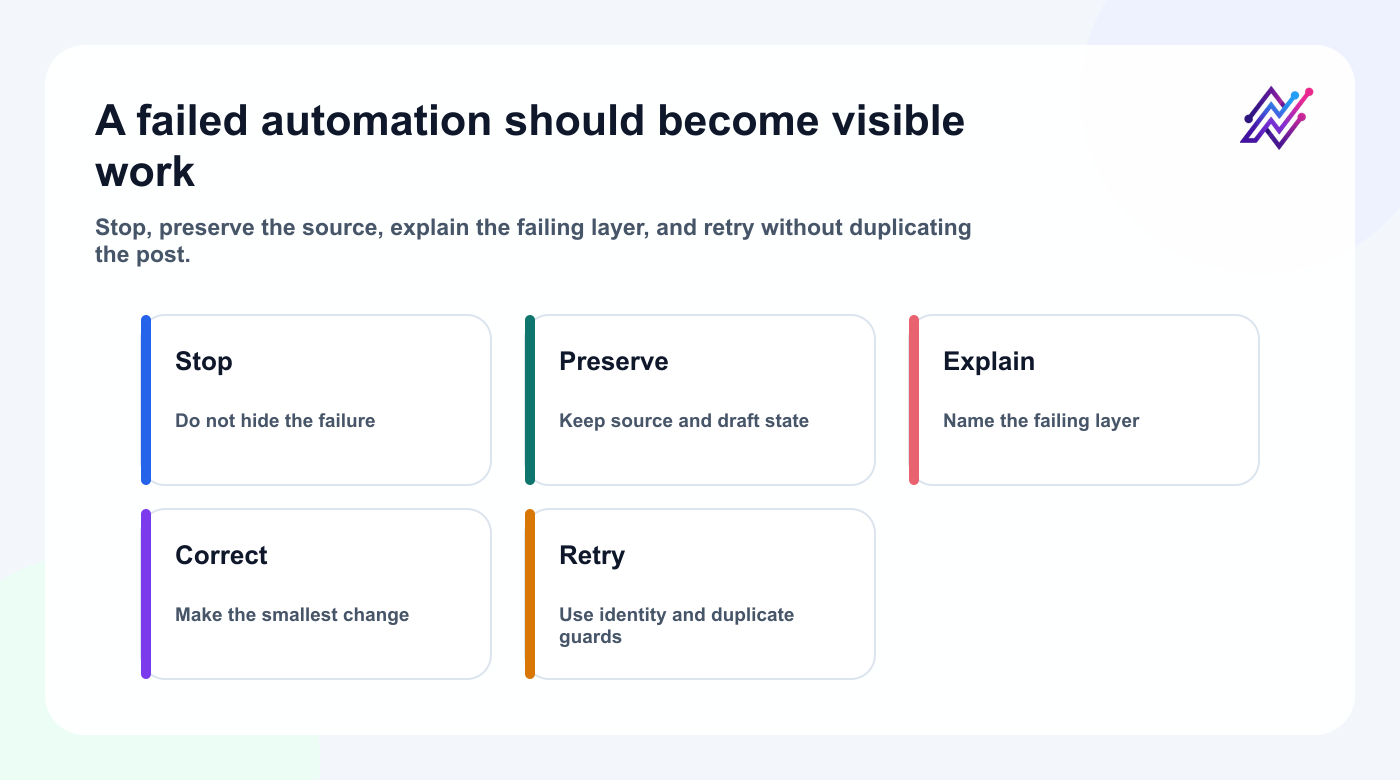
Reliable recovery preserves context and prevents a retry from creating the wrong or duplicate post.
disconnected account
expired token
invalid media
missing platform field
unsupported post type
duplicate request
failed publishing
approval expiration
analytics unavailable
rate limits
Recommended flow:
Validation error -> return to source
Authentication error -> alert owner
Retryable error -> wait and retry
Approval expired -> request new review
Permanent failure -> create incident
Do not silently skip failures.
Security checklist
Protect the workflow with scoped credentials, explicit account targets, draft-first actions, and traceable results.
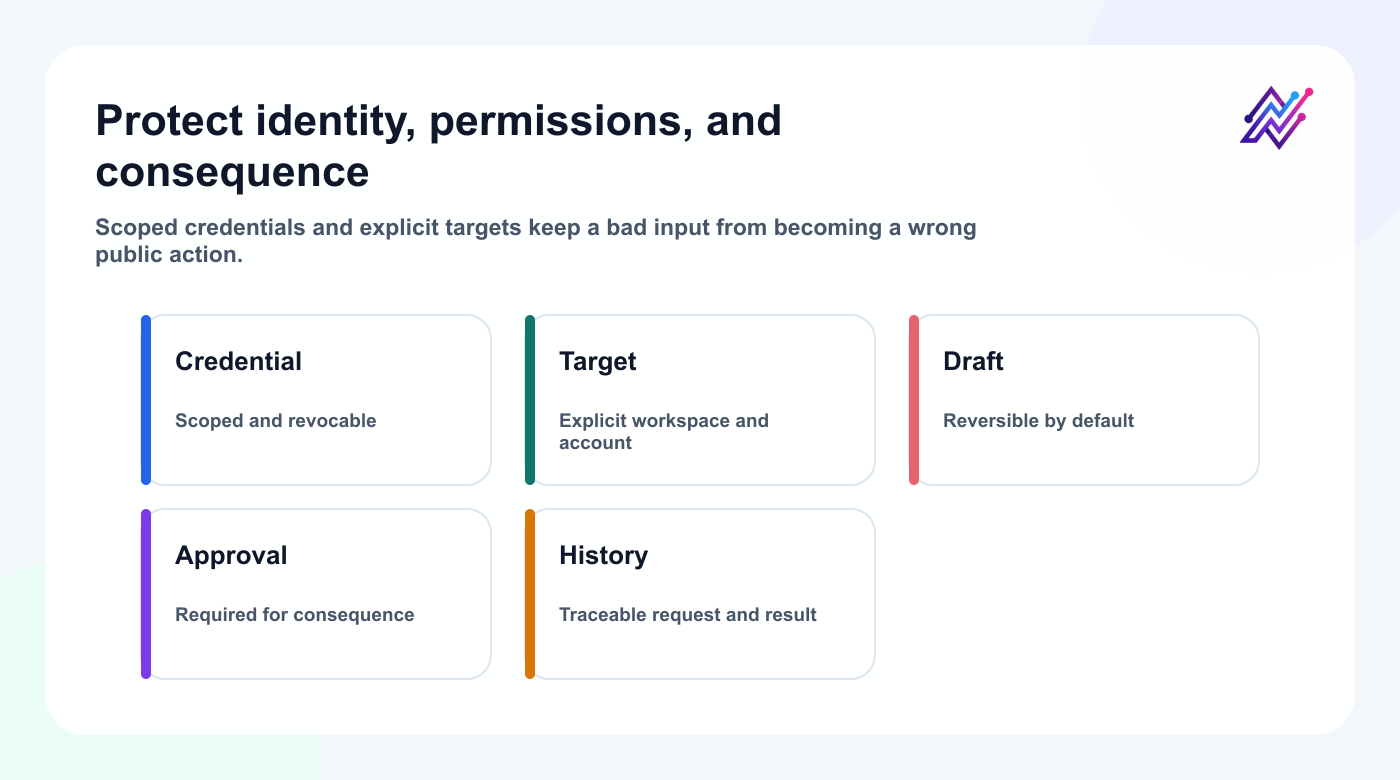
Security lives in enforceable workflow controls, not in a request to be careful.
- [ ] Use scoped Tareno credentials
- [ ] Store secrets securely
- [ ] Use explicit account IDs
- [ ] Separate client workspaces
- [ ] Keep publishing behind approval
- [ ] Keep deletion behind approval
- [ ] Validate media URLs
- [ ] Track Tareno action IDs
- [ ] Prevent duplicates
- [ ] Review automation logs
- [ ] Revoke unused credentials
- [ ] Test on drafts first
Fifteen workflow examples
Name the source, native output, approval rule, and next action.
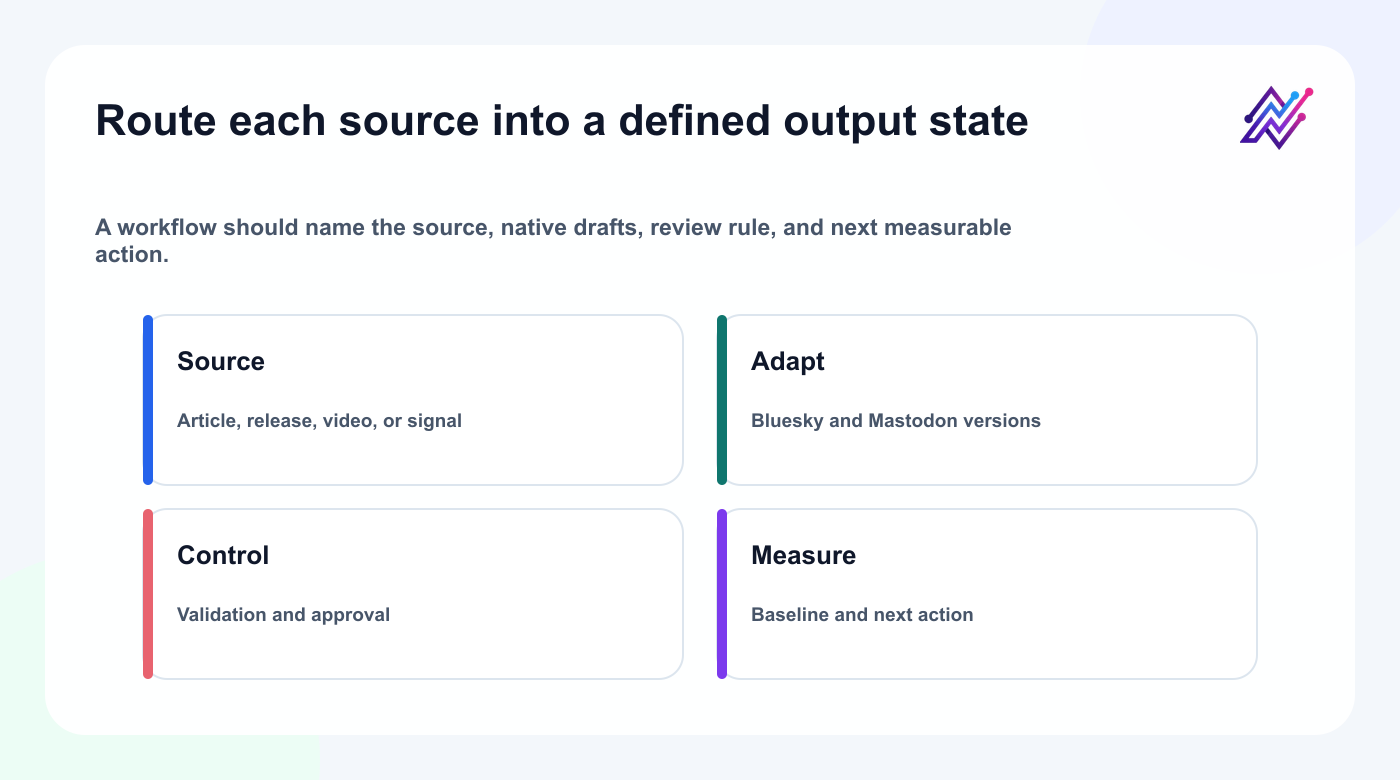
Reusable examples are strongest when the output state and control boundary are explicit.
LinkedIn post → Bluesky and Mastodon drafts
Blog publish → open-network distribution
Product release → platform-native announcement
YouTube transcript → Bluesky thread and Mastodon post
RSS feed → draft queue
Notion approval → Tareno drafts
Airtable row → multi-platform campaign
OpenClaw analysis → Tareno drafts
Hermes Agent plan → approval-first schedule
Codex release notes → product posts
High-performing post → repurposing queue
Multilingual campaign → language branches
Pending approval → Slack reminder
Published post → analytics task
Failed publish → incident workflow
Common mistakes
Mistake 1: Treating both networks as X clones
They have different cultures and workflows.
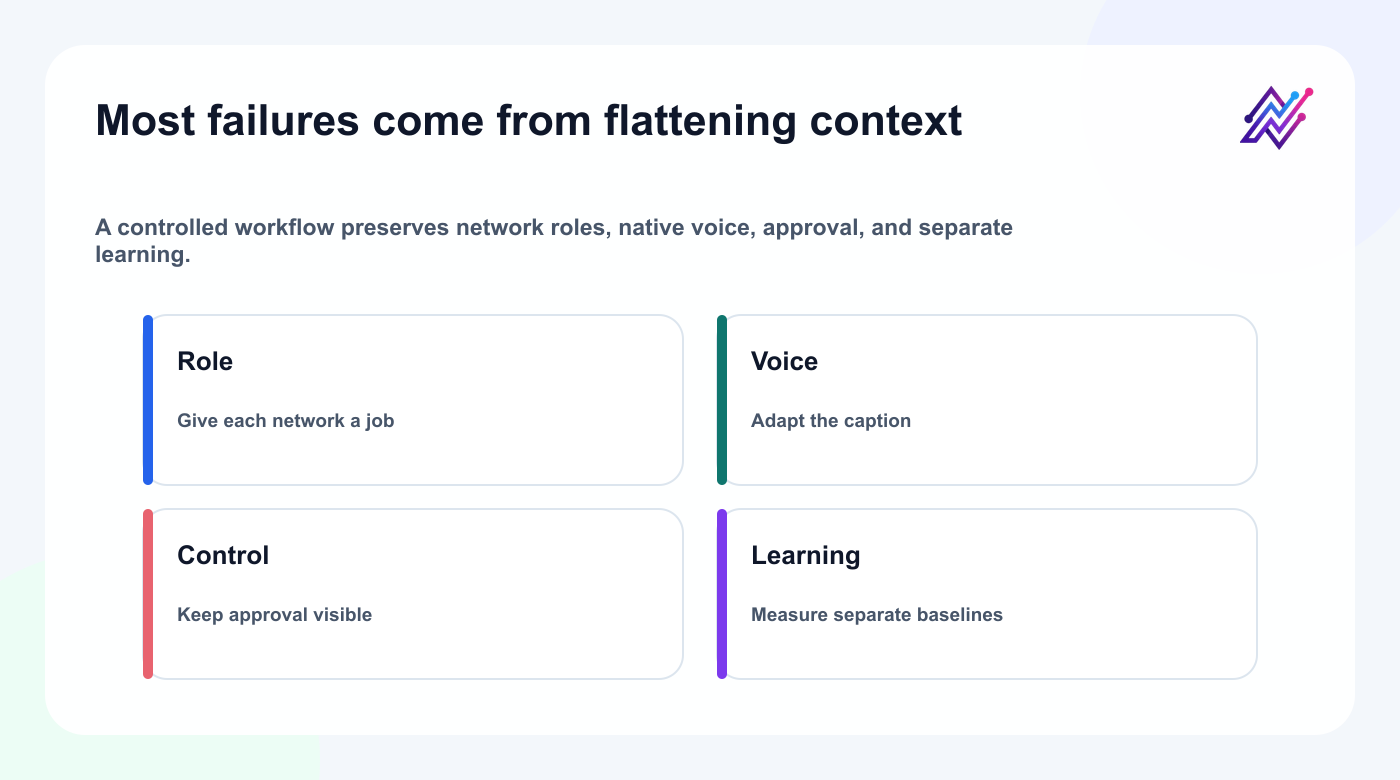
The workflow succeeds when it shares operations without erasing network context.
Mistake 2: Copying the same caption
Adapt the idea.
Mistake 3: Ignoring Mastodon community norms
Context and content warnings can matter.
Mistake 4: Over-promotional language
Both networks often reward useful, human content.
Mistake 5: No approval boundary
Automation should not remove accountability.
Mistake 6: No separate analytics
Each platform needs its own baseline.
Mistake 7: Adding accounts without a strategy
Give each network a role.
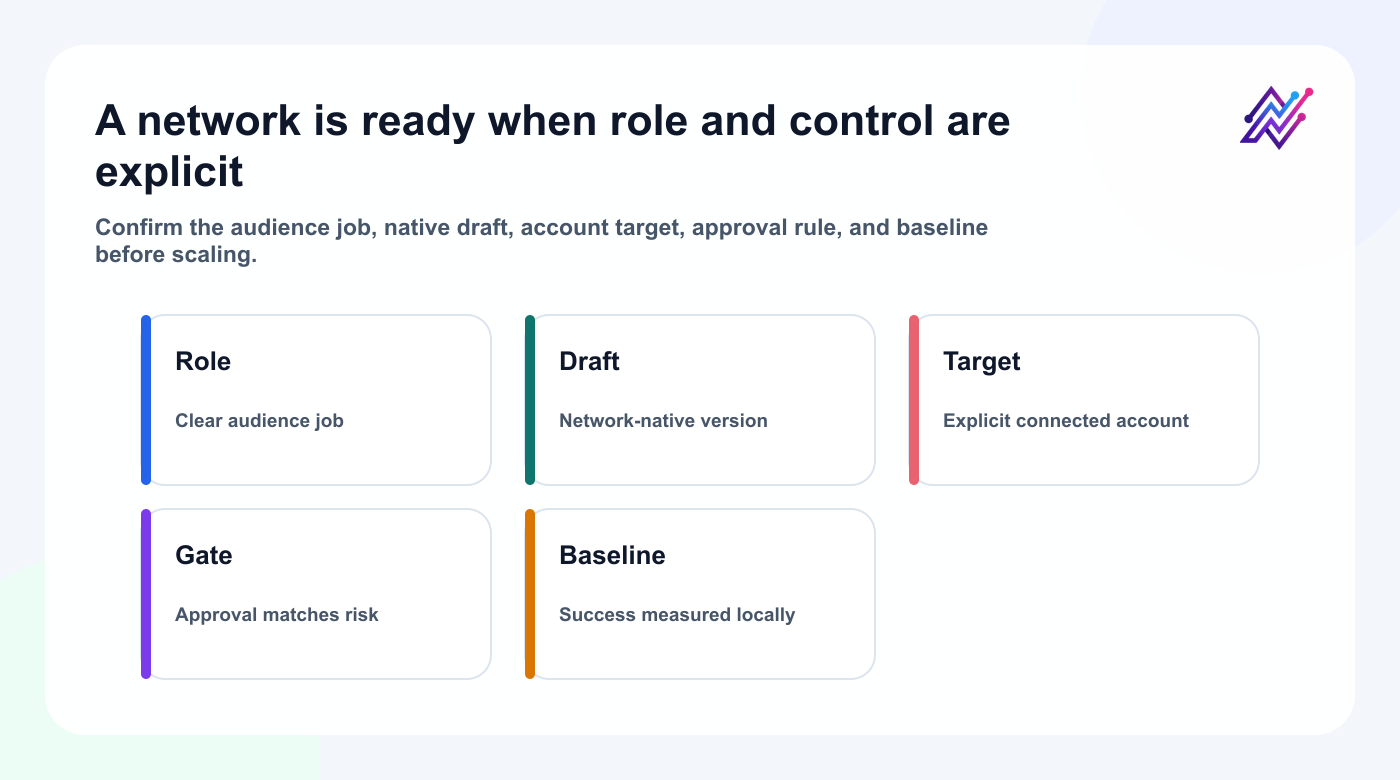
Add volume only after each network has a role, target, review rule, and useful baseline.
Related Tareno resources
Build the next part of this workflow
n8n guideBuild custom platform branches and validation logic.Explore resource →Make guideRoute one approved source into visual scenario branches.Explore resource →MCP guideLet agents prepare work without granting uncontrolled publishing.Explore resource →Repurposing workflowTurn proven posts into the next useful format.Explore resource →
FAQ
Can Tareno schedule Bluesky and Mastodon posts?
Yes. Connect the intended accounts, create separate platform drafts, validate each network’s fields, and keep scheduling behind the appropriate approval rule.
Can I publish the same post to both networks?
Reuse the approved idea, but adapt the hook, context, accessibility fields, hashtags, and CTA to each community.
Final thoughts
Put both networks in one controlled system: share the source, adapt the voice, preserve approval, and connect proven posts to a social media repurposing workflow.