Not every social media post needs the same approval process.
A simple evergreen tip should not require five reviewers.
A pricing claim should not publish without verification.
A client campaign post should not go live without client approval.
An AI-generated competitor comparison should not skip human review.
This is why teams need a social media approval matrix.
An approval matrix defines who reviews which type of content before publishing.
It prevents two opposite problems:
too much approval for low-risk content
too little approval for high-risk content
The goal is not to slow the team down.
The goal is to route content through the right review path based on risk.
Use this template if your team manages social media content for brands, clients, SaaS products, campaigns, sponsors, or multiple stakeholders.
Quick answer: a social media approval matrix should sort content by risk, name the reviewer for each level, and stop scheduling until the approved version is locked.
A social media approval matrix should define approval rules by:
content risk level
platform
topic
client or internal content
product or pricing claims
competitor mentions
sponsor requirements
AI-generated content
legal-sensitive content
repurposed old content
emergency posts
The key rule:
Approval should match the risk of the content.
Low-risk content needs speed.
High-risk content needs control.
Why teams use approval matrices
What is a social media approval matrix?
A social media approval matrix is a table that defines:
what type of content needs review
who reviews it
who gives final approval
whether publishing is blocked until approval
when re-approval is required
what happens if feedback is late
It is more specific than a general approval workflow.
A workflow says:
Draft -> Review -> Approved -> Scheduled
A matrix says:
Pricing claims require product or finance review before final approval.
That specificity prevents mistakes.
Why approval matrices matter
Approval matrices help teams avoid:
unapproved client content
inaccurate product claims
outdated pricing
risky competitor comparisons
sponsor content errors
AI-generated inaccuracies
late feedback
wrong-version publishing
unnecessary approval bottlenecks
inconsistent review decisions
They also help new team members understand what to do.
Instead of asking every time:
Does this need approval?
They can check the matrix.
Build the core approval logic
Step 1: Define risk levels
Start with three risk levels.
A strong matrix keeps low-risk content moving while routing higher-risk posts into deeper review. The point is not more approvals. The point is the right approval path for the claim, asset, audience, and channel involved.
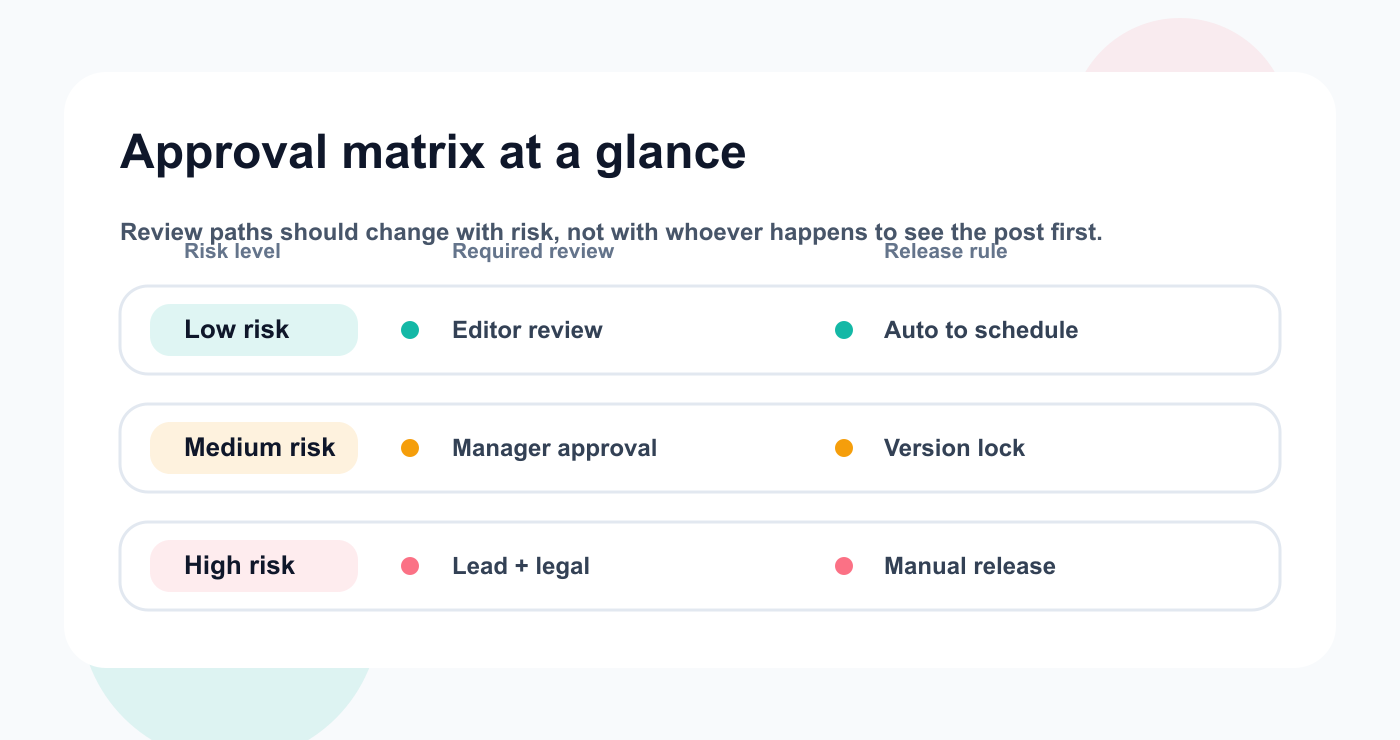
A useful social media approval matrix changes the review path based on content risk, not team guesswork.
A strong matrix keeps low-risk content moving while routing higher-risk posts into deeper review. The point is not more approvals. The point is the right approval path for the claim, asset, audience, and channel involved.
Low risk
Examples:
evergreen tips
simple community questions
generic educational content
non-controversial engagement posts
basic brand awareness content
Approval path:
owner review
optional internal review
Medium risk
Examples:
product education
campaign posts
customer examples
repurposed evergreen content
case study references
platform-specific educational content
Approval path:
internal reviewer
marketing lead or brand approver
High risk
Examples:
pricing claims
product launch claims
competitor comparisons
sponsor posts
client content
legal-sensitive content
crisis communication
AI-generated technical claims
regulated topics
Approval path:
specialist review
final approver
publish gate
This simple risk model is enough for most teams.
Step 2: Define roles
List the people or roles involved.
Common roles:
content owner
copywriter
designer
social media manager
brand reviewer
product reviewer
legal reviewer
client approver
sponsor approver
founder
publisher
analyst
Each role should have a clear responsibility.
The final approver should be explicit.
Avoid “everyone must approve” unless absolutely necessary.
That usually creates delays.
Step 3: Build the approval matrix
Use this template.
Content typeRiskReviewerFinal approverPublish gateRe-approval needed?Evergreen tipLowOwnerNone or social leadNoNoProduct educationMediumProduct reviewerMarketing leadYesIf claim changesPricing mentionHighProduct/financeMarketing leadYesYesCompetitor comparisonHighStrategy/productFounder/leadYesYesClient postHighAccount managerClientYesIf final version changesSponsor postHighAccount managerSponsor/clientYesYesAI-generated captionMediumHuman editorSocial leadSometimesIf claim changesCrisis responseHighLeadership/legalLeadershipYesYesRepurposed old postMedium/HighOwnerDepends on riskDependsIf outdated
Adjust this based on your team.
The matrix should be simple enough to use daily.
Step 4: Add platform rules
Some platforms may need extra review.
Examples:
LinkedIn posts with founder opinions may need executive review.
TikTok videos with product claims may need product review.
Instagram sponsor posts may need sponsor approval.
Pinterest pins with pricing may need pricing verification.
YouTube descriptions may need link and claim checks.
Threads posts may move fast but still need approval for high-risk claims.
Platform rule template:
PlatformExtra ruleLinkedInProduct or thought-leadership claims need reviewTikTokProduct demos need claim checkInstagramSponsor posts need client/sponsor approvalPinterestEvergreen pins with old claims need freshness reviewYouTube ShortsDescription links and claims need checkThreadsOpinions about competitors need review
Platform context matters.
Add policy rules before publishing
Step 5: Define re-approval rules
Many approval problems happen after approval.
A client approves the post.
Then someone changes the CTA.
Or the designer replaces the asset.
Or the social manager adapts the caption for another platform.
Does that need re-approval?
Define the rule.
Re-approval is required when:
claim changes
pricing changes
CTA changes materially
asset changes materially
platform version changes risk level
client/sponsor content is adapted
competitor mention is added
old content is repurposed with new context
Re-approval is usually not required for typo fixes, formatting cleanup, minor punctuation, platform-safe hashtag changes, or image compression changes.
This prevents unnecessary delays.
Step 6: Define late-feedback rules
Late approvals break calendars.
Define what happens when feedback is late.
Options:
Auto-delay
If approval is not received by the deadline, the post moves to the next available slot.
Replace with pre-approved content
Low-risk evergreen content fills the calendar gap.
Escalate
The account manager or internal owner contacts the approver.
Emergency approver
A backup approver can approve urgent content.
Add the rule to the matrix.
Step 7: Add AI content rules
AI-generated content needs special handling.
AI can create captions, hooks, hashtags, scripts, carousel outlines, platform rewrites, and repurposing drafts.
But AI output is not approved content.
AI approval rules:
AI content typeRiskRequired reviewGeneric caption draftLow/MediumHuman editorPlatform rewriteMediumHuman editorProduct claimHighProduct reviewerCompetitor comparisonHighStrategy/product reviewerPricing mentionHighProduct/finance reviewerClient contentHighClient approvalSponsor contentHighSponsor/client approval
This keeps AI useful but controlled.
Step 8: Add repurposing rules
Repurposed content may need review.
Old posts can become outdated.
Repurposing approval rules:
low-risk evergreen post -> light review
old product claim -> product review
pricing post -> pricing verification
competitor post -> strategy review
sponsor post -> sponsor/client review
client post -> client approval if adapted
old screenshot -> UI freshness review
old offer -> archive or update
Repurposing should not bypass approval.
It should follow the current risk level, not the original one.
Connect approval to execution
Step 9: Connect approval to scheduling
Approval should be a scheduling gate.
Scheduling is where approval rules become real. If the wrong version reaches the queue, the matrix failed even if people technically reviewed the post earlier.
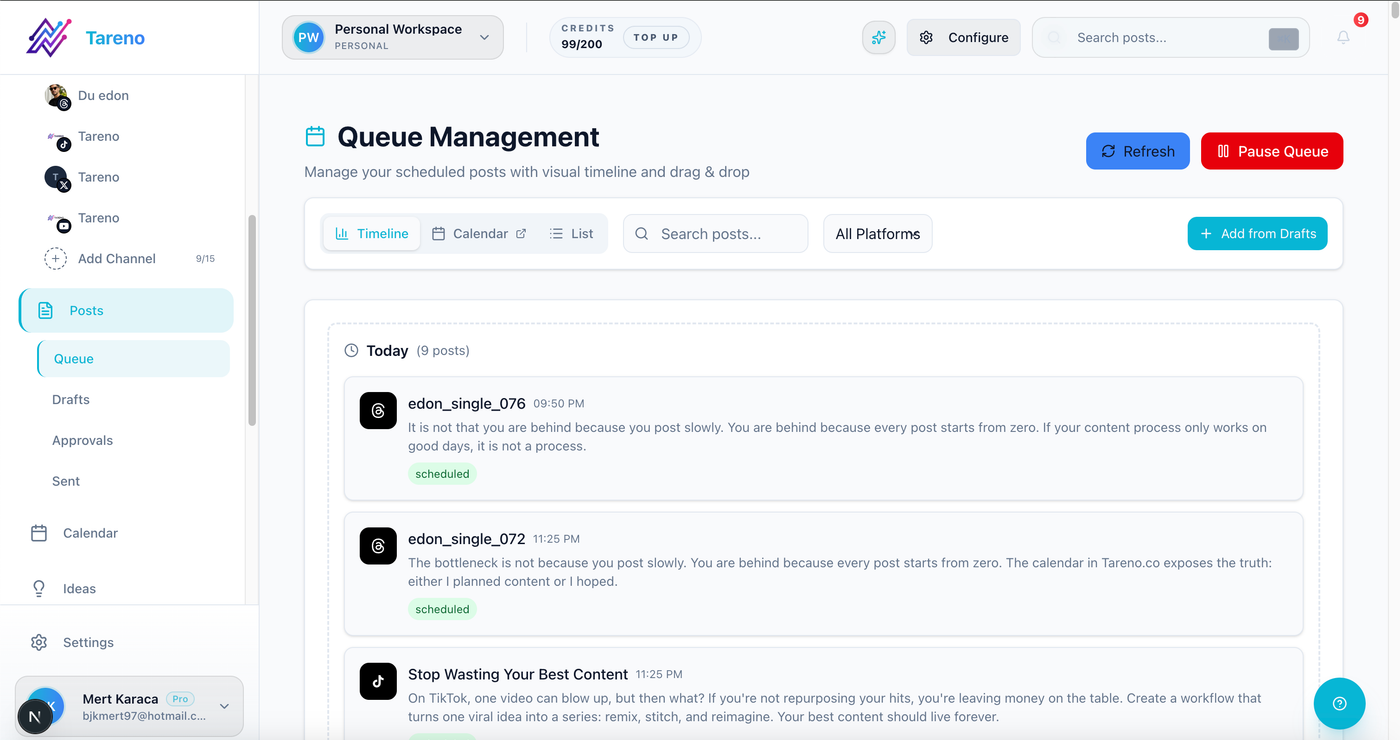
Approval should gate the exact version that reaches the queue, not just the idea of the post.
Scheduling is where approval rules become real. If the wrong version reaches the queue, the matrix failed even if people technically reviewed the post earlier.
The rule:
High-risk content cannot be scheduled as final until approved.
A good approval workflow should show:
current version
reviewer
final approver
approval status
requested changes
approval timestamp
scheduling status
This avoids wrong-version publishing.
Step 10: Add activity visibility
Track who did what.
Visibility matters because most approval delays come from uncertainty, not from policy itself. Teams move faster when everyone can see who is blocking release and what changed since the last review.

Activity visibility works when the team can see blocked drafts, owners, and review state in one place.
Visibility matters because most approval delays come from uncertainty, not from policy itself. Teams move faster when everyone can see who is blocking release and what changed since the last review.
Activity history should show:
who created the post
who edited it
who requested changes
who approved it
who scheduled it
who changed the publish date
who published it
This helps resolve mistakes.
It also makes the approval matrix enforceable.
Example approval matrices
Agency matrix
Content typeReviewerFinal approverEvergreen client contentAccount managerClient if requiredCampaign postAccount managerClientSponsor contentAccount managerSponsor/clientCrisis postLeadershipClient leadershipRepurposed client contentAccount managerClient if adapted
SaaS matrix
Content typeReviewerFinal approverProduct tipProduct reviewerMarketing leadFeature launchProduct + marketingFounder/leadPricing mentionFinance/productMarketing leadCompetitor comparisonStrategy/productFounder/leadSupport FAQ postSupport/productMarketing lead
Creator team matrix
Content typeReviewerFinal approverDaily postCreatorCreatorSponsored postAssistant/managerSponsorRepurposed postCreatorCreatorControversial opinionCreator/managerCreatorAI-generated scriptCreatorCreator
How Tareno fits approval matrices because it connects visible review states, scheduling rules, and workflow triggers in one operating layer. Teams can pair approval policies with a workflow builder instead of rewriting the same reminders every week. because it connects visible review states, scheduling rules, and workflow triggers in one operating layer. Teams can pair approval policies with a workflow builder instead of rewriting the same reminders every week.
Tareno is useful when approval rules need to live inside the workflow.
Tareno is most useful here when the matrix becomes operational: drafts, status changes, workflow triggers, and release rules stay attached to the same content object instead of being rebuilt in separate tools.
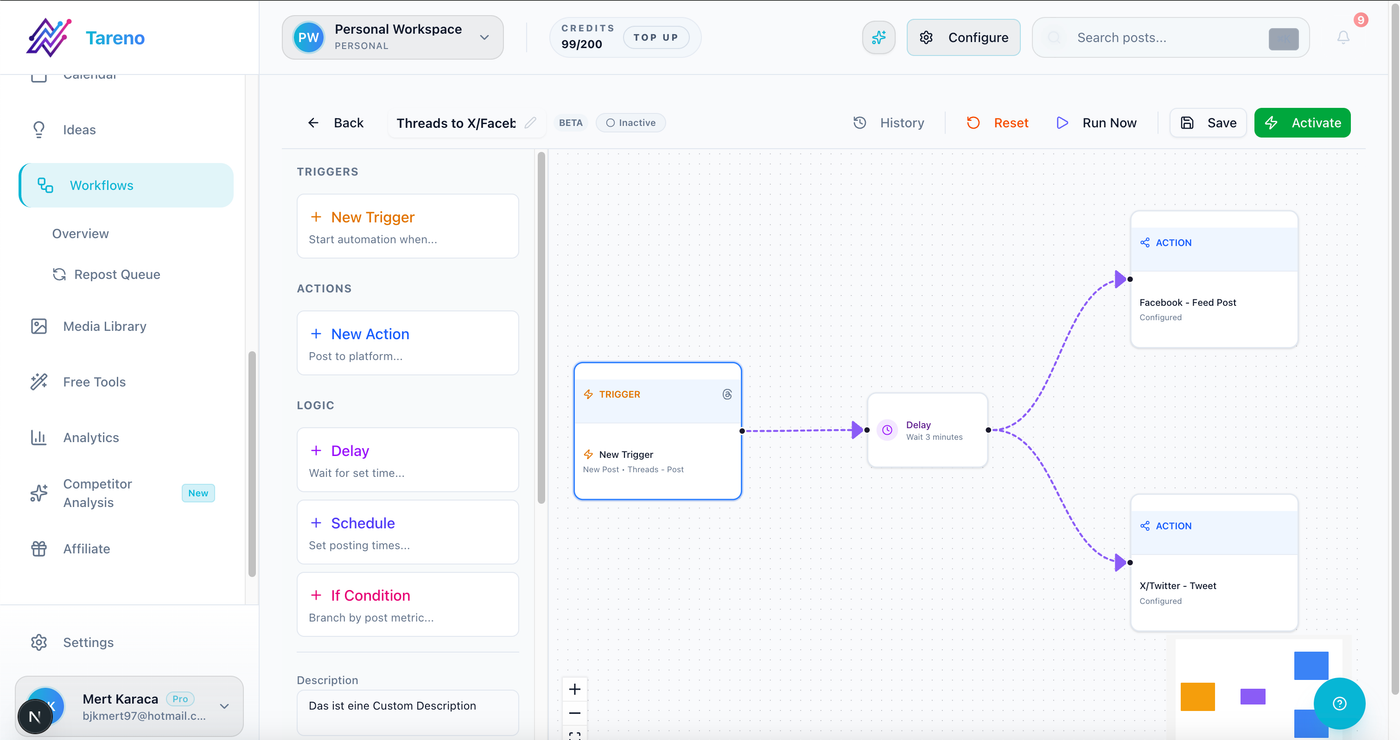
A workflow layer turns approval policy into repeatable execution instead of a checklist people forget.
Tareno is most useful here when the matrix becomes operational: drafts, status changes, workflow triggers, and release rules stay attached to the same content object instead of being rebuilt in separate tools.
Relevant Tareno components include:
approval workflows
roles and permissions
content boards
content calendar
activity visibility
team workspaces
client workspaces
workflow builder
repurposing queue
AI captions and hashtags
analytics
Make integration
n8n integration
API access
This matters because approval matrices are not useful if they only live in a document.
The rules should affect how content moves.
Example:
High-risk post -> product review -> final approval -> scheduling gate -> publish -> report
Copy/paste approval matrix
## Social Media Approval Matrix

### Risk Levels

Low-risk:
- Examples:
- Reviewer:
- Final approver:
- Publish gate:

Medium-risk:
- Examples:
- Reviewer:
- Final approver:
- Publish gate:

High-risk:
- Examples:
- Reviewer:
- Final approver:
- Publish gate:

### Special Rules

Pricing claims:
- Reviewer:
- Final approver:
- Re-approval needed:

Product claims:
- Reviewer:
- Final approver:
- Re-approval needed:

Competitor content:
- Reviewer:
- Final approver:
- Re-approval needed:

Client/sponsor content:
- Reviewer:
- Final approver:
- Re-approval needed:

AI-generated content:
- Reviewer:
- Final approver:
- Re-approval needed:

Repurposed content:
- Reviewer:
- Final approver:
- Re-approval needed:
Common approval matrix mistakes
Mistake 1: Every post needs the same approval
This slows teams down.
Mistake 2: No final approver
Without one final approver, decisions become unclear.
Mistake 3: Approval is not version-specific
Approval should apply to the final version.
Mistake 4: Repurposed content skips review
Old content may be outdated.
Mistake 5: AI content has no rule
AI drafts need human review.
Mistake 6: Approval does not block scheduling
High-risk content should not publish without final approval.
Related Tareno resources
Use the article as a working system
Feature Approval Workflows See how approval states, reviewers, and publishing gates can stay visible inside one workflow. Open feature -> Solution Approval Workflow Software Map your approval policy into a repeatable system instead of scattered comments and DMs. See solution -> Feature Post Scheduling Connect final approval to the exact version that moves into the calendar or queue. View scheduling -> Workflow Repurposing Workflow Build re-approval rules for recycled winners before they go live again. Open workflow ->
FAQ
What is a social media approval matrix?
A social media approval matrix defines who reviews and approves different types of social media content before publishing.
Why do teams need an approval matrix?
Teams need approval matrices to prevent risky content from publishing without review while avoiding unnecessary approval bottlenecks for low-risk content.
What social media content needs extra approval?
Pricing claims, product claims, competitor comparisons, sponsor posts, client content, legal-sensitive topics, crisis posts, AI-generated high-risk content, and repurposed outdated content usually need extra approval.
Should AI-generated social posts be approved?
Yes. AI-generated content should be reviewed by a human before publishing, especially if it includes claims, pricing, competitors, clients, or sponsors.
Does repurposed content need approval?
Sometimes. Low-risk evergreen content may only need light review, but old content with claims, pricing, screenshots, sponsors, clients, or competitors should be re-approved.
How do approval matrices connect to scheduling?
High-risk content should not move to final scheduling until the required reviewer or approver has approved the exact version being published.
Final thoughts
A social media approval matrix helps teams move faster and safer.
It gives low-risk content a lightweight path.
It gives high-risk content the control it needs.
The goal is not to add approval everywhere.
The goal is to add the right approval at the right time.
Define risk levels.
Assign reviewers.
Set final approvers.
Add re-approval rules.
Connect approval to scheduling.
That is how teams prevent mistakes without slowing every post.
Primary CTA: Explore Tareno features to see how approvals, roles, boards, calendar, activity visibility, repurposing queue, AI captions, workflow builder, Make, n8n, and API support a practical approval matrix.
Secondary CTA: Compare Tareno with approval-focused social media tools on the compare hub.