An AI social media agent should do more than write captions. It should understand a goal, inspect the correct workspace, prepare platform-native drafts, request approval for consequential actions, and learn from performance.
The design challenge is control: a wrong assumption can become a wrong-account post, an unsupported claim, or an unwanted deletion. The useful target is not maximum autonomy but useful autonomy with visible control.
Tareno supplies the social operating layer—accounts, drafts, media, approvals, scheduling, analytics, and repurposing—while the agent handles planning and adaptation.
TL;DR
A practical AI social media agent should follow this loop:
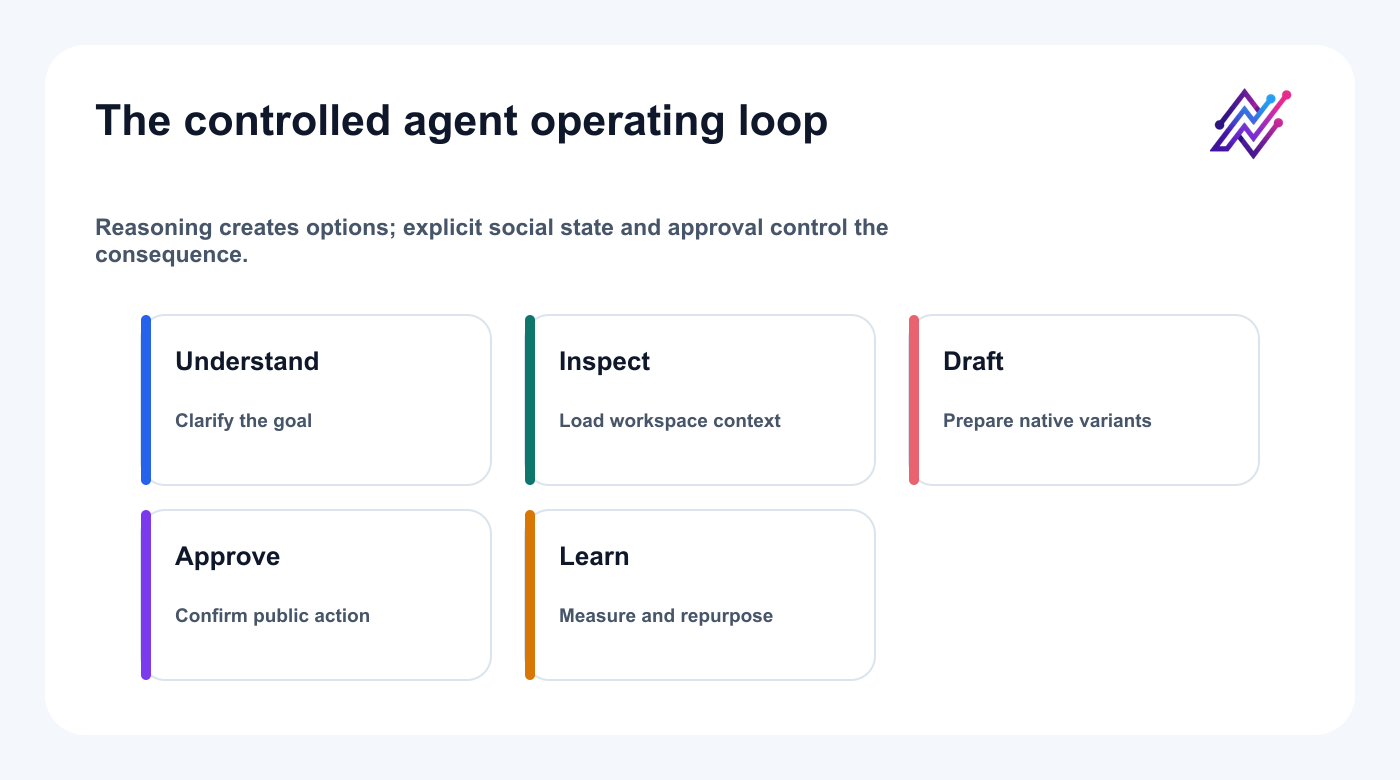
A useful agent can reason broadly while public actions remain explicit and reviewable.
understand the user’s goal
inspect the correct workspace and accounts
load platform requirements
gather relevant content and analytics
propose a plan
create drafts
classify risk
request approval for consequential actions
publish through Tareno
measure the result
create repurposing tasks
update the agent’s working context
The central rule is:
Let the agent decide how to help, but do not let it silently decide what becomes public.
A draft can be aggressive.
A plan can be experimental.
A public action should be reviewable.
What is an AI social media agent?
An AI social media agent can inspect context, choose narrow tools, create reversible work, check state, and stop for approval. Coordinating those steps around a goal—rather than returning one block of copy—is what makes the workflow agentic.
The five layers of the system
A reliable design separates five layers.
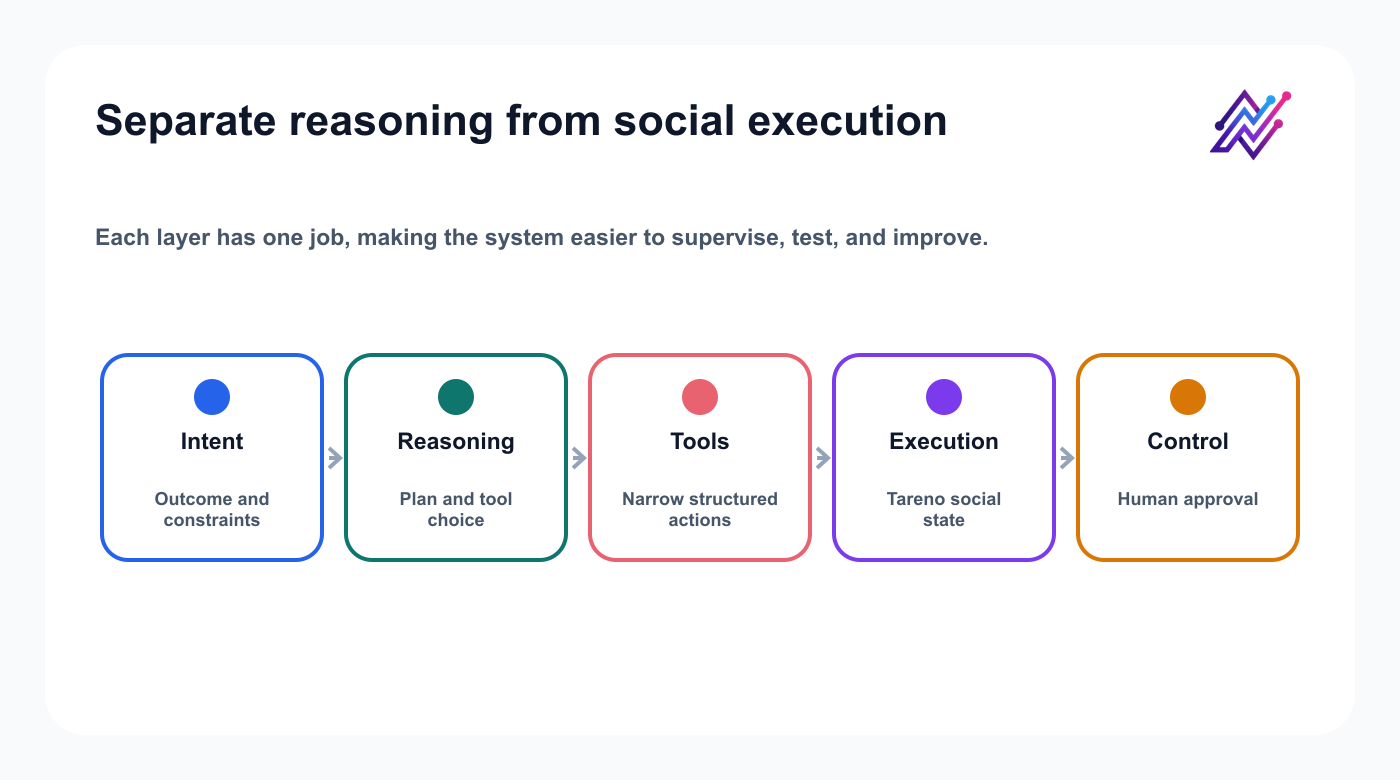
A layered design prevents one model prompt from owning every responsibility.
How the layers work together
User intent defines the outcome and constraints. Agent reasoning chooses the plan and safe next step. A narrow tool interface exposes validated actions. Tareno execution owns workspaces, drafts, approvals, publishing state, and analytics. Human control confirms the account, copy, media, timing, claims, and public consequence.
Keeping these responsibilities separate makes the system easier to test, supervise, and change without placing every rule inside one model prompt.
Agent maturity model
Use five levels.
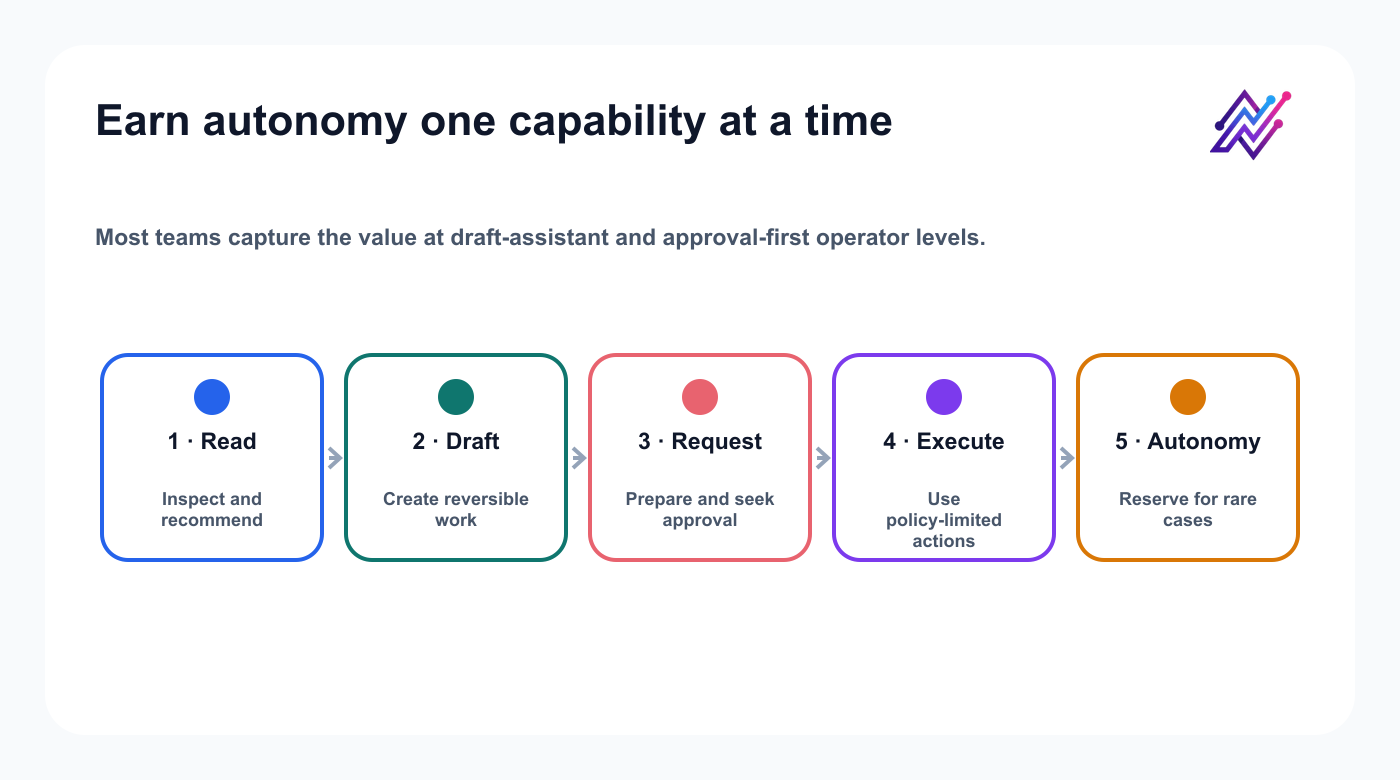
Progressive capability makes each expansion a deliberate operational decision.
Level 1: Read-only analyst
Can:
list accounts
read analytics
inspect drafts
review action status
make recommendations
Cannot:
create or change content
Level 2: Draft assistant
Can:
create drafts
generate variations
add internal notes
propose schedules
Cannot:
schedule or publish
Level 3: Approval-first operator
Can:
create drafts
prepare schedules
request approval
monitor status
Cannot:
execute consequential actions without approval
Level 4: Policy-limited operator
Can execute selected low-risk actions under predefined rules.
Example:
prepare recurring evergreen schedules that still enter dashboard approval
create drafts from an approved RSS feed
adapt a post to Bluesky and Mastodon
Level 5: Broad autonomy
Can make many external changes independently.
This level should be rare.
Most creators and teams gain substantial value at Levels 2 and 3.
The agent tool set
A good tool surface is narrow and explicit.
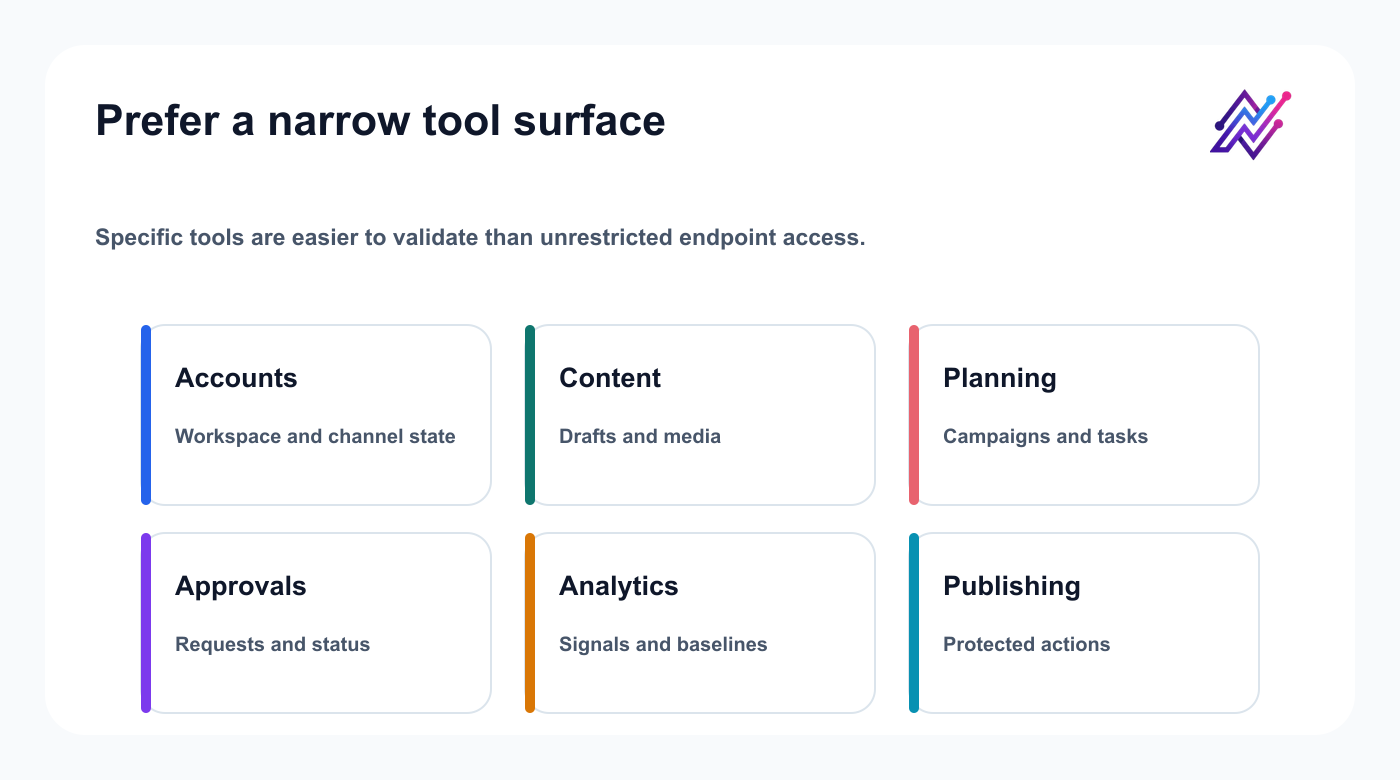
A smaller tool surface improves validation, permissions, and failure handling.
Cover the operating surface without exposing everything
The tool set should cover account inspection, draft and media operations, planning, approval status, publishing requests, and analytics. Each tool should name its target and validate its payload.
Classify operations by consequence: reads can usually run directly; drafts and notes are reversible; scheduling, publishing, deletion, and account changes normally require approval. Enforce that distinction in the backend or workflow, not only in the prompt.
Connect the agent through MCP
The Tareno MCP guide is useful because the agent can discover structured tools while Tareno keeps account ownership, scopes, and approval rules on the server.
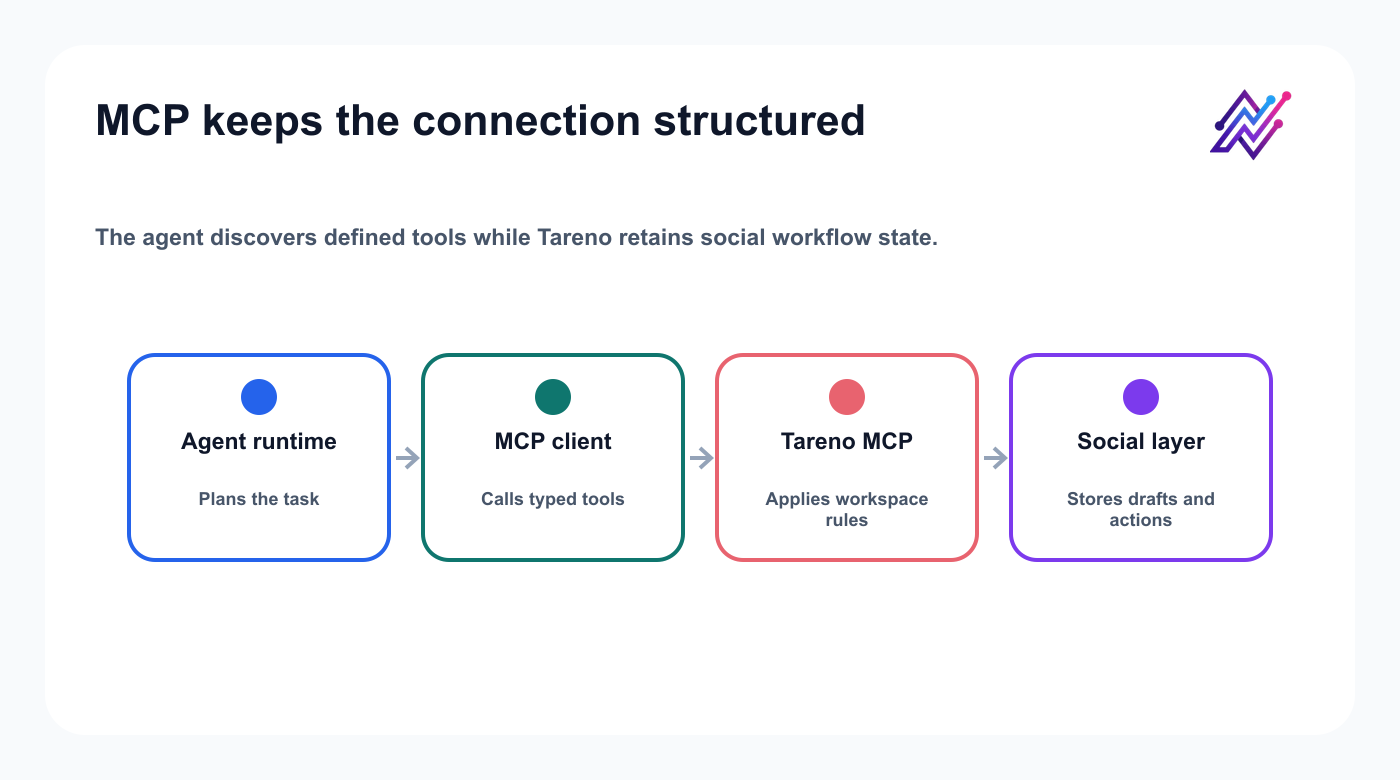
MCP separates agent reasoning from the system that owns social state and permissions.
Architecture:
Agent runtime
↓
MCP client
↓
Tareno MCP server
↓
Tareno social layer
Benefits:
standardized tool discovery
reusable connection across agents
structured schemas
clearer tool descriptions
easier client compatibility
less custom glue per agent
The current Tareno setup guide provides tested Streamable HTTP configuration for Codex, Claude Code, and Cursor. A saved client entry is only configuration; verify the deployed route and confirm that the client can discover the current live tool catalog with a real scoped key before assigning work. Record the probe output used for the run so later catalog changes remain auditable.
Other Streamable HTTP clients may work with the same endpoint, but treat them as custom integrations until authentication and tool discovery pass. ChatGPT is outside the current static-Bearer setup and requires the later OAuth flow described in the live guide.
Connect through the API
Use the Tareno API when building:
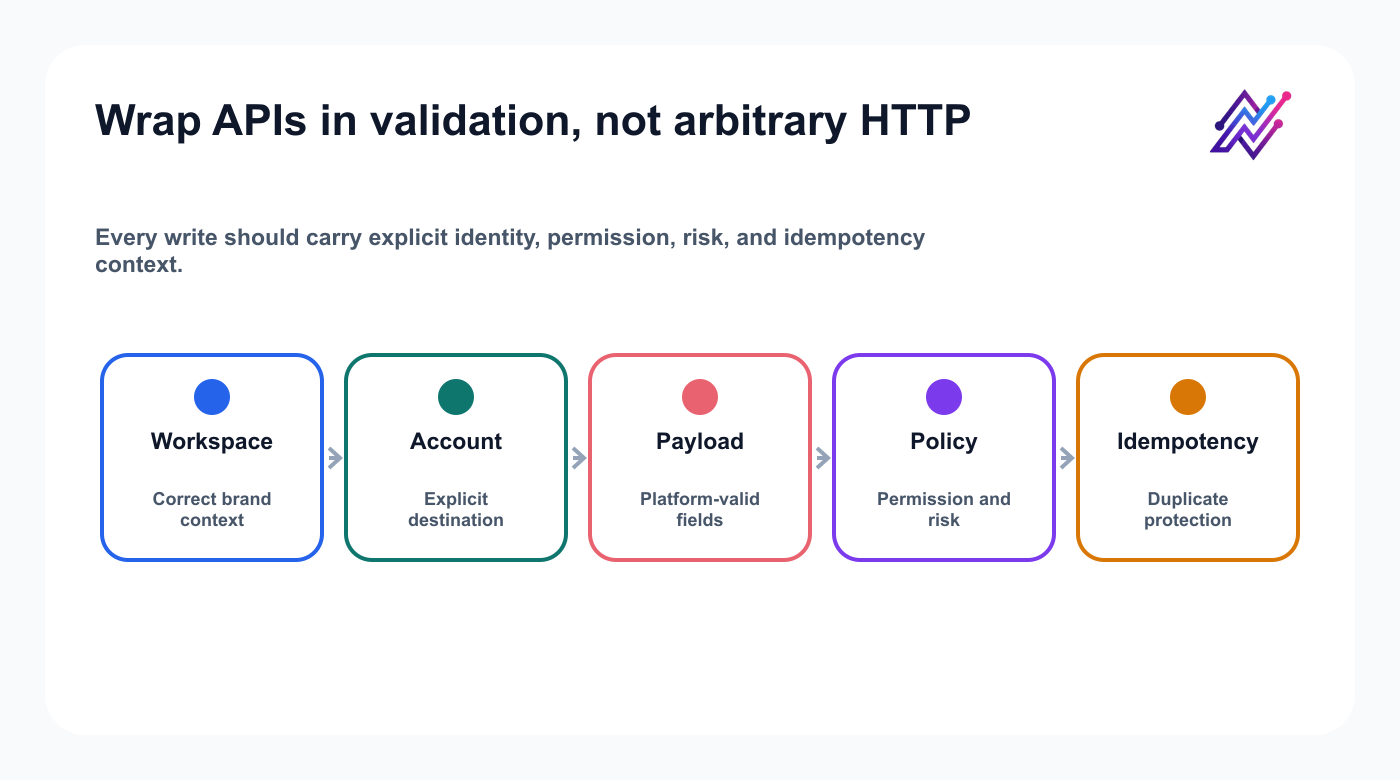
A narrow wrapper turns general model output into explicit, validated social operations.
Use narrow API wrappers for custom backends, assistants, or agent runtimes. Validate workspace, account, platform, payload, permission, risk, and idempotency before any write.
Define the agent’s system instructions
Require explicit workspace and account IDs, source-grounded claims, platform-native drafts, and approval before public or destructive actions. “Never assume a draft is approved” is testable; “be careful” is not.
Give the agent structured context
Load only the brand facts, audience, platform rules, claim policy, content pillars, language rules, and performance baseline needed for the task.
Use a workspace and account map
Carry the brand, workspace ID, account ID, platform, and client context with every external action. Never select the “first account.”
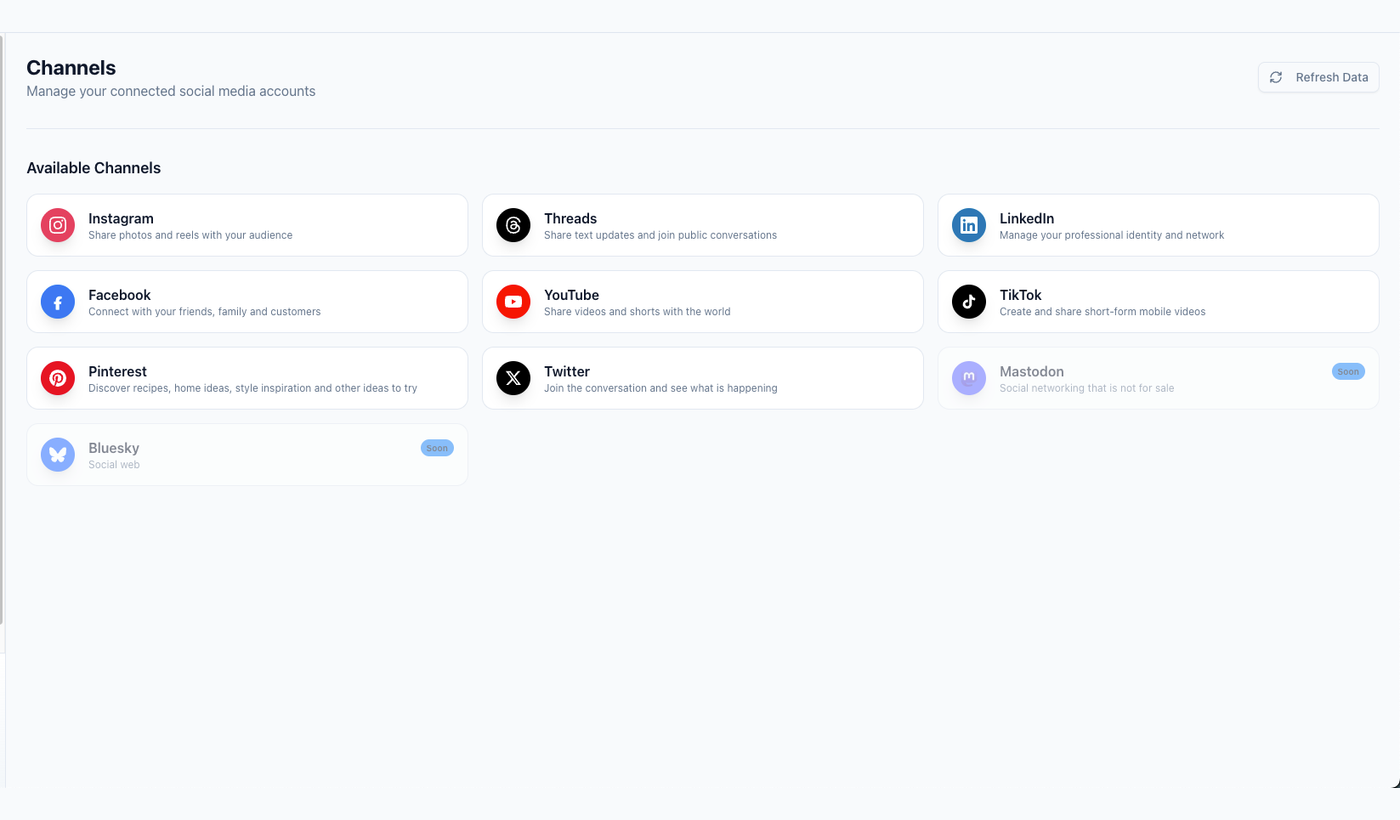
Explicit workspace and channel context reduces wrong-account actions.
Add a content risk classifier
The agent can classify content before deciding the review path.
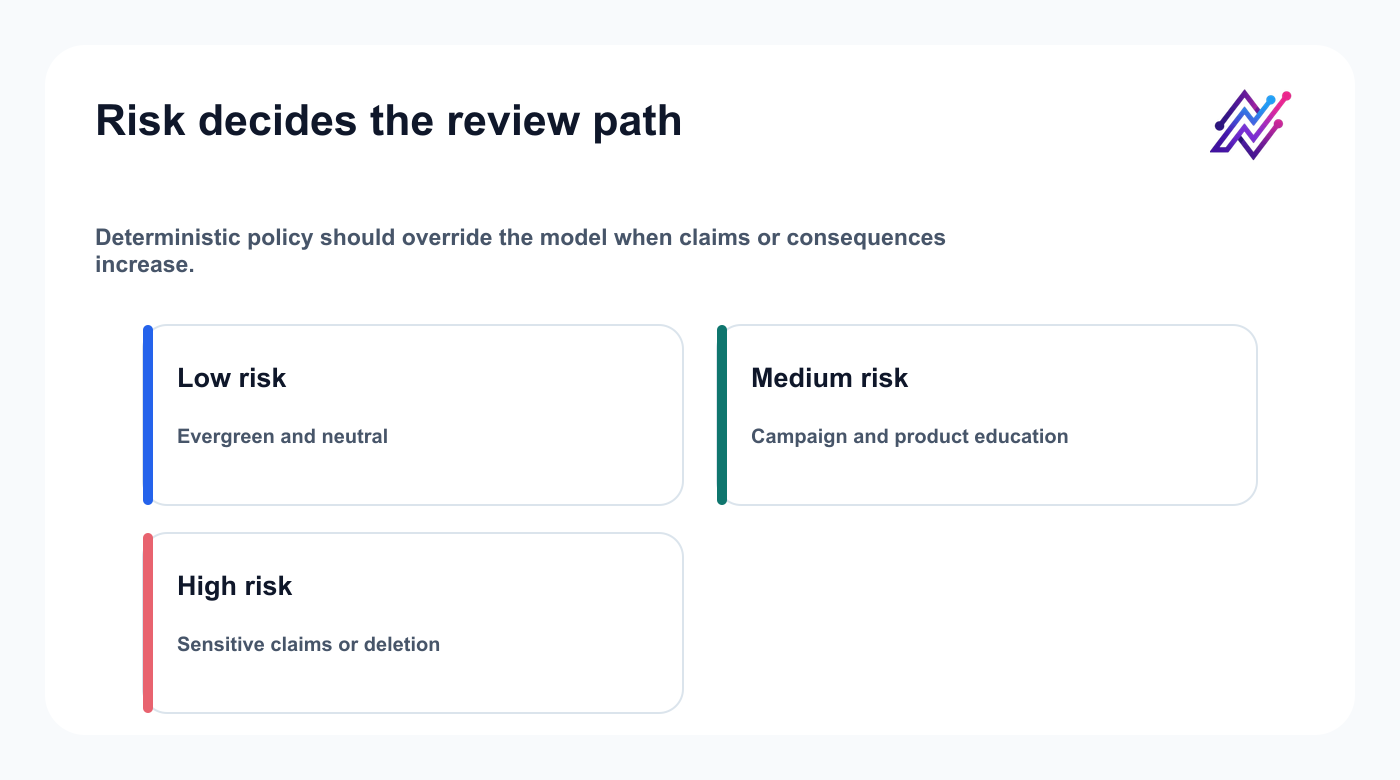
Risk classification determines when an agent can continue and when a human must decide.
Low risk
evergreen tips
general educational content
community questions
neutral updates
Medium risk
product education
launch content
repurposed customer questions
campaign posts
High risk
pricing
customer results
competitor comparisons
legal or financial claims
sponsored content
regulated topics
deletion
immediate publishing
A deterministic rule can override the model.
Example:
If content contains pricing,
customer result,
competitor name,
or sponsor relationship,
then final approval is required.
The model may suggest a risk level.
The policy engine should make the final decision.
Build the planning workflow
Prompt:
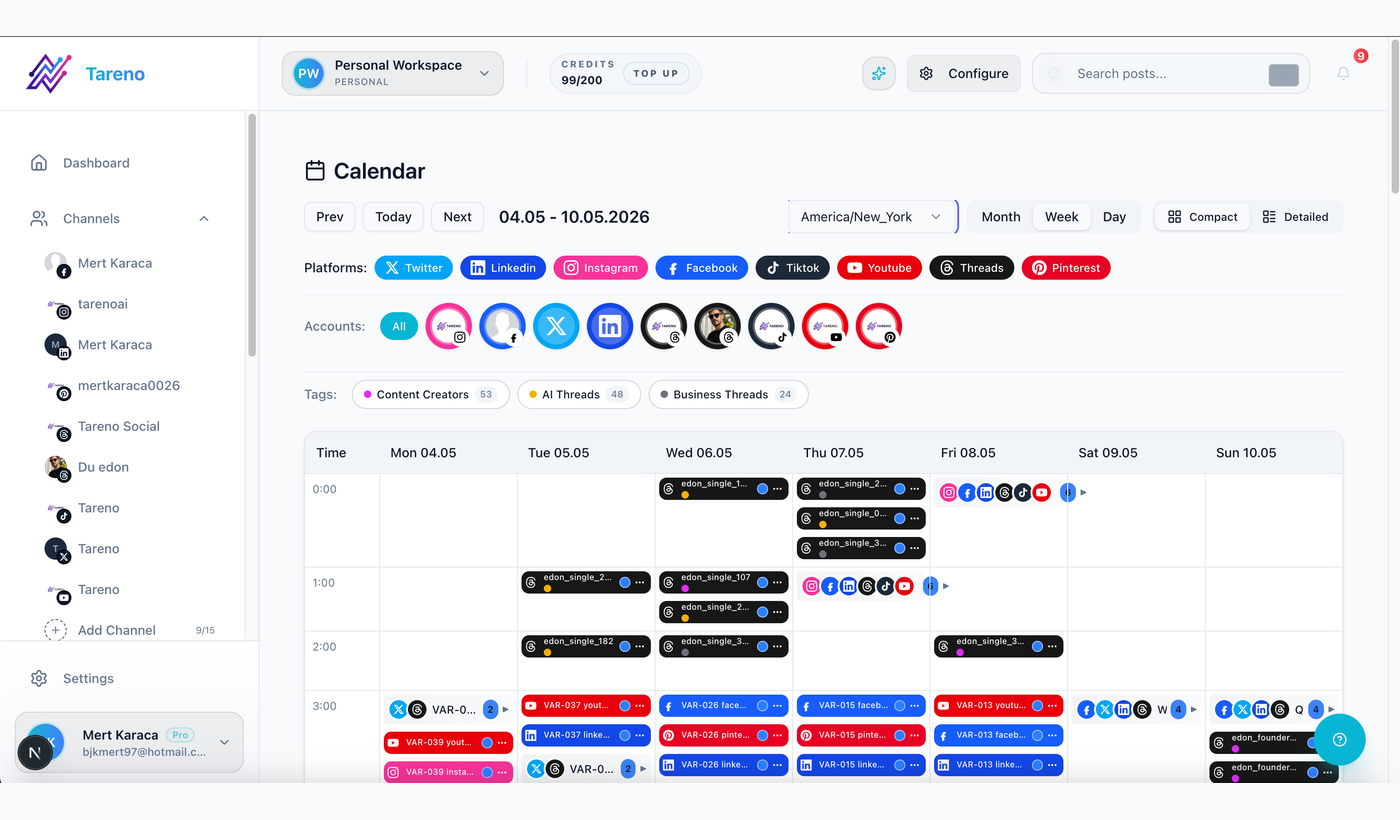
A shared calendar makes timing, channel balance, and unresolved approvals visible.
Review the last 30 days of content performance, current drafts, pending approvals, and unused repurposing items. Propose a five-post plan for next week. Include one proven topic, one educational post, one opinion post, one repurposed winner, and one experiment. Do not create drafts until the plan is approved.
The agent should produce a compact plan that makes the decision basis visible:
DayPlatformTopicFormatGoalEvidenceTuesdayLinkedInWorkflow lessonText postQualified repliesAbove-baseline saves on the source post
This creates a reviewable plan before production and gives the approver enough context to challenge the recommendation.
Build the draft workflow
After approval:
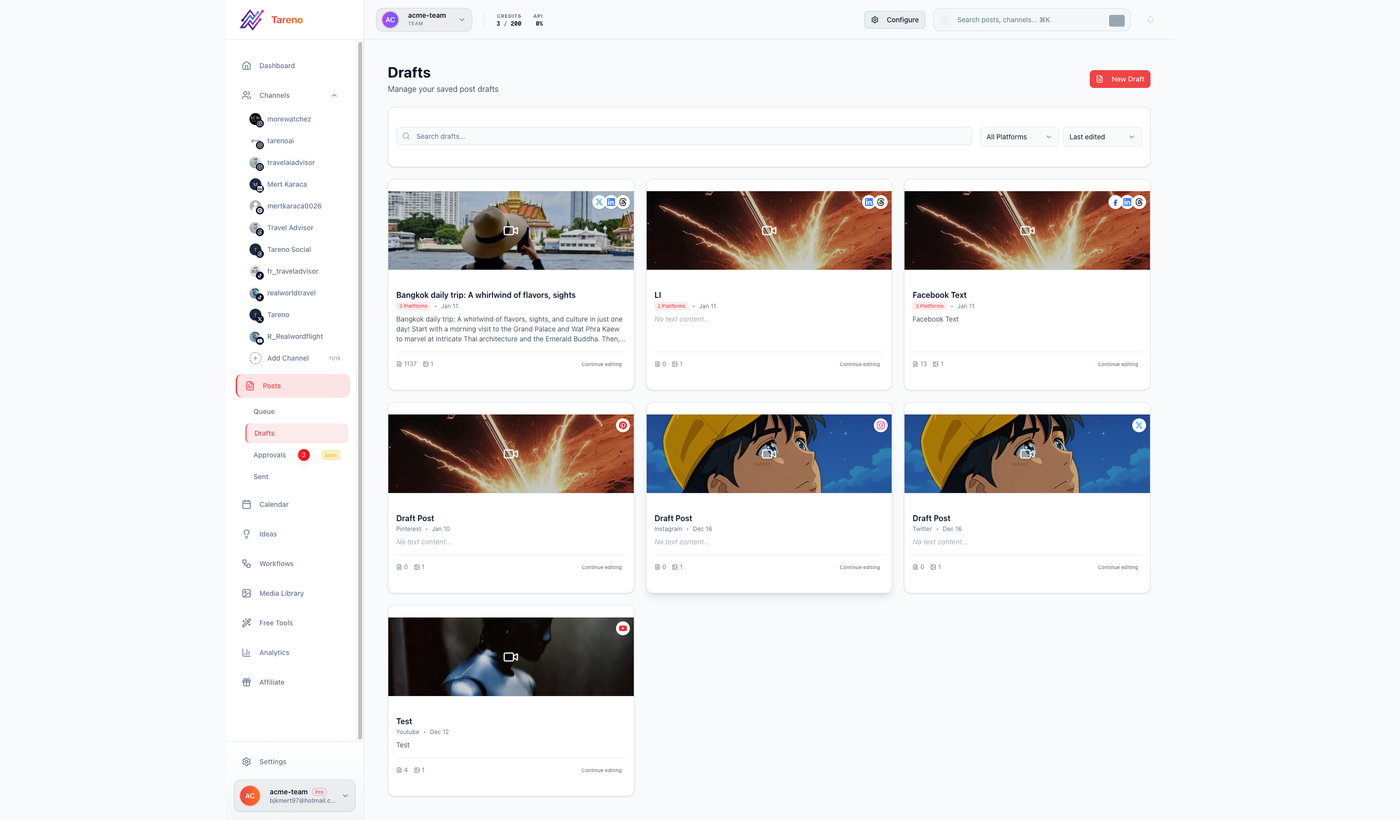
Draft-first execution provides a safe checkpoint for claims, media, tone, and platform fit.
Create the approved drafts. Adapt each version for its platform. Save drafts only. Add the source and business goal to internal notes.
The agent should not copy one caption everywhere.
Platform adaptation should cover:
hook
length
context
tone
CTA
hashtags
thread structure
content warning
alt text
Build the approval workflow
The agent prepares the action.
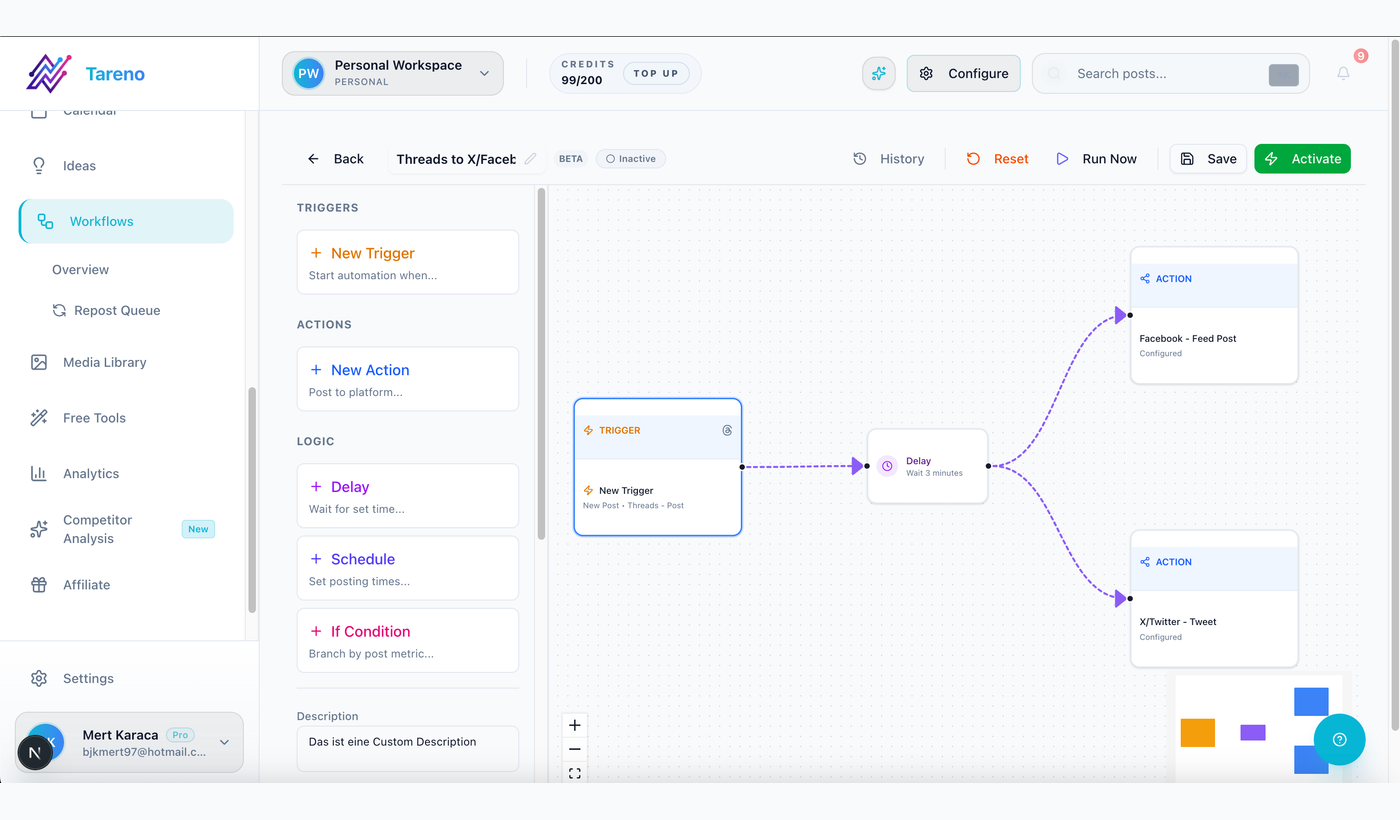
Approval logic belongs in the workflow, not only in the agent prompt.
Tareno presents:
workspace
account
platform
final copy
media
scheduled time
timezone
risk level
source
requester
The user chooses:
approve
reject
request changes
Bind approval to an immutable revision ID and the exact destination account, asset, caption, CTA, date, and timezone. Any material change must invalidate the earlier approval and return the new revision to review.
Material changes include:
caption claim
CTA
asset
account
date
product statement
disclosure
Build the analytics workflow
Use analytics reports as the evidence layer, then ask the agent to separate observations from recommendations.
Prompt:
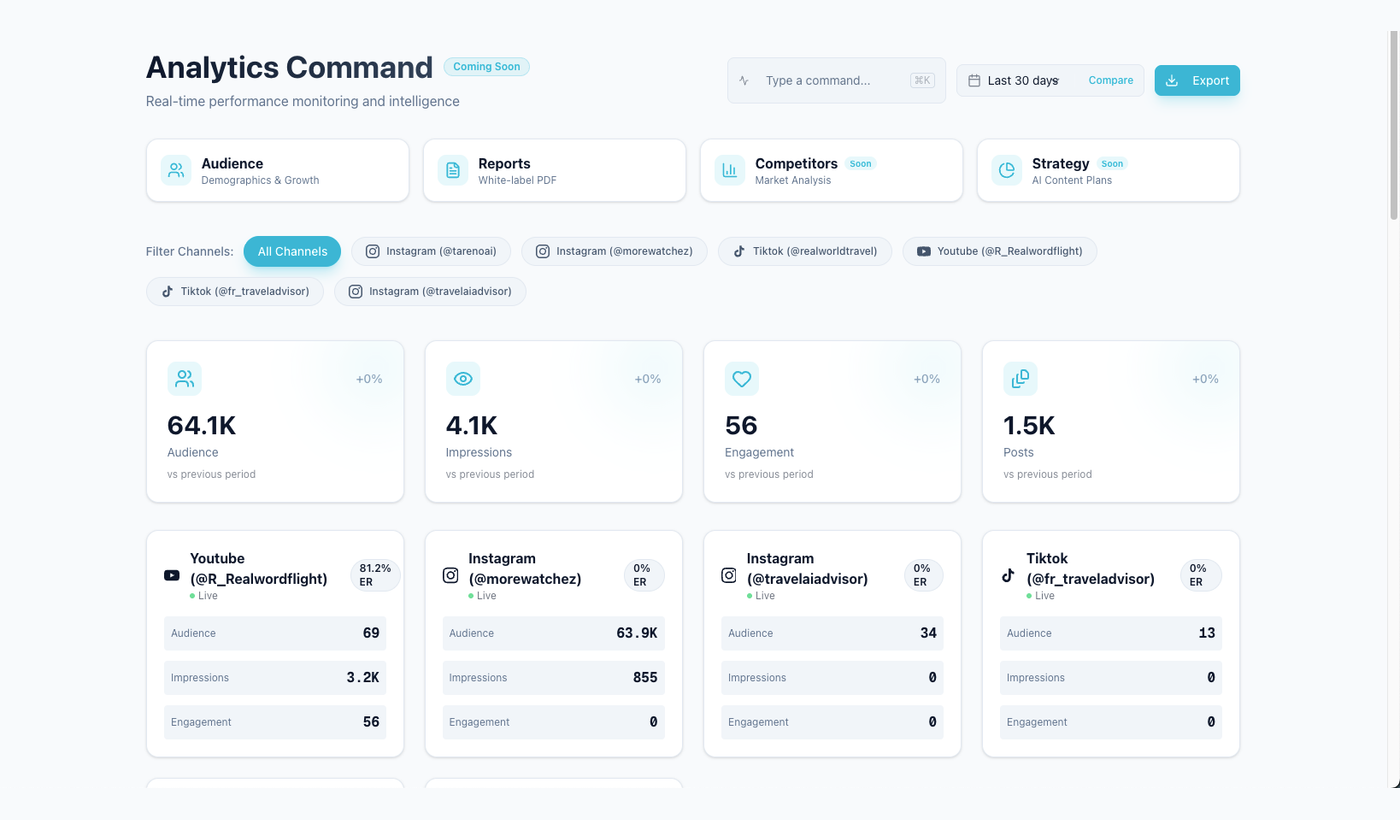
Analytics becomes useful when each signal leads to a specific next action.
Compare published content against each account’s baseline. Identify the strongest topic, hook, format, CTA, and platform. Separate evidence from interpretation.
The agent should not only summarize numbers.
It should produce decisions.
Treat each signal as a working hypothesis—not a causal conclusion—and assign one controlled next test:
SignalWorking hypothesisNext testHigh savesThe topic may have durable utilityTest a checklist version against the account baselineHigh repliesThe tension may invite discussionTest a follow-up with one sharper questionHigh clicksThe offer may match active intentTest one landing-page explanation with the same audienceStrong watch timeThe pacing may hold attentionReuse the structure while changing topic and evidenceLow completionThe middle may lose relevance or clarityShorten one section and compare completion
Build the repurposing workflow
Prompt:
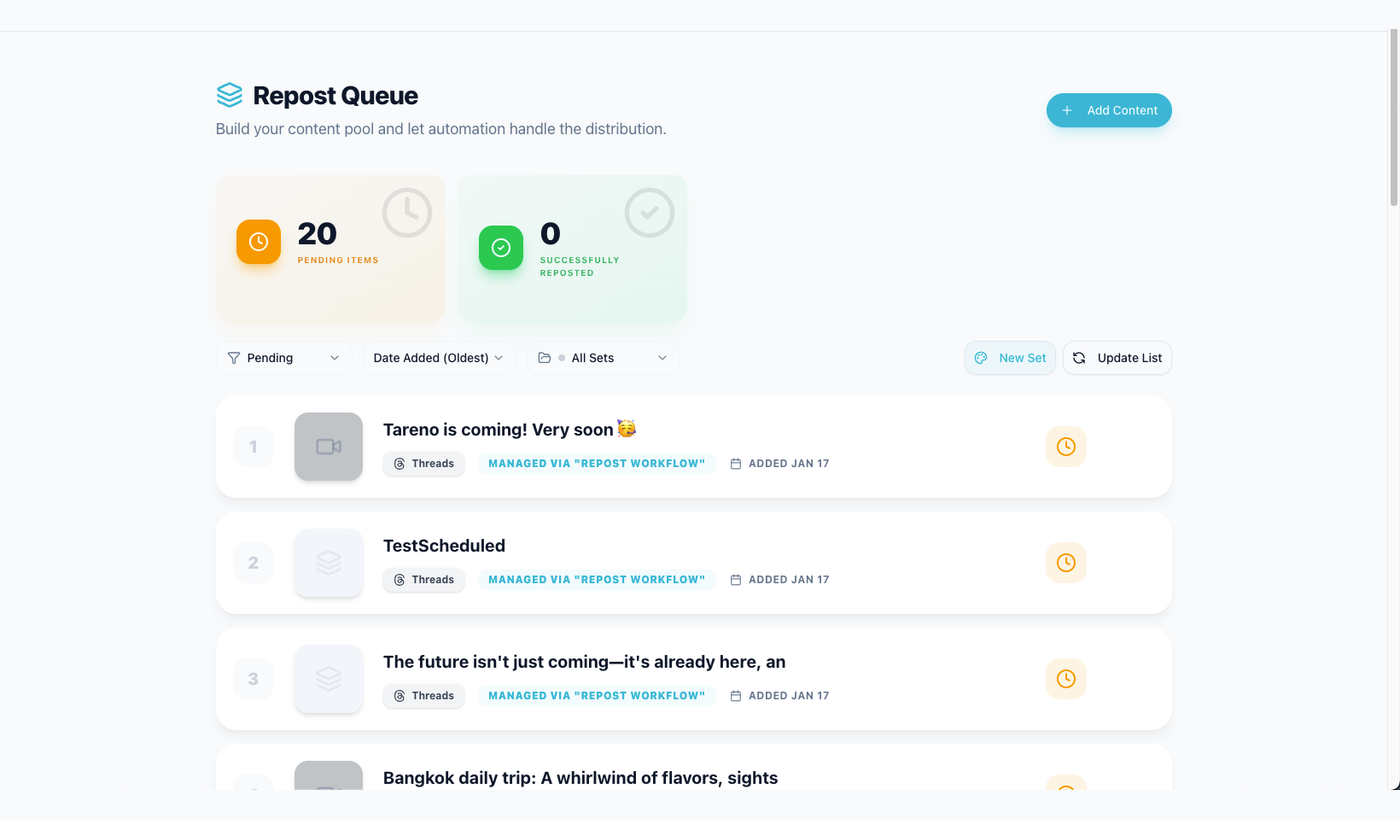
A repurposing task should retain the source, evidence, and intended new format.
Find three posts with strong meaningful signals. For each one, propose two new formats and one new platform. Save the selected ideas as repurposing tasks.
Possible conversions:
LinkedIn post → carousel
TikTok → YouTube Short
Bluesky thread → LinkedIn post
Mastodon post → FAQ article
webinar clip → short-form video
YouTube transcript → multilingual campaign
The source post and signal should remain attached to the task.
Specialized agents
Once the core loop is stable, add focused workflows such as YouTube research-to-script, Bluesky and Mastodon adaptation, multilingual localization, or an analytics-to-repurposing agent. Each should preserve the source, target audience, platform rules, claims to avoid, and review path.
Agent memory
Memory should retain durable operating facts and recent task state—not secrets, stale approvals, or guesses. Separate stable brand context from temporary campaign context and record where each fact came from.
Observability
Log every tool call.
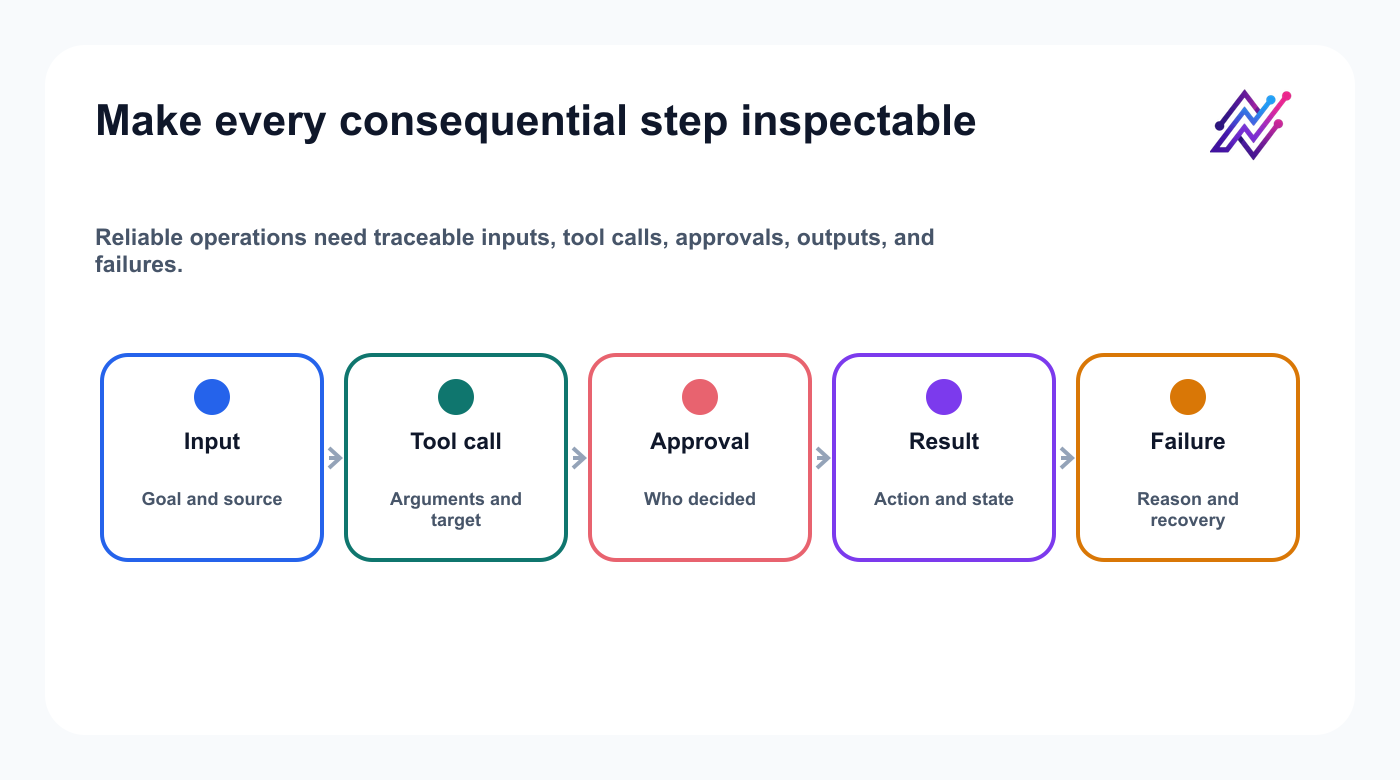
Traceability makes failures debuggable and public actions accountable.
Include:
request ID
idempotency key
agent
user
workspace
account
tool
arguments summary
action ID
result
error
timestamp
approval status, revision ID, and expiry
Do not log secrets.
Useful dashboards:
tool-call success rate
approval rate
rejection rate
average approval time
publish failure rate
duplicate rate
wrong-account prevention events
agent-generated content performance
You need evidence before increasing autonomy.
Testing
Test the boundary
Unit tests should cover schemas, policy rules, platform validation, and risk classification. Prompt tests should probe vague account selection, unsupported claims, and attempts to bypass approval. Integration and end-to-end tests should verify real workspace identity, draft state, confirmation, idempotency, failure recovery, and audit records.
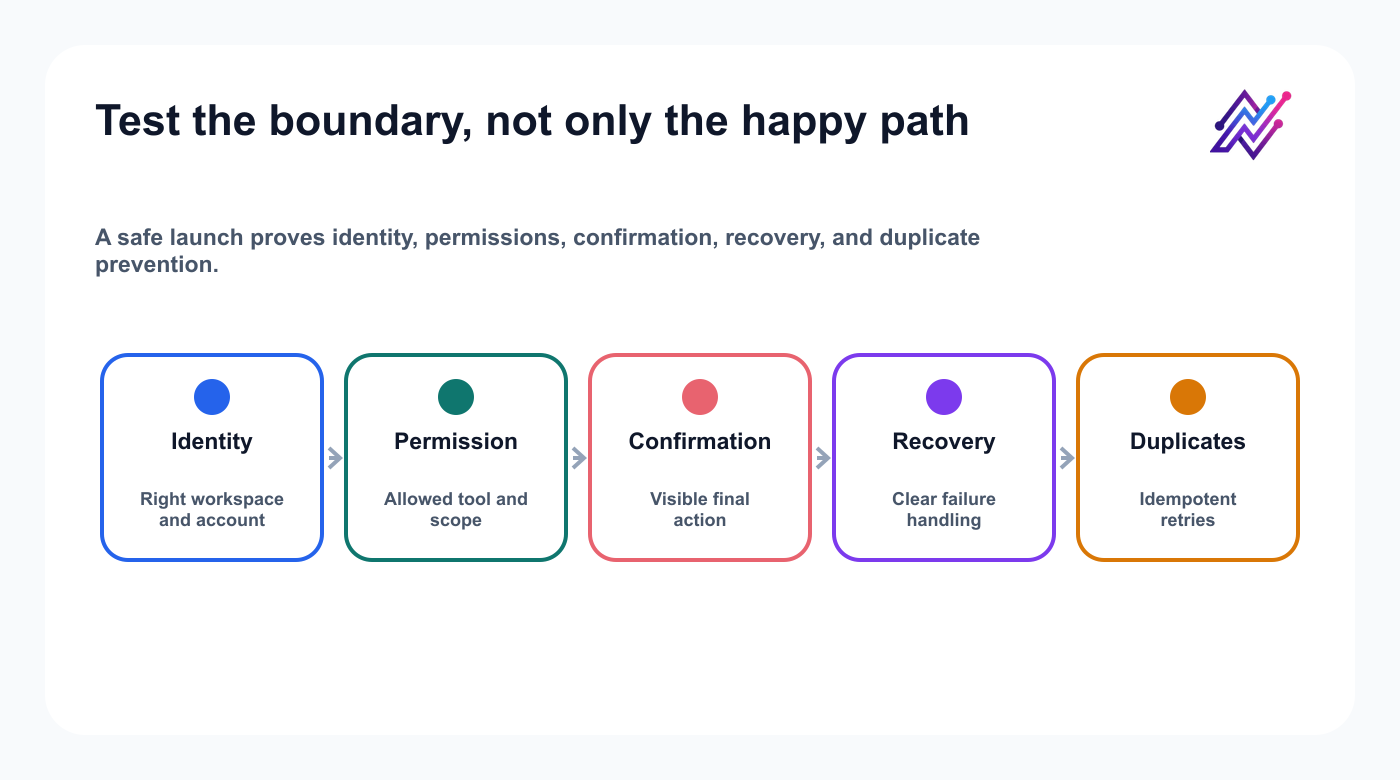
Boundary tests reveal the failures that polished demos tend to hide.
Red-team and failure handling
Test wrong-account requests, malicious source text, expired approvals, duplicate retries, disconnected channels, and changed content after approval. Failures should stop safely, preserve the error and action ID, explain what can be retried, and never silently switch targets.
Twenty AI-agent workflows
The same controlled architecture supports account audits, draft creation, approval review, weekly planning, campaign localization, content-gap research, launch packages, performance summaries, evergreen queues, repurposing tasks, calendar audits, claim reviews, comment mining, postmortems, and platform expansion.
Choose one workflow with a clear input, visible output, narrow tool set, and measurable completion rule. Expand only after its identity, approval, and recovery behavior is proven.
Common mistakes
Mistake 1: starting with full autonomy
Start narrow.
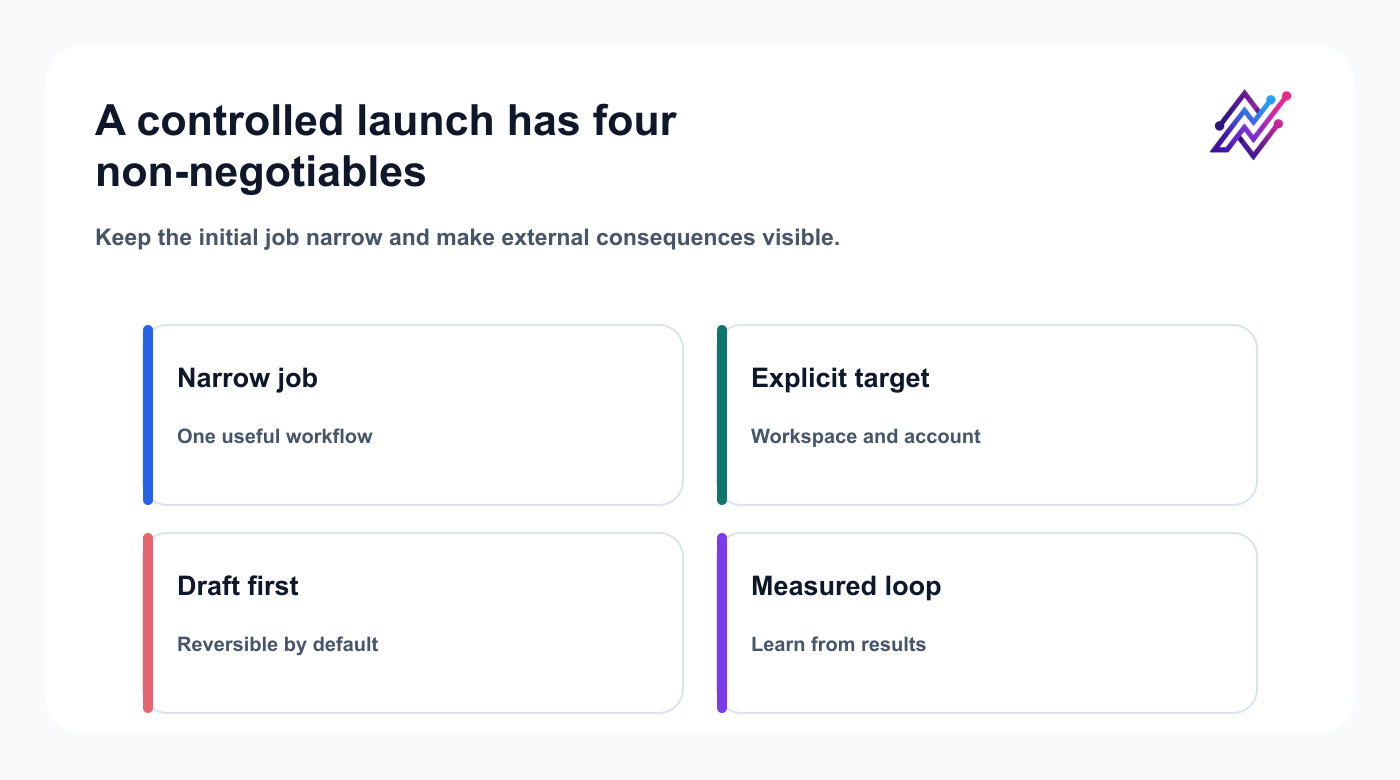
The strongest first version is narrow, explicit, reversible, and measurable.
What to avoid
Avoid unrestricted tools, implicit targets, prompt-only safety, stale memory, and publishing before draft behavior is proven.
Related Tareno resources
Continue building the workflow
Tareno MCPExplore resource →Approval workflowsExplore resource →Workflow builderExplore resource →Repurposing workflowExplore resource →
FAQ
What is an AI social media agent?
It is a multi-step system that uses tools and state to pursue a social goal.
Can an AI agent publish automatically?
Tareno can expose scheduling and publishing tools, but the current MCP workflow keeps scheduling, publishing, scheduled edits, and deletions behind explicit dashboard approval. Start with reads and drafts, then expand only after identity, validation, recovery, and audit behavior are proven.
Final thoughts
The best agent completes a useful job, targets the correct account, keeps consequences reviewable, and improves from evidence. Begin with reads and drafts.