Building social media functionality looks simple until the first real integration.
At first, the requirement sounds small:
Let users publish a post from our product.
Then the edge cases appear.
You need to handle:
several social platforms
different account types
different post formats
media uploads
character limits
thumbnails
scheduling
timezones
account permissions
expired credentials
failed publishing
approval states
analytics
retries
duplicate prevention
client workspaces
audit history
A direct integration with one social network may be manageable.
A reliable multi-platform publishing system is a product of its own.
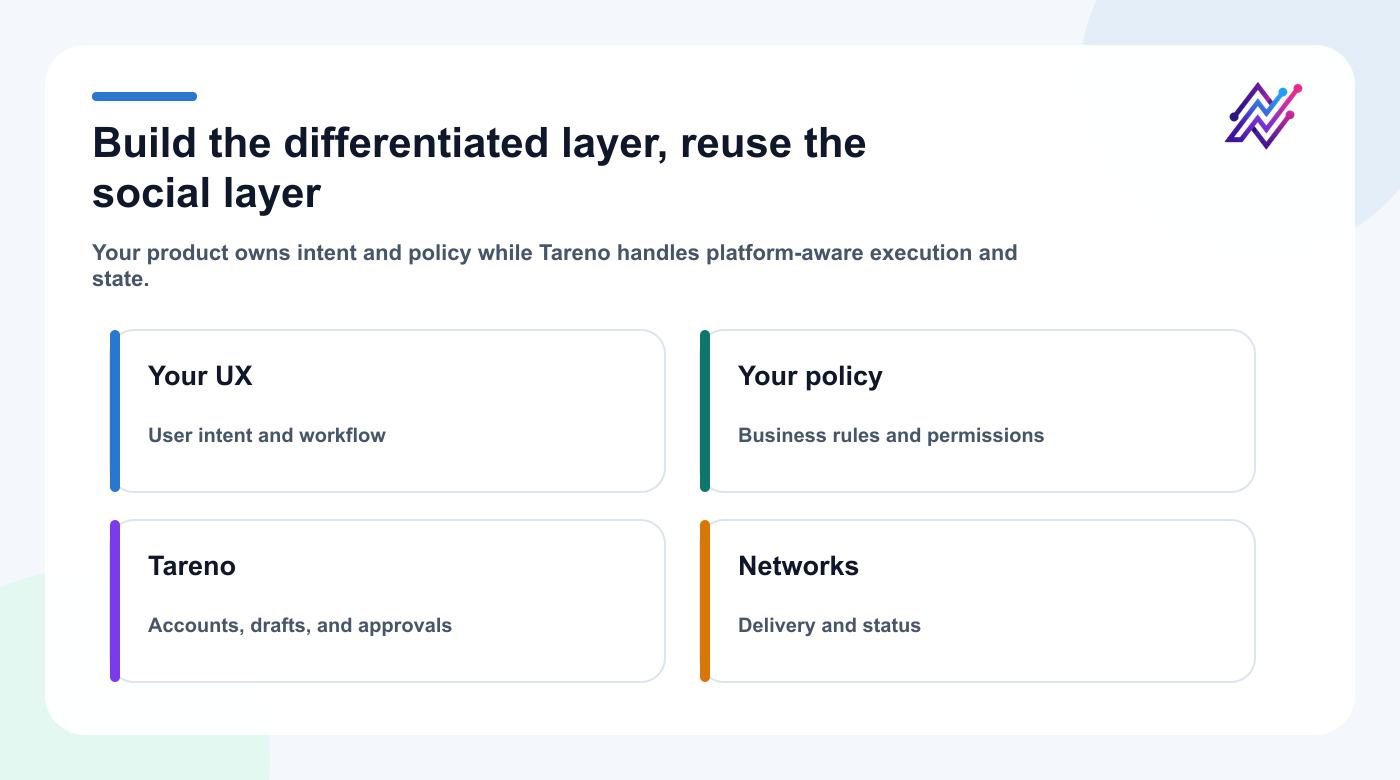
A clear ownership boundary keeps product logic differentiated without rebuilding every social platform integration.
That is why a social media automation API can be valuable.
Instead of rebuilding account connections, publishing rules, scheduling, approvals, and analytics for every network, your application can use Tareno as the social execution layer.
Your product owns the user experience and business logic.
Tareno manages the connected accounts and social media operations.
This guide explains how to design that architecture, how to separate your application from the publishing layer, which API capabilities matter, how to handle approvals and idempotency, and how to build AI agents, internal tools, SaaS features, agency portals, content pipelines, and analytics workflows on top of Tareno.
TL;DR
A strong API architecture looks like this:
Your application receives the user’s intent.
Your backend validates the business context.
The backend calls Tareno with a scoped credential.
Tareno validates the API-key owner, connected account, platform, and payload.
Low-risk work becomes a draft.
Your product approves an immutable payload revision before any public write.
The External API directly schedules or publishes that approved payload.
Your application tracks action and post IDs.
Analytics return to your product.
Strong posts become future repurposing tasks.
The key rule is:
Build your product experience. Reuse the social publishing infrastructure.
This reduces integration complexity and lets your team focus on the differentiated part of the product.
What a social media automation API should provide
A useful API needs more than a “publish post” endpoint.
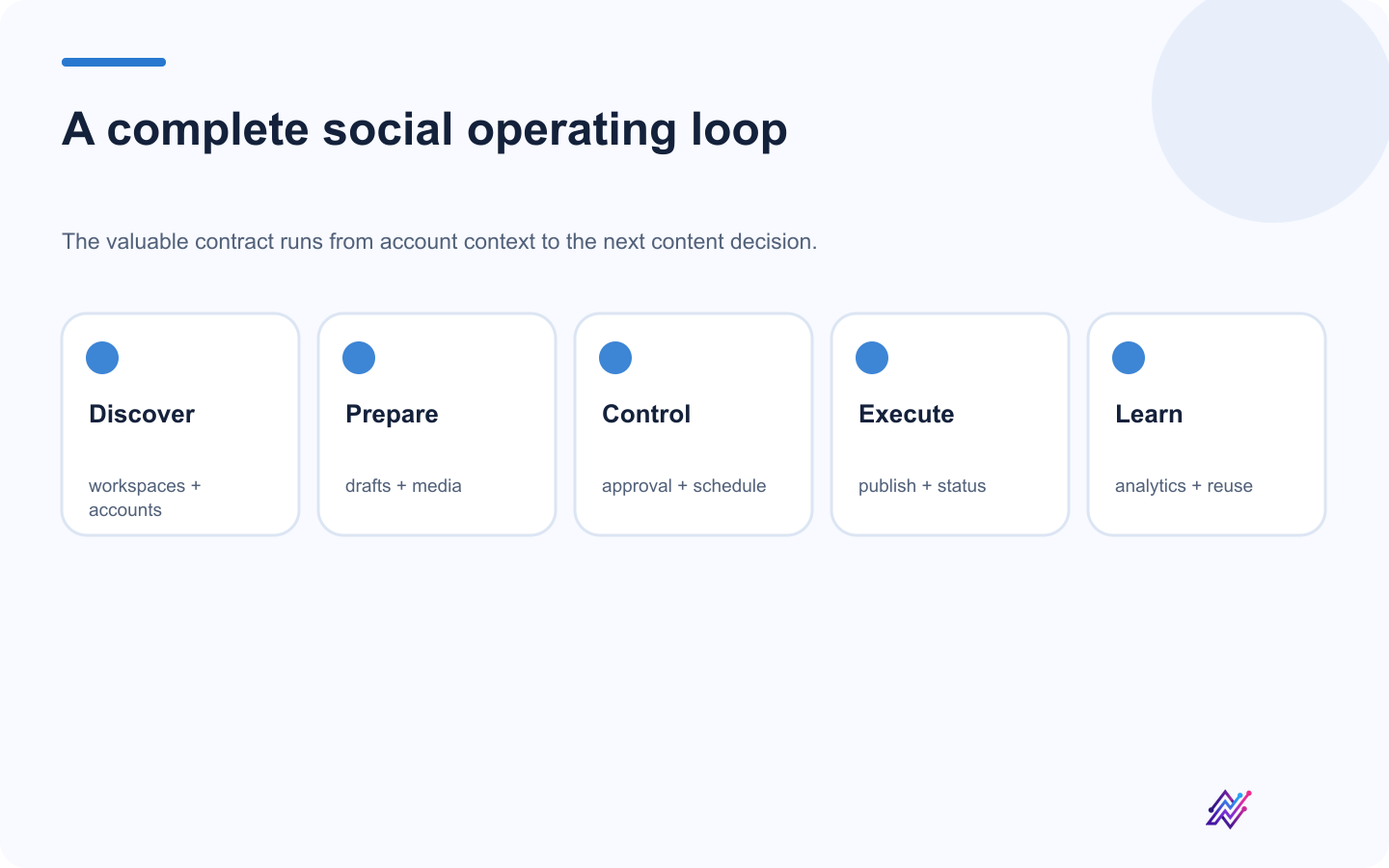
A useful API supports the whole operating loop, not only a publish endpoint.
It should support the full operating loop.
Tenant and credential mapping
The current External API does not expose a workspace-listing endpoint or accept a workspace ID in publish payloads. Your product should:
map each internal organization to the intended server-side API credential
list connected accounts for that key owner
separate client credentials and mappings
store explicit connected account IDs
verify ownership before every write
Account discovery
You need to know:
which accounts are connected
which platform each account belongs to
whether the account is active
whether authentication has expired
which post types are supported
Platform requirements
The API should help determine:
required fields
optional fields
supported media
account-specific options
publishing restrictions
platform differences
Draft creation
Drafts are essential for safe integration.
A draft allows:
review
editing
asset completion
approval
later scheduling
auditability
Media handling
An approval workflow may require:
upload
import from URL
file validation
MIME validation
size checks
redirect handling
private-network protection
reusable media references
Scheduling and publishing
The API should support:
scheduled publishing
immediate publishing requests
timezone handling
platform-specific payloads
action status
errors
retries
Approval
The External API exposes direct draft, schedule, and publish modes. It does not turn schedule or publish calls into dashboard approval requests, so a production product must approve an immutable payload revision before making either call.
Tareno's MCP schedule, publish, scheduled-edit, and delete tools use a separate server-enforced dashboard approval flow. Choose the interface deliberately, especially for AI-driven products.
Analytics
Useful API capabilities include:
post performance
account performance
platform comparison
campaign metrics
top posts
performance over time
Repurposing
The API can close the loop by creating:
new drafts
repurposing tasks
evergreen queue items
platform variants
follow-up content
The recommended architecture
A clean system separates five layers.
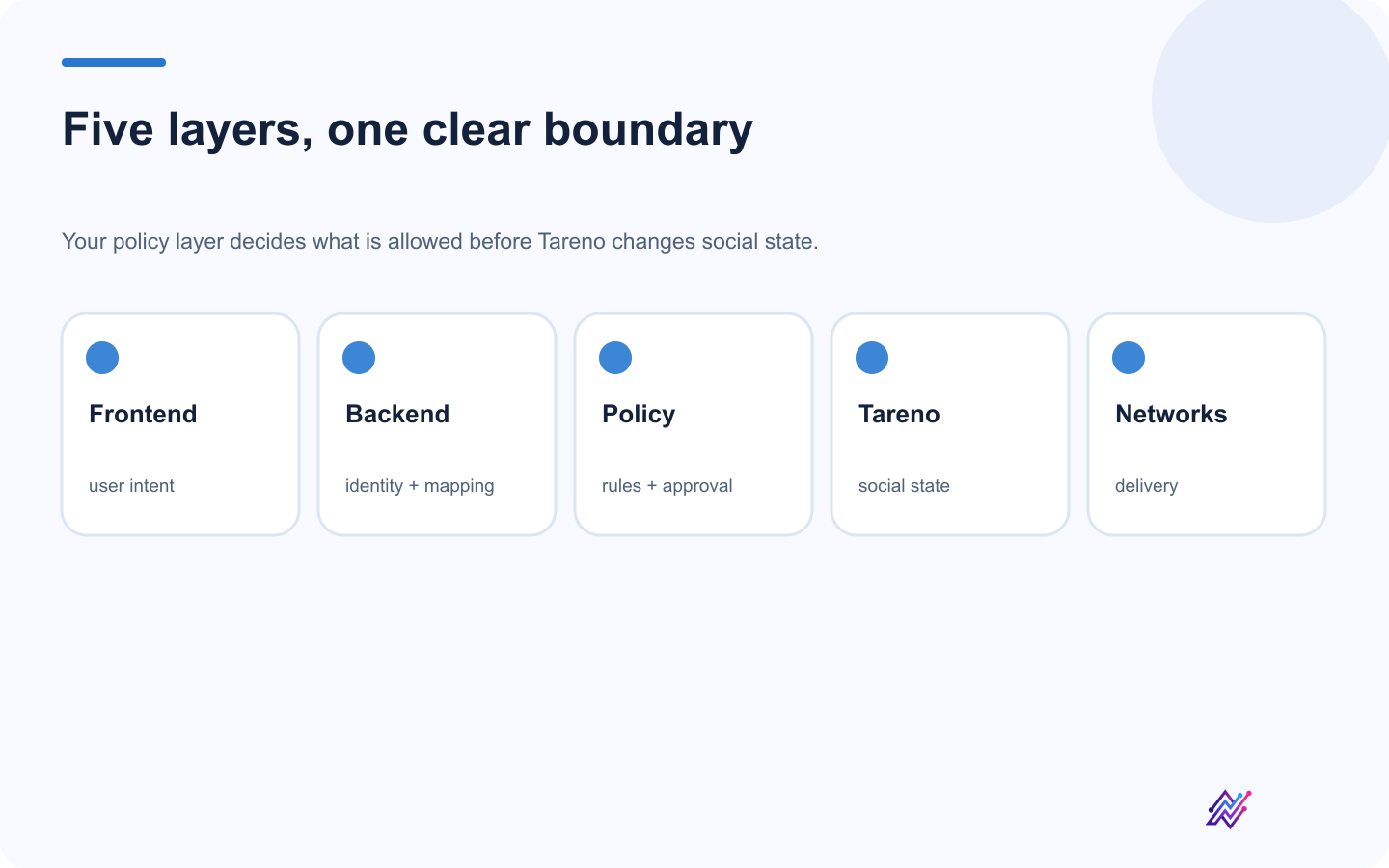
Separating identity, policy, execution, and delivery keeps the integration understandable.
Frontend
  ↓
Your backend
  ↓
Business-policy layer
  ↓
Tareno API
  ↓
Social networks
Frontend
The user:
selects an account
creates content
chooses a schedule
requests publication
reviews status
sees analytics
Your backend
The backend:
authenticates the user
loads organization context
validates permissions
maps internal IDs
creates idempotency keys
calls Tareno
stores returned IDs
handles status updates
Business-policy layer
This layer decides:
whether approval is required
whether a user can publish
whether a claim needs review
which accounts are allowed
whether immediate publishing is permitted
whether a client must approve
Tareno
Tareno handles:
API-key-owner and connected-account context
platform validation
drafts
scheduling
publishing
reviewable drafts and MCP-hosted approval state
analytics
activity state
Social networks
Tareno communicates with the platform APIs.
Your product does not need to implement every network separately.
Direct API integration vs MCP
The API and MCP serve different consumers.
Use the API when:
building a custom backend
embedding social publishing into a SaaS product
creating an internal dashboard
designing a mobile app
writing deterministic code
controlling requests directly
processing events in the background
Use MCP when:
an AI client should discover tools
an agent chooses actions dynamically
the user gives natural-language instructions
the workflow is conversational
several agent runtimes should reuse the same tool layer
A simple rule:
APIs are for software orchestration. MCP is for agent tool use.
The same Tareno infrastructure can support both.
Authentication, scopes, and safe writes
Do not expose a production API key in the browser.
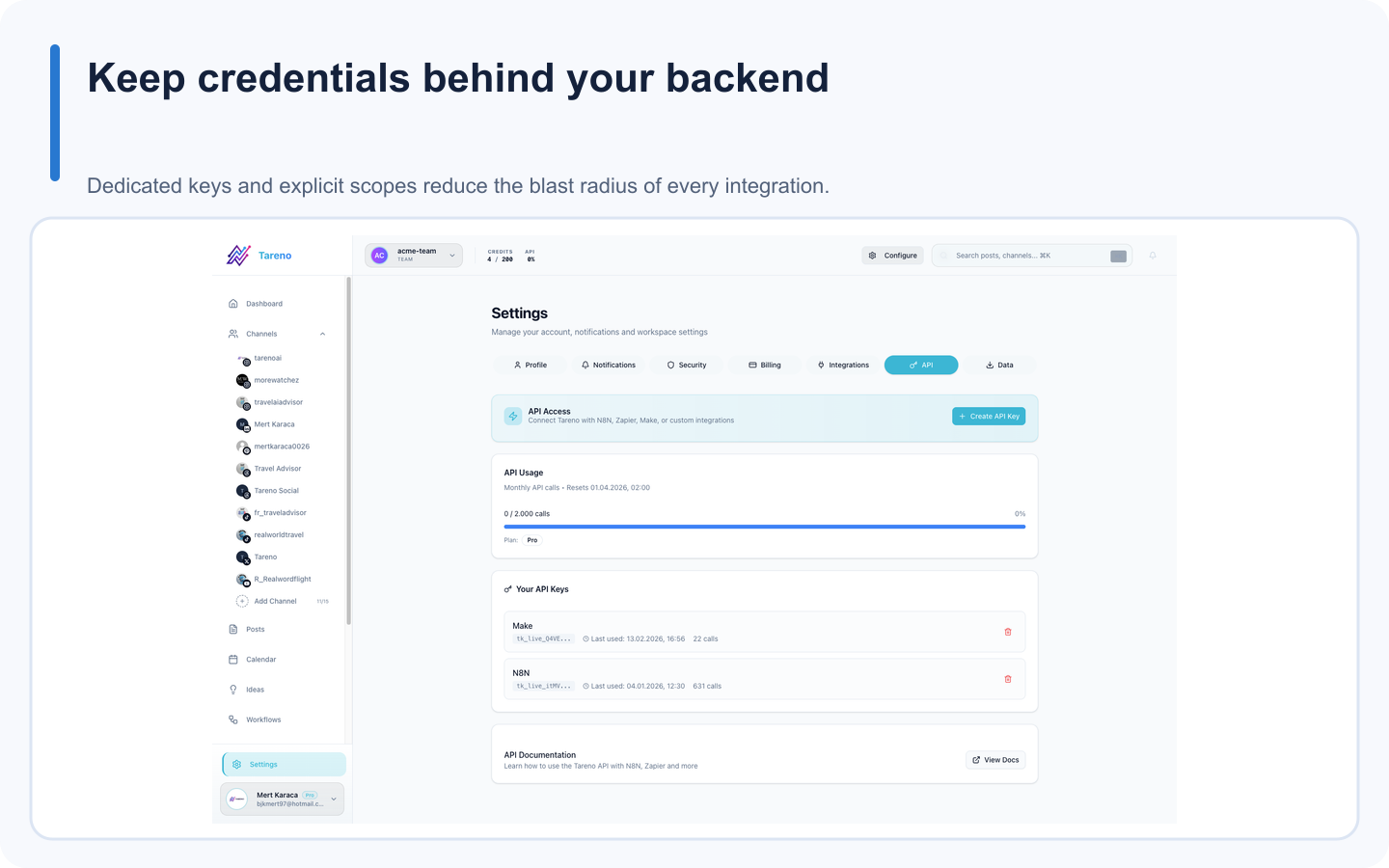
Create dedicated credentials in Tareno, then store them only in trusted server-side infrastructure.
Use a backend.
Recommended pattern:
Browser
  ↓ authenticated request
Your backend
  ↓ Tareno API credential
Tareno
The browser should never receive the full Tareno credential.
Use:
server-side secrets
encrypted environment variables
secret managers
separate staging and production keys
credential rotation
revocation
minimum scopes
For agency products, consider:
separate credentials per client
separate credentials per environment
separate tenant-to-credential and account mapping
explicit ownership checks
Tareno currently accepts a server-side Bearer API key or the documented X-Tareno-API-Key header. Read operations use the read scope; media uploads and post creation use the publish scope. Treat the live API reference as the source of truth.
Scope design
Use least privilege.
Tareno currently exposes two API-key scopes:
readfor accounts, usage, boards, posts, and analyticspublishfor media uploads and post creation in draft, schedule, or publish mode
Create separate keys for separate environments or clients, and omit publish from integrations that only inspect data.
The practical boundary is simple: a read-only integration receives read; a server that must create drafts receives publish as well, because the same write scope covers draft, schedule, and publish modes. Restrict public consequences in your business-policy layer, use separate keys per environment or client, and revoke a key when its owner or purpose changes.
Do not describe finer-grained role scopes unless they exist in the live contract. Authorization inside your product still decides which users may request drafts, schedules, or immediate publication.
Create a draft before publishing
Draft-first architecture is easier to test.
Current draft request:
POST /api/external/publish
Authorization: Bearer tk_live_your_key
Content-Type: application/json
Minimal payload:
{
  "mode": "draft",
  "platform": "linkedin",
  "title": "Release 42 review draft",
  "text": "A platform-native draft.",
  "mediaUrls": []
}
Draft mode can omit accountId, but platform is then required. Schedule and publish modes require a connected accountId; the server can infer the platform from that account and rejects a mismatched platform value.
The response returns the stored Tareno postId, status, message, and usage data. Treat the live External API reference as the contract for optional media, timezone, and platform metadata.
Model requirements before rendering a form
Different platforms need different fields. The current External API lists connected accounts but does not expose a general requirements-discovery endpoint, so maintain a versioned validation schema from the live API documentation and shared publishing contract instead of inventing a requirements call.
Do not hardcode one universal form.
A better workflow:
backend resolves the authenticated user's internal tenant and server-side credential
user selects account
backend loads its versioned platform requirements
frontend renders the relevant fields
backend validates the final payload
Tareno validates again
Possible requirement data:
post type
caption limit
media type
image count
video fields
thumbnail
first comment
board
visibility
language
content warning
alt text
This makes the product platform-aware.
Account selection
Never select “the first LinkedIn account.”
Use explicit IDs.
Store mapping:
Internal organizationIntegration credential ownerTareno accountCustomer Acredential_owner_alinkedin_aCustomer Acredential_owner_ainstagram_aCustomer Bcredential_owner_byoutube_b
For every request, verify:
current user belongs to organization
organization maps to the intended server-side credential owner
selected account is returned for that API-key owner
user has permission for account
platform matches payload
This prevents cross-client mistakes.
Approval-first publishing
A strong API should separate:
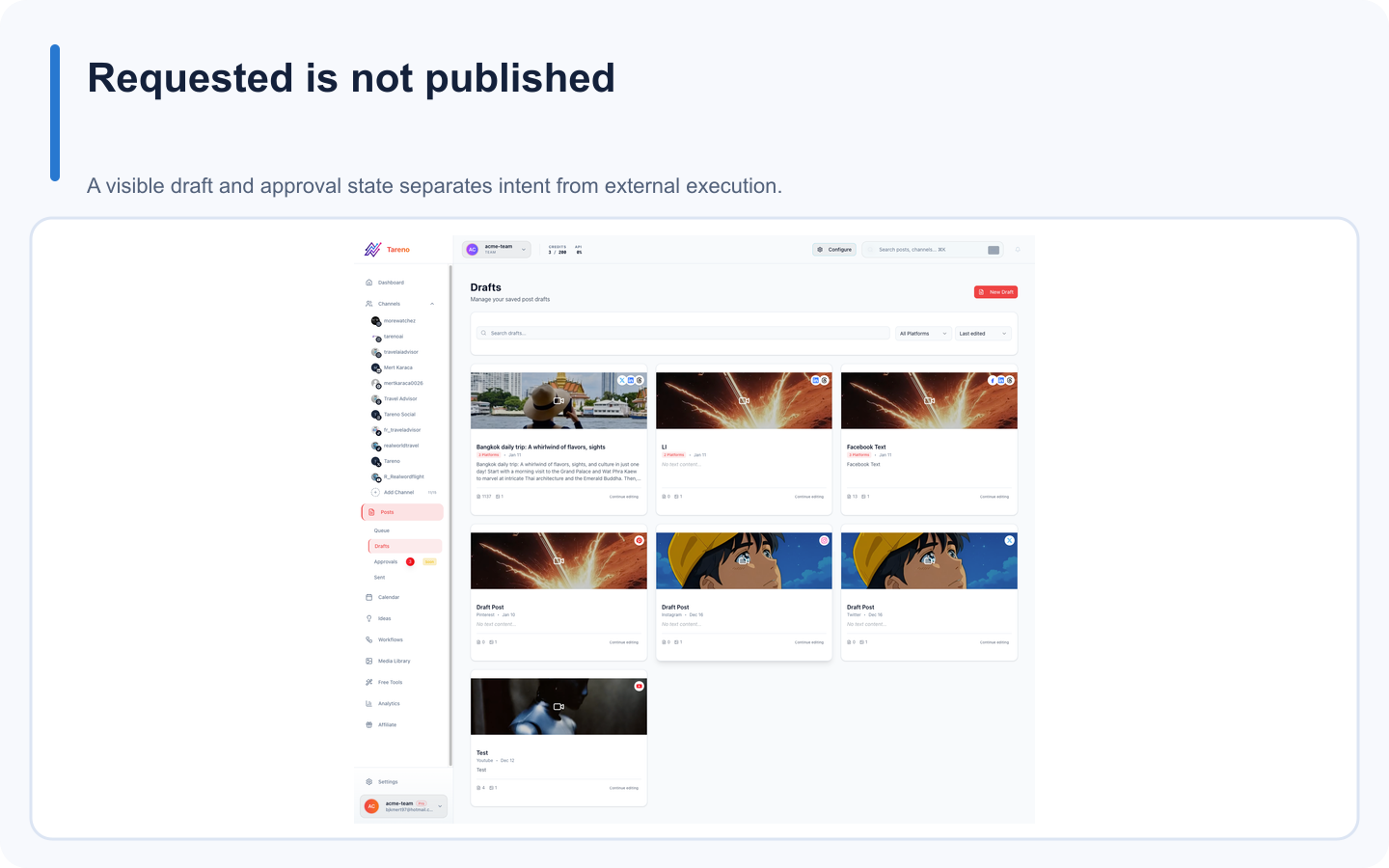
Draft-first API writes preserve a reviewable checkpoint before public action.
draft created
exact revision reviewed in your product
schedule or publish authorized by a named actor
direct External API write executed
returned post state reconciled
Current sequence:
POST mode=draft
  ↓
Review exact copy, media, account, time, and timezone
  ↓
Store approver + immutable payload digest
  ↓
Reject stale approval if the payload changes
  ↓
POST mode=schedule or mode=publish
  ↓
Store returned postId and status
  ↓
Reconcile scheduled, processing, published, or failed state
The External API does not create a pending dashboard action for schedule or publish. Schedule returns a stored scheduled post; immediate publish may return published or processing. If you need Tareno-hosted approval before mutation, use the corresponding MCP tool instead.
Reliable execution and recovery
Your application needs to know when an action changes.
Polling
The backend checks periodically.
Advantages:
simple
easy to debug
works without inbound webhooks
Disadvantages:
delayed updates
more API calls
less efficient
Webhooks
Tareno sends an event.
Advantages:
near-real-time
efficient
better user experience
Disadvantages:
webhook security
retries
duplicate events
endpoint availability
signature verification
The public REST-hook subscription endpoints are currently scoped to Zapier's Post Published trigger. Custom applications should poll the relevant public endpoint or operate an event relay they control instead of assuming a generic webhook contract.
Even with a supported hook, keep polling or reconciliation as a recovery path.
Never assume a webhook is delivered exactly once.
Webhook handling
For any supported hook or internal relay, verify:
event types
signature method
retry policy
ordering
payload schema
event ID
timestamp
replay behavior
Recommended handler:
receive event
verify signature
check event ID
reject duplicate
store raw event
process asynchronously
update internal state
return success
Conceptual events:
draft.createdaction.pendingaction.approvedaction.succeededaction.failedpost.publishedanalytics.updated
These names are examples only.
Idempotency
Idempotency prevents duplicate actions.
Example:
A network timeout occurs after your request reached Tareno.
Your backend does not know whether the draft was created.
It retries.
Without idempotency, two drafts may appear.
Create a stable deduplication key in your own database. The current External API publish route does not document an Idempotency-Key request header, so do not assume that replaying a timed-out request is safe.
Good caller-side keys include:
source record ID
account ID
platform
language
action type
source version
Example:
release42_linkedin_account456_en_schedule
Before retrying, look up the key and its stored Tareno ID or reconcile the matching post state. Only issue a new write when you can prove the first attempt did not create an effect.
Duplicate prevention
In addition to idempotency, store:
Tareno draft ID
Tareno action ID
Tareno post ID
source ID
content hash
account ID
platform
language
version
Before creating content:
search internal mapping
check current Tareno state
delete and recreate only when the current documented contract and your approval policy allow it
create only when no valid mapping exists
This is important for background jobs and retries.
Error handling
Classify errors.
Validation error
Examples:
missing caption
unsupported media
wrong platform field
invalid schedule
account mismatch
Action:
return clear user feedback
do not retry automatically
Authentication error
Examples:
invalid key
expired credential
missing scope
Action:
alert integration owner
pause workflow
Retryable error
Examples:
temporary timeout
rate limit
platform outage
transient server error
Action:
retry with backoff
cap retries
Approval error
Examples:
action rejected
action expired
content changed after approval
Action:
request new review
Permanent platform failure
Action:
create incident
preserve payload and response
alert owner
Rate limiting
Do not build a system that depends on unlimited API calls.
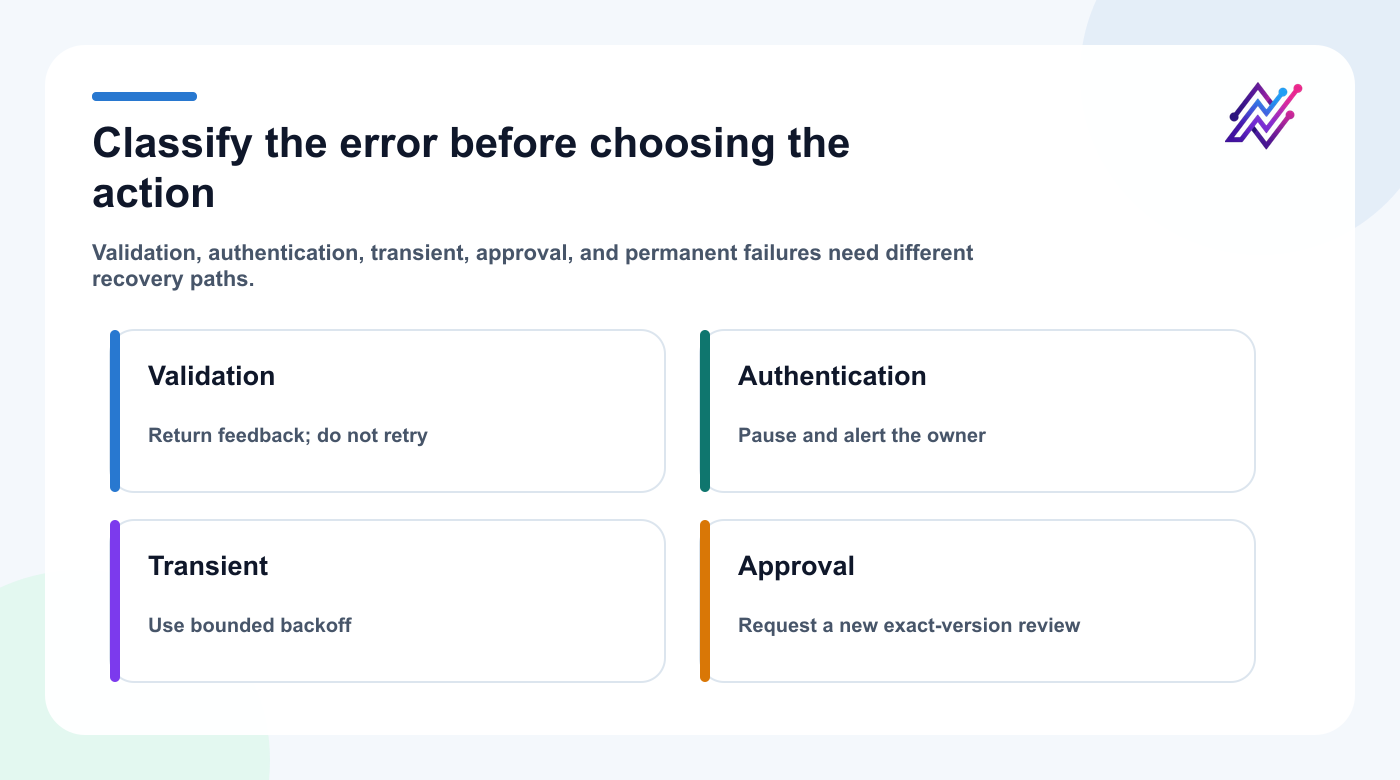
Error-aware recovery prevents blind retries from turning one failure into duplicates or unauthorized changes.
Use:
caching
batching
backoff
queues
concurrency limits
local state
status subscriptions
Examples:
cache account lists briefly
cache platform requirements
queue bulk draft creation
stagger analytics requests
avoid polling every second
group low-priority jobs
Read current plan usage from the /usage endpoint and handle upstream 429 responses with bounded backoff.
Media architecture
Two common patterns:
Upload through your backend
User uploads file
  ↓
Your storage
  ↓
Backend sends file or signed URL to Tareno
Import public media URL
Your app provides HTTPS URL
  ↓
Tareno validates and imports
Security checks should include:
HTTPS
MIME type
size
redirect limits
private IP blocking
content type
file integrity
Do not let users force the server to fetch arbitrary internal URLs.
This is an SSRF risk.
Scheduling and timezones
Store times explicitly.
Recommended data:
local date
local time
IANA timezone
normalized UTC timestamp
Example:
{
  "scheduledLocal": "2026-08-12T10:00:00",
  "timezone": "Europe/Berlin",
  "scheduledUtc": "2026-08-12T08:00:00Z"
}
Daylight-saving changes make fixed UTC offsets unreliable for recurring workflows.
Use IANA timezone names.
Show the final local time, IANA timezone, and resolved UTC instant during approval. Recompute the instant after daylight-saving or schedule edits and invalidate approval when any of those values change.
API product patterns
Once the core contract is stable, the same governed social layer can support several product surfaces without duplicating account and publishing infrastructure.
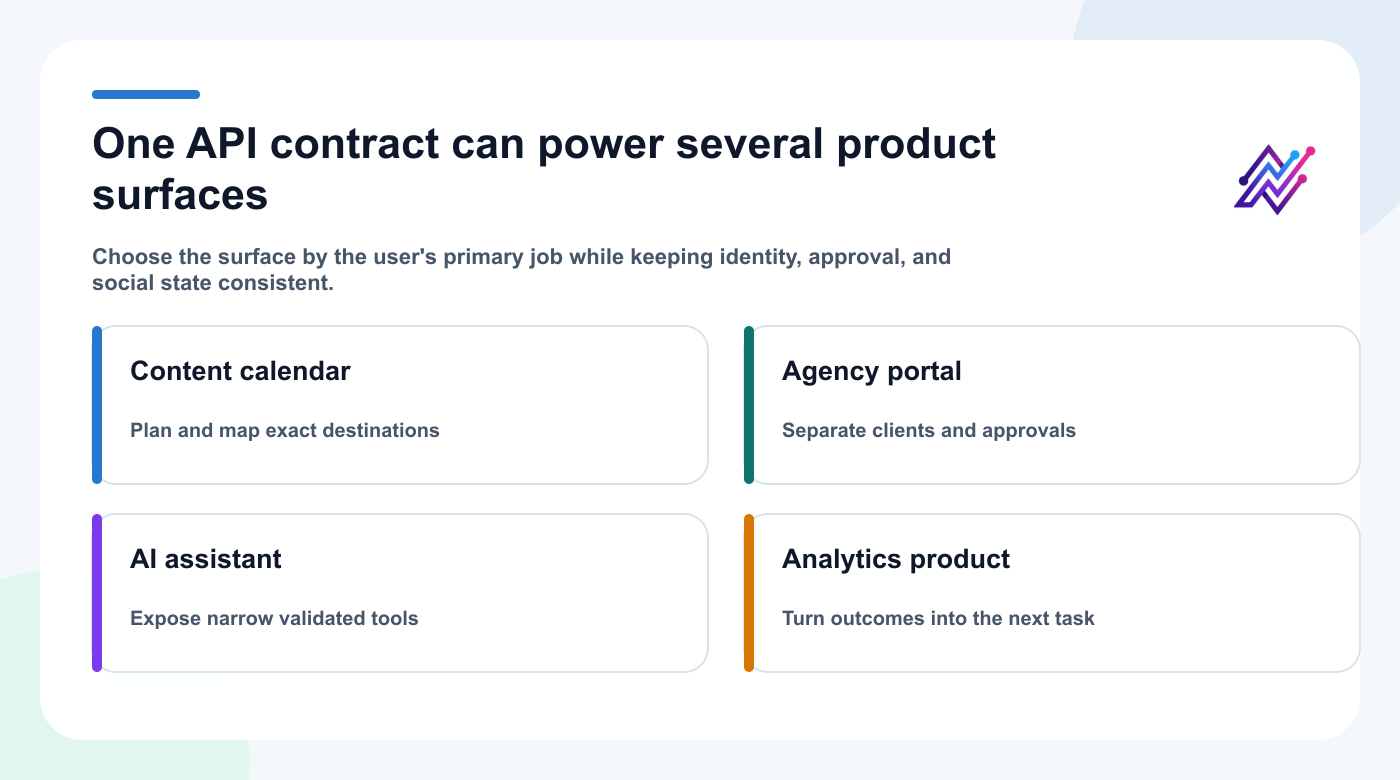
Different product experiences can share one governed contract for identity, approval, execution, and outcomes.
The interface can change by audience, but every surface should preserve the same internal tenant, API-key owner, explicit account, approved payload revision, and external-action record.
Build a custom content calendar
Your application can display:
internal drafts
Tareno drafts
pending actions
scheduled posts
published posts
failed posts
Use status mapping.
Example:
Internal statusTareno stateUIEditingDraftGrayWaiting for reviewPendingYellowApprovedApprovedBluePublishingExecutingPurplePublishedSucceededGreenFailedFailedRed
Keep your adapter aligned with the current response contract and action states in the API reference.
Build an agency portal
An agency product may need:
client workspaces
account mapping
client reviewers
internal reviewers
approval deadlines
comments
activity history
white-label reports
campaign views
Architecture:
Agency portal
  ↓
Client workspace mapping
  ↓
Tareno drafts
  ↓
Internal review
  ↓
Client approval
  ↓
Tareno publishing
  ↓
Client reporting
Keep every client separated.
Map each internal tenant to the intended server-side API credential and explicit connected account ID. The current publish payload does not accept a workspace ID.
Build an AI social media agent
An AI agent needs tools, not unrestricted API access.
Wrap API operations as narrow tools.
Examples:
list_accountsget_requirementscreate_draftprepare_scheduleget_action_statusget_analyticscreate_repurposing_task
Do not expose one generic tool that accepts arbitrary endpoints.
A narrow tool surface improves:
safety
model selection
validation
logging
approval
testing
The API can power the tools.
MCP can expose them to compatible agents.
Build a product-launch agent
Workflow:
read approved release notes
identify target audience
create platform-native drafts
mark claims
route to product review
prepare schedule
wait for approval
publish
collect analytics
create follow-up content
The source material should be explicit.
The agent should not invent release details.
Build a multilingual campaign tool
Your application can maintain a language matrix.
Fields:
language
market
tone
glossary version
source version
native review
Tareno draft ID
account ID
status
Tareno supports workflows across:
English
German
French
Spanish
Portuguese
Russian
Italian
Japanese
Arabic
Polish
Keep one draft per language and market so reviewers can validate meaning, tone, layout, and account targeting before scheduling.
Use the API to create localized drafts.
Review the final caption, asset, account, and schedule as one immutable revision in your product before calling the direct External API write.
Build a YouTube repurposing product
Workflow:
User submits one primary public YouTube URL
  ↓
Optionally add up to four distinct supporting sources
  ↓
Request source-bound quote and dashboard-approved Quick Blueprint
  ↓
Select evidence-backed content atoms
  ↓
Generate platform assets
  ↓
Create Tareno drafts
  ↓
Approval
  ↓
Schedule
  ↓
Analytics
Possible outputs:
TikTok script
Reel script
YouTube Short
LinkedIn post
X thread
Pinterest description
carousel
FAQ
Use the current API or MCP reference to select the available transcript and content operations for this workflow.
Build a channel-native distribution workflow
Start from the current External API platform list: Instagram, Facebook, TikTok, YouTube, Threads, Pinterest, X, and LinkedIn.
Transform the approved source into a native payload for each selected channel, resolve each connected account ID explicitly, and send one final platform-specific payload per write. Use MCP instead when a supported agent workflow needs Bluesky or Mastodon.
Build an analytics dashboard
Useful views:
performance by platform
performance by account
performance by campaign
performance by language
top posts
weak posts
trend over time
content pillar performance
format performance
approval delay
publishing failure
Do not reduce everything to one engagement score.
Preserve the underlying metrics.
Use account-specific baselines.
Build a repurposing engine
Workflow:
retrieve top posts
calculate signal
classify evergreen value
check freshness
generate new format
create Tareno draft
route to review
Input:
{
  "sourcePostId": "post_123",
  "signal": "high_saves",
  "targetPlatform": "pinterest",
  "targetFormat": "checklist_pin"
}
Again, the schema is conceptual.
The workflow principle is strong:
Analytics should feed a repurposing queue for future content.
Integration surfaces
Teams comparing automation alternatives may not need custom backend code for every workflow.
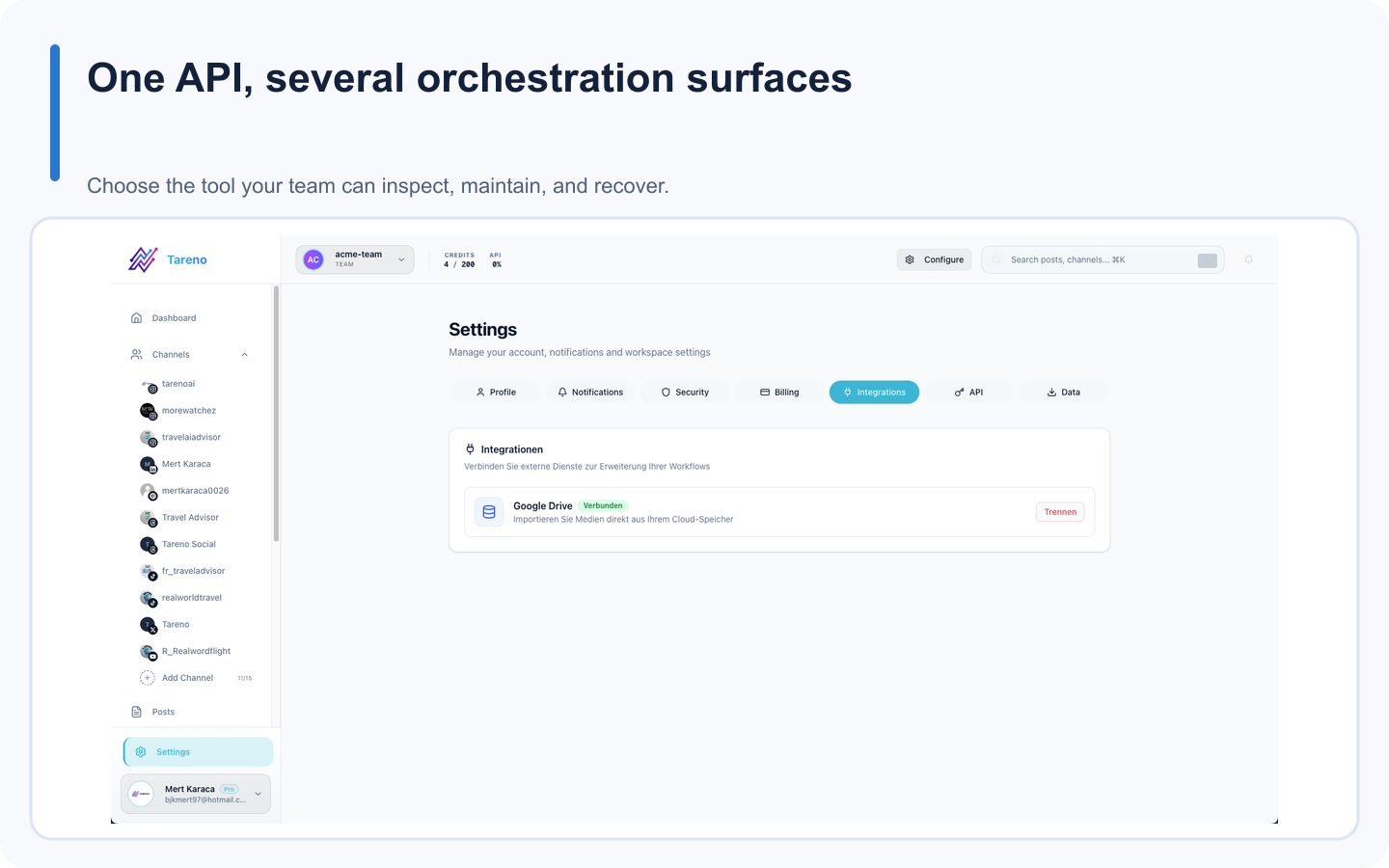
The same social contract can support code, visual scenarios, and trigger-based automation.
n8n
Best for:
self-hosted workflows
custom code
complex branching
policy layers
databases
technical teams
Make
Best for:
visual scenarios
routers
iterators
app mapping
non-developer maintenance
Zapier
Best for:
simple trigger-action flows
fast setup
straightforward app connections
The Tareno API can remain the underlying social layer.
API and MCP clients
Use the External API for server applications, background jobs, render pipelines, and deterministic integrations. Use MCP when an AI client should discover structured tools and operate within server-enforced approval boundaries.
The currently documented remote MCP clients are Codex, Claude Code, and Cursor over Streamable HTTP with a Bearer API key. ChatGPT requires a separate OAuth-based app or connector flow; do not copy the static Bearer configuration into ChatGPT.
In either interface, create drafts for reversible work. With the External API, your application must approve the exact revision before direct schedule, publish, or delete calls. With MCP, Tareno prepares dashboard approval for consequential scheduling, publishing, scheduled edits, and deletions.
Operations, testing, and security
Log:
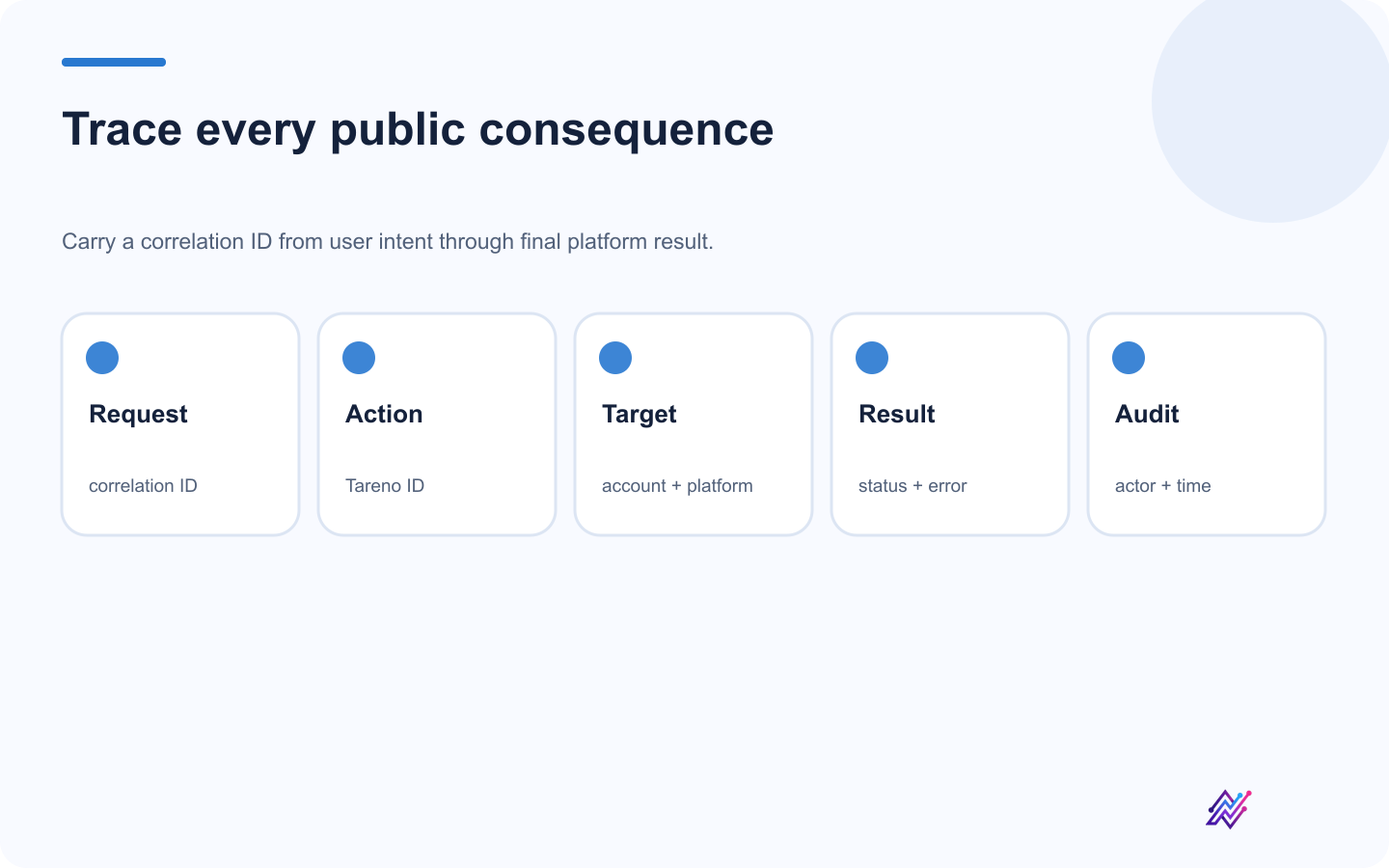
Traceability makes support, debugging, and governance possible after automation scales.
request ID
internal user
organization
internal tenant and API-key owner mapping
account
approved payload digest
caller-side deduplication key
Tareno action ID
response status
error
timestamp
latency
Do not log secrets.
For sensitive captions or client data, define retention and access policies.
Useful dashboards:
success rate
failure rate
approval time
publish latency
duplicate rate
rate-limit events
disconnected accounts
webhook failures
Testing strategy
Unit tests
Test:
payload building
account mapping
scope checks
idempotency keys
status mapping
Integration tests
Test:
draft creation
invalid account
missing field
approval flow
analytics response
media import
End-to-end tests
Test:
user request
draft
approval
scheduling
publication
analytics
Use staging accounts.
Do not test destructive behavior on important production accounts.
Security checklist
- [ ] Keep credentials server-side
- [ ] Use minimum scopes
- [ ] Separate staging and production
- [ ] Verify account ownership
- [ ] Verify the API-key owner and explicit connected account ID
- [ ] Validate payloads
- [ ] Validate media URLs
- [ ] Use idempotency keys
- [ ] Keep publishing behind approval
- [ ] Keep deletion behind approval
- [ ] Verify webhooks
- [ ] Prevent replay attacks
- [ ] Rotate credentials
- [ ] Avoid logging secrets
- [ ] Monitor failures
Reliability checklist
- [ ] Cache stable account metadata
- [ ] Cache platform requirements
- [ ] Queue bulk actions
- [ ] Use retry backoff
- [ ] Cap retries
- [ ] Store Tareno IDs
- [ ] Prevent duplicates
- [ ] Handle expired approval
- [ ] Handle disconnected accounts
- [ ] Use IANA timezones
- [ ] Reconcile final state
Common mistakes
Mistake 1: exposing the API key in the browser
Use a backend.
Mistake 2: hardcoding one platform form
Load the current versioned platform rules used by your backend; do not assume a requirements endpoint that the External API does not expose.
Mistake 3: selecting accounts by name only
Use IDs and ownership checks.
Mistake 4: treating accepted as published
Track action status.
Mistake 5: no idempotency
Retries can create duplicates.
Mistake 6: no approval layer
AI and public actions need control.
Mistake 7: polling too frequently
Use efficient status handling.
Mistake 8: ignoring media security
Validate URLs and file types.
Mistake 9: no observability
You need request and action traceability.
Mistake 10: rebuilding every platform directly
Use shared infrastructure where it creates leverage.
Twenty API product ideas
Social publishing inside a CRM
Social launch tool for SaaS products
Creator campaign portal
Client approval portal
AI social media agent
Multilingual campaign manager
YouTube repurposing app
Podcast-to-social platform
Internal employee-advocacy tool
E-commerce product-launch workflow
Channel-native distribution tool
Social analytics dashboard
Evergreen repost engine
Social content QA tool
Agency white-label dashboard
Founder content assistant
Webinar repurposing pipeline
Support-question-to-content tool
Competitor-insight-to-draft workflow
Social media operating system inside a vertical SaaS
Related Tareno resources
Automation API referenceUse the current endpoints, scopes, errors, and plan limits.MCP integrationGive AI clients structured access with enforced approvals.Media LibraryReuse validated assets across drafts and campaigns.Analytics reportsTurn published performance into the next content decision.
FAQ
What is a social media automation API?
It is an API that lets software create, schedule, publish, analyze, or manage content across social networks.
Why use Tareno instead of integrating every platform directly?
Tareno can centralize account connections, platform requirements, drafts, approvals, scheduling, analytics, and repurposing.
Can I build an AI agent with the API?
Yes. Wrap the API in narrow, validated tools and keep consequential actions behind approval.
Is the API the same as MCP?
No. The External API is designed for direct software requests and relies on the calling product to gate public writes. MCP is designed for AI clients to discover typed tools and routes consequential mutations through Tareno dashboard approval.
Can I build a client approval portal?
Yes. Your portal can manage the user experience while Tareno handles drafts, pending actions, publishing, and status.
Can the API publish to Bluesky and Mastodon?
Tareno supports both networks in its core platform and MCP catalog, but the current External API reference lists Instagram, Facebook, TikTok, YouTube, Threads, Pinterest, X, and LinkedIn. Treat that live supported-platform list as the contract for a custom API product.
Can I create multilingual posts?
Yes. Your application can generate localized versions and create separate Tareno drafts by language and market.
Can I use Get Viral Now through the API?
Quick Blueprint is available through the current MCP tool contract, not the External API publish surface. Use MCP for its source-bound quote and dashboard-approved run; use the YouTube transcript workflow when you only need public transcript evidence.
How do I prevent duplicate posts?
Use idempotency keys, source mappings, content hashes, and stored Tareno IDs.
Should users publish immediately?
Draft-first and approval-first workflows are safer for most products.
Final thoughts
Social publishing infrastructure is deeper than one API call.
It includes accounts, permissions, platform requirements, media, approvals, scheduling, failures, analytics, and audit state.
Your product may not need to rebuild that entire layer.
Use the Tareno API to handle social execution.
Keep your differentiated logic in your own application.
Create drafts first.
Use explicit account mapping.
Add approval before public actions.
Track every external effect.
Measure results.
Turn analytics into future content.
That is how a social media automation API can become infrastructure rather than another fragile integration.
Primary CTA: Open the Tareno API documentation and build a draft-only proof of concept.
Secondary CTA: Add approval-first scheduling after account mapping, idempotency, and status handling are complete.