To move a viral video blueprint into your content calendar, split the blueprint into what repeats (structure, length, text timing, call-to-action slot) and what changes every time (hook sentence, subject, occasion). Then write one calendar row per post. Each row needs a date, a full hook sentence, the audience question it answers, an owner, one CTA, a status, and the point where the work passes to the next person. The rest of this article does that for one blueprint and nine posts.
TL;DR
- A blueprint is a template that several entries borrow from; each entry must differ in hook, subject and viewer question.
- Add two columns: which blueprint block the row uses, and what is new in this row.
- Define hand-over points per person: who passes what, by when, against which check.
Quick definition
A video blueprint is a reusable breakdown of a reference video: hook, scene order, scene lengths, on-screen text, audio treatment and call-to-action slot, rewritten for your own brand. A calendar entry is one dated, owned, single-purpose post that uses that breakdown with new content.
The worked example
The example is a teaching case constructed for this article. It is not a real client, not a recorded product run, and it makes no performance claim. Names are placeholders, and the platforms (Instagram Reels and TikTok), the 20 to 25 second length and the posting capacity are assumptions.
The team. A regional bookshop, "Beispiel-Buchhandlung", with two people in marketing. Person A is a bookseller who films and edits. Person B runs events, checks facts and copy, and owns the calendar.
The input. A reference video from a retail creator: the creator holds up a product, gives a verdict in one sentence, shows proof in three quick cuts and ends with a call to action. The bookshop analysed it (for example with Get Viral Now, which according to its public page analyses hook, scene length, on-screen text and audio) and wrote its own blueprint.
The anchors. Three author readings: Thursday 19 November (crime author), Wednesday 25 November (non-fiction author) and Thursday 3 December (children's author).
Keep the Instagram formats and TikTok formats beside the blueprint: the same four-block structure does not guarantee the same publishing requirements.
Step 1: Split the blueprint into reusable and one-off parts
Do this before opening the calendar. The bookshop's blueprint, called "Verdict first":
Block 1  Verdict    One-sentence opinion, spoken while the book is held still
Block 2  Proof      Open page or shelf location, one cut
Block 3  Question   Answer one viewer question in a single line of text
Block 4  CTA slot   One action, shown as text and said aloud
Length   about 20-25 s (assumption)    Text timing: new line every 3-4 s
| Part | Reusable | One-off | Do not carry over |
|---|---|---|---|
| Structure | Four blocks in this order | ||
| Length and text rhythm | 20 to 25 s, new text line every 3 to 4 s | ||
| Hook | The pattern "verdict before proof" | The actual sentence | The reference creator's wording |
| Subject | The book, the author, the occasion | The reference product | |
| Footage and audio | Own shelf, own voice | The reference creator's footage and audio |
The last column matters. The calendar is built from your blueprint, never from the reference video itself. Rewriting hook and subject is what keeps nine posts from being nine copies of one clip.
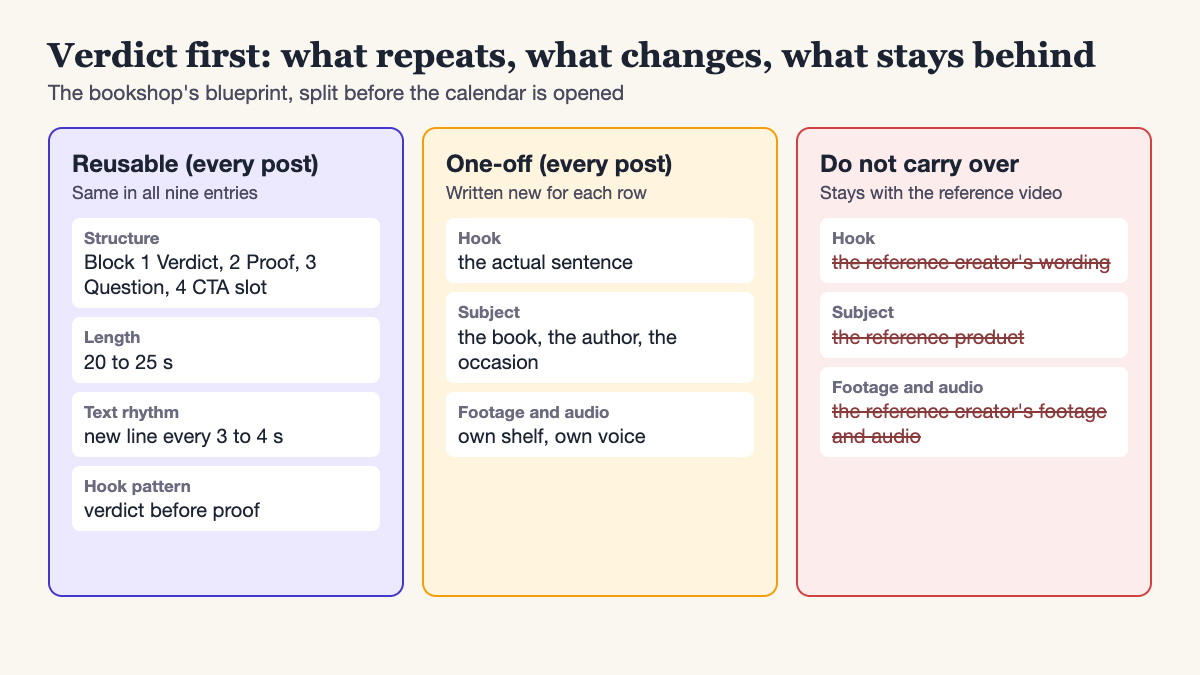
The same split as the table above, shown as three groups.
Step 2: Choose the sequence rule and the capacity
The bookshop sets one rule: every reading gets a run of lead-up (two to three days before), reading day, and follow-up, always on the same blueprint, always with a different viewer question. Three readings give nine posts, three per week, one reading per week. The last post of week 3 doubles as the round-up.
The capacity figures below are assumptions for this example, not benchmarks:
Person A (films, edits): 4 h per week for this plan
  per clip: film 30 min + edit 45 min = 75 min
  3 clips = 225 min = 3 h 45 min   -> fits, with 15 min spare

Person B (facts, rights, calendar): 2 h per week
  per clip: brief and fact check 10 min + review 20 min + scheduling 5 min = 35 min
  3 clips = 105 min = 1 h 45 min   -> fits, with 15 min spare
Under these numbers a fourth, reactive clip does not fit (another 75 min for A). The open slot in each week therefore stays empty unless a planned row is dropped or A has more hours. If the real minutes per clip are higher, take a row out rather than shorten the review.
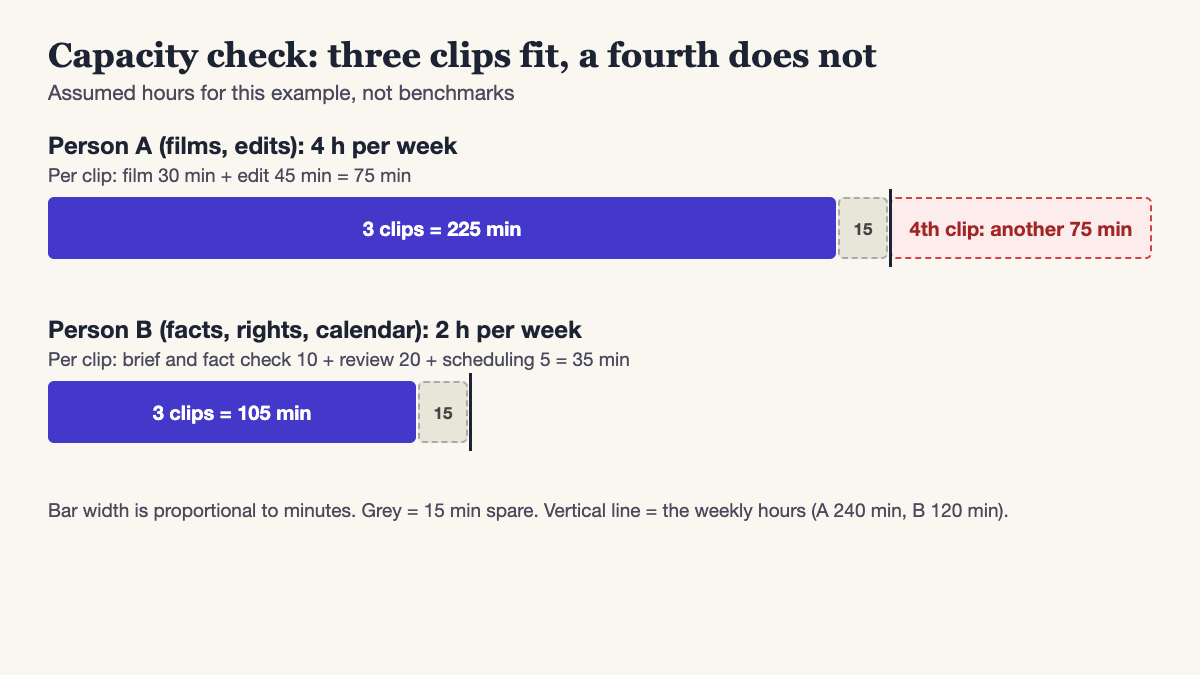
Assumed minutes from the calculation above, drawn to scale.
Two outside methods cover a different case, repurposing one shoot. A vendor blog, ReelsFarm, suggests stretching such clips across two to three weeks (untested); only the idea of spacing carries over. CLICK.BLUE (2024) tests an extraction log: if you cannot fill six rows without inventing new footage, the shoot was a single asset, not a source. The bookshop films new material per row, so its test is the "What is new" gate in Step 3.
Step 3: Use a calendar row that remembers the blueprint
Softomate describes a calendar schema with date and platform, pillar, format, working title, hook, body or script, one CTA per post, a status chain (Idea, Scripted, Filmed, Edited, Scheduled, Published) and a result field to fill 72 hours after publishing. It also says the hook should be a full sentence before a post counts as scripted. The page has inconsistent dates and unsourced statistics, so only the structure is used here.
Add the two columns that connect a row to its blueprint:
Date | Working title / hook sentence | Blueprint block used | What is new
Viewer question | Owner | CTA | Status | Hand-over | Result note (72 h)
"What is new" is a check, not a formality. If you cannot name a new subject and a new viewer question, the row does not go in.
Step 4: Write the nine entries
Hook sentences and scenes are written by the bookshop team for this example. Each reading has a lead-up, a reading-day post and a follow-up: entries 1 to 3 are the crime reading (19 Nov), 4 to 6 the non-fiction reading (25 Nov), 7 to 9 the children's reading (3 Dec). Entry 9 is also the round-up. Status is as of the planning day. Every hook is written as a verdict. The hooks of Entries 3 and 9 are drafts: they depend on the event and are finalised afterwards (see Step 5).
| # | Date | Role | Hook sentence | Viewer question | Owner | CTA | Status |
|---|---|---|---|---|---|---|---|
| 1 | Mon 16 Nov | Lead-up | "If you read crime novels at five in the morning, this is the one to pick up before Thursday." | Is it worth it without spoilers? | A films, B checks | Ticket link in bio | Scripted |
| 2 | Thu 19 Nov | Reading day | "Verdict: tonight is the evening to hear how this crime novel was written." | What will it be like on site? | A | "Seats at the door" | Scripted |
| 3 | Fri 20 Nov | Follow-up | "Verdict on the evening: this was the best question, and the author's answer in one line." | What did the audience ask? | B (rights), A | Signed copies | Idea |
| 4 | Mon 23 Nov | Lead-up | "One sentence on this book: it explains the subject without assuming you know it." | Is it for beginners? | A | Ticket link in bio | Idea |
| 5 | Wed 25 Nov | Reading day | "Verdict: if this subject always felt too big, tonight is the way in." | Can I still get a seat? | A | Remaining tickets | Idea |
| 6 | Fri 27 Nov | Follow-up | "Two books on the same topic. Start with this one." | Which one first? | A | Order link | Idea |
| 7 | Mon 30 Nov | Lead-up | "For parents: this picture book is built for reading aloud together." | From what age? | A | Ticket link | Idea |
| 8 | Thu 3 Dec | Reading day | "Verdict: a reading hour short enough for small attention spans." | How long does it last? | A | Registration | Idea |
| 9 | Sat 5 Dec | Follow-up and round-up | "Verdict on three readings: one of them we will repeat." | Which reading next time? | A films, B on camera | Newsletter | Idea |
The second table carries the two columns from Step 3 and the hand-over date for check (c) from Step 5.
| # | Blueprint block used | What is new | Hand-over (c) by |
|---|---|---|---|
| 1 | Blocks 1 to 4 | Crime novel; spoiler question | Fri 13 Nov |
| 2 | Blocks 1, 3, 4; Block 2 is the room set-up instead of a page | Event evening; on-site question | Tue 17 Nov |
| 3 | Blocks 1 to 4; Block 2 is the approved quote | Audience question; author's answer | Fri 20 Nov, morning; scheduled the same day |
| 4 | Blocks 1 to 4 | Non-fiction title; beginner question | Fri 20 Nov |
| 5 | Blocks 1, 3, 4; Block 2 is the stage or shelf | Second event evening; seat question | Mon 23 Nov |
| 6 | Blocks 1 to 4 | Second title for comparison; "which first" question | Wed 25 Nov |
| 7 | Blocks 1 to 4 | Picture book; age question | Fri 27 Nov |
| 8 | Blocks 1, 3, 4; Block 2 is the reading corner | Family event; duration question | Tue 1 Dec |
| 9 | Blocks 1, 3, 4; Block 2 is a collage of three covers | Round-up of three readings; poll question | Fri 4 Dec; scheduled the same day |
Each week also keeps one open slot that no row occupies (see Step 2). Scene notes for four rows follow:
Entry 1 (crime, lead-up, Mon 16 Nov)
  Block 1  A holds the novel still, says the hook sentence to camera.
  Block 2  One cut to the first page, thumb on the opening line.
  Block 3  Text: "Spoiler-free: the ending is not mentioned here."
  Block 4  Text and voice: "Tickets for Thursday, link in bio."

Entry 3 (crime, follow-up, Fri 20 Nov)
  Block 1  A says the hook sentence over a still of the empty stage.
  Block 2  The approved quote as text, with the author's voice only if cleared.
  Block 3  Text: the question as asked at the event (final wording after the reading).
  Block 4  "Signed copies on the shelf, link in bio."

Entry 7 (children's, lead-up, Mon 30 Nov)
  Block 1  Hook sentence with the picture book held up.
  Block 2  A double page with large illustration.
  Block 3  Text: "[age from publisher's guide]"
  Block 4  "Tickets for 3 December, link in bio."

Entry 9 (round-up, Sat 5 Dec)
  Block 1  B says the hook sentence to camera; A films.
  Block 2  Collage of the three covers, one cut per cover.
  Block 3  Text: "Vote in the comments: crime, non-fiction or children's?"
  Block 4  "Newsletter sign-up, link in bio."
The other five rows follow the same four blocks with their own subject. Entry 7 has a placeholder in Block 3 on purpose: the age comes from the publisher's guide, not from the team's opinion.
Entry 3 carries a rights rule: a quote from the reading is used only with the author's written approval. That is why Person B is the first owner, and why the row stops at check (c) until the approval is in.
Step 5: Fix the hand-over points
Statuses say where a row is; hand-over points say who must do what before it moves.
With D as the posting day:
(a) D-7   B -> A   Brief with confirmed facts: date, time, ticket price, title
(b) D-5   A -> B   Script: hook is a full sentence; one CTA only
(c) date in the second table, A -> B
                   Edit: captions checked, rights cleared (author, music),
                   CTA link works
(d) D-1   B        Date fixed in the calendar, post scheduled
                   (follow-ups: same day as (c), see exception below)
(e) D+3   B        Result note (72 h); decide: keep, change or drop blueprint
Dates are calendar days; if nobody works on weekends, move a weekend hand-over to the Friday before.
Exception for the two event-dependent follow-ups (Entries 3 and 9). Their footage and final hook exist only after the reading, so the standard order cannot hold. (b) at D-5 is a draft script with a placeholder hook; the real hook is finalised after the event. The edit and the check (c) happen on the day after the reading (Entry 3: Fri 20 Nov morning; Entry 9: Fri 4 Dec), and (d), scheduling, follows on the same day once (c) has passed. Entry 3 is posted on Fri 20 Nov, Entry 9 on Sat 5 Dec. Entry 1 in practice, on the standard order: brief to A on Mon 9 Nov, script to B on Wed 11 Nov, edit to B on Fri 13 Nov, scheduled on Sun 15 Nov, post on Mon 16 Nov, result note on Thu 19 Nov.
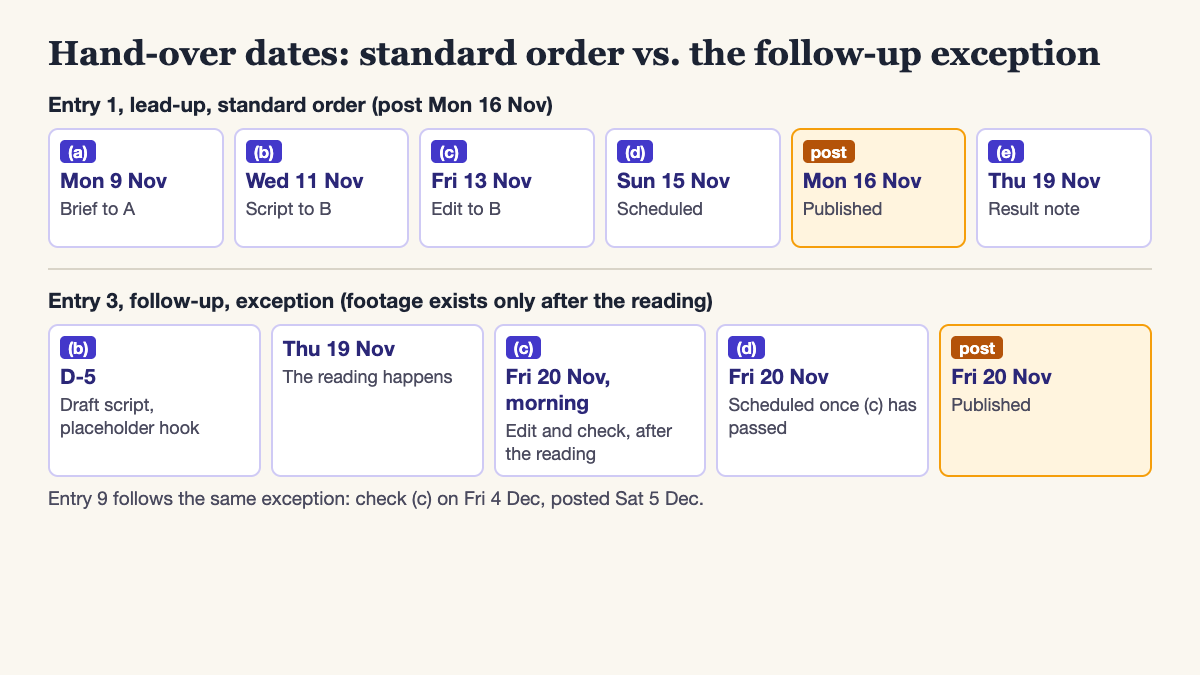
Entry 1 on the standard order, Entry 3 on the follow-up exception.
Check (c) is where Entry 3 stops until the author has approved the quote. Check (e) is where the blueprint's life gets decided (next section). Vidrial offers a similar review board with fields such as source timecode, destination, approval owner and result note. Its example week is hypothetical by its own account and the page promotes a product, so treat it as a field list, not as evidence.
Step 6: Decide how long the blueprint lives
A blueprint carries as many entries as you can give new subjects and questions, and it ends when the reference format has expired.
| Blueprint type | Typical lifespan | Re-research when |
|---|---|---|
| Format-based ("verdict first") | Several weeks, as long as subject and question change | Result notes show you would change structure, not just subject |
| Trend-bound (sound or challenge) | Short; SocialPilot describes a trend cycle with a peak around days 4 to 10 and decline after day 11 (a vendor claim) | The trend has passed its peak when the row is due |
For the bookshop, "verdict first" is format-based, so the three-week plan stands. A trend-bound blueprint would need its entries scheduled within about a week or be dropped.
The effect of the plan on reach is not known: the example has no measurement, and nothing here promises results. The result note after 72 hours is what turns it into evidence for the next run.
Use the analytics reports to check available channel results when writing the 72-hour note. The note and the decision to change the blueprint remain the team’s work.
Where Tareno fits
This part depends on tooling, and some of it is not confirmed from public pages.
- Blueprint: the Get Viral Now page describes a blueprint with hook, scenes, B-roll, on-screen text, script, audio and notes, handed to Content Boards or the Composer. It is listed for the Business plan; "Viral Research" is marked as an admin beta there.
- Board: Content Boards describes a Kanban board whose cards carry a brief, owner and due date, with review columns and a path from a card into the Composer. Whether hook and scenes travel into the card automatically is not stated, so copy them into the brief yourself.
- Calendar: Post Scheduling describes week, month and day views with drag and drop. The Boards page does not say that cards appear in the calendar, so check that in a trial rather than assuming it.
How check (c) is supported in a tool is not covered here; in the example, Person B does it by hand. If you want to turn one finished video into platform versions afterwards, see one idea to platform-native posts.
When to use this, and when not
| Use it when | Do not use it when |
|---|---|
| You have a recurring occasion (event, launch, season) that can host a sequence | The reference is a one-off trend with a short window |
| Two or three people share filming, review and scheduling | You cannot name a new subject and viewer question per row |
| You want hooks and CTAs that differ per post | You would copy the reference's wording, footage or audio |
| You will record result notes and act on them | You will never look at results and would repeat the same plan |
Common mistakes
- Planning from the reference video instead of your own blueprint.
- Marking a row "Scripted" with only a topic and no full hook sentence.
- Giving a row two CTAs.
- Skipping the rights check on quotes, music or guest footage.
Key takeaways
- Separate the reusable structure from the one-off hook and subject before planning dates.
- Give every row a role, a blueprint block, a "what is new" and a hand-over date.
- Estimate minutes per clip for each person before you fix posts per week.
FAQ
How many posts can one blueprint carry?
As many as you can fill with a new subject and a new viewer question, and as many as your people can film and check. The example uses nine over three weeks.
Does every entry need a different hook?
Yes. The pattern repeats (verdict before proof), but the sentence must differ in every row.
Who should own which step with only two people?
Split by job: one person produces (script, filming, edit), the other checks facts, rights and the CTA link and owns the calendar date, as A and B do in Step 5.
What should the status field say?
Idea, Scripted, Filmed, Edited, Scheduled, Published. Add the hand-over check next to it so "Edited" cannot move to "Scheduled" before rights and links are cleared.
When do I research a new blueprint?
When result notes point to a structural change, a trend-bound format has passed its peak, or rows no longer get a new subject (Step 6).
Can I copy the reference video's text or audio into my entries?
No. Reuse structure and rhythm only. Write your own hook, use your own footage and clear any music rights.
Conclusion
A blueprint becomes a calendar when each row says which block it uses, what is new in it, who hands it to whom and what check must pass. Try the nine-row layout on your next recurring event, then record the 72-hour note and decide whether to keep the blueprint.
To build the blueprint, start from Get Viral Now, then check in a trial whether your board cards show up in the calendar.