The easiest way to overcomplicate social media automation is to begin with tools.
A team opens n8n, Make, Zapier, or an AI-agent platform and immediately starts connecting nodes.
The workflow looks impressive.
The business value is unclear.
A better starting point is the repeated problem.
Ask:
Which task happens often?
Which task follows a predictable pattern?
Which task requires judgment?
Which task creates delays?
Which task creates avoidable mistakes?
Which result should become the next action?
Then choose the right execution model.
Use:
Tareno Workflow Builder for native recurring social logic
Zapier for simple app-to-app automation
Make for visual scenarios and multiple branches
n8n for technical, self-hosted, or deeply customized workflows
MCP and AI agents for flexible natural-language reasoning
Tareno API for custom products and internal systems
This guide provides 50 concrete automation ideas organized by stage.
Every idea can be adapted to creators, agencies, SaaS teams, brands, or internal marketing departments.
The most important design principle remains the same:
Automate repetitive preparation aggressively. Keep consequential publishing visible and reviewable.
Quick decision guide
Workflow needBest starting pointSimple trigger and actionZapierVisual multi-branch scenarioMakeSelf-hosted or custom logicn8nNatural-language decisionsMCP agentCustom product integrationTareno APIRecurring native social workflowTareno Workflow Builder
The tools can also be combined.
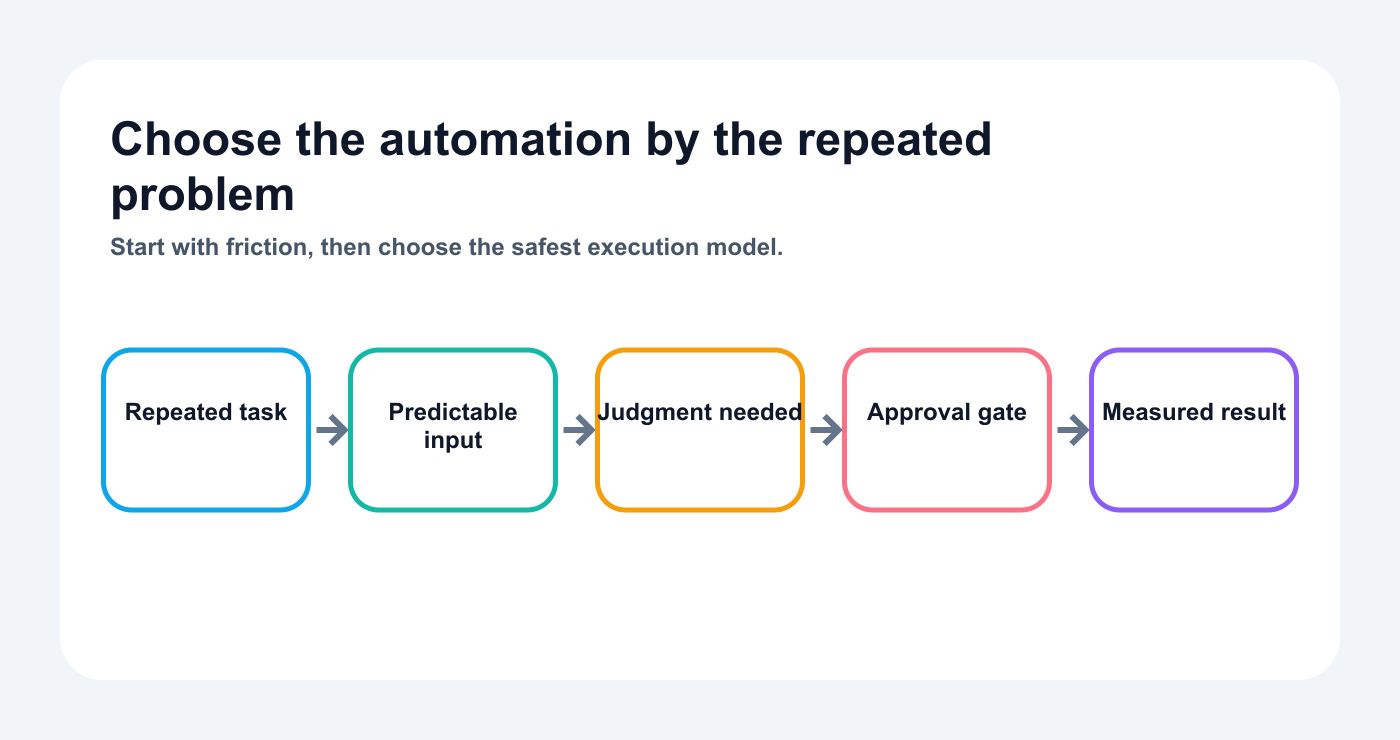
A useful automation begins with repeated friction, not a favorite tool.
Example:
Notion trigger in Make
  ↓
AI creates platform versions
  ↓
Tareno drafts
  ↓
Human approval
  ↓
Tareno publishes
  ↓
n8n creates reporting tasks
  ↓
OpenClaw reviews performance
Content intake and research automations
1. RSS feed to draft queue
Trigger: New article in an RSS feed
Action: Summarize the source, create platform-native drafts, and save them in Tareno.
Best for:
company blogs
industry news
knowledge bases
creator publications
Recommended control:
drafts only
preserve source URL
check claims before approval
2. New blog post to multi-platform campaign
Trigger: Blog status changes to published
Action: Create separate drafts for LinkedIn, Threads, Bluesky, Mastodon, X, Facebook, and Pinterest.
Do not produce one universal caption.
Use a platform router.
Store:
article URL
campaign ID
primary CTA
platform version
measurement date
3. YouTube URL to Get Viral Now
Trigger: A YouTube URL is added to Airtable, Notion, a form, or an agent conversation
Action: Retrieve the transcript, analyze structure, and generate an original script.
Outputs may include:
TikTok script
Reel script
YouTube Short
LinkedIn post
Bluesky thread
Mastodon post
Control:
no copied wording
source remains visible
human script review
4. Podcast episode to content atoms
Trigger: New podcast episode
Action: Extract questions, stories, opinions, frameworks, and quotes with context.
Create:
five text-post ideas
three short-form scripts
one carousel
one FAQ article
one email section
Use AI for extraction.
Use Tareno for draft and campaign organization.
5. Webinar transcript to a 30-day plan
Trigger: Webinar transcript becomes available
Action: Divide the transcript into educational themes and build a month-long calendar.
Useful categories:
core lessons
objections
audience questions
demonstrations
examples
CTA moments
Do not schedule every output automatically.
Approve the plan first.
6. Customer-support questions to FAQ posts
Trigger: Repeated question appears in support software
Action: Create an educational draft.
Examples:
“How does approval work?”
“Can I schedule to Bluesky?”
“How do I connect n8n?”
“Can an AI agent publish?”
High-value questions can become:
short post
carousel
help article
demo video
comparison page
7. Sales objections to content ideas
Trigger: Objection tagged in CRM
Action: Add it to a content-research board and propose responses.
Examples:
too expensive
too complex
already using another tool
worried about AI quality
worried about account safety
Require product or sales review before publishing claims.
8. Reddit or community thread to draft idea
Trigger: Relevant discussion is discovered
Action: Summarize the underlying problem and create an original response angle.
Important:
do not copy community comments
do not pretend to have experience you do not have
preserve source context
add real product or user evidence
9. Competitor topic monitoring
Trigger: Competitor publishes a new guide, release, or video
Action: Classify the topic and identify an unanswered angle.
Possible outputs:
alternative viewpoint
deeper tutorial
fair comparison
missing workflow
customer question
implementation guide
Avoid unsupported competitor claims.
10. Search-query cluster to content board
Trigger: New keyword list or search-query export
Action: Group queries by intent and create article briefs.
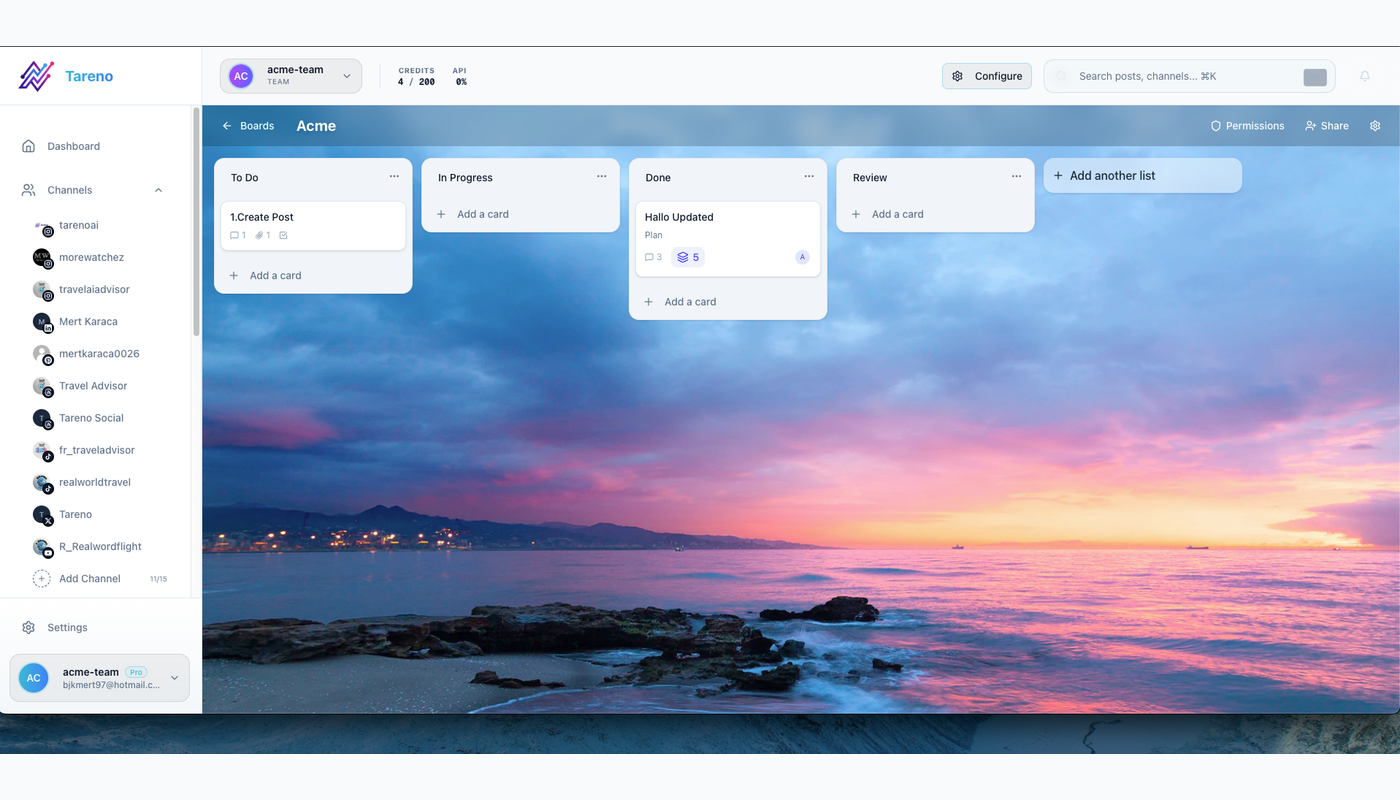
A structured ideas board gives search signals and audience questions a visible owner and next step.
Intent groups:
how-to
comparison
alternative
pricing
integration
template
troubleshooting
use case
Create one board item per cluster, not per keyword.
Drafting and repurposing automations
11. One idea to seven platforms
Trigger: Source idea approved
Action: Create native versions for seven target platforms.
Adapt:
hook
context
format
CTA
length
hashtags
asset
The source idea is shared.
The final captions are not.
12. LinkedIn winner to carousel
Trigger: LinkedIn post exceeds save baseline
Action: Create a carousel outline and new visual brief.
Store:
source post
performance signal
slide count
CTA
design owner
review status
13. High-comment post to FAQ series
Trigger: Post receives a high number of useful questions
Action: Cluster comments and create a FAQ content series.
Possible output:
one answer per post
one long guide
one short video series
one webinar topic
14. High-save post to evergreen queue
Trigger: Post exceeds save threshold and passes freshness review
Action: Add it to Tareno’s evergreen repurposing queue.
Before reusing:
verify claims
update screenshots
remove expired dates
adapt the hook
check recent duplicates
15. Long video to short-form script pack
Trigger: Video transcript approved
Action: Create five short-form scripts with different hooks.
Versions:
direct
contrarian
story-led
educational
demonstration-led
Test one variable at a time where possible.
16. Blog section to Bluesky thread
Trigger: A blog section is marked repurpose-ready
Action: Create a concise thread.
Rules:
remove corporate filler
keep one main idea
make every post understandable
avoid copying headings mechanically
17. Blog section to Mastodon guide
Trigger: Educational section selected
Action: Create a context-rich Mastodon post.
Check:
content warning
relevant hashtags
link placement
alt text
community tone
18. Product release notes to social package
Trigger: Feature marked released
Action: Generate:
launch announcement
use-case post
founder post
demo script
FAQ
Bluesky version
Mastodon version
Provide approved release notes.
Do not let AI invent availability.
19. Testimonial to social proof draft
Trigger: Testimonial approved for use
Action: Create platform-specific proof content.
Required fields:
consent
exact quote
approved customer name
claim context
CTA
usage rights
Keep the final post behind approval.
20. Case study to a week of content
Trigger: Case study published
Action: Extract:
problem
old process
intervention
result
lesson
CTA
Create five different posts rather than repeating the same result.
Approval and governance automations
21. Draft-ready notification
Trigger: Draft status becomes ready for review
Action: Notify the assigned reviewer.
Notification should include:
title
platform
account
deadline
risk level
Tareno link
Avoid copying the entire approval process into chat.
22. Approval reminder
Trigger: Approval remains pending near deadline
Action: Send one concise reminder.
Escalate only when:
publish date is at risk
campaign dependency exists
client deadline is approaching
Avoid daily notification noise.
23. Risk-based approval routing
Trigger: Draft created
Action: Classify risk and assign reviewer.
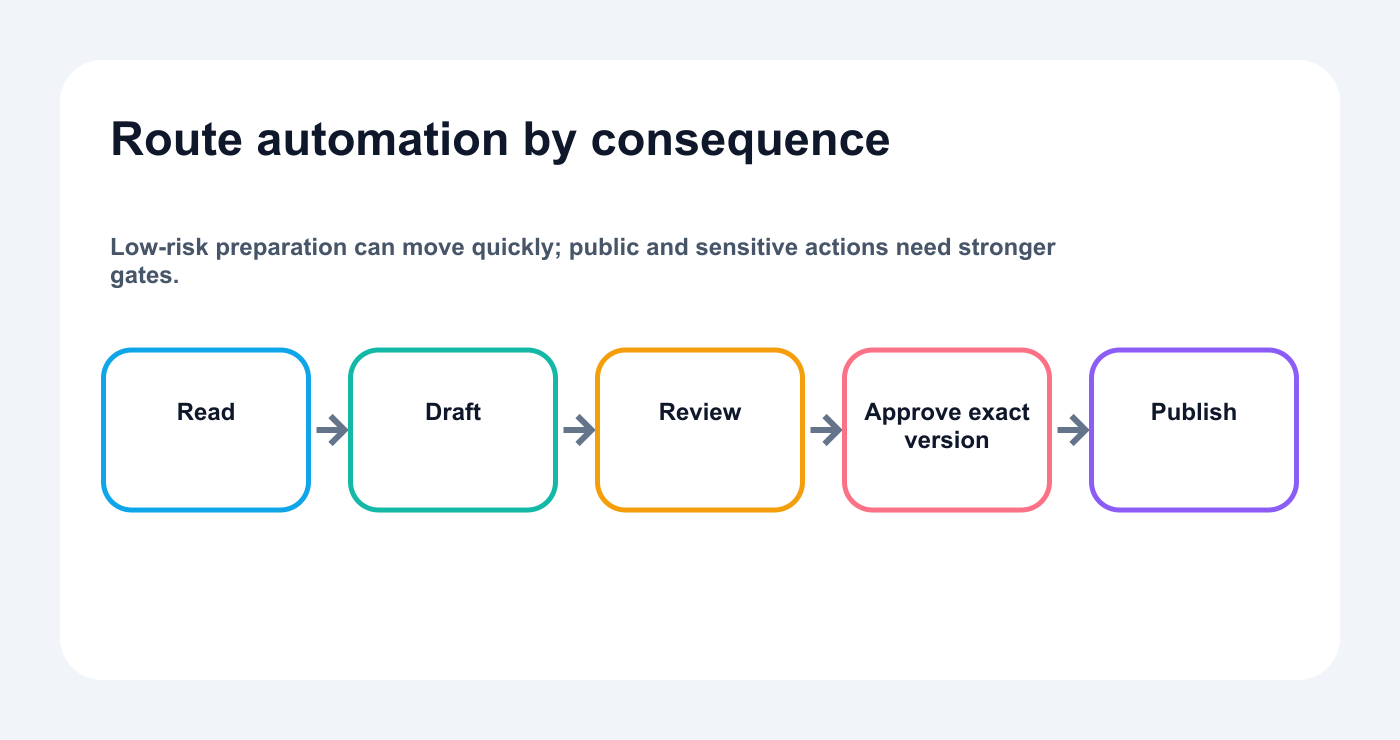
Approval strength should rise with account, reputational, and publishing risk.
Rules:
pricing → product or finance
competitor mention → marketing or legal
customer result → customer success
sponsor post → brand
Japanese or Arabic major campaign → native reviewer
deletion → final approver
24. Material-change reapproval
Trigger: Approved content is edited
Action: Compare versions.
Require reapproval when:
claim changes
asset changes
CTA changes
account changes
schedule changes materially
disclosure changes
Small spelling corrections may follow a lighter policy.
25. Client workspace approval queue
Trigger: Agency draft ready
Action: Add to client-specific approval queue.
Use:
separate workspace
explicit client account
client reviewer
deadline
final-version history
Never mix client accounts in one ambiguous queue.
26. Sponsor-content disclosure check
Trigger: Content marked sponsored, gifted, affiliate, or paid
Action: Require disclosure and brand review.
Check:
disclosure wording
platform tool
caption placement
usage rights
final sponsor approval
27. Content quality-control gate
Trigger: Item approved for scheduling
Action: Run final QC.
Check:
correct account
final caption
final asset
link
CTA
claims
disclosure
time
timezone
campaign label
measurement date
28. Wrong-account prevention
Trigger: Schedule request
Action: Compare workspace, brand, and account mapping.
Reject when:
account does not belong to workspace
client name does not match
language account is wrong
platform mismatch exists
This should be deterministic.
29. Calendar conflict detection
Trigger: New schedule prepared
Action: Check for:
duplicate topic
same account collision
campaign overlap
repeated CTA
wrong timezone
too many posts in one period
Return a warning before approval.
30. Expired approval workflow
Trigger: Pending action exceeds approval window
Action: Mark expired and request fresh review.
Do not execute based on stale approval.
This matters when:
content changed
campaign date passed
pricing changed
asset became outdated
Publishing and distribution automations
31. Approval to scheduled post
Trigger: Final approval recorded
Action: Schedule through Tareno.
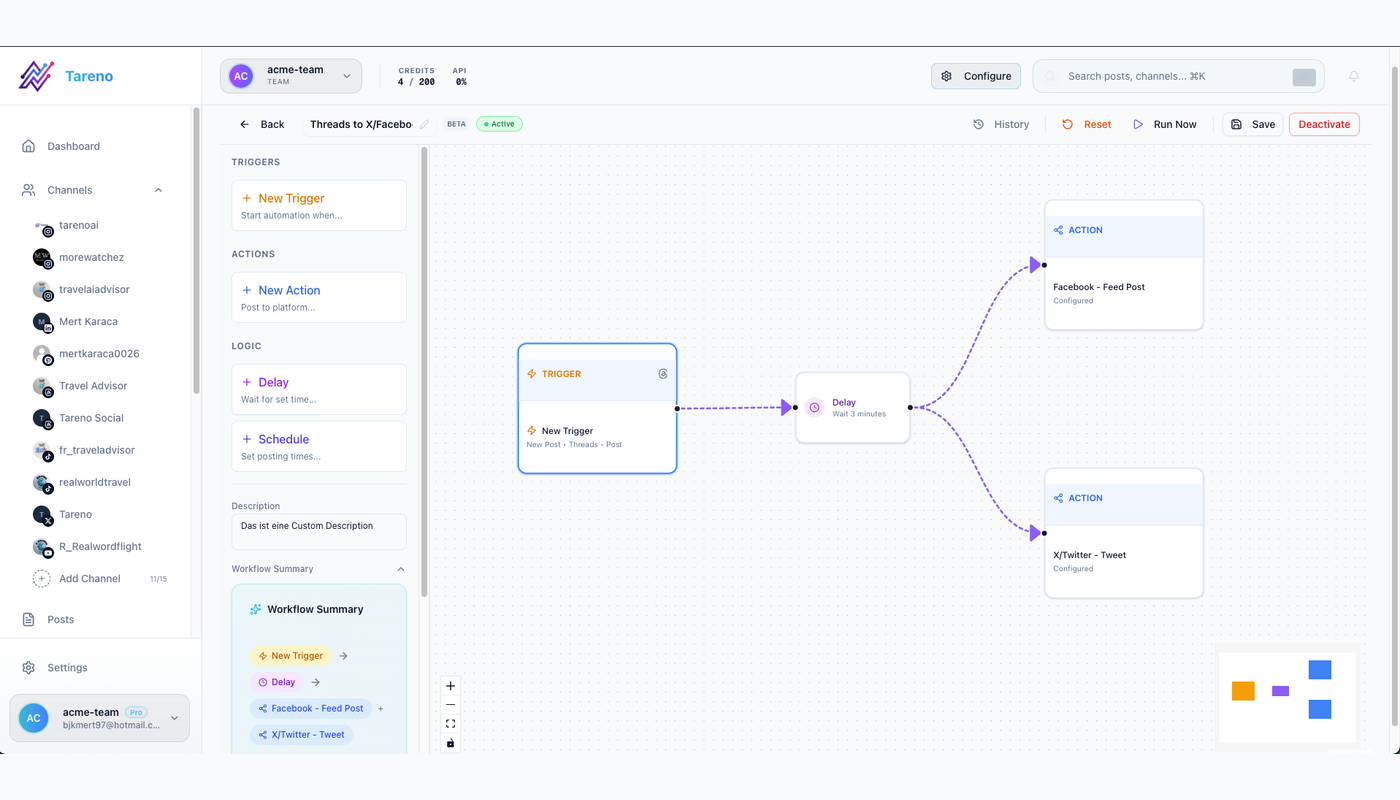
Visible triggers and actions make an approval-to-schedule workflow easier to test and audit.
Store:
approval ID
action ID
post ID
final version
scheduled time
timezone
32. Delayed cross-platform sequence
Trigger: Source post published
Action: Publish adapted versions after delays.
Example:
LinkedIn on Monday
Bluesky on Tuesday
Mastodon on Wednesday
Threads on Thursday
Pinterest next Monday
The versions should already be approved.
33. Bluesky and Mastodon expansion
Trigger: Existing post marked open-network ready
Action: Create separate Bluesky and Mastodon drafts.
Bluesky:
concise
self-contained
low-hype
Mastodon:
more context
community-aware
content warning where relevant
34. Campaign launch across workspaces
Trigger: Global campaign approved
Action: Create market-specific schedules across approved workspaces.
Use explicit mappings:
campaign + language + workspace + account + platform
Do not select accounts dynamically by name alone.
35. Local-time scheduling
Trigger: Language draft approved
Action: Convert campaign time into the target market’s IANA timezone.
Display both:
local market time
normalized UTC time
Review before scheduling.
36. Event reminder sequence
Trigger: Event date set
Action: Create reminders:
one week before
one day before
one hour before
follow-up after event
Avoid publishing all reminders if registration closes or event changes.
Add a cancellation condition.
37. Product-launch countdown
Trigger: Launch date confirmed
Action: Prepare a sequence:
problem
teaser
use case
launch
demo
FAQ
follow-up proof
Every item should connect to the same campaign.
38. New platform account activation
Trigger: Bluesky or Mastodon account connected
Action: Build a starter queue from selected evergreen content.
Do not repost the entire archive.
Choose:
high-value evergreen posts
accurate product education
introductory brand content
community questions
39. Campaign asset completion
Trigger: Final asset uploaded
Action: Attach it to all approved platform drafts that reference the asset.
Run platform validation.
Do not attach one visual everywhere if dimensions or text are unsuitable.
40. Failed-publish incident workflow
Trigger: Publishing fails
Action: Classify the error.
Routes:
authentication → alert owner
invalid media → return to designer
platform outage → retry
missing field → return to editor
expired approval → request new approval
Preserve the action ID and payload.
Analytics and optimization automations
41. Seven-day performance review
Trigger: Seven days after publishing
Action: Retrieve analytics and compare with baseline.
Create:
performance summary
interpretation
next action
repurposing suggestion
42. Monthly account report
Trigger: Month ends
Action: Produce a client- or team-ready report.
Include:
executive summary
KPI scorecard
top posts
weak posts
decisions
next-month plan
workflow bottlenecks
Do not produce a metrics dump.
43. Analytics to repurposing task
Trigger: Post exceeds selected signal
Action: Create a new format task.
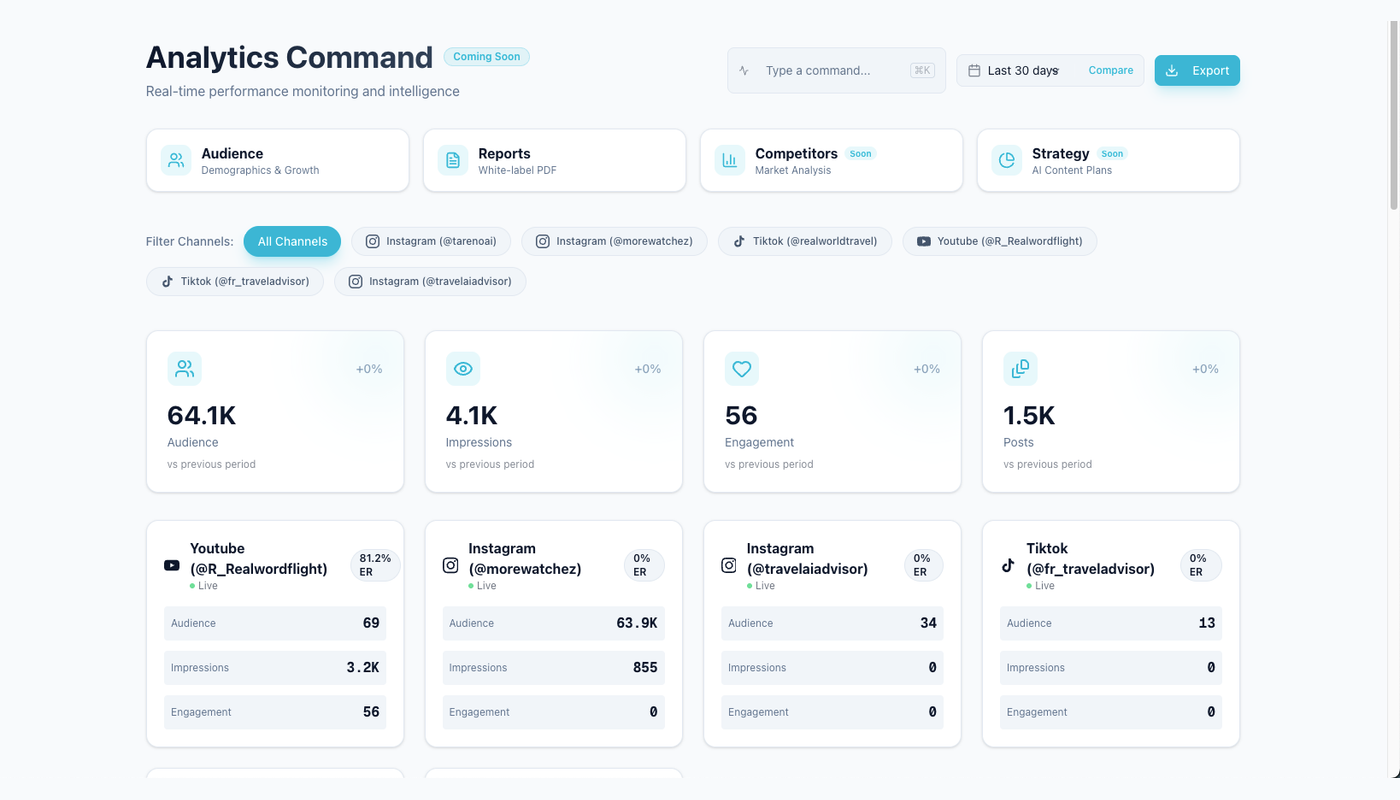
Analytics create value when a winning signal becomes a specific repurposing task.
Examples:
high saves → checklist
high comments → FAQ
high clicks → landing-page content
strong watch time → new video
strong shares → broader campaign
44. Weak CTA detection
Trigger: Content receives attention but low clicks or conversions
Action: Create CTA test variants.
Test:
wording
placement
offer
destination
urgency
specificity
Do not change several variables at once without reason.
45. Hook performance library
Trigger: Video measurement completes
Action: Store hook type and retention result.
Hook categories:
direct promise
mistake
contradiction
story
proof first
question
unpopular opinion
Over time, build an account-specific hook library.
46. Platform opportunity report
Trigger: Monthly review
Action: Compare content performance by platform.
Identify:
platform to expand
platform to reduce
best content type
underused account
strong cross-platform topic
Use each platform’s own baseline.
47. Language-performance comparison
Trigger: Multilingual campaign completes
Action: Compare results by language and market.
Ask:
which topic transferred globally?
which market needs a different CTA?
where did local content outperform the master?
which version deserves a local follow-up?
48. Comment-to-content mining
Trigger: New comment batch
Action: Cluster:
questions
objections
praise
confusion
feature requests
debate topics
Create new content tasks from recurring themes.
49. Evergreen freshness review
Trigger: Evergreen item reaches review date
Action: Check:
product accuracy
pricing
screenshots
links
dates
statistics
platform fit
recent duplicates
Approve, update, or archive.
50. Weekly AI social media operator
Trigger: Weekly scheduled agent run or manual request
Action: Review:
analytics
pending approvals
failed actions
unused drafts
evergreen queue
content gaps
next calendar
Output:
highest-priority issue
highest-potential content opportunity
drafts worth finishing
posts worth repurposing
schedule risks
recommended next actions
Do not publish automatically.
Use the agent to prioritize the work.
How to choose the right automation
Score each workflow across five areas.
AreaQuestionFrequencyDoes it happen often?PredictabilityAre the steps stable?JudgmentDoes it require interpretation?RiskCan a mistake create public harm?ValueDoes automation save meaningful time or improve output?
Deterministic workflow
Use when:
steps are predictable
data is structured
background execution is useful
Choose:
Tareno Workflow Builder
Zapier
Make
n8n
Agentic workflow
Use when:
the task is ambiguous
analysis matters
steps change
the user wants a conversational interface
Choose:
Tareno MCP
ChatGPT
Codex
OpenClaw
Hermes Agent
custom agent
Recommended rollout order
Do not implement all 50 ideas at once.
Phase 1: visibility
Start with:
account audit
analytics summary
pending approval review
failed-publish alerts
Phase 2: draft production
Add:
RSS to drafts
YouTube to drafts
one idea to multiple platforms
multilingual first drafts
Phase 3: approvals
Add:
risk routing
reminders
reapproval
QC gate
Phase 4: publishing
Add:
approval to schedule
delayed cross-platform sequences
local-time scheduling
Phase 5: learning loop
Add:
seven-day review
analytics-to-repurposing
hook library
local winner detection
weekly agent operator
This order builds reliability before autonomy.
Data fields to standardize
Every automation becomes easier when the core data model is consistent.
Recommended fields:
Source ID:
Campaign ID:
Workspace ID:
Account ID:
Platform:
Language:
Market:
Content type:
Caption/script:
Asset:
CTA:
Risk level:
Reviewer:
Approval status:
Schedule:
Timezone:
Tareno draft ID:
Tareno action ID:
Tareno post ID:
Measurement date:
Repurposing status:
Standardization reduces custom mapping.
Duplicate prevention
Use a composite key:
sourceId + platform + accountId + language + actionType
Store:
content hash
Tareno draft ID
action ID
post ID
source version
status
Before creating a new item:
check existing key
inspect state
update when appropriate
skip duplicates
create only when necessary
This matters for agents, retries, schedulers, and repeated triggers.
Approval policy
Recommended defaults:
ActionDefaultRead analyticsDirectList accountsDirectCreate draftDirectCreate repurposing taskDirectPrepare scheduleDirectExecute scheduleApprovalPublish nowApprovalEdit scheduled postApprovalDeleteApprovalChange account connectionApproval
Higher-risk content requires additional review.
Security checklist
- [ ] Store credentials securely
- [ ] Use minimum scopes
- [ ] Separate staging and production
- [ ] Protect webhooks
- [ ] Validate inbound data
- [ ] Use explicit workspace and account IDs
- [ ] Keep publishing behind approval
- [ ] Keep deletion behind approval
- [ ] Validate media URLs
- [ ] Use idempotency
- [ ] Store action IDs
- [ ] Add retry limits
- [ ] Log failures
- [ ] Revoke unused access
Common automation mistakes
Automating before defining the workflow
Fix the process first.
Publishing directly from unreviewed AI output
Create drafts first.
Using one caption everywhere
Adapt by platform.
No source traceability
Store URLs and source IDs.
No duplicate protection
Use IDs and hashes.
No error route
Every production workflow needs failure handling.
Too many notifications
Notify only when action is required.
No analytics loop
Automation should create future decisions.
No account mapping
Use explicit IDs.
Choosing tools based on hype
Choose based on workflow needs.
FAQ
Related Tareno resources
Build the next part of this workflow
MCP guideExplore resource →Zapier guideExplore resource →Approval workflowsExplore resource →Social analyticsExplore resource →
What social media tasks can be automated?
Research, intake, drafting, platform adaptation, localization, approvals, scheduling, reporting, repurposing, and error handling can all be automated to different degrees.
Should AI publish automatically?
For most teams, AI should create and prepare work while public publishing remains approval-first.
Is n8n better than Make?
n8n is strong for technical control and self-hosting. Make is strong for visual scenarios and non-developer maintenance.
Is MCP better than Zapier?
MCP is useful for interactive AI-agent tasks. Zapier is useful for simple deterministic triggers and actions.
Can Tareno automate Bluesky and Mastodon?
Yes, when the accounts and final feature operations are available. Create separate native versions for each network.
Can workflows generate multiple languages?
Yes. Tareno supports multilingual workflows across English, German, French, Spanish, Portuguese, Russian, Italian, Japanese, and Arabic, subject to final product verification.
Can I automate YouTube repurposing?
Yes. Get Viral Now can support a URL-to-transcript-to-original-script workflow.
How should I start?
Begin with one read-only workflow and one draft-only workflow. Add approval-first scheduling after both are stable.
Can agencies use these ideas?
Yes. Agencies should use separate workspaces, explicit client accounts, client approvals, and scoped credentials.
How many workflows should I build?
Build the smallest set that removes a real bottleneck. More automations do not automatically create more value.
Final thoughts
The best automation is not the most complicated one.
It is the workflow that removes repeated effort, preserves quality, and makes the next action obvious.
Start with a real bottleneck.
Choose whether the task is deterministic or agentic.
Create drafts before public actions.
Add approval where the risk increases.
Measure the result.
Turn useful signals into future content.
Tareno can become the shared operating layer across those workflows.
MCP agents can reason.
n8n, Make, and Zapier can orchestrate.
Tareno can manage accounts, approvals, publishing, analytics, and repurposing.
That is how automation becomes a content system instead of a collection of disconnected tricks.
Primary CTA: Choose one workflow from this list and build it as a draft-only Tareno automation.
Secondary CTA: Add approval-first publishing and analytics after the initial workflow is stable.