Can Claude post to Instagram, TikTok or LinkedIn through an MCP server? Technically yes, but only when a connected MCP server exposes posting tools, and whether a post actually goes live is decided by the platform and by who holds the platform's approval. Instagram offers API publishing for professional accounts. TikTok restricts posts from unaudited clients to private viewing (details below). LinkedIn's Posts API accepts only PUBLISHED on creation.
TL;DR
- Claude cannot post on its own. It needs a connected MCP server, and that server needs its own platform access.
- Instagram works for professional accounts; TikTok depends on the app's audit status; LinkedIn member posting has an access question the pages do not settle.
- None of the three platforms' API pages I read documents scheduling, so "scheduled" is the tool vendor's mechanism.
- Below: a worked week for a solo podcast host with three captions, an ISO 8601 schedule and a "who clicks what" list.
Quick definition
MCP (Model Context Protocol) is, in its own words, "an open-source standard for connecting AI applications to external systems". "Claude posting through MCP" therefore means: Claude calls a tool on an MCP server, and that server talks to the platform's API.
The three layers that decide whether a post goes live
Three separate gates decide the outcome.
- MCP layer. The protocol describes tools as "designed to be model-controlled" and says "there SHOULD always be a human in the loop with the ability to deny tool invocations" (specification revision 2025-06-18; a newer docs revision exists and I did not compare the wording). SHOULD is a recommendation, not a guarantee.
- Server layer. The server decides what Claude may do unattended. Tareno's MCP documentation, for example, states: "Read operations run directly; scheduling, publishing, scheduled edits, and deletions require approval in Tareno."
- Platform layer. Meta, TikTok and LinkedIn each set access rules for the app behind the server. Whoever holds that approval, the server operator or you, determines what is possible.
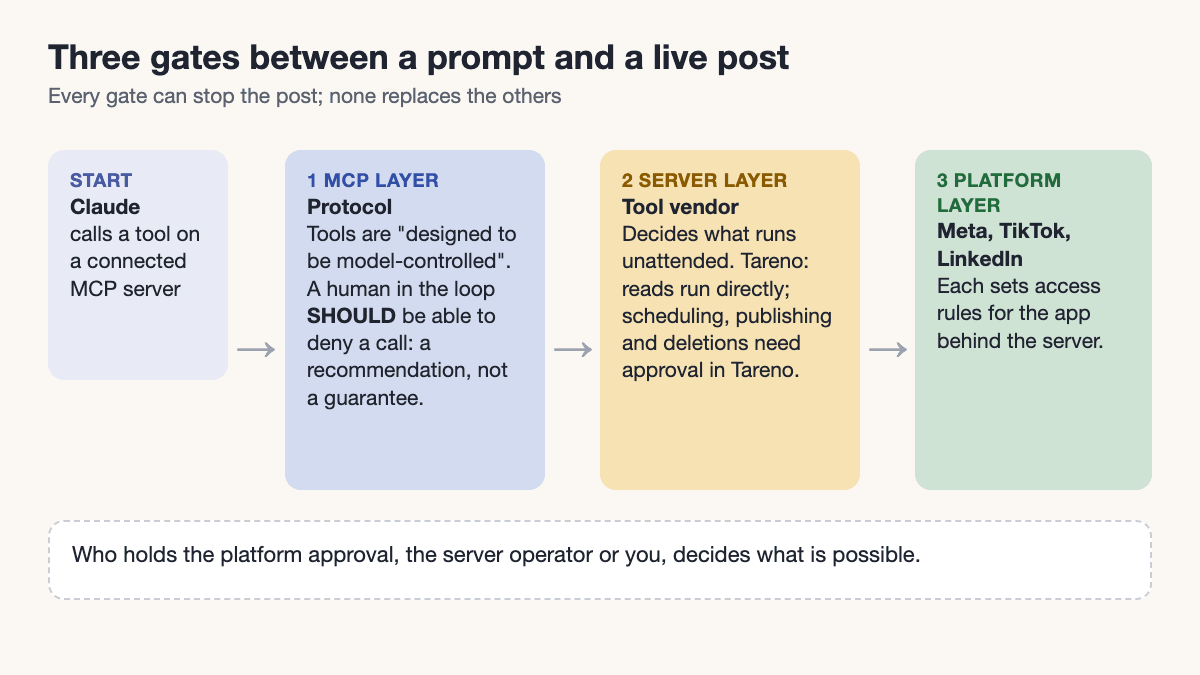
Each layer can stop a post; the platform approval decides what is possible.
On the Claude side, Tareno's Claude page says availability "depends on your Claude plan and your organization's settings".
One caution applies to everything below. Anthropic says that "Custom connectors allow you to connect Claude to arbitrary services that have not been verified by Anthropic" and that "Malicious MCP servers may include hidden instructions that try to make Claude perform unintended actions." Read every draft before it is approved, and connect only servers you trust.
Platform by platform
All sources below were read on 2026-11-07. Platform documentation changes, so check the dated pages before you build on a number.
| Platform | Direct post | Draft or inbox | Scheduling | Source and date |
|---|---|---|---|---|
| API publishing for professional accounts (business or creator) | Not documented on the page read | No scheduling parameter documented on the page; it only advises apps to enforce the rate limit "if your app allows app users to schedule posts" | Meta content publishing, page shows "Updated : Oct 20, 2026" | |
| TikTok | Direct Post endpoint, scope video.publish; unaudited clients restricted to private viewing |
Inbox upload, scope video.upload; the creator finishes the post in TikTok; at most 5 pending shares per 24 hours |
None documented in the four Content Posting pages read | TikTok Direct Post reference, upload reference, read 2026-11-07 |
Posts API; w_member_social for a member, w_organization_social for an organization |
DRAFT appears as a state in responses; creation accepts only PUBLISHED |
None documented in the Posts API page | LinkedIn Posts API, page dated 2026-05-07, updated 2026-05-13 |
"Not documented on the page" is not the same as "impossible". Any "scheduled" feature in an MCP tool is the vendor's own mechanism, so ask that vendor how it works.
Meta defines the account type: "An Instagram professional account can represent a business or creator." Personal accounts are not what the publishing API is built for.
The limits, quoted from the content publishing page:
- "Instagram accounts are limited to 100 API-published posts within a 24-hour moving period."
- "Carousels are limited to 20 images, videos, or a mix of the two."
- "JPEG is the only image format supported."
- "Shopping tags are not supported." and "Filters are not supported."
- The media must be "hosted on a publicly accessible server at the time of the attempt".
The same page contradicts itself. In the carousel section it says: "Accounts are limited to 50 published posts within a 24-hour period." I found nothing from Meta that resolves 100 versus 50. The practical answer is to query the account's GET /<IG_ID>/content_publishing_limit endpoint, which the page names, instead of trusting either figure. Third-party pages often say carousels hold 10 items. Meta's current page says 20.
Do you need Advanced Access? It depends on whose account the app serves. Meta's platform overview says: "If your app only serves your Instagram professional account or an account you manage, Standard Access is all your app needs." And: "Advanced Access is the access level required if your app serves Instagram professional accounts that you don't own or manage ... This access level requires App Review and Business Verification." So if you build your own server for your own account, Standard Access is enough. A service that connects many customers' accounts needs Advanced Access. The 100 versus 50 contradiction above is the main caveat on this page.
TikTok
TikTok's Get Started page says: "All content posted by unaudited clients will be restricted to private viewing mode." The content sharing guidelines add that unaudited clients "can allow up to 5 users to post in a 24 hour window" and "can only post contents in SELF_ONLY viewership". The Direct Post reference lists an error for the same case: "Unaudited clients can only post to a private account."
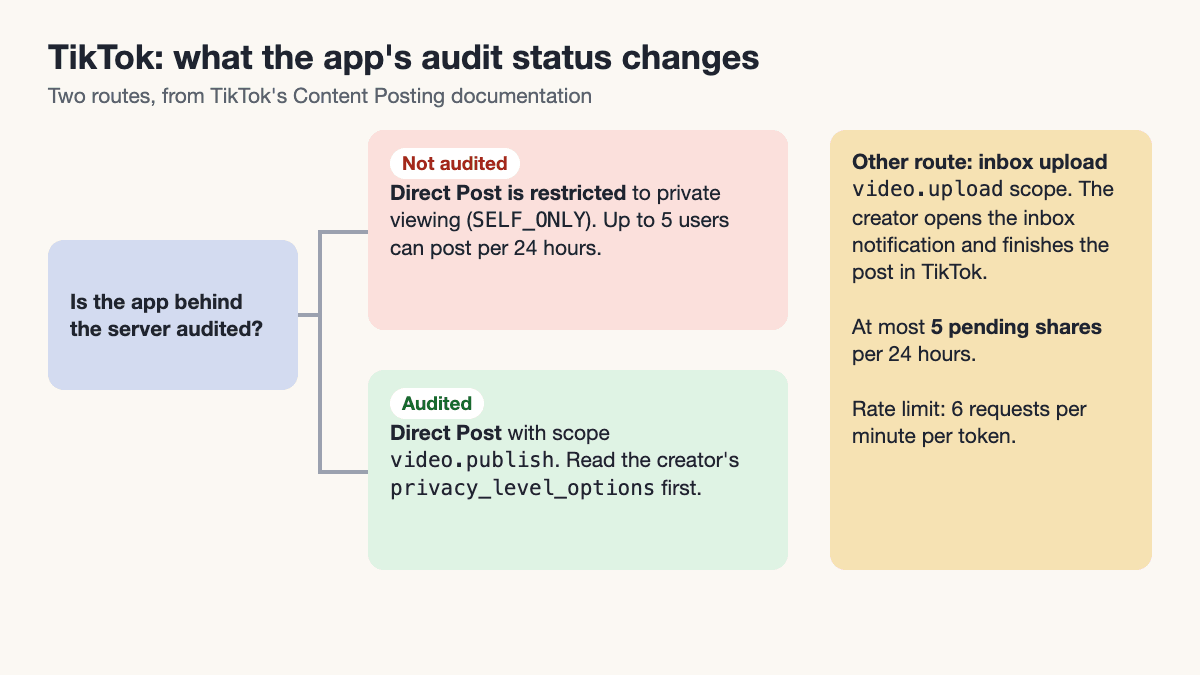
TikTok routes by audit status, from TikTok's Content Posting documentation.
The privacy_level "must match one of the privacy_level_options returned in the /creator_info/query/ API", so read the creator's options before any caption is queued. Each access token "is limited to 6 requests per minute" on the direct-post and inbox endpoints.
The inbox route is the other path. TikTok's upload reference says to "inform users that they must click on inbox notifications to continue the editing flow in TikTok and complete the post." The page does not use the word "draft", so I call it an inbox upload. I could not read TikTok's audit application page (it requires a login), so I do not describe the audit steps.
On the Posts API page, w_member_social is "Post, comment, and like posts on behalf of an authenticated member" and w_organization_social is the same on behalf of an organization. For lifecycleState, "PUBLISHED is the only accepted field during creation." The page's content table marks organic carousels "No" and multi-image posts "Yes".
Access is the harder question. In the pages I read, w_member_social is listed only under the Advertising API and Community Management API products. The Community Management overview calls the API a "Vetted Product with development and standard tiers", and the app review page says: "At this time, our Community Management APIs are only available to registered legal organizations for commercial use cases only." It also says personal email addresses won't pass vetting. Whether an individual can obtain w_member_social today without a legal organization is not answered by the pages I read. My reading, not LinkedIn's wording, is that a solo creator will usually not be the applicant, so a service that already holds access is the likelier route. An older Share on LinkedIn guide describes a self-serve route, but its page date is 2021 (updated 2023), so I do not treat it as current.
Worked example: one podcast episode, three platforms
This is a constructed teaching example. The podcast "Late Starters", its host, the episode and every line of speech below are invented. No account was connected and nothing was posted. The tool sequence follows the Tareno MCP reference; it is a documented flow, not a recorded test run.
The host is a solo creator who edits alone. Episode 41, "The first 90 days after switching careers", drops Tuesday 2026-11-10 at 06:00 (Europe/Berlin, +01:00). The 47-second vertical clip already exists; for making clips, see podcast snippets to video content.
Input
Transcript excerpt (invented):
[00:14:02] Here is what nobody tells you about month two. In month one everybody
is kind to you, because you are new. In month two they start assuming you know
things, and you do not. So the move is not to nod. The move is to write down
three questions every Friday and ask them on Monday, one per person, in person
if you can. I did this for ten weeks after I left logistics for UX research.
By week six people were bringing me their questions.
[00:14:49]
Clip file: 47 seconds, 9:16 MP4 at a public HTTPS URL (placeholder https://example.com/late-starters/ep41-clip-a.mp4). Style rules stored in a Claude Project: first person, no promises of results, at most three hashtags, no emojis.
Decision: one clip, three routes
| Platform | Route | Last click | Constraint |
|---|---|---|---|
| Instagram Reel | API publishing for a professional account | Host approves the scheduled action in the tool | Public media URL; no shopping tags, no filters |
| TikTok | Direct Post if the connecting app is audited; or inbox upload | Host approves in the tool, or opens the TikTok inbox notification and publishes | Read privacy_level_options first |
| Posts API, text post on the personal profile | Host approves in the tool; adds the episode link by hand | Creation accepts PUBLISHED only |
The routes follow the platform documentation. Tareno does not state publicly which API route it uses for Instagram, TikTok or LinkedIn, whether its TikTok client is audited, whether it posts to personal LinkedIn profiles, or how a scheduled action executes, so confirm these before relying on the plan. The times are an editorial choice, not a performance claim: Instagram Tuesday 12:30 and TikTok Tuesday 17:30 after the episode drop, LinkedIn Wednesday 08:15 on a workday morning.
Execution
1. list_accounts                      read-only, runs immediately
2. get_platform_schema                for the three accounts, read-only
3. get_platform_options               option tiktok_creator_info, read-only
4. upload_media_from_url              public HTTPS clip URL -> media URL
5. create_drafts                      3 items; "does not schedule or publish anything"
6. (host reads the three drafts)
7. schedule_posts                     scheduledAt in ISO 8601 with offset,
                                      plus an idempotencyKey of 8-128 characters
8. (host approves in the Tareno dashboard)
9. get_action_status                  pending / executing / succeeded / failed /
                                      rejected / expired
Per the reference, drafts run immediately, while scheduling and publishing "only create a pending action". A scheduledAt that is not a future ISO 8601 timestamp with offset returns INVALID_SCHEDULE_TIME.
Output
Instagram Reel caption:
Month two is when the kindness runs out and the assumptions start. My fix: write down three questions every Friday, ask one per person on Monday. Episode 41 of Late Starters is out now. #careerchange #latestarters #newjob
Platform character limits were not verified for these captions.
TikTok caption:
Month two at a new job: nobody explains anything anymore. The Friday-three-questions rule that got me through ten weeks. Full episode on every podcast app. #careerchange #latestarters
LinkedIn post:
When I left logistics for UX research, month one was easy. Everybody was kind because I was new.
Month two was different. People assumed I knew things, and I did not.
What worked for ten weeks: every Friday I wrote down three questions. On Monday I asked one question per person, in person when possible. By week six, colleagues were bringing me their questions.
Episode 41 of Late Starters covers the full first 90 days. Link in the comments.
The first-comment link is a manual step: Tareno's Claude page states that Tareno exposes no comment reading for LinkedIn or X, and the MCP reference describes its comment tools as read-only. If you do not want a manual step, move the link into the post body.
Schedule and who clicks what:
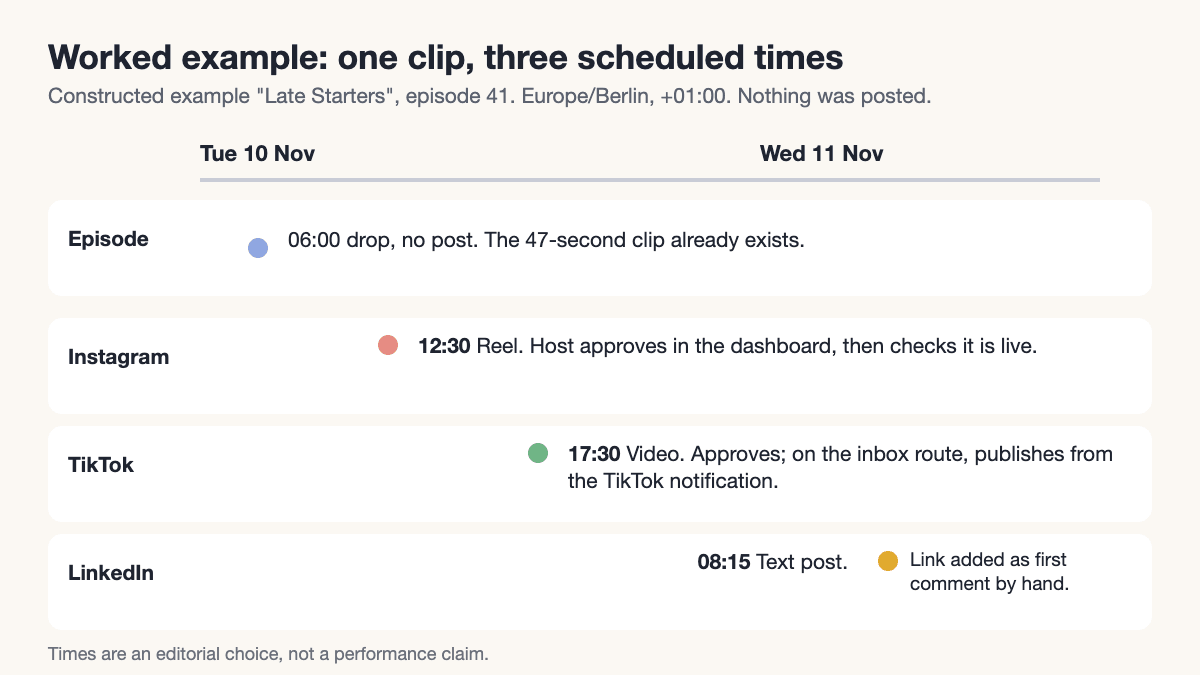
Constructed example; times are an editorial choice, nothing was posted.
| Item | Platform | Planned time | Route | Host action |
|---|---|---|---|---|
| Clip A Reel | 2026-11-10T12:30:00+01:00 | Platform route not stated publicly by Tareno (open) | Approve in the dashboard; check it is live | |
| Clip A video | TikTok | 2026-11-10T17:30:00+01:00 | Platform route and audit status not stated publicly by Tareno (open) | Approve; on the inbox route, open the TikTok notification and publish |
| Text post | 2026-11-11T08:15:00+01:00 | Platform route not stated publicly by Tareno (open) | Approve in the dashboard; add the episode link as first comment by hand |
Pre-flight checklist
- The account is a professional Instagram account, and the clip sits at a public HTTPS URL.
- You know whether the TikTok connection is audited.
- You read the creator's
privacy_level_optionsbefore queuing the TikTok caption. - You checked
content_publishing_limitif you post in volume. - Every time carries an offset (
+01:00), and every request has its own idempotency key. - You read all three drafts before approving.
Where Tareno fits
Tareno's MCP page lists Instagram, LinkedIn and TikTok as "Supported" in Core MCP, "where the connected provider supports the requested format". The Claude page states: "A post goes live only after you approve the request in the Tareno dashboard", and it shows the plugin with a Community label as of 26 October 2026. The format lists are on the Instagram, TikTok and LinkedIn pages. For setup basics, see social media automation with an MCP server.
When to use this setup, and when not
Use it when you publish the same material to several platforms each week, you want Claude to draft and structure it, and you are happy to approve each action.
Do not use it when:
- You need guaranteed public TikTok posts (see the audit point above).
- You rely on shopping tags or filters on Instagram.
- You need Claude to reply to comments. Tareno states TikTok comments are "Not available", and it exposes no LinkedIn comment reading.
- You are on a Free or Starter plan. Tareno's docs say these "do not include API access"; the trial gives 100 API calls and Pro 2,000 a month.
- You want to build your own multi-account app without planning for Meta's App Review, TikTok's audit and LinkedIn's vetting.
Key takeaways
- Claude posts only through a connected MCP server; the server and the platform decide the rest.
- Query Instagram's publishing limit, because Meta's page gives both 100 and 50.
- LinkedIn's Posts API creates
PUBLISHEDposts only, and member-posting access is unresolved in the pages read. - Approval gates differ by tool. Read every draft before you approve.
FAQ
Can Claude post to Instagram by itself?
No. Without a connected MCP server that holds access to your professional account, it can only write text.
Can Claude publish public TikTok videos through MCP?
Only if the app behind the server is audited (see the TikTok section). Ask your provider about its audit status, because Tareno's public pages do not state it.
Can Claude schedule posts?
Through a tool that offers scheduling, yes. Tareno's reference describes schedule_posts creating a pending action that you approve; how it executes per platform is not documented.
Does Meta have an official Instagram MCP server?
I found no Meta source saying so. One third-party article claims it, which I could not verify, so I do not rely on it.
Do I need Advanced Access to post to my own Instagram account?
Not for an app that serves only your own or a managed professional account; Meta says Standard Access is all it needs.
Conclusion
Claude can take a transcript and produce captions, a schedule and a checklist in one pass, but the platform decides what happens next. Check each route before you promise a publish time. To see the documented tool flow, read the Tareno MCP reference.